Multi-Agent Systems: A Guide to Agent Architecture
 By Hitesh SUpdated on: 10/02/2613 min read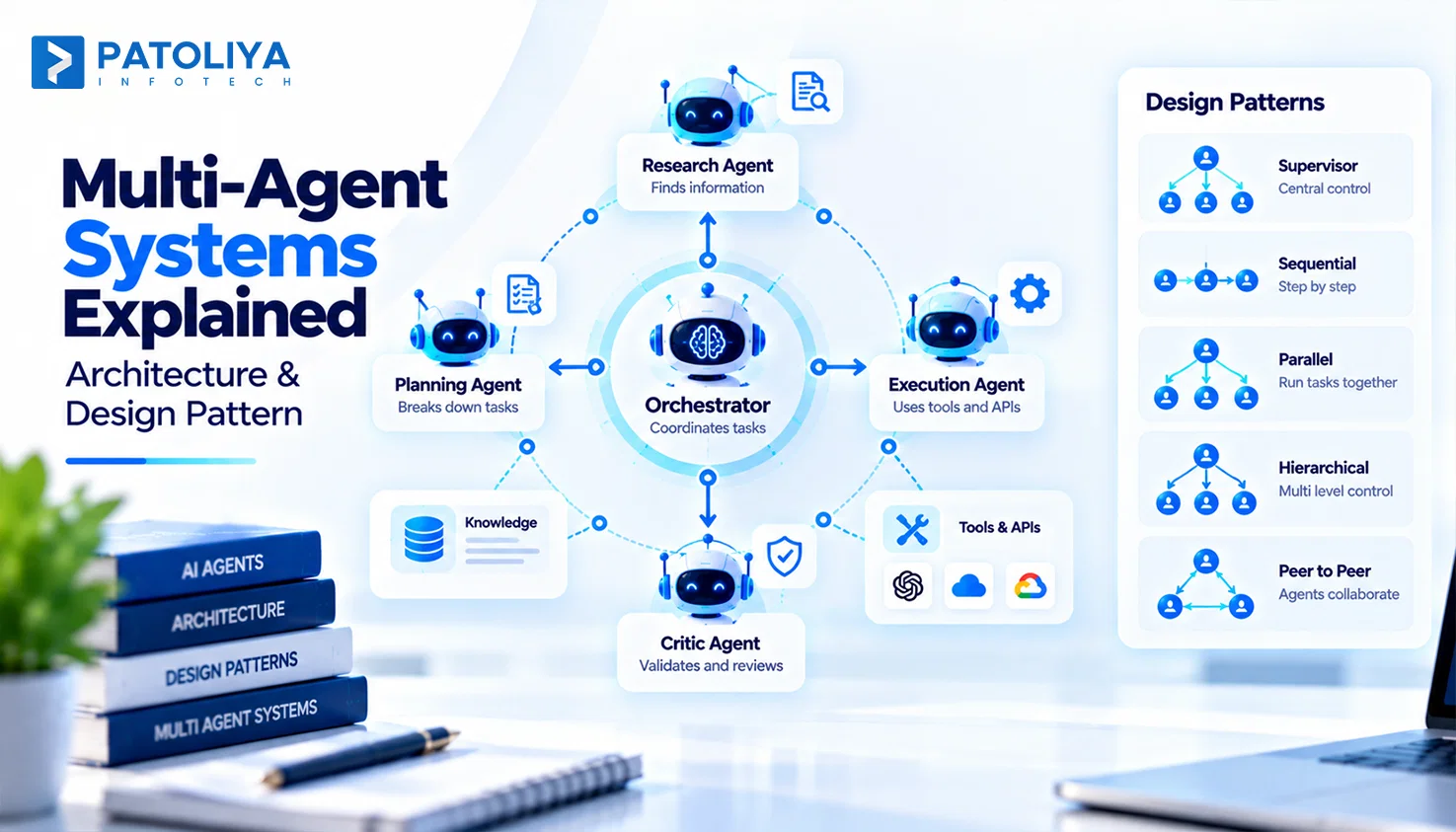
TL;DR: Multi-agent systems pay off when work splits into parallel, independent tasks. They waste the budget when each agent has to process the same context. UC Berkeley's MAST study found 14 distinct failure modes across 7 frameworks, grouped into design, coordination, and verification gaps. Pick the pattern first, then the framework.
Most teams add a second agent before the first one works reliably. That habit explains why multi-agent systems shine in demos and stall in production. The fix sits in the coordination pattern: choose it by failure boundaries and decision ownership, and the right agent count follows.
A wrong pattern costs you twice. You pay for extra tokens on every run, and you pay again when nobody can trace why an agent failed.
This guide will explain five production patterns, a selection framework, and the questions to ask any build partner.
Understanding Multi-Agent Systems
Multi-agent systems split one business job across several specialized AI agents. Each agent gets its own prompt, tools, and context window, and code or a lead agent coordinates the work.
A single agent works like one skilled generalist. It holds everything in one context, so it stays cheap and easy to debug. It struggles once a task needs ten tools, three data domains, or more reading than one context window holds. Patoliya's breakdown of AI agent architecture covers where agents beat rule-based flows in the first place.
|
Factor |
Single Agent |
Multi Agent |
|
Cost per task |
Low |
High |
|
Debugging |
One trace |
Many traces to correlate |
|
Parallel work |
Sequential |
Native |
|
Best fit |
Focused tasks, few tools |
Broad tasks that split cleanly |
Every production build of multi-agent systems needs six parts, whatever framework you choose.
Agents: a model, a role prompt, and a scoped tool list.
Coordinator: code or a lead agent that decides who works next.
State: shared memory or a task store every agent reads.
Tools and data: APIs, databases, and a RAG pipeline for grounded answers, which Patoliya builds into every agent stack.
Contracts: typed inputs and outputs between agents.
Guardrails: budgets, approvals, and stop conditions.
Teams usually overbuild the agents and underbuild the contracts. In multi-agent systems, that imbalance causes most early breakdowns.
With the parts defined, the next decision is how to wire them together.
5 Multi-Agent Architecture Patterns
Five coordination patterns shape how multi-agent systems divide work, manage decisions, and keep execution controlled in production.
Supervisor / Orchestrator Worker
Production multi-agent systems rely on five coordination patterns. The supervisor model, where one lead agent plans the job and assigns subtasks to narrow worker agents, fits most enterprise builds.
This orchestrator-worker pattern is the default multi-agent architecture we recommend for a first build. The supervisor agent owns the plan and the final answer.
For instance, a claims desk. The supervisor sends policy lookup, damage estimate, and fraud screening to three workers, then merges one decision packet.
Use it when subtasks run independently, and one agent can judge the final output. Breaks when the supervisor writes vague briefs. Weak task delegation makes workers duplicate each other.
Sequential Pipeline
Each agent finishes one stage and passes a structured output to the next, like an assembly line with a fixed order. Document heavy multi-agent systems often start here because each stage is easy to test.

For instance, Contract intake. An extractor pulls clauses, a risk agent scores them, a drafting agent writes the redline summary, and a reviewer checks citations. Patoliya prototypes this kind of agent orchestration in n8n before committing to code.
Watch for early errors that flow downstream unchecked. Put a validation gate after every stage.
Parallel / Router
A router classifies each request and sends it to the right specialist, or fans it out to several agents and merges the answers.
For instance, A support inbox sends billing, technical, and account questions to three specialists. Most support bots grow into routers, so Patoliya designs every AI chatbot architecture with routing from day one.
Watch for overlapping categories. Log every routing decision so you can audit misroutes. Routers keep multi-agent systems fast because no request waits in one shared queue.
Hierarchical
Supervisors manage other supervisors, which creates a tree of teams for very large jobs.
For instance, a due diligence run where a lead agent directs a finance team, a legal team, and a market team, each with its own workers.
Most multi-agent systems in business need two levels at most. Adding a third level increases latency and token costs faster than it improves decision-making.
Peer-to-Peer / Event-Driven
Agents communicate through a shared event bus, coordinating tasks without a central controller. Event-driven multi-agent systems work well for continuous operations such as logistics and monitoring.
For instance, A shipment delay event triggers a rerouting agent. That agent publishes a new ETA, which triggers a customer notification agent.
Watch for orphaned work. Every agent handoff needs an event log, an owner, and a timeout.
|
Pattern |
Control |
Debug effort |
Best for |
|
Supervisor |
Central |
Medium |
Most enterprise workflows |
|
Sequential |
Fixed order |
Low |
Staged document work |
|
Router |
Central |
Low |
Intake and support |
|
Hierarchical |
Layered |
High |
Very large research jobs |
|
Event driven |
Distributed |
High |
Continuous operations |
Knowing the patterns is half the job. Choosing one for your workflow is the harder half.
How to Choose a Multi-Agent Architecture
The right multi-agent architecture passes five tests: workflow complexity, context sharing, parallelism, failure boundaries, and decision ownership. Run all five before anyone writes code.
Map the happy path and the top five exceptions. If a flowchart covers nine cases in ten, a sequential pipeline or a plain workflow wins. Fewer than three judgment points means pipeline. More means supervisor.
Agents that need the same full context belong to one agent. In multi-agent systems, splitting them forces constant copying, which inflates tokens and drops details.
Split subtasks that can succeed with a short written brief. Give one agent better tools when they cannot.
Parallel patterns pay off only when subtasks share no dependencies. Research, multi-source lookups, and document batches parallelize well in multi-agent systems. Approvals and shared code edits rarely do.
That split decides the cost. Multi-agent systems multiply token spend with every agent you add, so only parallel, high-value work earns that bill.
For instance, checking 40 supplier contracts for one indemnity clause is perfect fan out work.
Draw a box around each component that can fail alone. Each box becomes one agent with its own retry and fallback. A failed pricing lookup should never corrupt the compliance check next to it.
Every final decision needs one named owner, human or agent. Teams skip this test more than any other when picking a multi-agent architecture.
|
If the final call belongs to |
Pick |
|
One accountable reviewer |
Supervisor |
|
A fixed approval chain |
Sequential pipeline |
|
The right specialist |
Router |
|
Several business units |
Hierarchical |
|
Whoever receives the event |
Event driven |
Picking a pattern gets you a design. Production readiness depends on five engineering layers.
What Makes a Multi-Agent System Production Ready
Agent Contracts
Production multi-agent systems need typed contracts, durable state, standard protocols, recovery paths, and full tracing. Define contracts first, as every subsequent layer relies on them. They turn a multi-agent architecture diagram into something engineers can test.
Each agent should define its inputs, outputs, tools, and execution budget. Here is a screening worker:
agent: fraud_screen
input: claim_id, amount, claimant_history
output: risk_score (0 to 1), reasons, escalate (yes or no)
tools: claims_db.read, sanctions_api.check
budget: 20k tokens, 60 seconds
Memory and State
Keep three layers separate: working context per agent, a shared task store, and long-term knowledge. Write the plan to durable storage so a crash resumes mid-task. A lost plan means a full rerun and a full bill.
MCP and A2A
Model Context Protocol (MCP) connects agents to tools and data through one standard. The A2A protocol enables communication between agents from different vendors and is supported by over 150 organizations. (Linux Foundation).
|
Protocol |
Connects |
Use it for |
|
MCP |
Agent to tools and data |
CRM, ERP, databases |
|
A2A |
Agent to agent |
Cross-team or partner handoffs |
Build every tool integration on MCP, so your multi-agent systems survive a model swap without rewiring.
Failure Recovery
UC Berkeley researchers annotated 1,600+ traces of multi-agent systems across 7 frameworks and found 14 distinct failure modes (Cemri et al., arXiv). Design failure recovery around their three failure groups: system design issues, inter-agent misalignment, and weak task verification.
Build reliability into every workflow with checkpoints after each stage, retries with backoff for tool errors, a verifier step before any output leaves the system, and human escalation with the full context attached.
Observability
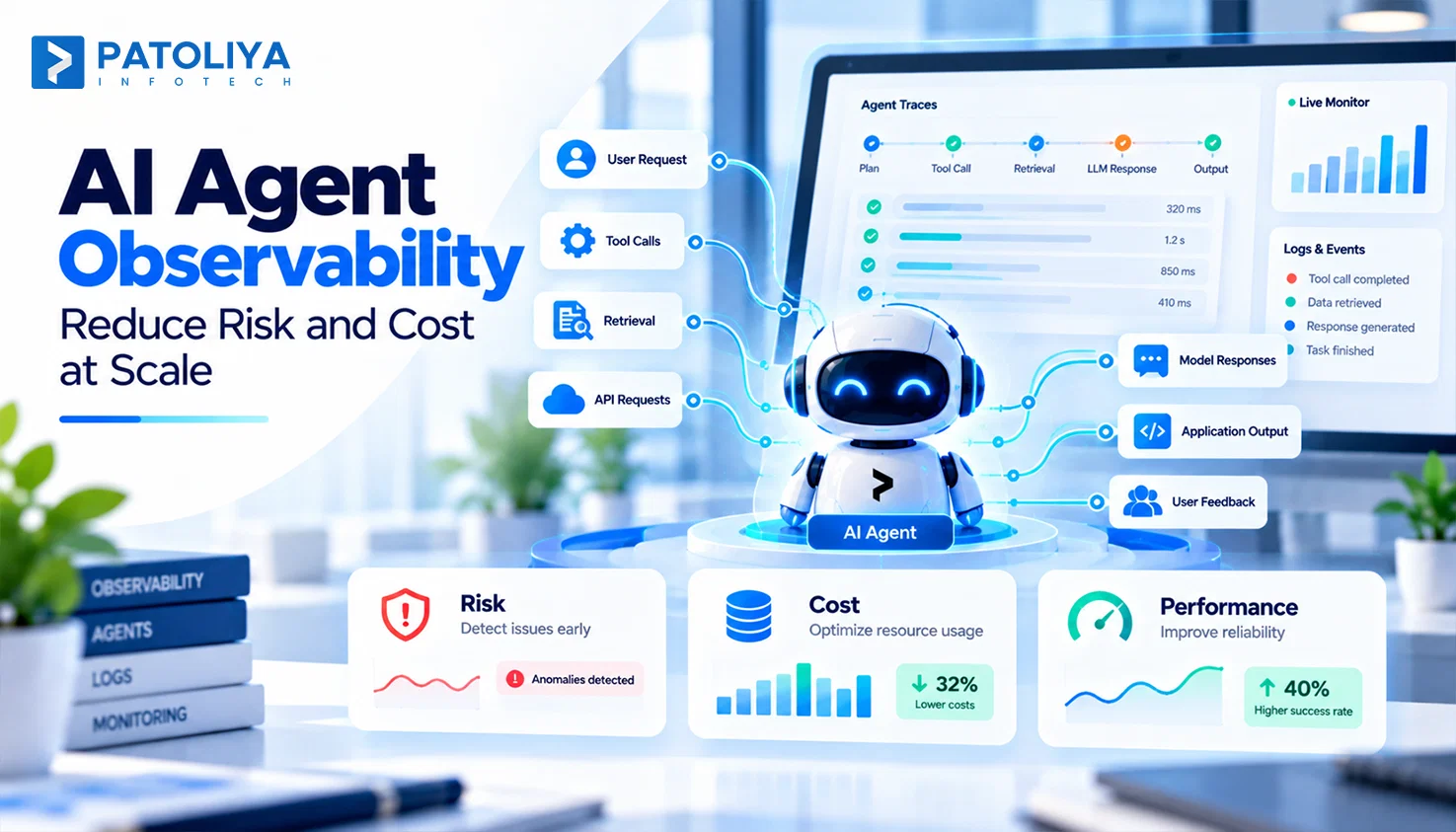
You cannot fix a run you cannot replay. Debugging multi-agent systems without traces turns every incident into guesswork. Trace every model call, tool call, routing decision, and token count per agent. Tag everything with one task ID so a single claim shows its full path.
Keep complete traces before launching. Tracing is the cheapest insurance any multi-agent architecture can buy. With those layers defined, the framework choice becomes much easier.
Frameworks for Multi-Agent Systems

LangGraph
Patoliya Infotech engineers shortlist LangGraph, CrewAI, and AutoGen most often when scoping multi-agent systems. Each models coordination differently: graphs, crews, or conversations.
LangGraph structures agents as nodes within a state graph, using defined edges and supporting resumable execution.
Key Features:
- Durable state and checkpointing.
- Human approval interrupts mid-graph.
Patoliya's Pick For: regulated workflows that need audit trails and restarts from the last good step.
CrewAI
CrewAI organizes agents as a crew with roles, goals, and tasks, run in order or under a manager agent.
Key Features:
- Fast role-based setup in readable configuration.
- Sequential and hierarchical processes built in.
Patoliya's Pick For: research, content, and operations teams that want a working prototype within days.
AutoGen
AutoGen coordinates agents through group conversation. It now receives maintenance updates only, with no new features planned.
Key Features:
- Group chat coordination patterns.
- Python and .NET runtimes.
Patoliya's Pick For: teams maintaining existing AutoGen code. For new builds, our engineers lean toward LangGraph.
For simpler flows, Patoliya runs n8n beside these AI agent frameworks. Pick the framework your team can debug at 2 a.m.
For multi-agent systems, framework choice matters less than the requirements you lock before implementation.
Enterprise Requirements Before Implementation
Enterprises should lock four items before building multi-agent systems: a documented workflow, control boundaries, an integration map, and acceptance criteria that finance and compliance both sign.
Document inputs, outputs, owners, monthly volume, and the top ten exceptions. For Example, process 3,000 invoices a month, flag mismatches above $500, route them to the AP lead. This document drives every later choice in your multi-agent architecture.
Control Boundaries
Define what each agent can read, write, and approve. Payments, patient record edits, and contract signatures always need a human. Store dollar and risk thresholds in config, where auditors can see them. Multi-agent systems without this list drift into actions nobody approved.
Integration Surface
List every system the agents touch, its API quality, and its auth method. Weak APIs sink more projects than weak models. Patoliya wraps agents in a workflow automation architecture that handles triggers, schedules, and retries.
Write pass or fail numbers before the build starts. Sample targets:
|
Metric |
Example target |
|
Accuracy on golden test set |
95% or higher |
|
Cost per completed task |
Under $0.40 |
|
Human escalation rate |
Under 10% |
|
P95 latency |
Under 90 seconds |
Without these numbers, multi-agent systems never reach a clear go-live decision. Clear requirements also reveal if you need multiple agents at all.
When Multi-Agent Architecture Makes Sense

Signals That Justify It
Multi-agent architecture makes sense when a job splits into independent subtasks, exceeds one context window, or needs separate permission scopes per step.
Use multi-agent systems when work spans multiple data domains, tasks can run in parallel, steps need separate access, or the value justifies the extra token cost.
Example: a hospital back office running eligibility, prior authorization, and billing agents, a setup Patoliya covers in its guide to multi-agent orchestration.
Signals That Don't
Avoid multi-agent systems when tasks involve a single team and system, take less than five minutes for a person to complete, depend on extensive shared context, or lack funding for tracing and evaluation.
If one well equipped agent hits your targets, stop there. The final risk sits with whoever builds it.
Evaluating a Multi-Agent Implementation Partner
Assess partners by how they design, test, monitor, and improve multi-agent systems in real production environments.
Architecture Questions
The right partner for multi-agent systems answers with evidence from shipped work: live traces, eval results, and incident reports. Start with Patoliya's AI vendor evaluation checklist, then add these.
- Which multi-agent architecture fits our workflow, and which simpler option did you rule out?
- How do you define agent contracts and cost ceilings?
Production Questions
- Show us a trace from a live system.
- What happens when a tool fails mid-run?
- How do you version prompts and roll back?
Governance Questions
- Who approves high-risk actions, and where does that log live?
- How do you scope data access per agent?
- Who retains ownership of the code, prompts, and evaluation sets after the handoff?
How Patoliya Infotech Builds Multi-Agent Systems
Patoliya Infotech designs multi-agent systems around your failure boundaries and approval rules, then ships them with tracing and eval sets in the first release. Our AI agent development team delivers:
- Pattern selection and agent contracts before any code.
- MCP-based connections to your CRM, ERP, and data stores.
- Cost dashboards, traces, and escalation paths from day one.
Bring one workflow to a free architecture consultation, and we will map the pattern it needs.
Conclusion
Multi-agent systems work best when teams design coordination around a clear business need rather than adding agents for complexity's sake. Begin by establishing roles, boundaries, data permissions, and measurable success criteria.
Choose an architecture that matches how work actually moves through your organization, then validate it with measurable outcomes. Keep execution traceable, control costs, and introduce additional agents only when they solve a proven limitation. The goal is not to build the largest agent network. It is to create a reliable system that handles complex work with clear ownership.
FAQs:
A typical multi-agent system includes agents, tools, shared or isolated context, communication mechanisms, an orchestration layer, and monitoring. The exact components depend on the workflow and architecture.
Agents can communicate through structured messages, shared state, events, APIs, or agent-to-agent protocols. The communication method depends on the framework and the level of coordination the workflow requires.
Yes. Certain architectures rely on peer-to-peer messaging or event-driven coordination rather than a central orchestrator. The choice depends on how much centralized control the workflow requires.
Test individual agents first, then evaluate the complete workflow for accuracy, latency, tool failures, handoffs, cost, and recovery behavior. Use repeatable evaluation datasets and production traces where possible.
Common risks include excessive tool permissions, unauthorized data access, prompt injection, insecure agent handoffs, and insufficient auditability. Apply least-privilege access, validation, isolation, and monitoring throughout the workflow.
Yes. Agents can connect with enterprise applications through APIs, databases, workflow tools, and standardized tool interfaces. Access controls should remain aligned with the permissions of the underlying systems.