Agentic AI in Healthcare Operations: Automating Non-Clinical Workflows
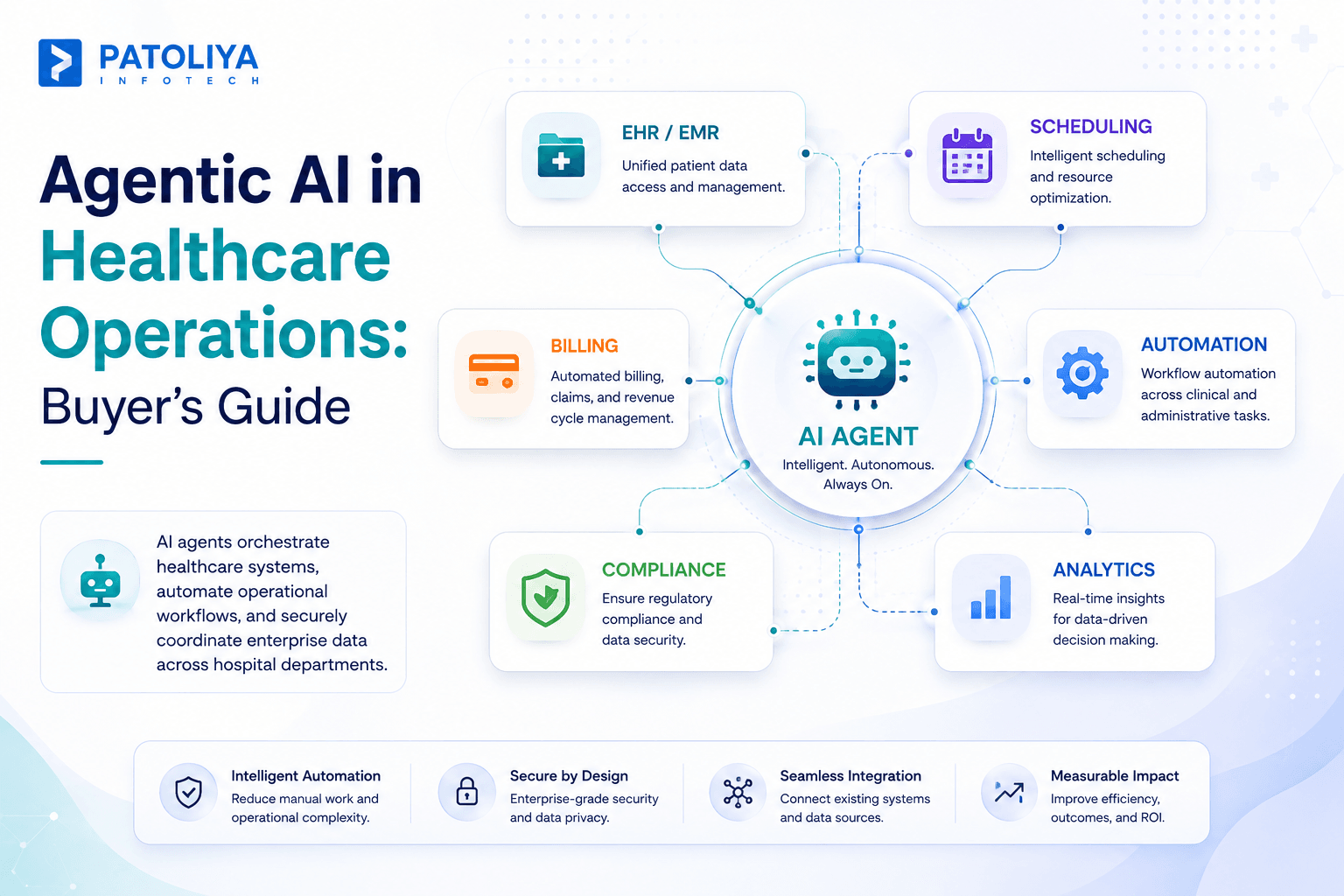
TL;DR: Agentic AI in healthcare enables hospitals to automate non-clinical workflows like scheduling, billing, eligibility, and prior authorization. Unlike traditional automation, AI agents complete tasks independently, reduce staff workload, improve operational efficiency, and help healthcare organizations scale smarter with secure, phased deployments.
Scheduling backlogs, prior authorization delays, and billing errors eat thousands of staff hours every month at a mid-sized hospital. Most health systems already run some form of automation, yet the tools mostly flag problems for a human to fix rather than finishing the job.
Agentic AI in healthcare changes that equation. An agent does not stop at a suggestion; it books the slot, checks the payer rule, and updates the record on its own. This guide explains what agentic AI in healthcare actually automates today, how it differs from older automation through AI agents vs workflow automation, what it costs, what it returns, and how operations leaders should pick a partner before committing budget to a full rollout across departments.
What Is Agentic AI in Healthcare?
Agentic AI in healthcare refers to software agents that plan, act, and adjust across multiple systems without a human approving every step. A scheduling agent checks provider availability, patient history, and insurance rules together, then confirms an appointment on its own. This is agentic AI for healthcare operations in its simplest form: reasoning through a task end to end, not just answering a question or filling a template.
In practice, autonomous agents for hospital back-office work show up first in scheduling and billing, the two areas where volume is highest, and rules are clearest, which is why most teams evaluating agentic AI in healthcare start there before touching anything clinical.
Core Capabilities: What Agentic AI Actually Automates in Hospital Back Office Operations
Scheduling and Patient Access Agents
Autonomous agents for hospital back office teams handle appointment booking, waitlist management, reminder calls, and patient intake automation before the patient even arrives. A patient reschedules through a chat window, and the agent finds the next open slot with the right provider, updates the calendar, and sends a confirmation without staff touching the request.
Eligibility and Prior Authorization Agents
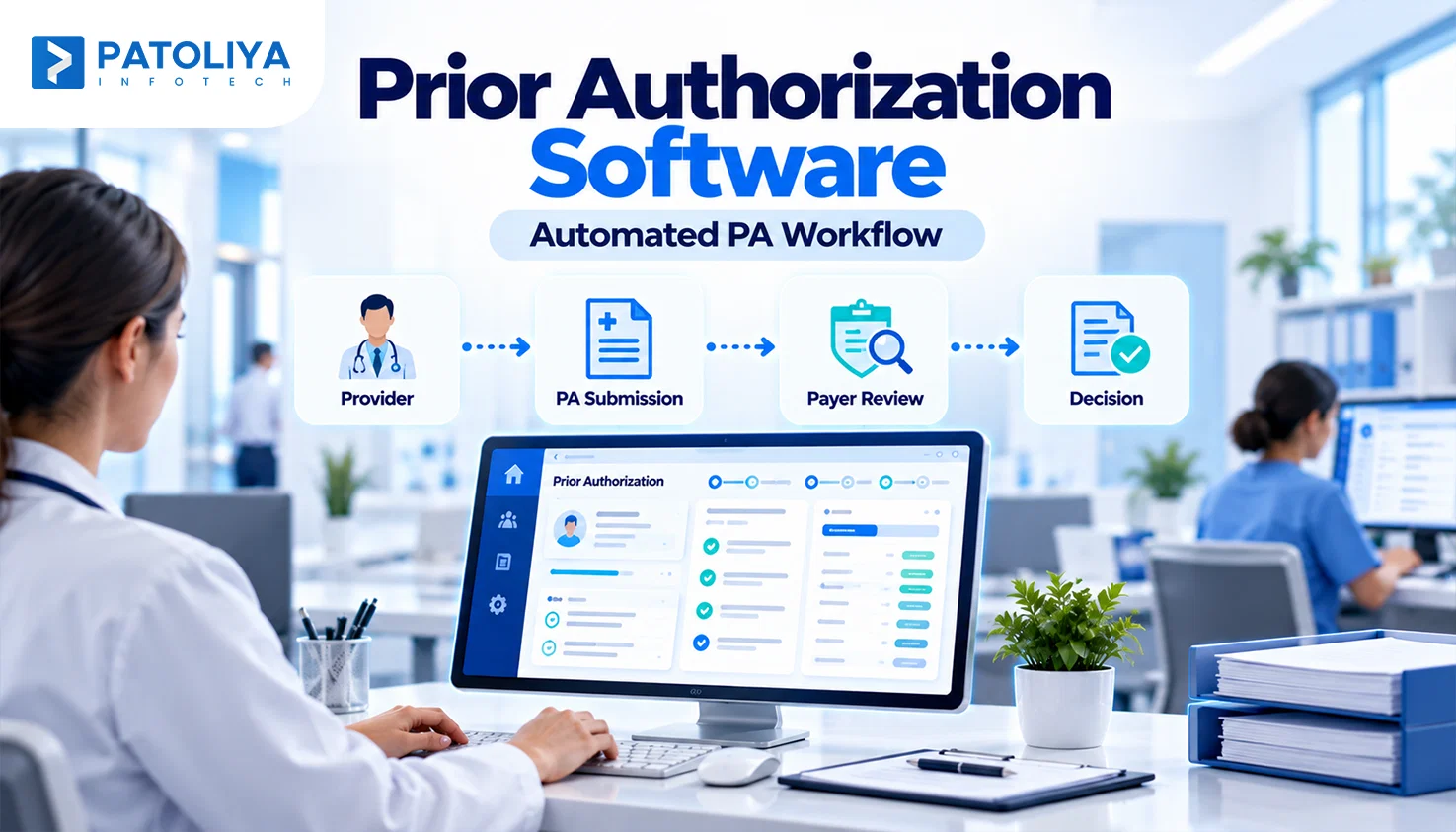
An agent checks payer portals, pulls coverage details, and submits prior authorization requests with supporting documentation attached automatically.
This is where agentic AI for healthcare operations saves the most staff hours, since eligibility checks used to mean three or four browser tabs open at once. Autonomous agents for hospital back-office eligibility work close this gap in minutes rather than hours. Agentic AI in healthcare orchestration ties departments together that used to run on separate spreadsheets.
Medical Billing and Revenue Cycle Agents
Billing agents scrub claims before submission, flag missing codes, and resubmit denied claims with corrected fields. AI workflow automation for hospitals applied to revenue cycle catches errors before a claim ever reaches the payer, cutting the rework cycle from weeks to hours.
Documentation and Compliance Agents
Agents compile audit trails, track consent forms, and flag missing signatures across departments.
Agentic AI in healthcare documentation work reduces the manual chasing that compliance teams do every quarter before an audit, and autonomous agents for hospital back-office compliance tasks keep that trail current without a weekly manual review.
Cross System Orchestration
The real value shows up when one agent hands a task to another. A scheduling agent confirms a visit, an eligibility agent checks coverage, and a billing agent pre-populates the claim, all before the patient walks in.
Agentic AI in healthcare orchestration relies on healthcare data integration to connect departments that previously depended on separate spreadsheets. This pattern of hospital back-office AI agents working in sequence is what separates a real deployment from a single chatbot bolted onto one system.
Agentic AI in healthcare starts with focused workflows, where non-clinical AI agent automation reduces manual tasks, and healthcare workflow automation scales hospital operations gradually.
Solving Healthcare's Top Non-Clinical Bottlenecks with Agentic AI
Scheduling No-Shows and Staff Time Drain
- Front desk teams spend hours managing appointment confirmations, cancellations, and rescheduling requests.
- AI agents for scheduling and billing automate reminders, identify available slots, and fill cancelled appointments from waitlists.
- Agentic AI in healthcare scheduling workflows reduces staff workload and improves patient access during high-volume periods.
Prior Authorization Delays Stalling Care and Cash Flow
- Delayed approvals slow procedures and create revenue bottlenecks for healthcare organizations.
- Agentic AI for healthcare operations prepares authorization requests, checks payer requirements, tracks responses, and escalates stalled cases automatically.
- Autonomous agents for hospital back-office workflows reduce repetitive follow-ups and administrative delays.
Claim Denials and Manual Rework in Revenue Cycle
- Missing documentation and coding errors increase claim denials and create additional manual correction work.
- AI workflow automation for hospitals identifies potential issues before submission and improves claim processing efficiency.
- Revenue cycle teams spend less time fixing errors and more time handling complex financial cases.
Fragmented Systems Requiring Manual Data Re-Entry
- Hospitals often transfer information manually between EHRs, scheduling platforms, and billing systems.
- Agentic AI in healthcare connects workflows through agent orchestration in healthcare, allowing systems to share information automatically.
- Autonomous workflow agents healthcare teams deploy reduce data errors and improve operational consistency.
Agentic AI vs. Traditional RPA and Point Solutions in Healthcare Operations
Agentic AI vs. Rule-Based RPA
RPA scripts follow a fixed path and break the moment a field changes or an exception appears. Agentic AI in healthcare reasons through the exception, checks what changed, and finishes the task without a developer rewriting the script.
A denied claim with an unusual reason code stops an RPA bot cold; an agent reads the reason, checks the payer policy, and refiles the claim correctly.
|
Factor |
Rule-Based RPA |
Agentic AI in Healthcare |
|
Handles exceptions |
No, breaks or stalls |
Yes, reasons and adjusts |
|
Setup effort |
Scripted per workflow |
Trained on outcomes |
|
Cross-system tasks |
Limited |
Native across EHR, billing, scheduling |
|
Maintenance |
Frequent rewrites |
Periodic tuning |
Agentic AI vs. Single Point Chatbots and Copilots
|
Factor |
Single-Point Chatbots & Copilots |
Agentic AI for Healthcare Operations |
|
Function |
Answers questions and provides suggestions |
Completes multi-step tasks across systems |
|
Workflow |
Assists users within one tool |
Executes actions across EHR, scheduling, and billing platforms |
|
Example |
Suggests available appointment slots |
Books appointments, confirms patients, and updates billing automatically |
|
Human Involvement |
Requires staff to complete the final action |
Handles workflows independently with human oversight when needed |
Where Agentic AI Currently Falls Short
Agentic AI in healthcare still needs guardrails on clinical judgment calls, and most deployments today stay inside non-clinical, operational lanes such as scheduling, eligibility, and billing rather than diagnosis or treatment planning. Complex payer negotiations and unusual patient circumstances still need a human reviewing the final decision.
The gap between RPA, copilots, and true agentic AI for healthcare operations shows up clearest in AI agents for scheduling and billing, where an agent has to weigh several rules at once instead of following one script. Teams evaluating agentic AI in healthcare platforms should ask a vendor to demonstrate exception handling live, not in a recorded demo.
Agentic AI Implementation Pricing for Healthcare Organizations
Pilot / Single Workflow Deployment ($15,000 to $45,000)
A single workflow pilot, such as scheduling or eligibility checks, gives hospitals a practical way to test agentic AI in healthcare without changing the entire back office.
This approach validates how the agent handles real workflows and helps teams measure the cost and impact of AI workflow automation for hospitals before expanding further
Multi-Workflow Departmental Rollout ($60,000 to $180,000)
Hospitals can connect workflows like scheduling, eligibility, and billing while integrating EHRs, clearinghouses, and operational systems.
This stage helps agentic AI for healthcare operations move from an experiment into a scalable department-level automation strategy.
Enterprise-Wide Agent Orchestration ($200,000+)
Large healthcare organizations can implement agent orchestration in healthcare across multiple facilities and departments.
This level connects multiple workflows under shared governance, reporting, and automation frameworks to support enterprise-scale operations.
Hidden Costs to Budget For
Staff training, change management, and ongoing model tuning rarely appear in the initial quote. Budget for a support retainer covering the first six months after go-live, since agentic AI in healthcare deployments needs tuning as real patient scenarios surface edge cases.
Contract Models
Vendors price by workflow, by seat, or by outcome. Outcome-based pricing ties cost to claims processed or appointments booked, which keeps AI workflow automation for hospitals spend aligned with the value delivered rather than a flat license fee.
Budgeting for agentic AI in healthcare correctly means separating the build cost from the ongoing support retainer, since autonomous agents for hospital back-office teams need tuning long after go-live.
A vendor quoting AI workflow automation for hospitals without a line item for post-launch support is leaving out a real cost. Compare agentic AI in healthcare pricing across at least three vendors before signing.
ROI and Business Impact of Agentic AI in Healthcare Operations
Documented Savings Figures: Hospitals running agentic AI in healthcare report fewer hours spent on manual eligibility checks and faster claim turnaround, which shows up directly in reduced overtime and lower denial rates within the first two quarters of deployment.
Time to Value Impact: A single workflow pilot for scheduling or eligibility typically reaches production inside two to three months, giving finance teams a measurable before and after comparison instead of waiting a year for a full enterprise rollout to prove anything.
This short cycle is a big part of why agentic AI in healthcare budgets are easier to approve than a traditional software overhaul.
Scalability Economics: Once one workflow runs cleanly, adding a second or third workflow costs less because the integration layer connecting the EHR and billing systems already exists. Agentic AI in healthcare scales cheaper the second time around than the first.
Finance teams tracking return on agentic AI for healthcare operations should measure staff hours reclaimed alongside denial rate changes, since AI workflow automation for hospitals shows up in both columns of the ledger. Boards approve a second workflow faster once the first one shows numbers on paper.
Risks and Challenges of Deploying Agentic AI in Healthcare
Data Privacy and IP Risk
Patient data passing through a third-party model provider expands the attack surface if the vendor cannot demonstrate HIPAA compliance with HIPAA regulations, a signed Business Associate Agreement, and clear data residency terms before go-live.
Agentic AI in healthcare deployments that skip this check put every department downstream at risk, and autonomous agents for hospital back-office teams working with PHI need that agreement in writing before the first test record ever moves.
Communication and Change Management Risk
Staff who fear job loss resist adopting agentic AI in healthcare tools quietly, so leadership needs a plan explaining what the agent handles and what stays with the team before launch day arrives.
Output Quality and Reliability Risk
An agent that misreads a payer rule can submit a bad claim faster than a human ever could. Review checkpoints on early workflows catch errors before they compound across hundreds of claims.
Contract and Vendor Lock-In Risk
Some vendors build proprietary connectors that make switching platforms expensive later. Ask for data portability terms and exportable workflow logic before signing a multi-year contract for agentic AI for healthcare operations.
Every risk above is manageable with the right contract terms and strong healthcare software security practices, while autonomous agents for hospital back-office deployments that build in review checkpoints from day one avoid most of these problems before they start. Treat agentic AI in healthcare risk review as an ongoing task.
Vendor Selection Checklist for Agentic AI in Healthcare
Selection of the right partner for agentic AI in healthcare comes down to a few checks that separate a real deployment from a demo that never scales.
- Confirms EHR integration depth with Epic, Cerner, or Oracle Health while supporting the HL7 FHIR standard before quoting a realistic implementation timeline.
- Provides a signed Business Associate Agreement and names where patient data lives.
- Shows a live reference client running the same workflow in production, not a slide deck.
- Scopes the first engagement as one workflow with a measurable outcome, not a platform license.
- Offers exportable workflow logic so switching vendors later does not mean starting over.
- Explains how the agent escalates uncertain cases to a human reviewer.
- Includes staff training and change management support inside the base contract.
- Publishes response times for support tickets once the workflow goes live.
Successful deployments matter more than polished demos, making a structured AI vendor evaluation process essential before selecting an implementation partner. Validate experience through customer references, measurable results, and real operational performance.
Top Agentic AI Vendors for Healthcare Back Office Automation
Patoliya Infotech
A custom AI development company that builds AI agents, workflow automation, and business process automation tailored to each client's operations. Patoliya focuses on healthcare deployments where integration with the EHR and payer systems decides whether a workflow holds up on day one.
Key Features:
- Custom AI agent development for scheduling, eligibility, and billing.
- AI workflow automation built with n8n, LangGraph, CrewAI, and Model Context Protocol (MCP) for secure multi-agent orchestration.
- CRM, ERP, and API integration that connects agents with existing hospital systems.
- Ongoing optimization and maintenance after go-live.
Pricing: Custom quote based on project scope.
Best For: Small and mid-sized health systems automating scheduling, billing, or internal operations.
Client Review: 4.9/5.
ScienceSoft
A healthcare software and AI development company known for HIPAA-compliant builds across scheduling, billing, telehealth, and clinical data systems, backed by a large enterprise engineering bench.
Key Features:
- Healthcare software development spanning EHR, telehealth, and revenue cycle systems.
- AI and machine learning integration for operational and clinical workflows.
- HIPAA-compliant architecture with security review built into every project.
- Long-standing enterprise healthcare client base across hospitals and payers.
Pricing: Project-based, scoped per engagement.
Best For: Health systems wanting a large, established partner for complex, multi-system builds.
Client Review: 4.8/5.
KMS Technology
A healthcare-focused software and automation partner known for building HL7 and FHIR-compliant integrations across EHR platforms before layering agent based automation on top. This makes KMS a fit for teams that need autonomous agents for hospital back-office workflows built on solid data plumbing.
Key Features:
- Healthcare data engineering and interoperability work across HL7 and FHIR.
- Custom automation for scheduling, claims, and care coordination.
- Legacy system modernization alongside new agent deployments.
- Dedicated healthcare compliance and QA review process.
Pricing: Project-based, scoped after a discovery phase.
Best For: Larger health systems needing interoperability work alongside automation.
Client Review: 4.8/5.
Itransition
An enterprise AI and healthcare consulting company that pairs strategic advisory with hands-on development, building intelligent automation and agent-based workflows for larger, multi-department health systems.
Key Features:
- Enterprise AI consulting alongside hands-on development work.
- Intelligent automation for administrative and operational workflows.
- Healthcare specific advisory on architecture and compliance.
- Cross-industry engineering bench for complex, multi-system integrations.
Pricing: Custom quote, scoped per engagement.
Best For: Larger health systems wanting consulting and build support in one contract.
Client Review: 4.9/5.
Chetu
A healthcare software development shop specializing in EHR and EMR integrations, with AI solutions layered on top of existing hospital systems.
Key Features:
- Custom EHR and EMR integration work.
- AI solution development for scheduling, billing, and clinical support tools.
- Legacy system support alongside new automation builds.
- Dedicated healthcare vertical engineering team.
Pricing: Project-based, scoped per engagement.
Best For: Health systems needing deep EHR/EMR integration work alongside automation.
Client Review: 4.3/5.
Compare vendors on integration experience, pricing, and proven healthcare deployments. Before making a decision, request live customer references and validate real-world implementation results.
Why Patoliya Infotech for Agentic AI in Healthcare
Patoliya Infotech delivers AI development services through HIPAA-aligned agentic builds with signed Business Associate Agreements and healthcare-specific data handling protocols from day one.
- Integrates directly with Epic, Cerner/Oracle Health, and major payer clearinghouses rather than shipping a generic automation layer that needs custom work later.
- Scopes every engagement as a phased, outcome linked pilot proving return on one workflow before expanding scope to the rest of the department.
- Builds agent orchestration architecture designed to scale from a single workflow to enterprise wide agentic AI in healthcare deployment without a rebuild down the line.
- Provides dedicated post-launch support, change management guidance, and staff training as part of every engagement, not a paid add-on charged later.
- Works as an extension of internal IT and revenue cycle teams, with transparent, milestone-based reporting throughout the build.
Patoliya Infotech and get a plan built around your actual back office challenges. This is what agentic AI for healthcare operations looks like when a build starts with your workflow.
Conclusion
Agentic AI in healthcare has moved past the demo stage, but most organizations still run pilots rather than full deployments, leaving a real window open for teams that move now. The systems getting the most value choose partners experienced in custom healthcare software development, integration depth, and phased proof of return rather than broad claims about capability.
Start with one workflow causing the most staff pain today, measure what changes, then expand the orchestration layer from there. AI workflow automation for hospitals works best as a series of small proven wins rather than one large bet. A scoped estimate from Patoliya Infotech shows exactly which agentic AI in healthcare workflow to automate first.
FAQs:
Pilot deployments for a single workflow typically run $15,000 to $45,000, while multi-workflow departmental rollouts range $60,000 to $180,000. Enterprise-wide orchestration exceeds $200,000 depending on integration complexity. AI workflow automation for hospitals at this scale usually pays back within the first year.
RPA follows fixed rules and breaks on exceptions. Agentic AI in healthcare reasons through exceptions, re-plans, and orchestrates multiple agents across EHR, scheduling, and billing systems without a rewrite for every edge case.
A single workflow pilot typically reaches production in eight to fourteen weeks. Multi-workflow orchestration across several facilities can take several months depending on EHR and payer integration depth.
Most deployments need integration with major EHRs such as Epic or Cerner/Oracle Health, plus payer clearinghouses for eligibility and claims data. Integration depth drives most of the cost and timeline.
Compliance depends on the vendor. Confirm a signed Business Associate Agreement, HIPAA-compliant hosting, and clear data residency terms before deployment, since unmanaged data flows through third-party providers expands risk. This is the single biggest reason autonomous agents for hospital back-office rollouts stall midway through an agentic AI in healthcare vendor review.
No. Current agentic AI in healthcare fits non-clinical, operational workflows such as scheduling, billing, and eligibility. Clinicians remain the decision makers on diagnosis and treatment, and autonomous workflow agents healthcare teams deploy today stay confined to the back office.