AI Governance Framework for Enterprise Compliance Guide
 By Hitesh SUpdated on: 10/06/2611 min read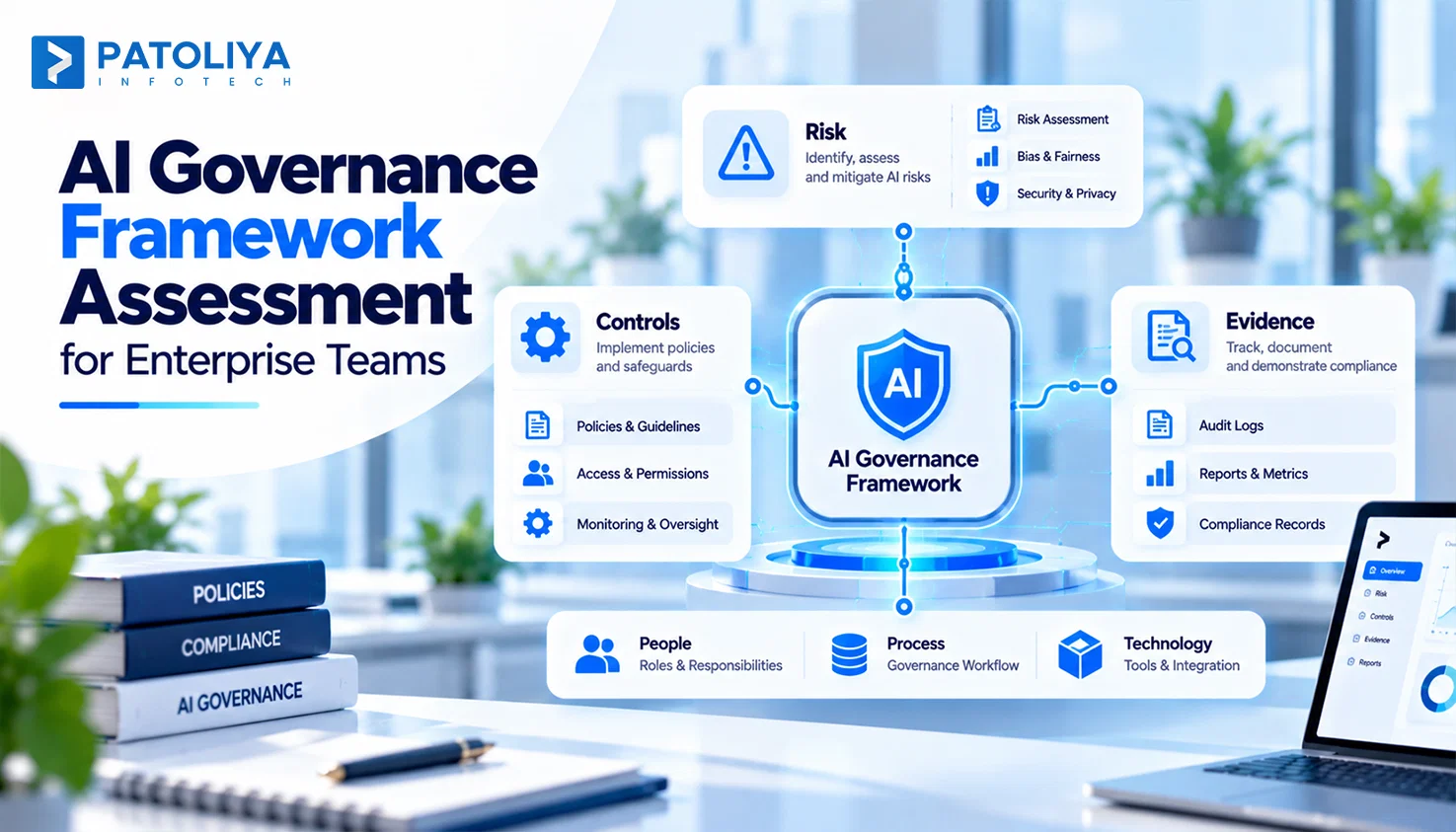
TLDR: An AI governance framework works only when every AI system links to a named risk, a working control, an owner, and stored evidence. The Digital Omnibus delayed EU Annex III high-risk obligations until 2 December 2027, while transparency requirements take effect on 2 August 2026. Establish a unified control layer now and align all three frameworks within it.
Most enterprises can show an AI policy. Very few can prove that a specific model, used in a specific decision last Tuesday, ran under the controls that policy promised. That gap is the real governance risk in 2026, and an AI governance framework closes it only when it runs as a control system with owners and evidence.
The exposure is wide. Copilots draft contracts and code. Chatbots answer billing and claims questions. Decision tools score credit, candidates, and patients. Vendors embed AI inside the SaaS products you already pay for, and autonomous agents now call APIs that move data and money.
Three references shape the work. The EU AI Act sets legal obligations. The NIST AI RMF structures risk through Govern, Map, Measure, and Manage. ISO/IEC 42001 defines a certifiable AI management system.
Treat them as three inputs to one operating model. Three parallel programs burn budget and still leave gaps.
This guide will break down how to connect risk, controls, ownership, evidence, and monitoring into one AI governance framework, and it closes with an AI compliance checklist your teams can run this quarter.
Build One Risk-Based AI Governance Framework
An effective AI governance framework begins with the AI systems your organization currently operates. List every AI system with its use case, owner, data, affected users, and autonomy level. Then classify the use case. A model scoring loan applicants carries far more risk than the same model summarizing internal memos.
Every system follows one lifecycle from discovery to retirement. Its risk tier decides how strict the controls get, who owns them, and what evidence the team keeps at each review.
|
Framework |
What it gives you |
|
EU AI Act |
Legal obligations by risk tier |
|
NIST AI RMF |
Risk process: Govern, Map, Measure, Manage |
|
ISO/IEC 42001 |
Repeatable management system and continual improvement |
Run one enterprise control layer and map all three frameworks into it. Your security, privacy, and audit teams already have established control processes in place. Extend those controls into your AI governance framework. The register comes next.
AI Inventory With Enforceable Controls
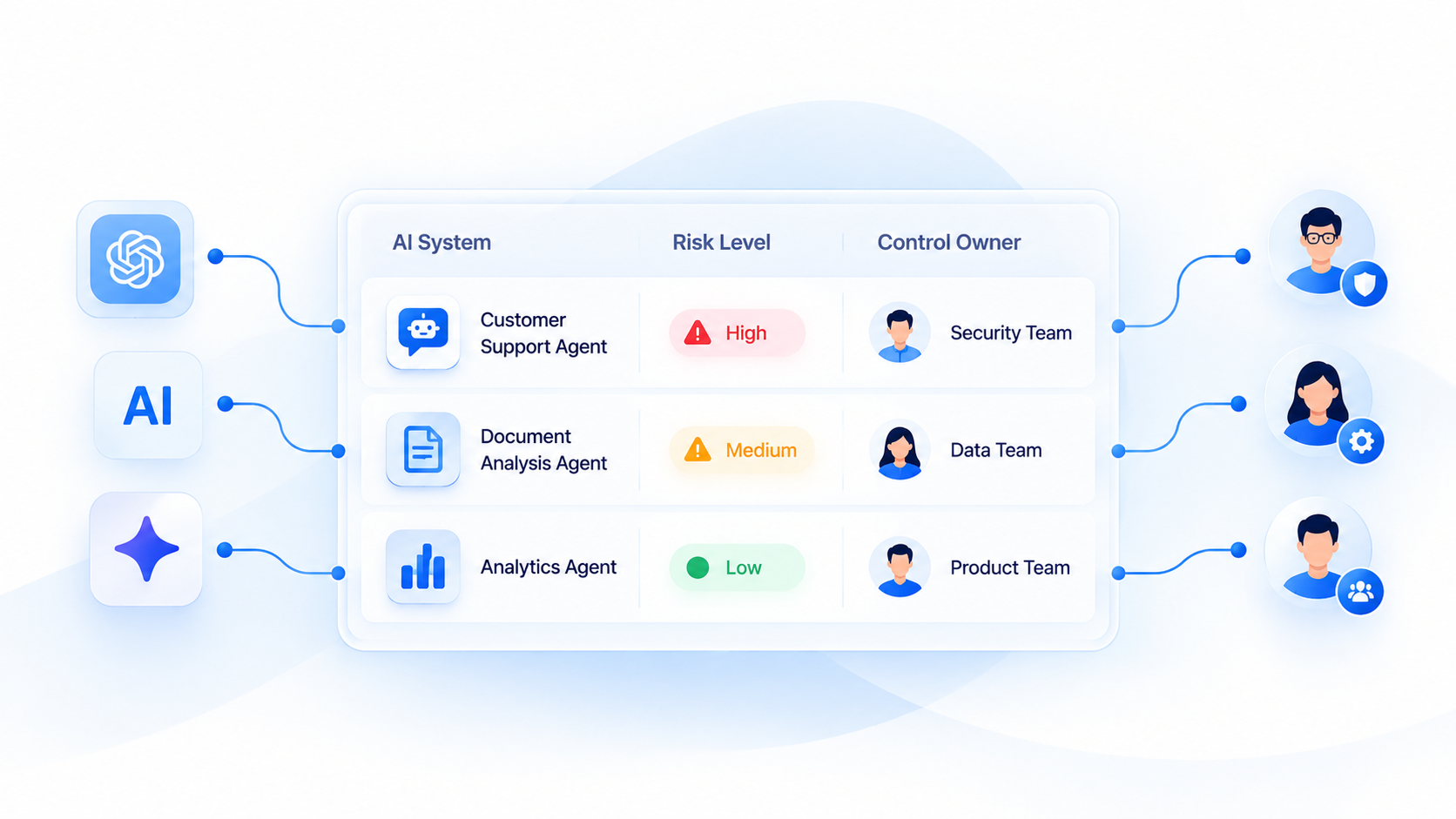
An AI governance framework register records the business use case, the decision it influences, model, provider, and version, data sources, affected populations, autonomy level, connected tools and APIs, risk tier, regulatory applicability, and final decision authority.
|
Trigger |
Control |
|
Risk tier |
Approval workflow |
|
Sensitive data |
Access restriction |
|
High impact output |
Mandatory human review |
|
Agent tool access |
Permission boundary |
|
Model change |
Reassessment trigger |
Multiple AI apps, agentic workflows, regulated use cases, several model providers, and frequent vendor changes push your AI governance framework into code. Plan the AI system implementation early. Here is how it runs.
From AI Inventory to Runtime Control: How an AI Governance Framework Actually Operates
Start With the AI Use Case
A robust AI governance framework starts with a centralized AI inventory that serves as the reference point for every control. Each record holds the business purpose, the model, provider and version, data sources and their sensitivity, affected users, autonomy level, business impact, system owner, lifecycle status and applicable regulations.
That record ties each asset to its risks, controls, owner, and proof. A spreadsheet inventory goes stale within two quarters. A unified record remains current as approvals, monitoring activities, and audits continuously draw information from it.
Your existing data privacy compliance program already knows which datasets hold personal data. Link that knowledge to each AI record on day one, and your AI governance framework inherits privacy controls you built years ago.
Turn Risk Classification Into Control Requirements
Connect each tier to a concrete governance response inside your AI governance framework.
|
Risk signal |
Governance response |
|
Low business impact |
Standard documentation and monitoring. |
|
Moderate impact |
Formal assessment and a named owner. |
|
High impact |
Strong testing, approval, and human review. |
|
Autonomous or high consequence |
Runtime controls, intervention and continuous monitoring. |
Seven factors raise the governance burden: decision impact, data sensitivity, regulatory exposure, autonomy, number of affected users, business criticality, and how easily you can reverse an action.
Internal risk classification sets control intensity. It never replaces the legal categories of the EU AI Act.
Say your team rates a CV screening tool as moderate because humans make the final call. The EU AI Act still lists employment screening among high-risk AI systems under Annex III, so your legal mapping must win that argument.
Map Three Frameworks Into One Control Layer
Every requirement should trace to a risk, a control, an owner, evidence, and a review date. Your AI governance framework then shows one control serving several sources.
|
One control |
EU AI Act |
NIST AI RMF |
ISO/IEC 42001 |
|
Human approval for high-impact outputs |
Article 14 |
Manage |
Clause 8 operation |
|
Event logging per decision |
Article 12 |
Measure |
Clause 9 evaluation |
|
Risk register per system |
Article 9 |
Map |
Clause 6 planning |
The Regulation (EU) 2024/1689 gives the legal articles, and the NIST AI Risk Management Framework gives the four functions.
Build your AI governance framework on what exists. Extend your current AI risk management registers, vendor reviews, and audit workflows. One AI compliance checklist then covers all three frameworks without duplicate testing.
Design Evidence Into Every Control
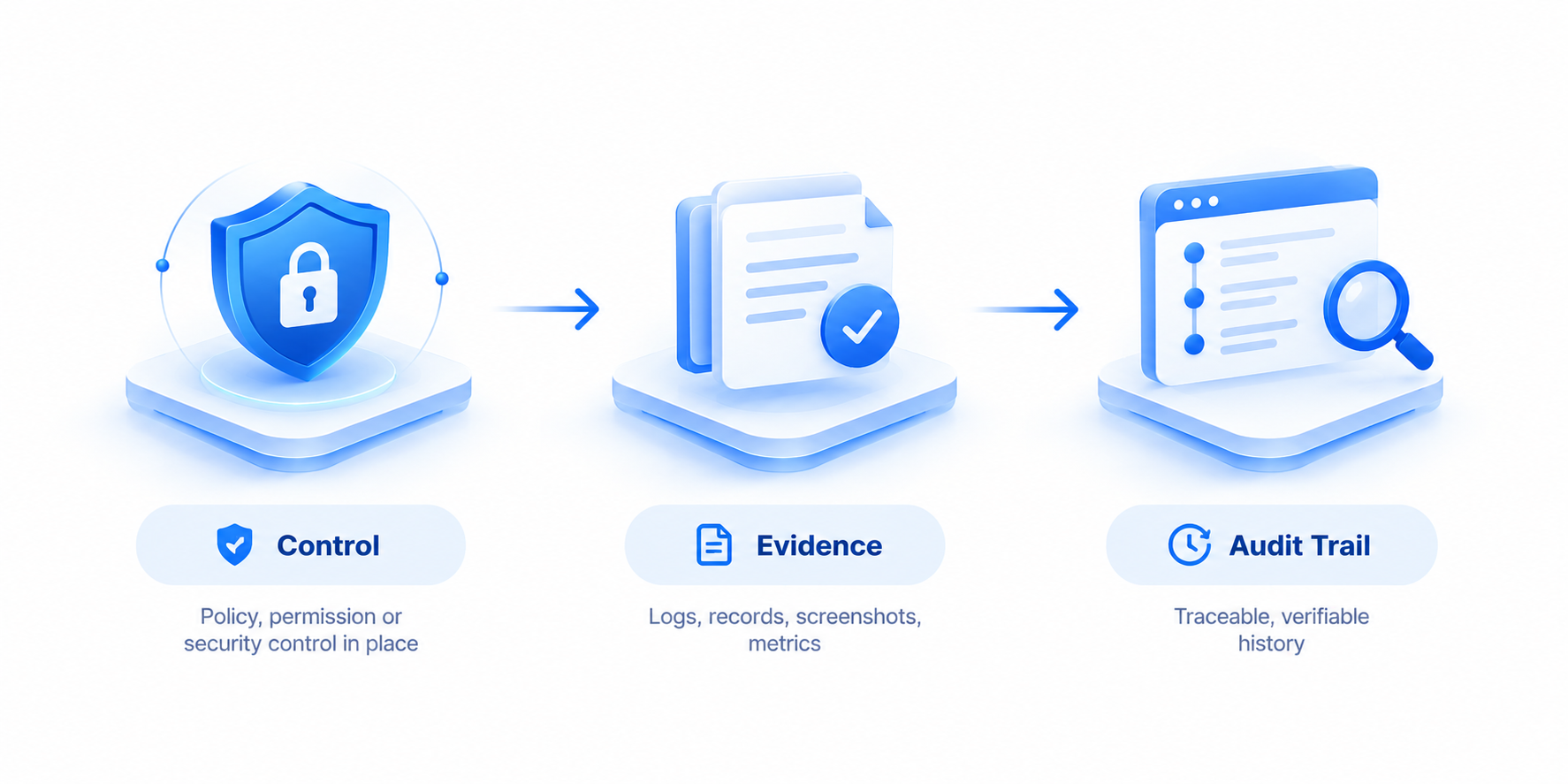
Auditors ask for proof, and control wording decides whether proof exists.
|
Level |
How it reads |
|
Policy |
Human oversight required. |
|
Control |
High-impact outputs below a 0.85 confidence threshold need human approval. |
|
Evidence |
Output, model version, threshold, reviewer, decision, and timestamp. |
Only the control line gives your AI compliance checklist something to test. Your AI governance framework needs three evidence layers:
|
Evidence layer |
Question it answers |
|
Design evidence |
Did we establish the control? |
|
Operating evidence |
Did the control actually execute? |
|
Change evidence |
Did we reassess it after a material change? |
Keep model documentation in that trail, linking every test and decision to its risk. Red team results add operating evidence for your AI security controls. If a control produces no evidence, your auditor treats it as missing.
Make Human Oversight an Authority Model
Most programs define human oversight as "a person reviews the AI." That wording assigns no power. Spell out whether the reviewer can approve, reject, override, escalate, pause, or stop the system.
|
Risk level |
Human authority |
|
Low |
Notification or periodic review. |
|
Higher |
Approval before any action. |
|
Critical or autonomous |
Live intervention and stop authority. |
Patoliya's work on human oversight in healthcare AI ties every high-risk output to a named clinician with override rights.
Your AI audit trail must rebuild the full story, from input and model version to output, human action and final business action. Without that record, your AI governance framework cannot prove who decided what.
Extend the Control Model to AI Agents
Agent governance must control authority and action, beyond model output.
|
Traditional AI |
Agentic AI |
|
Generates output |
Executes actions |
|
Model centric |
Workflow centric |
|
Output monitoring |
Action monitoring |
|
Model access |
Tool and API access |
|
Human review |
Human intervention |
Extend your AI governance framework so every agent gets its own identity, least-privilege access, and an approved tool list. Set data boundaries, action limits, and approval gates. Log every tool call, and keep pause, stop, and rollback controls ready.
Ask one question for every agent: what is the maximum action it can take without human approval? A procurement agent, for example, creates purchase orders up to $5,000. Anything above that routes to a finance lead, as your AI governance framework defines. Apply zero trust architecture to agent credentials, and match the design to your agent architecture decisions.
Make Change a Governance Event
Deployment approval captures one moment. Your AI governance framework must reopen review when the model or provider changes, or when prompts and architecture shift. A new data source, geography, user group, tool, or autonomy level triggers the same review. So do performance drops and new regulations.
Each change needs a risk check, a control check, a retest, a fresh approval, and stored evidence. Suppose your vendor silently upgrades its foundation model. Outputs shift, and your threshold stops fitting. A contract clause requiring version notice, plus a fresh AI vendor risk assessment, catches this before customers do. Add vendor change triggers to your AI compliance checklist as a standing line item.
Centralize Standards, Delegate Decisions
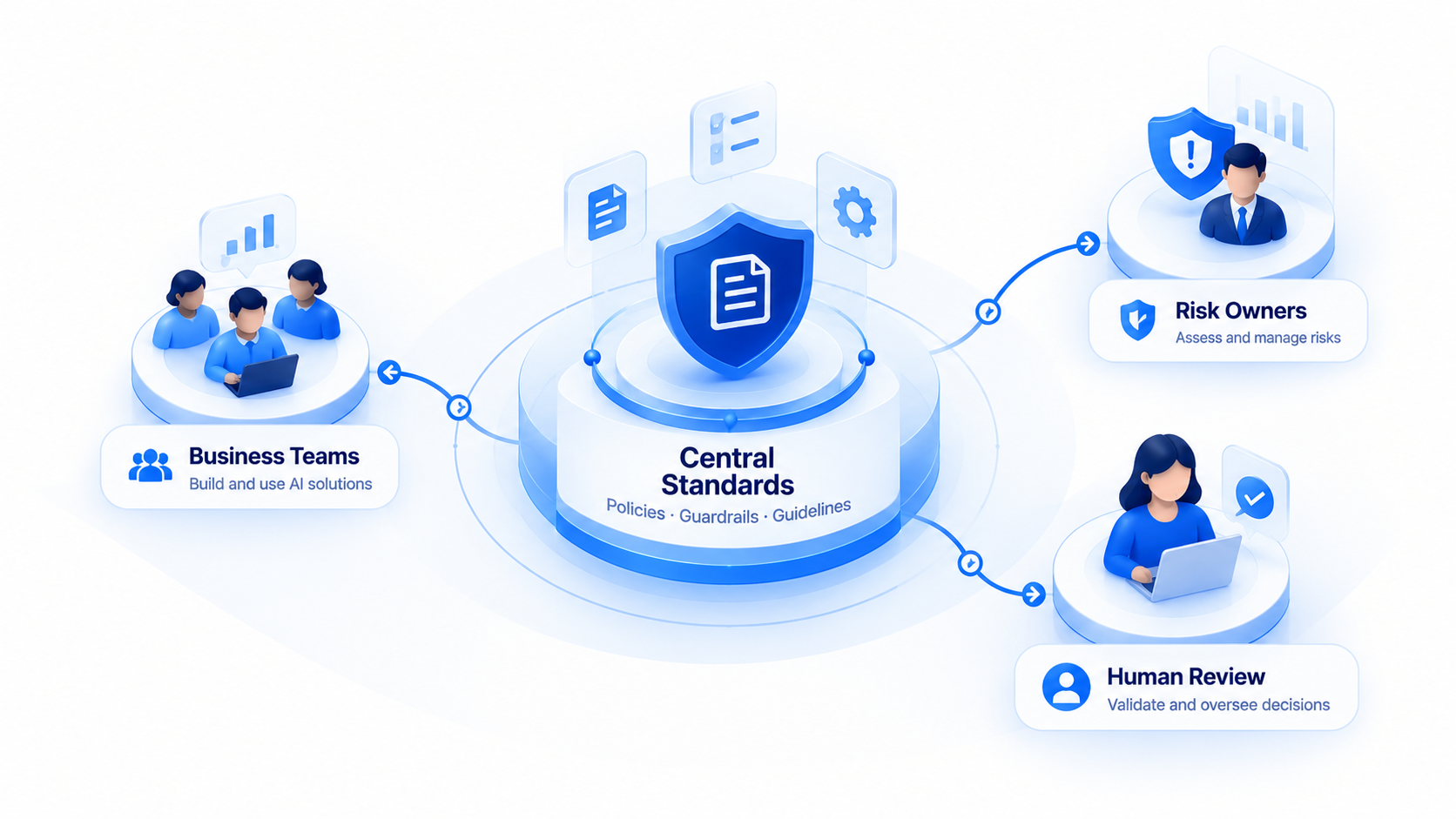
Central teams own the rules. Business owners own the context. Clear AI governance ownership splits this way:
|
Centralize |
Keep with business owners |
|
AI taxonomy and risk methodology. |
Business purpose. |
|
Control library and regulatory mappings. |
Operating thresholds. |
|
Minimum security requirements. |
Risk acceptance. |
|
Evidence and monitoring standards. |
Human decision authority. |
|
- |
Workflow-specific controls. |
The complete architecture of an AI governance framework runs as one loop. The inventory feeds risk and regulatory assessment. Those decide control selection and approval. Live systems feed monitoring and evidence, and every material change triggers reassessment. Teams scaling enterprise AI adoption need this loop before agent count grows.
AI Compliance Checklist for 2026
An AI compliance checklist turns your AI governance framework into tasks with owners and evidence. Run this AI compliance checklist per system, then roll results into one control matrix.
|
AI Compliance Area |
Compliance Requirement |
Evidence to Maintain |
Review / Owner |
|
AI Inventory |
Every AI system and use case documented. |
AI inventory record |
AI Owner |
|
Risk Classification |
Risk level and regulatory applicability assessed. |
Risk assessment |
Compliance |
|
EU AI Act |
Applicable obligations identified and mapped. |
Regulatory assessment |
Legal/Compliance |
|
Data Governance |
Data sources, sensitivity, and lineage documented. |
Data records |
Data Owner |
|
Model Governance |
Model, provider, version, and limitations documented. |
Model documentation |
AI Owner |
|
Testing & Evaluation |
Required performance and risk testing completed. |
Evaluation results |
AI/ML Team |
|
Human Oversight |
Review, approval, override, and escalation rules defined. |
Oversight controls |
Business Owner |
|
AI Security |
Access, permissions, and credentials restricted. |
Security controls |
CISO/Security |
|
Agent Governance |
Tools, APIs, and autonomous actions authorized. |
Permission records |
Security/Engineering |
|
Transparency |
Required transparency obligations met and disclosures provided. |
Disclosure records |
Product/Legal |
|
AI Audit Trail |
Decisions, outputs, interventions, and actions traceable. |
Audit logs |
AI Operations |
|
Incident Management |
AI incidents detected, escalated, and investigated. |
Incident records |
Risk/Security |
|
Change Management |
Material model, vendor, or workflow changes trigger reassessment. |
Change assessment |
System Owner |
|
Third Party AI |
Vendor AI assessed for compliance, security, and data practices. |
Vendor assessment |
Procurement/Risk |
|
Evidence Retention |
Compliance evidence retained and retrievable. |
Evidence repository |
Compliance |
|
Framework Mapping |
EU AI Act, NIST AI RMF and ISO 42001 requirements mapped. |
Control matrix |
Governance Lead |
|
Periodic Review |
Controls and risks reassessed on a defined cadence. |
Review record |
Governance Lead |
Start your AI compliance checklist with your five highest impact systems. Mark each row green, amber, or red against real evidence, and fix red rows first. Then publish your responsible AI policy against controls that actually run.
Every red row exposes a gap in your AI governance framework that a regulator could raise. Close them in order of business impact.
How Patoliya Infotech Engineers the Governance Layer
Patoliya Infotech builds the control layer behind your AI governance framework. Our teams integrate inventory, risk classifications, approvals, logging, and agent permissions with your existing AI applications, data platforms, and IAM infrastructure.
- Governed AI registers connected to approval workflows.
- Runtime evidence capture for every high-impact decision.
- Agent permission boundaries with pause and stop controls.
Bring one AI system and your current AI compliance checklist. Our responsible AI consulting team will map its control gaps in a 30 minute working session.
Conclusion
A mature AI governance framework runs one program and maps three sources into it. It connects inventory, risk, controls, accountability, evidence, monitoring, and change in one loop. The EU AI Act, NIST AI RMF, and ISO/IEC 42001 work as complementary inputs to that model. None of them works as a badge on its own.
The real test is simple. Can your leadership name every AI system you run, the risk it creates, the controls that apply, the person who owns each decision, and the evidence that proves those controls work? If any answer takes a week to find, start there.
Your AI compliance checklist shows the gaps. Engineering closes them inside your AI governance framework across applications, agents, data, security and existing enterprise systems. Let's sit down and map your first three systems together.
FAQs:
An AI governance framework includes AI inventory, risk assessment, ownership, policies, controls, documentation, monitoring, incident management, and continuous review across the AI lifecycle.
AI governance requires shared ownership across business, technology, security, legal, and compliance teams, with designated system owners accountable for individual AI use cases.
Start with an AI inventory, assign owners, classify risks, map requirements, define controls, establish approvals, and implement monitoring and evidence collection across the lifecycle.
Maintain risk assessments, approvals, model documentation, test results, monitoring logs, incidents, vendor reviews, policy exceptions, and governance decisions as auditable evidence.
Apply the same governance process to third-party AI tools, assessing data handling, security, access permissions, contractual obligations, regulatory exposure, and vendor documentation before deployment.
Human oversight defines when people must review, approve, override, or stop AI systems based on risk, autonomy, business impact, and potential consequences.
Measure control coverage, assessment completion, unresolved exceptions, monitoring coverage, incident response, review completion, and evidence availability to determine whether governance works operationally.