AI Agent Frameworks: Compare SDKs and Custom Code
 By Hitesh SUpdated on: 11/19/2610 min read
TL;DR: AI agent frameworks coordinate models, tools, state, and multi-step execution. Pick one based on your workflow’s control, state, and recovery needs. LangGraph suits complex stateful flows, CrewAI suits role-based teams, vendor SDKs suit one-model ecosystems, and custom code suits small, predictable loops.
A demo agent works beautifully on Friday. On Monday, it charges a customer twice after a payment call times out and the agent retries. The framework made retrying easy. Nobody asked what a retry does to a real card.
So AI agent frameworks deserve care. These are development tools that coordinate model reasoning, tool calls, state, handoffs, and workflow execution. They shape debugging, recovery, and maintenance costs.
Modern AI agent frameworks come as orchestration tools, role-based crews, and vendor SDKs, with custom code as the fourth path. The best AI agent framework follows your control, state, and recovery needs. Popularity says little about fit, so judge on the failures they help you survive.
LangGraph vs CrewAI: Control, Collaboration and State Management
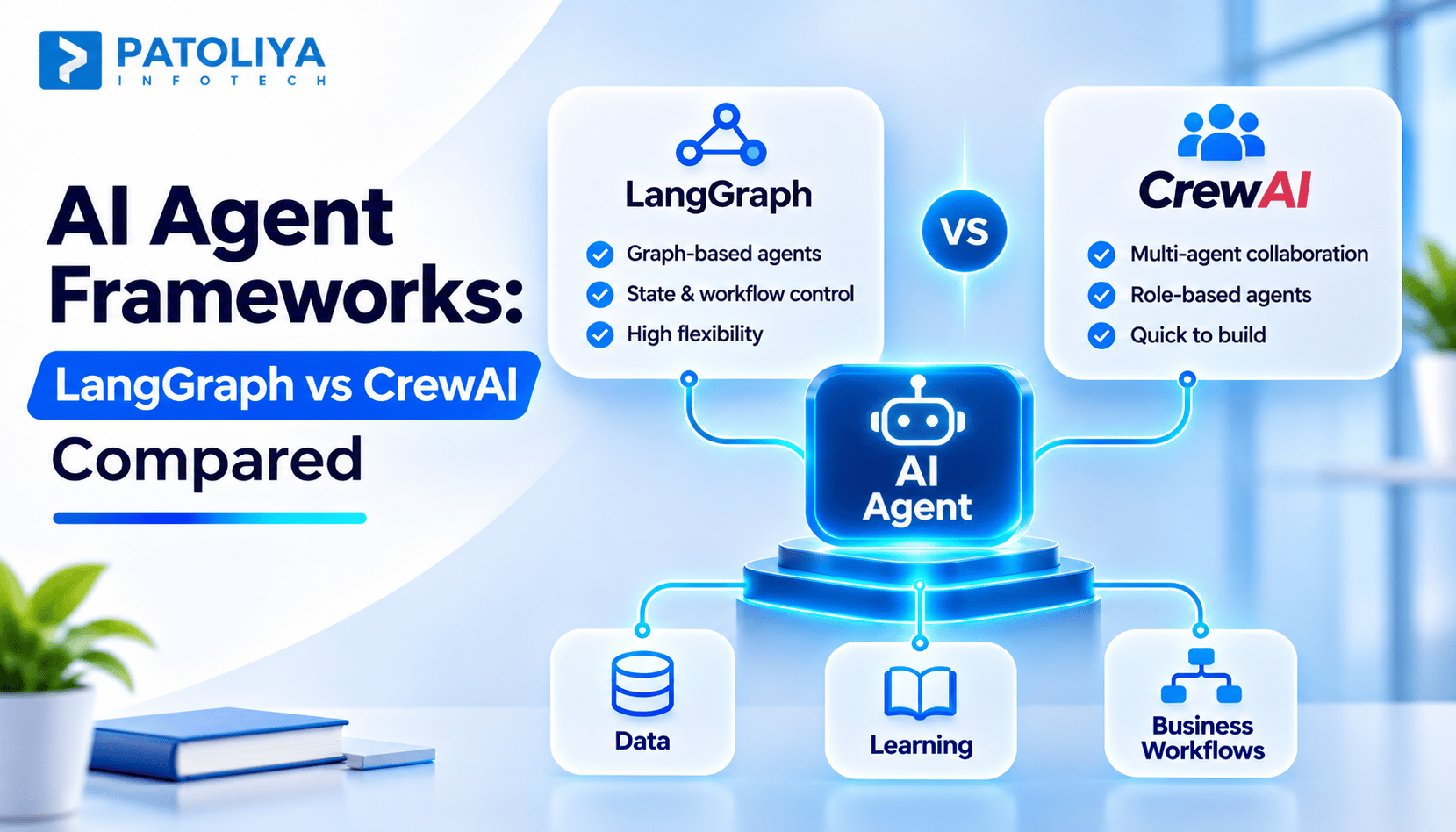
LangGraph treats an agent as a graph. Each node does a piece of work, each edge decides what happens next, and state travels explicitly from step to step. Branches, loops, checkpoints, and pauses for human approval are all first-class ideas. Picture a loan review agent that collects documents, waits three days for an underwriter, and then resumes at the exact step where it stopped. Among AI agent frameworks, LangGraph was built for that patience.

CrewAI starts from people. You describe a crew of agents with roles, such as a researcher, a writer, and a reviewer, and let them pass work between them in sequence or under a manager agent. Flows wrap that crew in structured, event-driven control when the business process needs firm steps. That makes it quick to prototype. Our guide to multi-agent systems walks through these coordination patterns.
|
Criterion |
LangGraph |
CrewAI |
|
Core model |
Graph-based orchestration |
Role-based agents and Flows |
|
Strong fit |
Complex, stateful workflows |
Coordinated, role-based tasks |
|
Control flow |
Explicit nodes and transitions |
Crews plus structured Flows |
|
State |
Checkpointed graph state |
Crew memory and Flow state |
|
Learning curve |
More design up front |
Faster start, harder edge cases |
On paper, both AI agent frameworks handle structured workflows well. The difference shows up at 2 a.m. when a process dies halfway. Workflow state, conversation history, and saved checkpoints often live in different places, and each recovers differently. Ask exactly where each one is stored.
If an agent sent an invoice just before crashing, a careless restart sends it again. Our favourite LangGraph vs CrewAI test is blunt: kill the process mid-task and watch what each one does on restart. Good AI agent frameworks give you the hooks to recover cleanly, but the safeguard itself lives in your design.
Reach for LangGraph when precise control and resumability sit at the centre. Reach for CrewAI when the work maps naturally onto specialist roles.
With AI agent frameworks, customer-facing workflows usually lean towards control, while internal research tasks often suit roles. Run every LangGraph vs CrewAI shortlist through the same crash test, and confirm production features in current documentation, because it in this pair change fast.
OpenAI Agents SDK vs Claude Agent SDK vs Google ADK: An Agent SDK Comparison
OpenAI Agents SDK
With the OpenAI Agents SDK, you get an agent loop, tool calls, handoffs between agents, guardrails, and built-in tracing, in Python and TypeScript. It shines with focused agents and clear delegation, such as a triage agent passing billing questions to a specialist. Sessions add memory; long-running persistence needs your own storage.
Claude Agent SDK
The Claude Agent SDK runs on the same harness as Claude Code. Agents come with built-in tools for files, shell commands, and web access, plus permission modes, hooks, subagents, and MCP support. It is strong for coding, repository, and document-heavy work, such as an agent that runs tests and drafts a fix. Our AI agent security checklist helps you set those permissions safely. Few AI agent frameworks ship with tools this ready to use. Treat it as a distinct runtime.
Google ADK
Google ADK offers agent abstractions, graph workflows, and multi-agent patterns across Python, Go, TypeScript, Java, and Kotlin. It speaks the A2A protocol for agents across frameworks. Among AI agent frameworks and SDKs, it feels most at home for teams already invested in Gemini and Google Cloud.
|
SDK |
Core approach |
Best fit project |
Main consideration |
|
OpenAI Agents SDK |
Agent loop with handoffs |
Focused agents, clear delegation |
Persistence needs extra work |
|
Claude Agent SDK |
Tool rich agent runtime |
Coding and file-heavy tasks |
Permission design |
|
Google ADK |
Multi-language agent toolkit |
Google Cloud workloads |
Ecosystem alignment |
Every agent SDK comparison of vendor tools and AI agent frameworks lands on one tradeoff. A vendor SDK gives you deep access to one provider’s models and features. A neutral framework orchestrates many models and services.
A bank that may switch models for cost or compliance values freedom. A coding product built around one model values depth. Many teams end up with both, using a vendor SDK inside each agent and one of the neutral AI agent frameworks above them.

Language support, MCP integrations, deployment targets, permissions, tracing, approval patterns, and failure handling all differ across these SDKs, so test them on your own work with proper LLM evaluation.
A fair agent SDK comparison also prices the exit: how much code would you rewrite to leave? Releases ship monthly, so revisit quarterly. Write down why you chose. The next review of AI agent frameworks goes faster, and the LangGraph vs CrewAI debate stays settled.
AI Agent Frameworks vs Custom Code: Production Readiness and Tradeoffs
Tool Calling: Frameworks make it easy to define tool interfaces, validate arguments, and coordinate calls. They leave permissions and result checks to you. A refund tool, for instance, should cap every refund at the order value and ask a human above a set limit.
Good AI agent frameworks make tool schemas painless, yet permission logic stays your job. Treat every tool as a door into a live system, and lock it accordingly.
State and Memory: Framework state abstractions speed up the very first build. Your own database gives you full control of session history and persistence. For long-term knowledge, retrieval from a RAG pipeline usually beats stuffing facts into agent memory.
Retries and Durable Execution: A saved checkpoint keeps your place. It never makes a repeated payment safe. Durability needs retry policies, checkpoints, and idempotency keys, so a resumed agent skips work it already finished.
Pause before anything irreversible, such as a payment or an email, and record each completion before moving on. AI agent frameworks with checkpoints help here. Side effect safety still lives in your own code.
Observability and Evaluation: You need traces, logs, latency, token usage, and tool outcomes per run. AI agent observability turns that data into regression tests and task-level scores. Favour AI agent frameworks that export standard traces into your existing monitoring, and alert on tool failures and sudden cost spikes.
A small, predictable loop often beats a large, general framework. The reasoning and acting pattern behind most agents, first introduced in the ReAct (Reasoning and Acting) approach, fits in a few hundred lines. A visual workflow tool can also cover many of these cases. Custom code shines when steps rarely change, and auditors want every decision traceable.
Among AI agent frameworks, orchestration tools give the most control, vendor SDKs the fastest start, and custom code the most ownership.
Total cost includes implementation effort, model usage, hosting, debugging, framework upgrades, and maintenance. Even the best AI agent framework cuts build work only. AI agent frameworks never replace security, testing, monitoring or ownership, and no agent SDK comparison should pretend otherwise.
How to Choose the Best AI Agent Framework for Your Project
Begin by describing the workflow honestly. Is it a single loop with a few tool calls, a branching process, or a genuine team of agents? Our comparison of AI agents vs workflow automation helps you place it, and plenty of tasks need no AI agent frameworks at all.

Next, settle the control model. An insurance claim with fixed approval stages wants explicit orchestration and approval gates. A content team splitting research, drafting, and review across specialists suits roles. Then ask about model flexibility. A regulated client may insist on a second provider as backup, ruling out lock-in.
The hardest question is what must survive a failure. Spell out persistence, resumability, retries, side effects, and human intervention before writing code. A travel booking agent must cancel cleanly if payment fails. Finally, check how AI agent frameworks fit your languages, APIs, deployment targets, and team experience.
Pilot on at least twenty messy, real cases, covering failures, permissions, latency, and cost. Then score candidate AI agent frameworks against your must-haves. The table below gives starting points.
|
Your situation |
Evaluate first |
|
Complex stateful workflows |
LangGraph |
|
Role-based collaboration |
CrewAI |
|
Focused agents and handoffs |
OpenAI Agents SDK |
|
Claude-oriented agent work |
Claude Agent SDK |
|
Google ecosystem alignment |
Google ADK |
|
Simple, deterministic tasks |
Custom code or a workflow tool |
Treat this table as a shortlist. The best AI agent framework is the one that survives your failure tests.
For simple, deterministic tasks, a visual tool may be all you need, as our guide on How to Build AI Agents in n8n shows. A quick FAQ assistant and a month-end reconciliation agent with approvals need very different tools, and both teams can be right.
Ask what the best AI agent framework costs to run and to leave, and fold that into your agent SDK comparison and your LangGraph vs CrewAI scoring. Date your shortlist and revisit it yearly. Teams that write requirements first get far more from AI agent frameworks than teams that start with a favourite.
From Agent Strategy to Production With Patoliya Infotech
Patoliya Infotech evaluates workflows, data access, integrations, and autonomy limits to select the right architecture. Our AI agent development services cover secure tool access, human approvals, testing, monitoring, and recovery.
We evaluate AI agent frameworks against real workflow requirements and recommend simpler alternatives when they deliver better results. Our AI product engineering services support broader product integration, while disciplined LLMOps maintains reliability through traceability, version control, and monitoring.
We start with a bounded agent, validate performance against agreed metrics, and expand capabilities only after testing confirms readiness.
Conclusion
Selection of the right AI agent frameworks starts with understanding your workflow, integration requirements, and operational risks. While frameworks accelerate development, architecture determines reliability, scalability, and recovery.
Evaluate LangGraph vs CrewAI, complete your agent SDK comparison, and identify the best AI agent framework through practical testing rather than feature lists. Assess tool execution, failure recovery, observability, and operating costs before committing to production.
A focused pilot helps validate technical assumptions and business value before expansion. Let’s identify the right agent architecture for your workflow and build a reliable foundation for production deployment.
FAQs:
Python and TypeScript are widely used for AI agent development because they support model integrations, API connectivity, orchestration libraries, and production application development.
AI agents manage conversation history through persistent storage, session identifiers, memory components, and retrieval mechanisms that restore relevant context when users return later.
Vector databases store and retrieve semantically similar information, helping AI agents access relevant documents, organizational knowledge, and contextual information during task execution.
Developers inspect execution traces, model inputs, tool responses, intermediate decisions, and error logs to identify failures and reproduce unexpected behavior systematically.
Effective controls include encryption, role-based access, secret management, data redaction, audit logging, and isolation of sensitive information across tools and execution environments.
Teams estimate infrastructure requirements by measuring request volume, context length, model latency, concurrent sessions, tool usage, storage needs, and expected workload growth.