Adaptive AI Use Cases Across Business Operations
 By Hitesh SUpdated on: 11/18/2611 min read
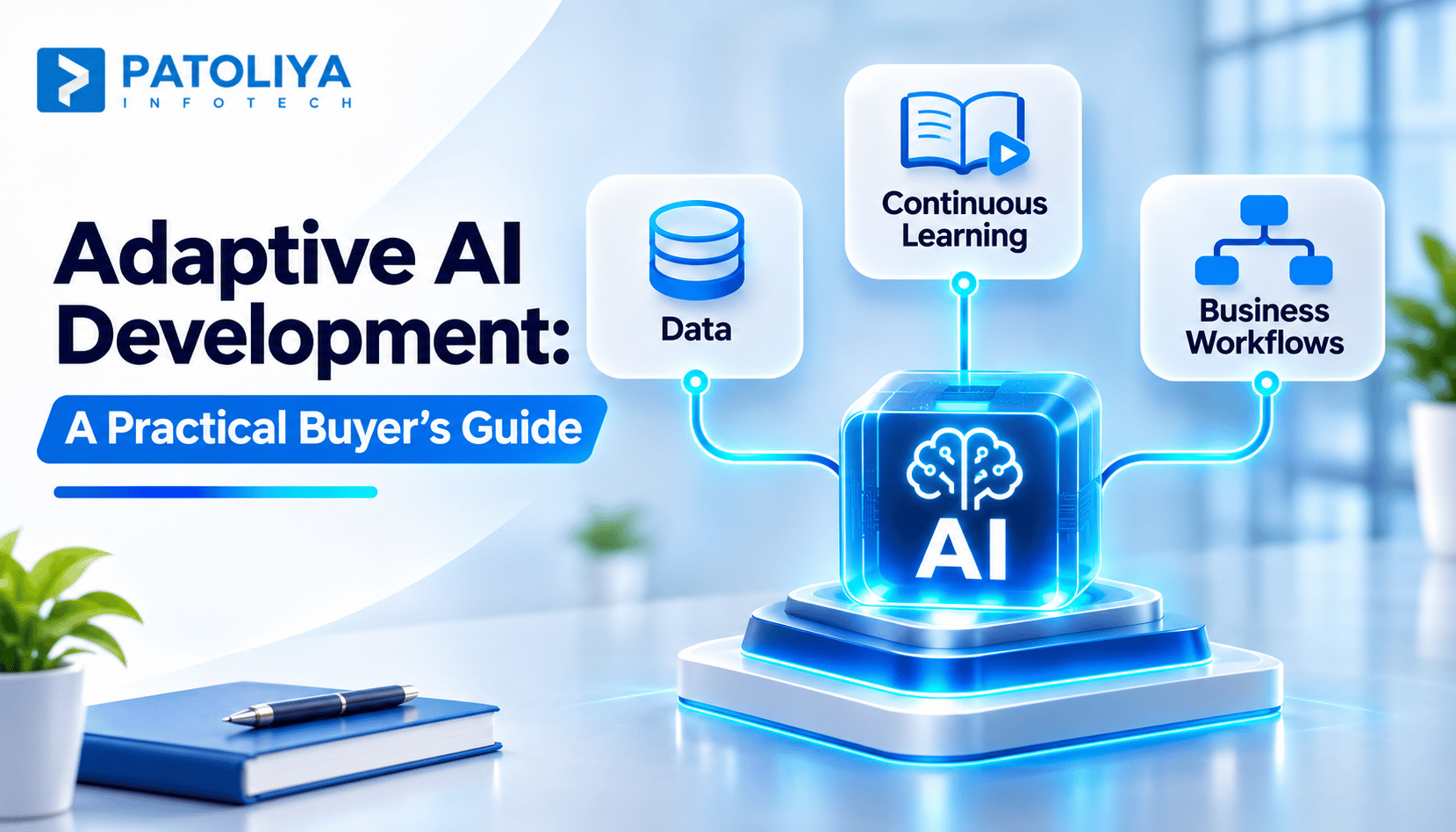
TLDR: Adaptive AI adjusts its behaviour as data, feedback, or conditions change. It pays off when your market shifts faster than a fixed model can follow, and when you can measure whether each change helped. Start with the lowest level of adaptation that solves the problem, then govern every update.
Adaptive AI is an approach where AI systems adjust their behaviour or learning in response to new information, feedback, or changing conditions. How far they adapt depends on design and controls.
A fraud model trained last year never saw this month’s scam. A demand forecast built before a competitor’s launch misses the dip. That frustration is why buyers ask what it is.
Adaptive machine learning keeps a system tuned to evolving patterns, so it relies less on one frozen training set. Some adaptive AI systems adapt an output, such as a threshold or a recommendation. Others update the model’s learned parameters. The second carries far more risk and cost.
Common adaptation mechanisms include incremental updates, scheduled retraining and reward driven policies. Your real question: does your business change enough to justify adaptive AI, and can you prove each change helped? Answer that, and it becomes a clear decision.
Adaptive AI vs Traditional AI: What’s the Difference?
|
Dimension |
Traditional AI |
Adaptive AI |
|
Learning |
Trained in planned cycles |
Takes in new signals more often |
|
Response to change |
Waits for an update or rule |
Responds through configured mechanisms |
|
Maintenance |
Planned retraining |
Extra monitoring, validation and controls |
|
Performance over time |
Degrades as data shifts |
Can still degrade if updates go wrong |
|
Governance |
Validate each release |
Validate the update pathway and results |
|
Best fit |
Stable patterns |
Meaningful, recurring change |
These are broad patterns. A traditional model can retrain monthly, and an adaptive system can run controlled, scheduled updates.
Traditional fits: credit document classification, invoice coding, defect detection on a stable production line
Adaptive fits: pricing in volatile markets, fraud patterns that shift weekly, content feeds where taste moves fast
Example: a lender’s document classifier sees the same five forms every year. Retraining it nightly adds cost and risk with zero gain. A ride hailing price engine faces new demand patterns every evening, so a fixed model falls behind within days.
More adaptation never guarantees more accuracy. It guarantees more moving parts.
Many problems that look like they need adaptive AI really need fresher knowledge. A RAG pipeline updates what a system knows by refreshing its documents, while the model stays unchanged.
Example: a support assistant learns your new refund policy the day you publish it, with zero retraining. This route suits knowledge that changes, such as policies, prices, and product specs. Behaviour that changes, such as fraud tactics, still needs model updates. Use it for behaviour shifts and retrieval for knowledge shifts.
The adaptive AI vs traditional AI choice is about the pace of change in your data. Compare it against your release cycle. If patterns shift faster than you can retrain, then it earns its place.
If they shift slowly, a well run traditional model wins on cost and simplicity. Treat adaptive machine learning as a tool for a specific gap. Frame every adaptive AI vs traditional AI debate around one measurable business outcome, and let it prove itself there.
How Adaptive AI Works: Learning, Feedback and Model Updates
The system observes operational behavior, detects anomalies, evaluates their impact, adapts to changing conditions, validates the results, and continuously monitors performance.
Observe: Collect signals from transactions, user actions, sensors, or business conditions. Example: basket size, return rates, and delivery delays for a grocery app.
Detect change: Watch data distributions and performance indicators for drift. The overview of concept drift detection methods explains approaches for identifying changes in data patterns. Seasonal swings are normal.
Evaluate feedback: Check outcomes, corrections, and verified labels. Decide whether behaviour truly needs adjusting. Delayed labels matter here. Fraud outcomes can take weeks to confirm, so early signals need careful weighting.
Adapt: Pick the lightest mechanism that solves the problem. Each step up adds cost, risk and review effort.
Validate and deploy: Test performance, safety, and regressions before any update reaches production. Run the new version in shadow mode first, scoring live traffic without acting on it. Rigorous LLM evaluation applies when language models sit in the loop.
Monitor again: Confirm the change improved outcomes and broke nothing. Compare against the previous version, the champion, before you retire it. Keep the champion ready for instant rollback.
|
Mechanism |
What it does |
Good example |
|
Continual learning |
Adds new knowledge while protecting old skills. |
A vision model learning a new product line. |
|
Online learning |
Updates incrementally as each record arrives. |
Click prediction on a news site. |
|
Model retraining |
Retrains on refreshed data, then validates. |
Monthly churn model refresh. |
|
Reinforcement learning |
Improves a policy from actions and rewards. |
Warehouse robot routing. |
Incremental updates suit models where errors are cheap and reversible. Retraining with sign off suits anything touching money or customers. In adaptive AI, the champion and challenger pattern keeps every update honest.
A signal can change behaviour without touching model weights. In practical adaptive AI, it can trigger:
- a recommendation for a human to review.
- a rule or threshold change.
- a retraining request that waits for approval.
The safest adaptive AI changes behaviour through the smallest lever available.
Example: a retailer’s forecast error rises after a holiday. The system flags it, an analyst confirms the cause, and a retrain runs overnight with sign off by morning. That is adaptive machine learning with a human hand on the switch. Teams asking what adaptive AI in practice is usually picture constant self-change. Real it in production looks far calmer, and well governed adaptive AI stays that way.
Adaptive AI Use Cases: Where Continuous Adjustment Pays Off
|
Business problem |
Why patterns change |
Adaptation method |
KPI to monitor |
|
Pricing |
Demand, stock, competitor moves |
Bounded price recommendations |
Margin, conversion |
|
Recommendations |
Shifting tastes |
Incremental preference updates |
Click through, conversion |
|
Demand forecasting |
Seasons, disruptions |
Triggered retraining |
Forecast error |
|
Fraud detection |
New attack patterns |
Retraining with analyst labels |
False positive rate |
|
Predictive maintenance |
Wear, operating changes |
Sensor driven updates |
Unplanned downtime |
|
Support routing |
New issue types |
Outcome based routing rules |
Resolution time |
Dynamic Pricing
An online retailer adjusts suggested prices as stock and demand move. The commercial team sets hard floors and ceilings. Adaptive AI proposes, and business rules decide.
Watch for a quieter trap: the model’s own prices change the demand it learns from. Hold back a small control group at fixed prices so you can still measure true demand.
Fraud and Anomaly Detection
Fraudsters study your defences and change tactics. Adaptive AI helps your models keep pace, while analysts verify new labels before they feed any update.
Example: a card issuer sees a surge in small test transactions. Analysts confirm the pattern, and the retrained model starts flagging it within days.
Predictive Maintenance
A pump’s vibration signature shifts as parts wear. Adaptive machine learning recalibrates failure predictions for each machine. A pump fleet in a hot climate wears faster, so its failure window shifts earlier than the factory model expects.
Support Routing
New product launches create new issue types. Routing rules adapt from resolved tickets, and supervisors approve each new queue.
Adaptive AI earns its cost when three things hold: the incoming signal means something, the environment changes often enough to matter, and you can verify that adaptation improved results.
Margin matters most for pricing. False positives matter for fraud. If your use case meets all three conditions, the adaptive AI vs traditional AI question answers itself. If you still wonder what it is worth here, run the numbers on one row of the table first. Adaptive AI proves value one use case at a time, and pilots should start where change costs you most.
Concept Drift, Model Monitoring and the Risks of Self-Updating AI
Four Risks to Plan For
- Drift: The link between inputs and outcomes changes. A credit model built in a low-interest year misjudges borrowers when rates rise. Watch both data drift, where inputs change, and outcome drift, where the meaning of inputs changes.
- Bad feedback: Wrong labels, biased responses, and manipulated signals corrupt updates. Worse, feedback loops can reinforce poor recommendations.
A system that only shows popular items learns that only popular items sell. Attackers can also feed fake signals on purpose. Rate-limit feedback sources and weight verified labels above clicks. Clicks are cheap. Outcomes are gold.
- Forgetting: Updates can erase older skills. Research on catastrophic forgetting shows why protecting earlier knowledge takes deliberate design. For example, a support classifier retrained on new product tickets may start misrouting questions about older products.
- Silent behaviour change: Without controls, adaptive AI shifts while nobody notices. Log every version and its live dates so you can explain any past decision.
Track prediction quality, data drift, business KPIs, error rates, and unexpected behaviour. AI agent observability and disciplined LLMOps give you that visibility. Set alert thresholds per KPI, each owned by a named person.
Monitoring identifies problems, while a governed update process determines the appropriate response. The process detects drift, verifies its cause, tests proposed updates, approves deployment, monitors outcomes, and rolls back changes when necessary.
Back it with versioning, staged rollouts, approval gates, audit logs, and rollback plans. Set clear criteria for when new data triggers investigation, retraining, or rejection.
Require review when adaptation could affect money, customer rights, safety, or regulated decisions.
Example: a pricing update that moves any item beyond a set percentage waits for commercial approval. Human review keeps adaptive AI accountable. Our AI governance framework shows how to assign that ownership. Governed adaptive AI keeps trust intact. The adaptive AI vs traditional AI gap is widest here, because adaptive machine learning multiplies the number of releases you must control. Strong teams treat every update as a release, and that habit keeps it safe at scale.
When Is Adaptive AI Worth It? Cost, Readiness, and Implementation
The Adaptation Ladder
Choose the level of adaptation based on your problem's complexity and business requirements. Start with a fixed model and periodic reviews, then move to scheduled retraining or drift-triggered retraining as needed. For more advanced requirements, consider incremental updates and reward-driven policies.
Most businesses do well at rungs two or three. Rungs four and five suit high-volume, fast feedback environments with mature adaptive AI operations.
Readiness Check
Volatility: do demand, behaviour, or risk patterns shift often enough to matter?
Data: can you access reliable, timely data and measure outcomes?
Cost: have you priced pipelines, monitoring, evaluation, infrastructure, retraining, governance, and maintenance?
Skills: do you have people to review updates and own rollbacks?
Pilot: do you have a baseline and success criteria?
A retailer with weekly sales and monthly planning rarely needs rung four.
Use our AI vendor evaluation guide to vet partners and our custom AI software development guide to compare build paths.
Establishing a Measurable Path to Adaptive AI
Patoliya Infotech helps businesses determine where adaptive AI can deliver measurable operational improvements. Our artificial intelligence consulting services assess feasibility, identify high-value use cases, and define the appropriate level of adaptation.
Through adaptive AI development and AI product engineering services, we integrate adaptive capabilities into existing systems and establish monitoring, validation, and governance workflows.
Each engagement starts with a bounded pilot, baseline measurements, and agreed success criteria, helping your team verify performance, manage risks, and establish evidence before scaling across operations.
Conclusion
Adaptive AI helps businesses respond to changing conditions by updating models, policies, or decisions as new data becomes available. Its value depends on whether changing patterns materially affect business outcomes and whether your team can validate, govern, and maintain those updates.
Stable environments may benefit more from traditional AI with periodic retraining, while dynamic operations can justify continuous adaptation. Understanding what it means for your specific workflows clarifies the choice between adaptive AI vs traditional AI.
Start with a measurable use case, establish clear performance thresholds, and expand only when evidence supports the investment. Let’s assess where adaptive AI can deliver measurable business value.
FAQs:
Adaptive AI requires reliable data pipelines, appropriate storage, feedback mechanisms, monitoring tools, and integration capabilities to support timely updates and consistent evaluation across production environments.
Businesses track prediction accuracy, drift detection, adaptation frequency, operational costs, error rates, and business KPIs against established baselines to evaluate performance improvements objectively over time.
Key risks include model drift, feedback loops, unexpected behavior, data quality issues, compliance violations, and performance degradation without appropriate testing, monitoring, and human oversight.
Yes, adaptive AI can integrate with existing enterprise systems through APIs, data pipelines, event streams, and middleware, depending on architecture, security requirements, and infrastructure readiness.
Implementation costs depend on data readiness, model complexity, integration requirements, infrastructure, governance controls, and maintenance needs, making feasibility assessments essential before committing budgets.
Update frequency depends on data volatility, business risk, feedback availability, and validation requirements. Some systems update continuously, while others require scheduled, approved releases.