LLM Evaluation for Leaders: Quality, Cost and Risk
 By Hitesh SUpdated on: 10/09/2612 min read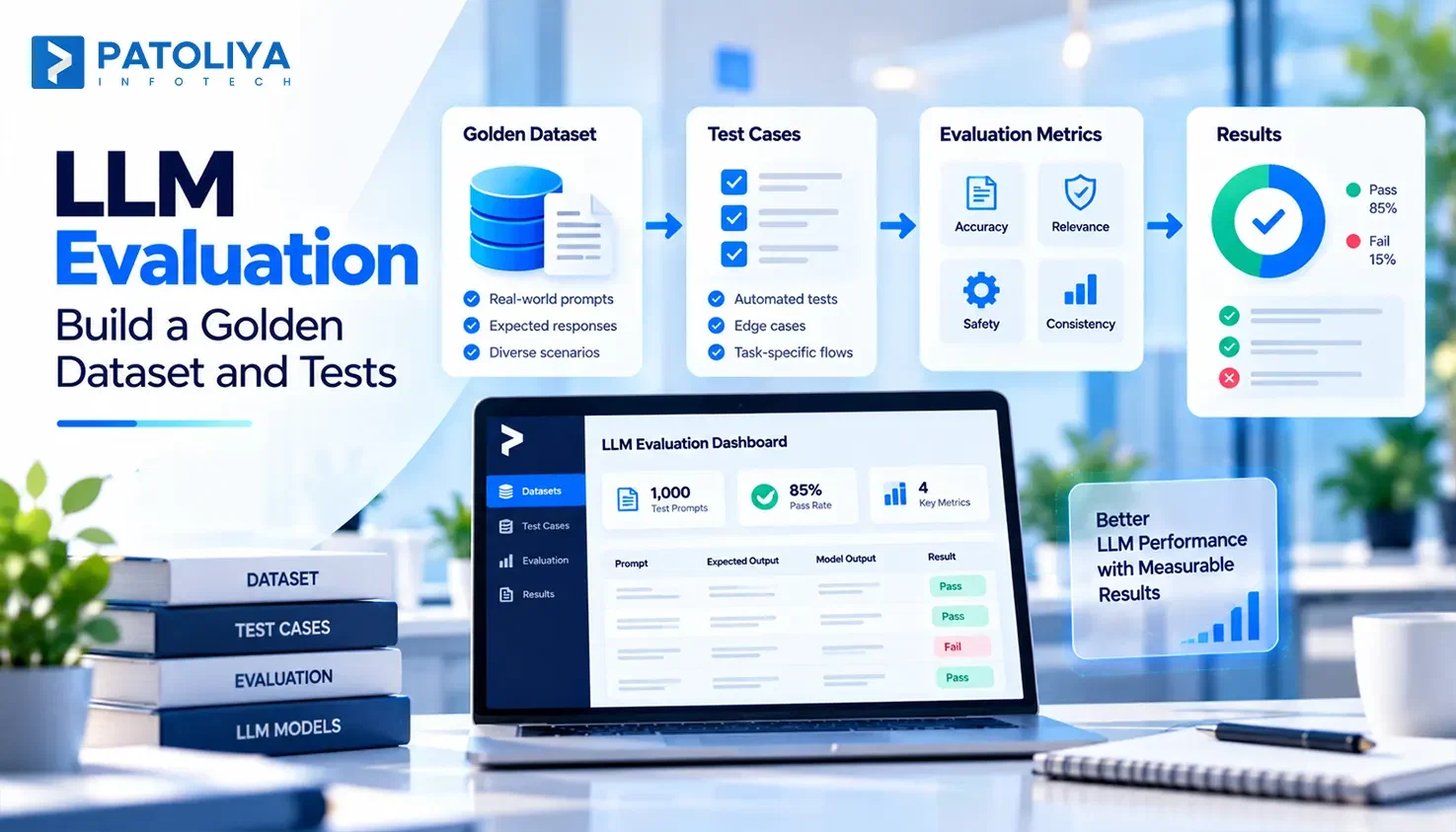
TLDR: LLM evaluation works when you define failure modes first, build a golden dataset from real cases, and pick LLM evaluation metrics that match each failure. Wire those checks into an automated harness with release gates. Every production failure then becomes a permanent test.
A model that scores 88% on a public benchmark can still approve the wrong refund for your customers. Benchmarks measure general skill. Your business needs proof that one specific workflow behaves correctly. LLM evaluation closes that gap when you treat it as an engineering system: datasets, evaluators, thresholds, and release gates.
Most teams start with a dashboard of LLM evaluation metrics and wonder why failures still reach users. The fix starts earlier, with a clear list of what can go wrong. This guide explains how to create an evaluation harness that identifies these failures before they affect users.
Start With Failure Modes Before Metrics
Your system must show six things: correct answers, relevant answers, grounded claims, safe output, completed tasks, and acceptable speed and cost. Strong LLM evaluation proves each one with evidence.
Sort every failure into five groups: model failures such as incorrect reasoning, fabricated facts, or broken formats; prompt and application failures caused by missing instructions or poor templates; retrieval failures involving incorrect or missing documents; tool and agent failures such as wrong tools, invalid arguments, or loops; and production failures including timeouts, cost spikes, or rate limits.
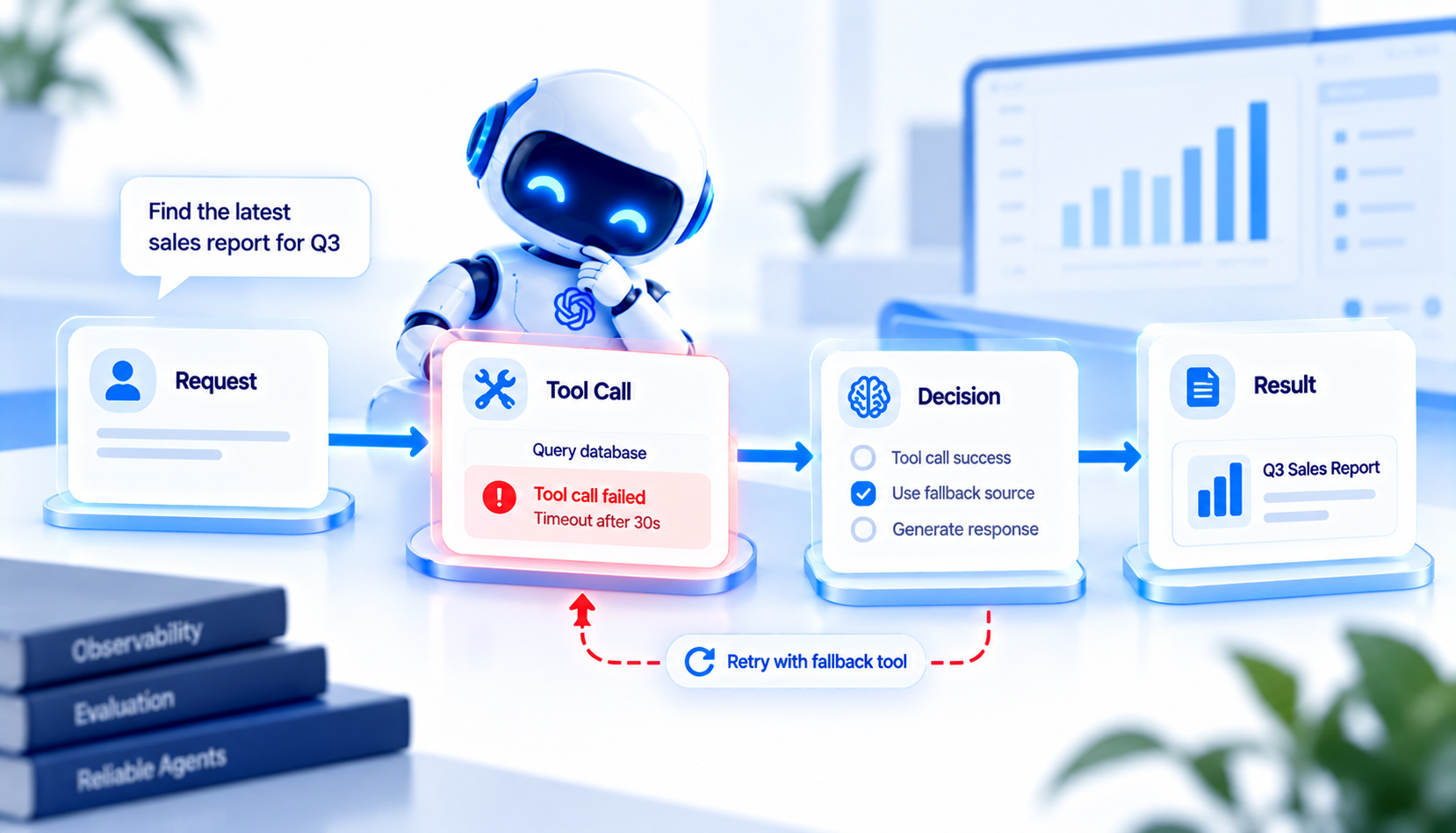
Example: a support bot quotes an expired return policy. That is a retrieval failure, and no amount of prompt tuning fixes it.
The benchmark vs task specific eval gap explains most surprise failures. A benchmark tests general knowledge on public questions. Your workflow tests one policy, one data source, and one customer type. Task specific LLM evaluation uses your own cases, your own rules, and your own definition of success.
Define what can go wrong before you decide what to measure. That list becomes the backbone of your LLM evaluation metrics. Failure modes tell you what to test. A dataset gives you the tests.
Build the Golden Dataset and Evaluation Contract
A golden dataset contains the cases your system must consistently handle correctly. Build it from six sources: real production examples with personal data removed, expected behavior defined by domain experts, edge cases such as empty fields, long inputs, and mixed languages, adversarial cases including prompt injection and policy bypass attempts, historical failures that affected users, and regression cases that failed in previous releases.
Begin with 100 to 200 test cases, prioritizing quality over quantity. Organize each case by risk using four labels: intent, difficulty, risk level, and expected behavior. For example, tag a case as “refund request, hard, high risk, must cite policy section 4.” These labels let you measure performance by risk tier, which provides more useful insight than relying on a single average score.
Create an Evaluation Contract
An turns vague quality goals into machine-checkable rules. For example, a faithfulness score must reach 0.95, with failures classified as high severity. If the threshold is missed, the release is blocked, and the trace is routed for human review. Every claim must also cite a retrieved document as evidence.
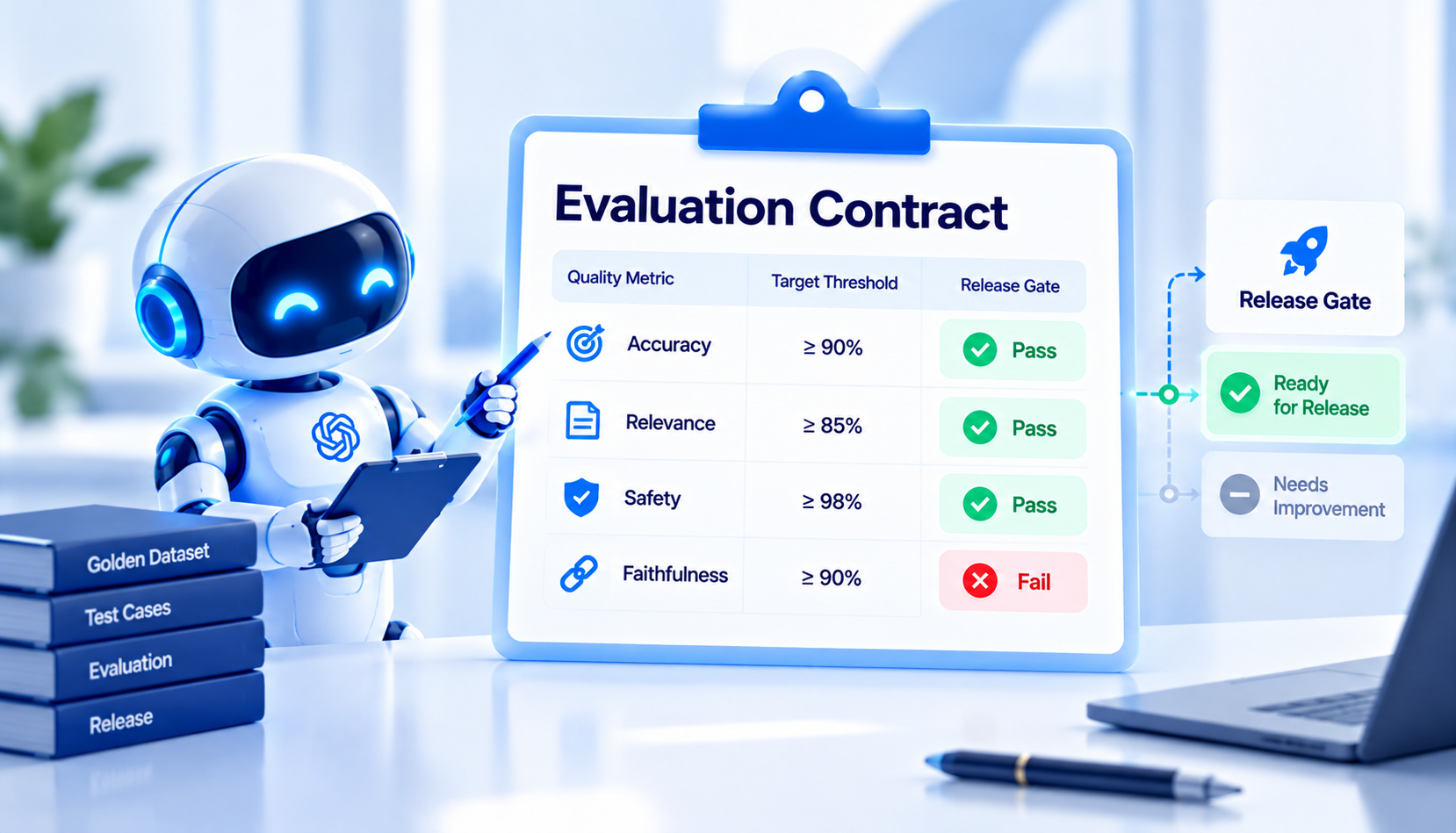
Write one contract per criterion. Your LLM evaluation team, product owner, and compliance lead should sign off on each threshold.
A Golden Dataset Holds Behavior
A golden dataset stores expected behavior, evidence rules, and failure conditions. A list of nice sample answers misses the point. Each test case should define the required elements of a correct response, the content to exclude, and the source it must reference. This turns LLM evaluation into a repeatable contract. With the contract set, you can choose the right metrics.
Choose LLM Evaluation Metrics by Failure Mode
Map each failure to one metric. This keeps every score focused and easy to act on.
|
Failure |
Metric or evaluator |
|
Incorrect answer |
Correctness |
|
Irrelevant answer |
Answer relevancy |
|
Unsupported claim |
Faithfulness |
|
Missing information |
Completeness |
|
Poor retrieval |
Context precision and recall |
|
Unsafe output |
Safety |
|
Wrong agent behavior |
Tool and trajectory evaluation |
|
Slow response |
Latency |
|
Excessive spend |
Cost and token usage |
Reference-based metrics evaluate generated outputs by comparing them with verified answers. They suit factual lookups and structured outputs. Reference free metrics judge output on its own, such as relevance or tone. Use both, because most real workflows mix fixed facts with open text.
Exact match, BLEU, and ROUGE run fast and cost almost nothing. They miss meaning, though. LLM based metrics read meaning and cost more per check. In code generation, pass@k indicates the likelihood that at least one of k generated attempts successfully passes the tests.
Example: with pass@5, a coding assistant succeeds when any of five generated functions passes the unit tests. Completeness catches answers that are accurate yet skip a required step, such as a cancellation fee.
RAGAS popularized four retrieval metrics: faithfulness, answer relevancy, context precision, and context recall. The RAGAS metrics reference lists how each is computed. Add task-specific metrics on top, such as "cites the correct policy section."
A single average can hide a critical failure. A 94% overall score means nothing if the remaining 6% includes unsafe financial advice. Report LLM evaluation metrics per failure mode and per risk tier. Some metrics need a model to grade them, which brings its own risks.
LLM as a Judge: A Useful Evaluator That Needs Validation
LLM as a judge scores open-ended answers that rules miss: relevance, tone, reasoning quality, and business criteria like "follows our escalation policy." Frameworks such as DeepEval package these judges as reusable metrics.
Judges carry known biases. Research on judging LLM as a judge documents position bias, verbosity bias, and self-preference. Judges also react to small prompt changes and score the same answer differently across runs. Use a different model family for the judge than for the application where possible, which reduces self-preference.
Build reliability in five moves:
- Write a rubric with clear pass and fail definitions.
- Add scored examples of good and bad answers.
- Force structured output, such as a score plus a one line reason.
- Calibrate against a labeled sample.
- Sample for human review every week.
Track judge and human agreement, disagreement rate, false positives, and false negatives.
Example: if humans flag 40 unfaithful answers and the judge catches 31, the judge misses 23% of real failures. Your judge is part of your LLM evaluation system, and it needs its own tests. Weak judges produce misleading scores. Single answers are only part of the picture. Systems fail between steps.
Evaluate RAG and Agents at the System Level
RAG Evaluation
RAG evaluation splits into two stages. Retrieval quality measures context relevance, precision, and recall, while generation quality evaluates faithfulness, answer relevance, and citation accuracy. Assess each stage independently to pinpoint where improvements are needed.
Precision measures the share of retrieved context that proves useful. Recall checks whether the retrieval process captures all necessary information. Citation correctness verifies that each referenced source supports the associated claim.
Diagnose the Actual RAG Failure
Four outcomes tell you where to look:
Wrong retrieval, wrong answer: fix chunking, embeddings, or search.
Correct retrieval, wrong answer: fix the prompt or the model.
Incomplete retrieval, plausible answer: the most dangerous case, because it looks right. Raise recall and add completeness checks.
Correct retrieval, correct answer: add the case to your golden dataset. Our guide to RAG accuracy and evaluation covers chatbot specific fixes.
Agent Evaluation
Agents need LLM evaluation across the whole path. Score goal completion, tool selection, tool arguments, execution order, state handling, recovery after errors, and the final output.
Store the expected tool sequence for each case, then score the actual sequence against it. Allow valid alternate orders, and flag extra calls that touch sensitive data. Our breakdown of AI agent evaluation explains how agent paths differ from fixed workflows. An agent may produce the correct answer while following an unsafe process.
Example: a finance agent produces the correct report but queries the full customer table when it needed one row. The output passes. The behavior fails a data access policy. System-level LLM evaluation metrics catch that gap, and system-level LLM evaluation keeps it from reaching production.
Build the Eval Harness
An eval harness follows a fixed sequence: load test cases from the golden dataset, run the AI application, apply deterministic checks and LLM evaluators, enforce contract thresholds, classify failures, compare results with the previous version, and return a final pass, review, or block decision.
Step 1: Run Deterministic Checks
Start with cheap, exact checks: schema validation, exact match, required fields, tool call format, latency limits, and token or cost limits. They run in milliseconds at almost zero cost. Example: a claims bot must return valid JSON with a claim_id field. A schema check fails the case before any judge runs, which saves model spend.
Step 2: Run Model-Based Evaluators
Next, score correctness, relevance, faithfulness, safety, and your business criteria with calibrated judges.
Step 3: Store Every Evaluation
Save each result with the dataset version, model, prompt version, retrieval configuration, evaluator version, score, and failure type. Versioned results explain exactly why a score moved. Keep them in a table your team can query by run ID.
Step 4: Add Human Review
Route four case types to people: high-risk failures, judge disagreements, new failure categories, and a random weekly sample. Human review keeps your LLM evaluation honest.
Step 5: Run It Automatically
Trigger the harness on every change to the model, prompt, RAG pipeline, embeddings, tools, agent workflow, or business rules. Run 50 critical cases on every pull request and the full suite nightly. Connect it to your CI pipeline like any automated testing frameworks your team already uses. Our overview of AI testing and evaluation covers tooling options.
A harness gives you LLM evaluation metrics on every build. Teams that run LLM evaluation this way find regressions in minutes. Scores alone change nothing. Release rules turn them into decisions.
Turn Evaluation Into Regression and Release Gates
Did the system improve? Did anything regress? Is that regression acceptable? Regression testing answers the second question by rerunning every past failure on each build.
|
Check |
Threshold |
Action |
|
Critical safety failure |
0 |
Block |
|
Faithfulness |
95% or higher |
Pass |
|
Task completion |
90% or higher |
Pass |
|
Regression vs last release |
2% or lower |
Review |
|
p95 latency |
Within target |
Pass |
Treat this policy as code. Store it next to the eval harness so every threshold change goes through review.
Severity Changes the Meaning of a Score: A 1% drop on a low-risk FAQ answer barely matters. One critical failure in a loan approval workflow stops the release. Weight your LLM evaluation by risk, and set thresholds per tier. Your LLM evaluation metrics dashboard should show results split by severity.
Close the Production Feedback Loop: Turn every production failure into a test case, add it to the golden dataset, and include it in the regression suite before the next release. For example, a user reports an incorrect warranty answer on Monday.
By Tuesday, the reported question becomes part of the regression suite, helping prevent the same error from recurring in future releases. Mature LLM evaluation programs track the time from incident to new test. This loop links LLM evaluation with LLMOps and production AI monitoring.
When a Production LLM Eval Stack Needs More Than a Framework
Open-source frameworks are effective for managing golden datasets, evaluating RAG performance, and incorporating human feedback. Production systems add four things most frameworks cover only partly: custom business evaluators, full agent path evaluation, automated regression gates, and an audit trail regulators accept.
They also connect evaluation to production monitoring, so live failures feed the test suite.
Example: a lending team must store every decline explanation with its evaluation score for seven years. Most frameworks leave that audit layer to you.
A custom layer pays off when you run several models or providers, complex RAG, agent workflows, business critical or regulated processes, frequent prompt and model changes, or an existing observability stack that needs scores attached.
Make AI Evaluation an Operating Control
Leadership needs to know which AI failures create material exposure, which workflows require human approval, what evidence supports an AI output, how quickly regressions are detected, what each workflow costs, and which thresholds should block deployment.
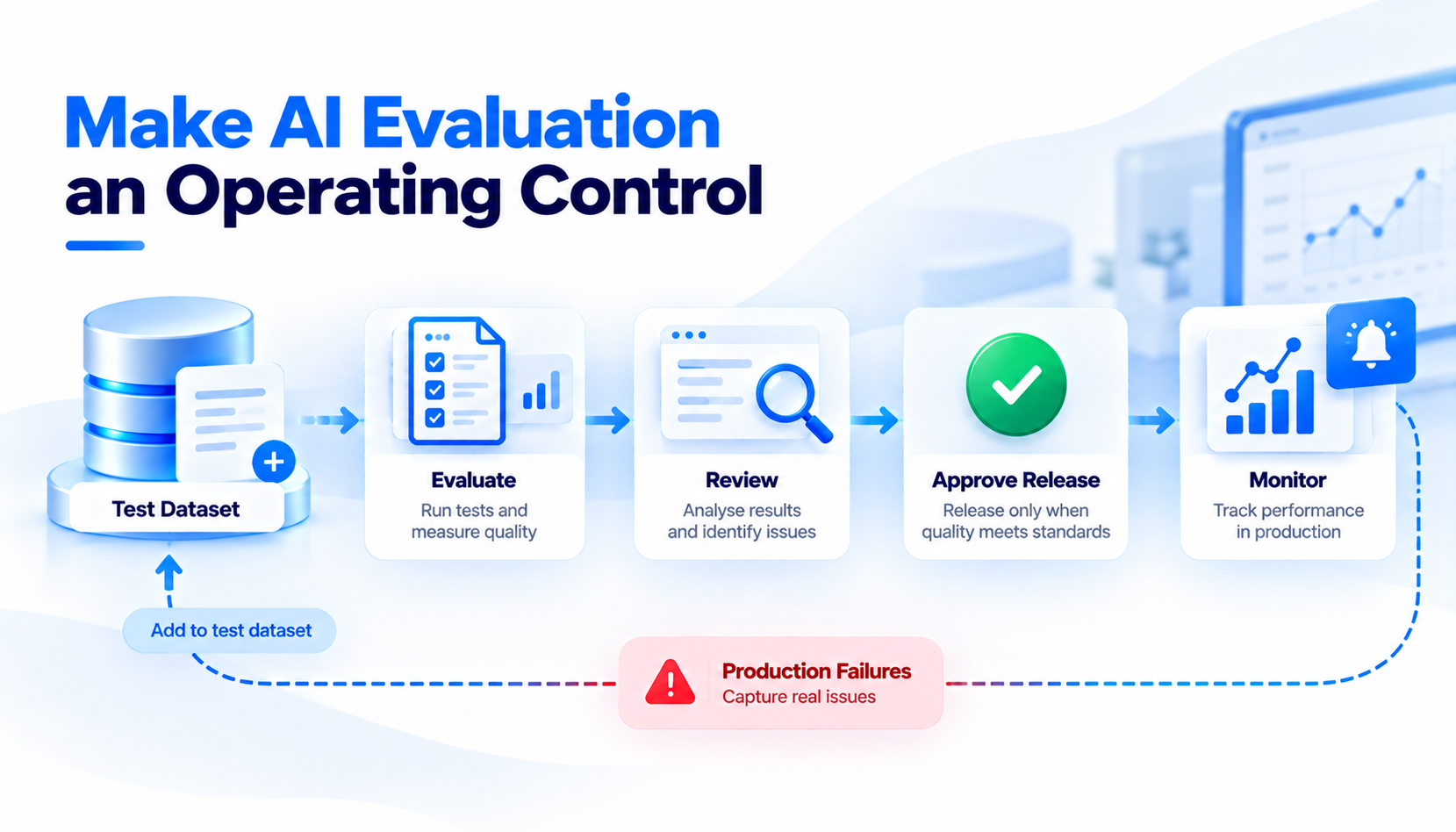
Tie each control to a named risk in the existing risk register and assign one owner per workflow to review its thresholds quarterly.
Translate technical metrics into business controls by measuring faithfulness for reliable information, task completion for workflow effectiveness, latency against operational expectations, cost for economic sustainability, safety for exposure and risk, and regression to identify risks introduced by the latest release.
LLM evaluation creates measurable evidence that AI operates within business-defined limits. Review LLM evaluation metrics monthly through a one-page scorecard organized by severity, treating AI quality as an operating control rather than a purely technical metric.
How Patoliya Builds the Evaluation Layer
We build the LLM evaluation layer around your actual workflows, failure modes, thresholds, and release process. Your business defines the rules, while the evaluation harness enforces them. Our AI testing and QA team delivers:
- Golden datasets built from production logs and past incidents.
- Calibrated judges validated against human-reviewed labels.
- Release gates integrated into your CI pipeline.
Bring one AI workflow for a 30-minute review, and we’ll map its first evaluation contract with you. Technical controls also need a clear executive owner to turn evaluation results into release and risk decisions.
Conclusion
Benchmarks show what a model can do, but LLM evaluation shows whether your AI workflow is ready for production. A reliable evaluation process connects real failure modes to measurable criteria, validated judges, and release thresholds. Build your golden dataset around production risks, select LLM evaluation metrics that reflect business outcomes, and turn every meaningful failure into a regression test.
This creates a repeatable quality loop across models, prompts, retrieval, and tools. With evaluation embedded into delivery, teams can improve AI reliability without relying on intuition or one-time testing.
FAQs:
Yes. A consistent evaluation framework can test different models against the same datasets, criteria, latency requirements, and cost targets, making model selection more objective.
AI evaluation provides documented evidence that workflows meet defined quality, safety, and business requirements, helping teams support governance reviews and release decisions.
Yes. Agent testing can assess tool selection, tool-call accuracy, workflow completion, and behavior across multi-step tasks.
Translate technical results into business indicators such as failure rates, customer risk, operational impact, cost exposure, and release readiness.
A failed evaluation should trigger investigation, failure classification, remediation, and regression testing before the affected workflow is approved for release.