AI Development Cost: Plan for Total Ownership
 By Hitesh SUpdated on: 01/01/709 min read
TLDR: AI development cost depends on five things: solution complexity, data readiness, integrations, quality requirements, and deployment model. A simple API feature and a production AI platform live in different budget worlds. Plan the build and the monthly running bill together, or the second one will surprise you.
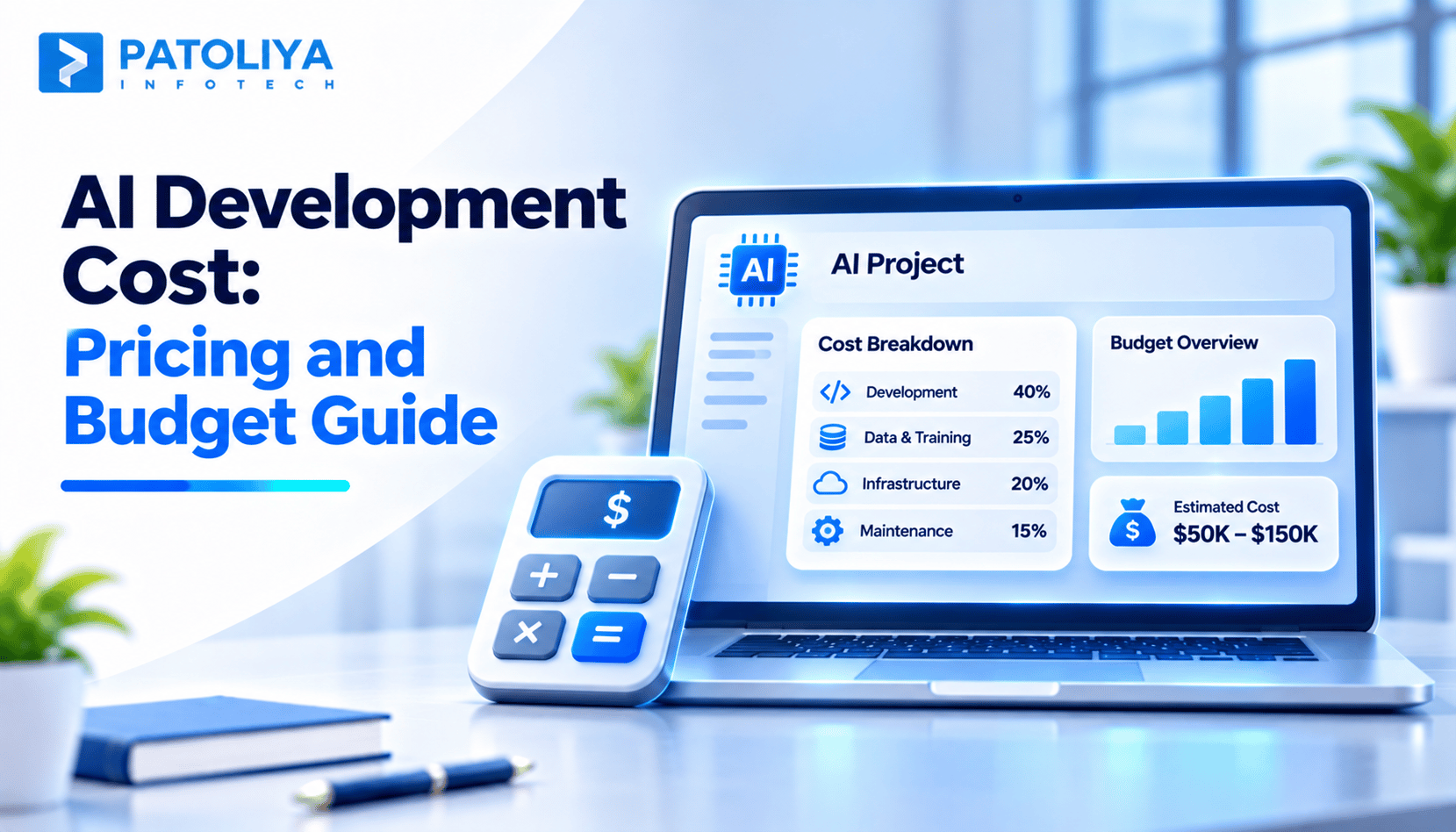
What is the cost of AI system development? First of all, there is no single answer; it depends on what kind of functionality you expect your system to provide. Complexity, bad data, integration depth, accuracy requirements, and deployment location affect the price.
Building a summary button based on a model API will take a small development team several weeks. Creating a production system capable of reading contracts, permission checks, writing to your ERP, and being audit-ready will take months. Both of them are considered AI systems but have drastically different prices.
This AI development cost guide separates one-time build costs from ongoing operating costs. We give the estimates according to the type of project, the model of the development team, and the region.
AI Development Cost by Project Type: Chatbots, RAG, and Custom ML
AI Chatbot Development Cost
The FAQ bot is used for answering questions based on a set of predefined responses. The knowledge-based assistant takes answers from the documents you have and references them. The Connected bot interacts with CRM records, sets appointments, and transfers to humans.

Each step up raises AI chatbot cost through conversation design, escalation rules, integrations, and evaluation. Our AI chatbot development cost guide goes deeper.
Escalation is where AI development cost secretly escalates. The moment when the bot escalates a dissatisfied user to an agent, while ensuring the context gets transferred as well, is something that requires considerable effort.
When wondering how much does AI development cost for a chatbot, one must account for this process from the very beginning, and thus control AI chatbot costs.
RAG Development Cost
RAG model training costs will include document ingestion, document cleaning, document chunking, embeddings, retrieval fine-tuning, access control, evaluation, and monitoring.
A proof of concept that asks questions from fifty clean PDF documents is easy to develop and inexpensive. A secure assistant that asks questions from thousands of documents with access control and accuracy tracking is more complex. Our RAG pipeline guide explains each layer, and every layer adds to your AI software development cost.
Generative AI Development Cost
Generative AI development cost depends on workflow complexity. Developing one tool, such as creating responses to emails, will be cheap. Developing several processes, which include extraction, writing, checking, and routing to be approved, costs more.
An application that orchestrates several models and writes into business systems costs the most. Guardrails and human approval steps add design and testing time, but they protect your budget from expensive mistakes.
ML Model Development Cost
Predictive algorithms, recommendation systems, demand forecasting, and computer vision have the largest AI software development costs when the amount of labelled data is low.
Development cost of the ML model depends on data labeling, training cycles, experiments, validation, and requirements for deployment. For instance, a churn model built on CRM data is cheap. A defect detection model requiring ten thousand labeled images will be much more expensive.
|
Project type |
Typical scope |
Main cost drivers |
Relative complexity |
|
FAQ chatbot |
Fixed answers, web widget |
Content setup, testing |
Low |
|
Connected chatbot |
CRM actions, human handoff |
Integrations, escalation, evaluation |
Medium |
|
RAG assistant |
Secure answers from internal documents |
Data cleanup, retrieval, permissions |
Medium to high |
|
Generative AI workflow |
Multi step drafting with approval |
Orchestration, guardrails, review |
Medium to high |
|
Custom ML model |
Prediction or vision on your data |
Labelling, training, validation |
High |
Keep proof of concept and production AI software development cost estimates separate. Most cost to build AI solution surprises come from treating a demo budget as a production budget. Any AI development cost quote you receive should state its scope, market, and currency.
What Determines AI Software Development Cost?
Data Preparation and Quality: Data collection, cleaning, labeling, and validation can increase AI development cost. Scanned documents need OCR, missing labels require annotation, and scattered data needs integration. Start with a data audit to avoid unexpected expenses.
Model Selection and Accuracy Requirements: Your model choice directly affects AI software development cost. Existing APIs cost less initially, while fine-tuning and custom models require more investment. Higher accuracy also means more testing and validation. Our custom AI software development cost guide explains these options.
Integrations, Security, and Deployment: CRM and ERP integrations, authentication, audit logs, and hosting add engineering costs. Regulated industries also require stronger security and validation. Use software cost estimation to budget for each integration.
Scope and Feature Complexity: A single AI workflow costs less than multi-agent systems or real-time automation. To control AI software development cost, prove one business outcome first. An AI MVP development approach helps validate value before expanding scope.
AI Development Cost by Team Model and Region
In-House Team vs. Outsourcing vs. Dedicated AI Team
An in-house team gives you full control and long-term ownership. It also brings recruitment time, salaries, onboarding, and rare ML skills that lift spending early.
Outsourcing gives fast access to specialists and lower upfront costs, but needs strong coordination. A dedicated external team works inside your process without hiring overhead. Staff augmentation fills short skill gaps at a cost to build AI solution plan.
|
Team model |
Cost structure |
Best fit |
Trade offs |
|
In house |
Salaries, benefits, hiring costs. |
Long-term core AI product. |
Slow to hire rare skills. |
|
Project outsourcing |
Fixed or milestone pricing. |
Defined scope, fast start. |
Less day to day control. |
|
Dedicated team |
Monthly team cost. |
Evolving product, steady roadmap. |
Needs strong product ownership. |
|
Staff augmentation |
Hourly or monthly per person. |
Skill gaps for a set period. |
You manage delivery. |
How Region and Seniority Affect Rates
Hourly rates, and so AI software development costs, differ widely across North America, Western Europe, and India. Teams asking how much does AI development cost by region should compare total delivery, not just the rate card.

Senior engineers who have shipped production AI often finish faster than a larger junior team. A lower hourly rate only lowers the bill when the team delivers with similar speed and quality. A cheaper team that needs twice the hours and repeated rework costs more.
Fixed Price vs. Time and Materials
Fixed price contracts cap spending when scope, data, and acceptance criteria are clear. Time and materials suit uncertain AI work, where early experiments change the plan.
Either way, insist on clear milestones, acceptance criteria, change control, and transparent reporting. Our AI vendor evaluation guide covers what to ask before you sign. A clear contract turns cost to build AI solution guesses into a managed budget.
Hidden AI Costs: Inference, Hosting, and Maintenance
Inference Cost and Model Usage
- Inference cost grows with input and output tokens, request volume, context length, model choice, retries, and multi step workflows. An agent that calls a model six times per task costs six times more than a single call.
- Teams asking how much does AI development cost per month should start here.
- Measure spend per successful task. A cheap API call that fails half the time costs more per result than a pricier call that works.
- The Stanford AI Index tracks how quickly model performance and pricing are shifting, which is worth checking before you lock in a usage forecast.
- Our breakdown of AI agent development cost shows how usage patterns reshape monthly bills.
Hosting, Storage, and Monitoring
- Your AI development cost includes application hosting, vector databases, storage, observability tools, backups, and security controls.
- Managed model APIs bill per use. Self hosted models need GPUs, scaling setup, and engineers who keep them running.
- Self hosting pays off at high, steady volume or under strict data rules, and it changes the cost to build AI solution infrastructure.
- For most teams starting out, managed APIs keep upfront spend and AI software development cost lower.
AI Maintenance Cost
- AI maintenance cost covers model and API changes, evaluation regressions, prompt updates, data drift, dependency updates, incident response, and retraining.
- A static knowledge assistant mainly needs content refreshes and regression tests. A predictive ML model needs drift monitoring and periodic retraining as customer behavior shifts.
- Leave maintenance out and your AI development cost estimate covers half the real bill.
- Google's research on hidden technical debt in machine learning systems explains why this upkeep grows over time. A disciplined LLMOps setup keeps this work predictable.
Build a Total Cost of Ownership Budget
|
Budget line |
Type |
What it covers |
|
Discovery |
One time |
Use case, data audit, success criteria. |
|
Data preparation |
One time |
Cleaning, labelling, structuring. |
|
Development |
One time |
Models, application, workflows. |
|
Integration and deployment |
One time |
Systems, security, release. |
|
Monthly usage |
Recurring |
Inference, hosting, storage. |
|
Maintenance |
Recurring |
Updates, monitoring, retraining. |
Estimate each recurring budget line at low, expected, and high usage. Caching repeated answers, routing simple requests to smaller models, trimming context, and setting usage limits all cut monthly spend while protecting quality.

This full view answers how much does AI development cost over three years, which is the number that matters for your cost to build AI solution.
How to Budget for AI Development With Patoliya Infotech
Define your business goals, data, integrations, and success criteria. Our artificial intelligence consulting services help estimate AI development cost based on actual requirements.
Run a focused pilot to test data readiness, model accuracy, and business value before committing your full AI project budget.
Our generative AI development services account for deployment, security, monitoring, and maintenance. Plan one-time and recurring costs to understand total ownership expenses before scaling.
Conclusion
Understanding AI development cost starts with defining your business needs, evaluating data readiness, and setting realistic expectations. Model selection, integrations, security requirements, and ongoing maintenance all influence the final budget.
A focused proof of concept helps validate feasibility before you commit to full development. Start with the features that deliver measurable value, then expand as results justify further investment.
This approach keeps spending aligned with business priorities, reduces unexpected expenses, and ensures your AI solution remains practical, scalable, and financially sustainable as your requirements evolve.
FAQs:
AI licensing fees depend on vendor pricing, usage limits, commercial permissions, and deployment terms. Review contracts carefully to avoid unexpected costs as adoption grows.
Reserve approximately 10 to 20% of your estimated budget for unexpected integration issues, data problems, and testing changes. Adjust this buffer based on project uncertainty.
Open-source models can reduce licensing expenses, but infrastructure, customization, security, and specialist expertise still require investment. Compare total ownership costs before choosing.
Cloud infrastructure costs vary with compute requirements, storage, traffic, and availability needs. Estimate workloads early and monitor resource consumption to prevent unnecessary spending.
AI development companies commonly offer fixed-price projects, time-and-materials billing, or dedicated teams. Choose based on scope clarity, flexibility requirements, and budget control preferences.
Upgrade when current infrastructure cannot meet performance, reliability, or capacity requirements. Use monitoring data and workload forecasts to justify investments rather than upgrading prematurely.