A2A Protocol for Enterprise AI Architecture Decisions
 By Hitesh SUpdated on: 10/12/2613 min read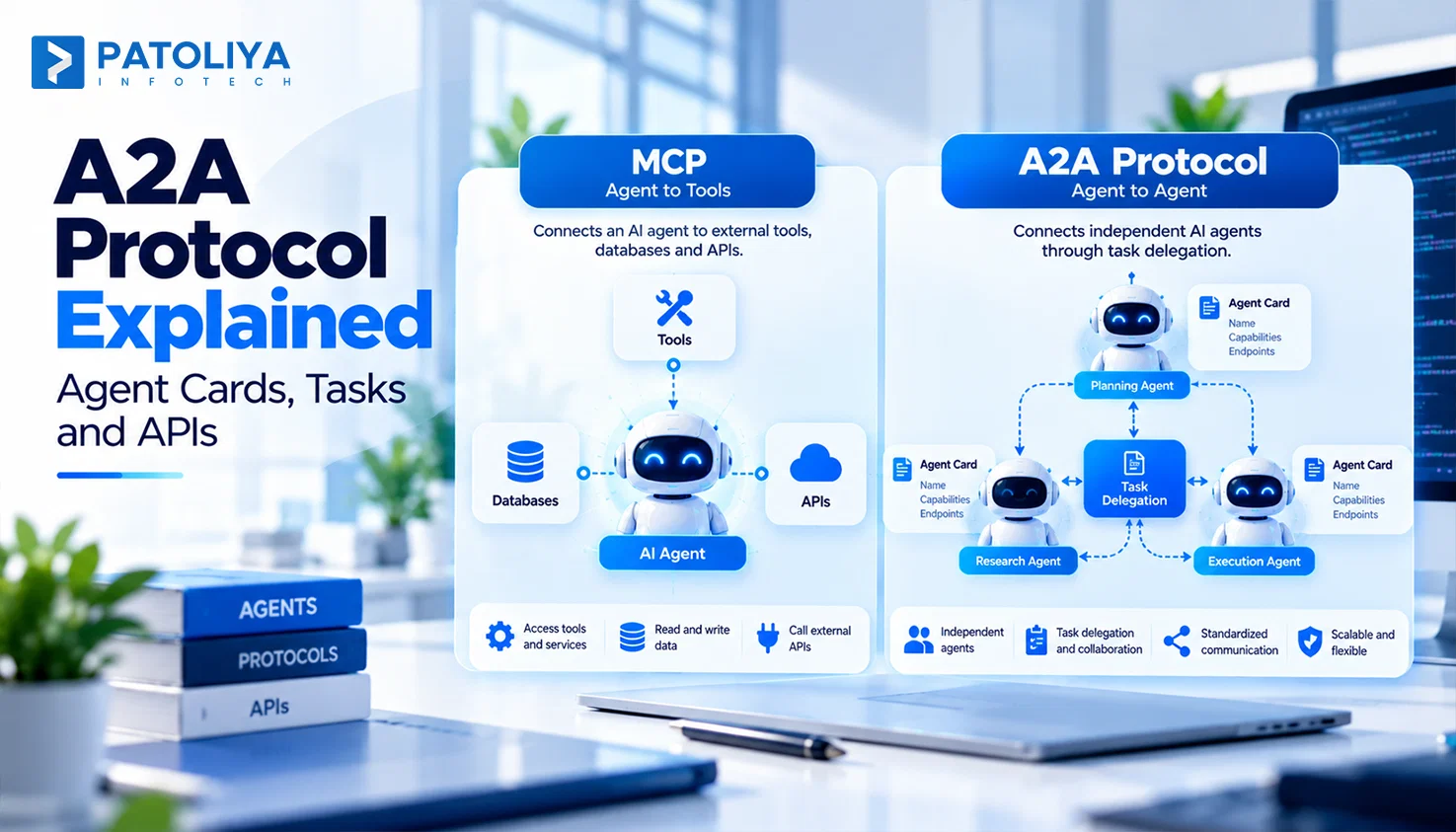
TL;DR: A2A enables independent AI agents to find one another, assign tasks, and deliver results across systems. MCP connects one agent to tools and data. The MCP vs A2A choice comes down to one question: does your agent need a capability, or does it need another agent to do the work?
A support agent needs to search a database, call a billing API, hand a fraud check to a specialist agent, wait for the verdict, and then continue its own workflow. Two protocols cover that journey. MCP handles the database and the API. The A2A protocol handles task delegation and transfers work to the fraud detection agent. Most teams frame MCP vs A2A as a rivalry, and that framing leads to messy architecture.
The simpler mental model works better: MCP connects agents to capabilities, and A2A connects agents to agents. This guide will break down how each one works and how to combine them in production.
MCP vs A2A at a Glance
|
MCP |
A2A |
|
|
Connects |
Agent to tool or data |
Agent to agent |
|
Primary job |
Capability access |
Agent collaboration |
|
Core concepts |
Tools, resources, prompts |
Agent Cards, tasks, messages, artifacts |
|
Remote system |
Exposes a capability |
Stays an independent, opaque agent |
|
Discovery |
Server capabilities |
Agent Card |
|
Long running work |
Depends on the app |
Built into the task model |
|
Best fit |
Search, APIs, databases, files |
Delegation, specialist and vendor agents |
Picture a bank's customer service agent that needs a fraud check. Without the A2A protocol, the team builds a custom API that wraps the fraud system, and every new fraud vendor means another integration project. With the A2A protocol, the customer agent simply sends a task to the fraud agent. The fraud agent runs its own models and tools, then returns a verdict.
The remote system in A2A stays opaque, so you delegate an outcome and never touch the internals. Long-running work is also native to A2A, so a check that takes an hour fits the protocol without custom polling code.
The second design scales. You swap fraud vendors by pointing to a new agent, and your customer agent stays untouched. That flexibility is the practical value the A2A protocol adds to an enterprise stack.
What Is the A2A Protocol?
The A2A protocol, short for Agent2Agent, is an open standard that lets agents work together across teams and vendors. Google unveiled the A2A protocol in 2025, and the Linux Foundation later launched it as an open project and adopted it as an open-source project later that year. Linux Foundation governance keeps the standard vendor neutral.
The Problem It Solves
Agent A should operate independently of Agent B’s internal reasoning and tool choices. It only needs to know who Agent B is, what it can do, how to reach it, how to authenticate, how to submit and track work, and how to receive the result. Everything else stays private inside Agent B, including its model, its tools, its data, and its internal workflow.
Think of it like hiring a contractor. You agree on the job and the deliverable, and the contractor picks the tools. The calling agent never sees the other agent's internals. That opacity protects each vendor's logic and data while still allowing real agent interoperability.
It is also why the A2A protocol suits cross-vendor agents. An insurer's claims agent can ask a partner's medical review agent to analyze a claim and wait for the finished review, without either company exposing its stack to the other.
How A2A Actually Works
Agent Discovery Through the Agent Card
Agent discovery starts with agent cards. An Agent Card is a JSON document that describes a remote agent: its identity, its service endpoint, the skills it offers, and the authentication it requires. A client reads the card, checks the skills, and decides whether the agent fits the job.

Take a procurement agent that needs a contract reviewed. It finds a "contract review" skill on the legal team's Agent Card, confirms the card accepts OAuth tokens, and sends the request.
From Message to Task
The A2A protocol organizes work around tasks. The client discovers the agent and sends a message describing the request. The remote agent creates a new task or continues an existing one, and the task moves into a working state.
It ends as completed, failed, canceled, or rejected, and it can pause along the way to ask for more input or for authorization. The finished output comes back as an artifact.
Those pause states matter in practice. A tax agent can stop halfway through a filing, ask for a missing invoice, and resume as soon as the client replies.
Messages vs Artifacts
A message is communication. An artifact is the result. "Analyze this invoice for fraud risk" is a message. The finished fraud analysis report is an artifact. Each one carries parts such as text, files, or structured data.
Keeping conversation and output separate makes results easy to store, audit, and pass to the next step. A REST call returns a response, while an A2A task returns a full status history and a result, which turns delegation into a trackable unit of work under the A2A protocol. Underneath, the protocol needs transports that support long jobs.
A2A Protocol Architecture: Transports, Streaming and Async Tasks
The Protocol Layer
The A2A protocol separates its data model from the wire format. The current A2A specification defines three bindings: JSON-RPC 2.0, gRPC, and HTTP with JSON. Teams can select the integration method that suits their tech stack while maintaining a consistent task model across all three options.
Three Communication Modes
Synchronous calls suit quick lookups, where the client sends a request and gets the answer in the same exchange. Streaming suits longer work that users watch, because the agent sends progress updates over Server Sent Events before the final result.
Asynchronous mode suits jobs that run for minutes or hours. The client gets a task ID while the agent processes it asynchronously, with updates delivered through status polling or webhook notifications.
A compliance team shows why that last mode matters. Its agent submits 2,000 contracts for review at 6 PM and receives a webhook with the finished artifact the next morning, with no open connection all night.
Why This Matters
Delegated work can take seconds or an entire afternoon. The A2A protocol treats long-running work as normal, with task IDs, states, and notifications built in from the start. That design separates it from a simple REST wrapper, and it sits at the technical heart of the MCP vs A2A distinction.
MCP and A2A Together: The Architecture That Matters
The MCP vs A2A debate disappears once you see both protocols working in one system.
MCP Operates Inside the Agent
The Model Context Protocol (MCP) gives an agent direct access to tools, resources, databases, APIs, and files. The agent stays in control of each call.
A2A Operates Between Agents
The A2A protocol handles discovery, delegation, collaboration, task tracking, and result exchange between independent agents. Each agent manages its MCP connections internally, keeping its underlying databases and tools hidden from partner agents.

A Real Example
A retail customer agent uses MCP to read order history from the CRM and search the help center. The customer then asks for a refund on a disputed charge. The agent sends an A2A task to the payments team's specialist agent. That agent uses its own MCP servers to check the ERP and the payment gateway, then returns a refund decision as an artifact. Neither team rebuilt the other's integrations.
Where Teams Get This Wrong
The most common mistake is wrapping another team's agent as an MCP tool. It works in a demo. In production, the wrapped agent loses its task states, its pause for input, and its status history, and every vendor change breaks the wrapper. Use MCP for capabilities you call. Use A2A to delegate tasks to agents you trust to execute them. Put simply, MCP gives an agent hands, and A2A gives agents a way to work together.
Teams already running multi-agent orchestration inside one codebase can adopt the A2A protocol at the boundaries where agents belong to different teams or vendors. Our guide to AI agent orchestration shows how routing works inside a single workflow. Settling MCP vs A2A this way keeps each protocol in its lane.
A2A vs MCP vs ACP vs AP2
|
Protocol |
Primary role |
How it works |
Example |
|
MCP |
Agent access to tools and data. |
Connects agents with APIs, databases, files, and other tools. |
Search travel fares through a connected tool. |
|
A2A |
Agent-to-agent collaboration. |
Lets independent agents discover, communicate, and delegate tasks. |
Delegate hotel booking to a partner agent. |
|
ACP |
Agent communication. |
IBM’s REST-first approach to agent messaging; its team joined A2A under the Linux Foundation in 2025. |
Agent messaging between services. |
|
AP2 |
Agent-driven payments. |
Extends MCP and the A2A protocol to enable authorized agent payments and verify what the user approved. |
Complete a hotel purchase after user authorization. |
A travel agent can use MCP to search fares, A2A to delegate booking to another agent, and AP2 to complete the payment. Comparing MCP, A2A, and AP2 as alternatives misses the point because each protocol serves a distinct layer of the same workflow.
Enterprise A2A: Discovery, Authentication and Trust
Before an agent delegates work to another agent, the architecture should establish five controls: identify the receiving agent, define what it is authorized to do, determine what data can cross the boundary, authenticate the delegated task, and maintain an audit trail of the interaction.
The Trust Flow
A secure A2A protocol exchange follows a clear order. Your agent discovers the remote agent, verifies its identity, authenticates, authorizes the specific task, delegates the work, and audits the result.
What to Configure
Agent Cards declare the authentication schemes each agent accepts, such as OAuth 2.0, API keys, or mutual TLS. Authorization rules limit which skills a calling agent may invoke. HTTPS protects every exchange in transit. Credentials stay in a secrets manager and out of prompts and task payloads. Audit logs record each task ID, caller, skill, and artifact.
Cross-organization trust is the hardest part. Your own agents share an identity provider. A partner's agents run on their own identity system. Agree on token issuers and data rules in the contract before any production traffic flows.
Our guides on API authentication and AI agent security cover these controls in depth. Strong governance makes the A2A protocol safe for regulated work, and it keeps A2A protocol adoption moving through security review.
Where A2A Changes Enterprise Architecture
Today, many agents connect to partners through one-off integrations: a vendor SDK here, a custom API there, and a new adapter for every partner. With the A2A protocol, one standard interface reaches internal agents, vendor agents, and partner agents alike.
Each new partner becomes a configuration change. Healthcare teams already see this pattern with FHIR, where shared standards drove agent interoperability across hospital systems. Each new partner reuses the same interface, so integration work stops growing with every connection.
Five Architecture Questions
Start with which agents should stay independent services. Then decide who owns agent discovery, the registry of Agent Cards, and approval of new external agents. Define what information may cross each boundary. Plan how you will track long-running tasks across teams. Finally, settle how you will handle failures, retries, and authorization.
Assign an owner to each answer. Platform teams usually own discovery and identity, while product teams own data boundaries. Settle these early, and the A2A protocol becomes a platform decision. Answering the MCP vs A2A question per workflow keeps the design clean.
Our MCP development and AI agent development teams build both layers, from MCP servers to A2A ready agents. Bring one workflow to a 30-minute architecture review, and we will map where each A2A protocol boundary belongs.
When Should You Use MCP, A2A or Both?
Start with one question: does the agent need a capability? If yes, MCP is your answer. Then ask a second question: does another autonomous agent own that capability? If yes, A2A handles that part.

Choose MCP when the agent says, "I need this tool, data, or capability." Querying inventory is a classic case.
Choose A2A when the agent says, "I need another agent to perform this task." Asking a vendor's logistics agent to book a shipment fits here.
Choose both when your agent needs tools and also delegates to other agents. Most enterprise agents land here within a year. An HR onboarding agent reads the employee record through MCP, then delegates laptop provisioning to the IT team's agent and badge access to the facilities agent over A2A. Each delegated task reports its own status, so the HR agent knows exactly which step is still pending. That answer settles MCP vs A2A for architects, and it tells you where the A2A protocol belongs. For linking agents across many apps, see our cross-system agent integration examples.
A2A Protocol Implementation Checklist
Before any A2A protocol endpoint goes live, confirm five areas. For discovery, publish the Agent Card, document every skill, and verify the endpoint.
For communication, document the binding, define streaming and async behavior, and handle the full task lifecycle.
For security, configure authentication, enforce authorization, and define data boundaries.
For operations, define retries, make failures observable, trace every task ID, and validate artifacts against an agreed schema before downstream agents use them.
For governance, approve external agents, control sensitive data, and retain the audit trail.
Test each skill with valid, invalid, and unauthorized requests, plus a timeout scenario, and repeat the review whenever an Agent Card changes. Our AI agent architecture guide helps you place each agent first.
How Patoliya Builds A2A-Ready Agent Architecture
Patoliya designs A2A protocol integrations around clear agent boundaries, trust controls, and workflow ownership.
We map where MCP vs A2A fits, define Agent Card capabilities, establish authentication and authorization rules, and preserve task context across delegated workflows.
Our architectural approach also covers long-running tasks, failure handling, artifact validation, observability, and audit trails.
Rather than adding another integration layer, we help teams create an agent architecture where internal capabilities remain private while independent agents can collaborate reliably across teams, systems, and vendors.
Conclusion
MCP and A2A address different layers of modern agent architecture. MCP gives agents controlled access to tools, resources, and data, while the A2A protocol enables independent agents to discover, delegate, and collaborate across organizational boundaries.
The strongest enterprise designs use both without blurring their responsibilities. Start with one delegated workflow, establish identity, authorization, data boundaries, and task ownership, then validate the interaction before expanding.
A clear MCP vs A2A decision keeps integrations manageable while creating room for cross-vendor agent interoperability, long-running work, and governed automation as adoption grows.
FAQs:
Yes. The A2A protocol is designed for interoperability across independent agents, allowing teams and vendors to collaborate without exposing their internal models, tools, or implementation details.
The calling system should handle failures through defined retries, timeouts, task states, and fallback paths. Long-running tasks should also preserve enough context for recovery.
Yes. An A2A task can pause while waiting for additional input or authorization, allowing human approval to remain part of governed workflows when required.
Enterprises should establish an approval process for external agents, verify their identity and capabilities, restrict accessible data, and define security and accountability requirements before production use.
The A2A protocol can support regulated workflows when implementations enforce authentication, authorization, data boundaries, auditability, and appropriate human oversight around delegated tasks.
A2A can reduce repeated point-to-point integrations when agents expose standardized capabilities and task interactions. The greatest benefit appears across teams, vendors, and independently managed agent systems.