RAG vs Fine-Tuning: A Practical Decision Framework
 By Hitesh SUpdated on: 10/13/2613 min read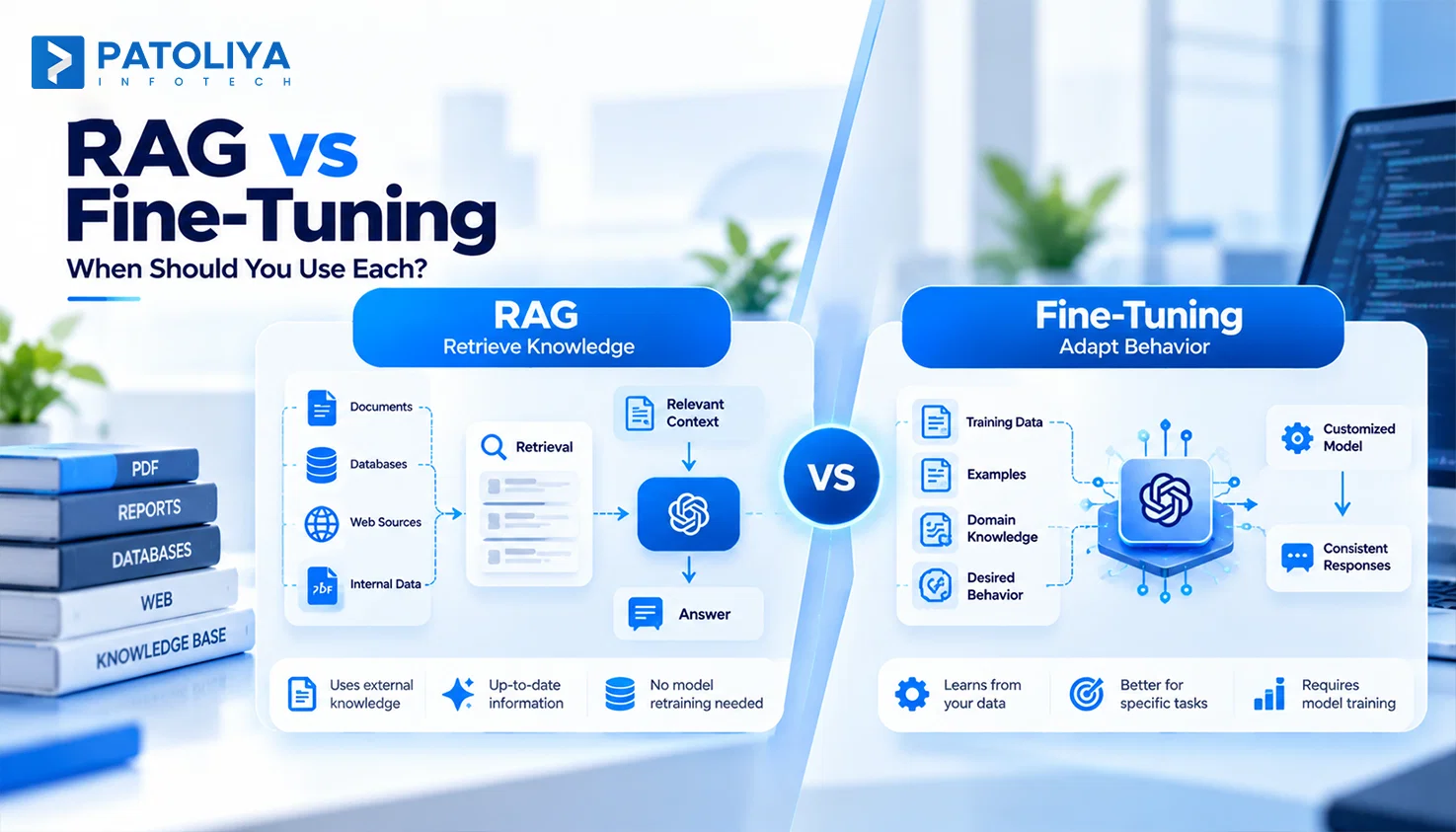
TLDR: Choose your fix by the failure you see. Stale knowledge calls for RAG, and a broken format calls for a better prompt. Training earns its budget in the RAG vs fine-tuning decision only when behavior stays wrong after strong prompts and context.
Most teams waste their first AI budget on the wrong question. When a model gives outdated answers, someone proposes fine-tuning, and when it knows the facts but breaks the format, someone proposes RAG. Both moves miss the cause, because the RAG vs fine-tuning choice depends on which layer of your system failed.
Prompting changes instructions, RAG changes available knowledge, and fine-tuning changes learned behavior. Once your team sees those three layers clearly, most arguments end in a single meeting, and when to fine-tune an LLM becomes a question you answer with evidence.
This guide will explain the diagnosis, the full lifecycle cost, the accuracy tradeoffs, and a decision matrix your leadership can approve.
Three Ways to Change an LLM System
LLM systems can change at three levels: instructions, knowledge, or model behavior, each solving a different problem.
Prompting Changes Instructions
Every LLM application has three layers you can change: the prompt, the knowledge, and the weights. Pick the wrong one, and you spend months fixing the wrong problem.
Prompt engineering edits what the model hears on every request. You define the role, rules, output schema, and worked examples, then ship or roll back changes within minutes.
RAG Changes Knowledge
Retrieval-augmented generation pulls relevant documents into each request, so an unchanged model reads current, private sources before responding.
For example, a bank assistant reads this week's fee schedule before quoting a charge. In any RAG vs fine-tuning comparison, this layer wins whenever facts change faster than you can retrain.
Fine-Tuning Changes Behavior
Fine-tuning trains the model further on your own examples and shifts habits such as classification logic, tone, and output structure. Every change needs training, evaluation, and a redeploy, so it adjusts slowest.
The Distinction That Decides Everything
If the model lacks the facts, fix retrieval. If the model misbehaves, fix the prompt first and weigh training second. This rule settles most RAG vs fine-tuning disputes before anyone writes code and frames when to fine-tune an LLM as the step after cheaper layers fail a measured test. Skip it, and the budget pays to teach a model facts that expire next quarter.
Before Choosing: Identify the Failure
Most failed LLM projects start with a wrong diagnosis. Name the symptom you see, map it to knowledge, instructions, or behavior, and only then approve any RAG vs fine-tuning spend.
Knowledge problems show up as answers that quote an outdated policy or ignore internal documents. Grounding problems look similar, except the right data sits in your index and the model still invents an answer.
Instruction problems produce correct facts in the wrong format, while behavior problems give similar tickets different labels or fail the same task daily. Prompts past two pages signal a context design problem, and weekly content changes signal a knowledge architecture problem.
Take an insurer whose claims bot cites last year's deductible. The team wants a training budget, yet a fresh index of the current policy PDF fixes it within a day.
The Three Question Test
Three questions sort almost every case. If the model needs new information, test RAG, and if it needs clearer instructions, rewrite the prompt. If it must behave differently on every request despite strong prompts, you have the real starting point for when to fine-tune an LLM.
Run it with real failed outputs on screen, and a RAG vs fine-tuning opinion fight becomes a ten minute triage. Knowledge gaps make retrieval your first build.
RAG: When the Problem Is Knowledge
RAG changes what the model reads at answer time and leaves its weights untouched. It fits any problem where the answer lives in documents the model never saw during training.
Your team splits source data into chunks that each hold one clear idea. Embeddings turn those chunks into vectors, and hybrid search pairs vector similarity with keyword matching so product codes and SKUs still return exact hits.

A reranker rescores the top results, and the best passages enter the context window. Our breakdown of RAG vs fine-tuning pipeline design covers each stage in depth.
When RAG Is the Right Call
RAG fits best when information changes weekly or daily, when data is private and must stay inside your systems, and when users need citations they can check. It also handles access rights per user and collections far larger than any prompt.
Our rule of thumb: if a subject matter expert would answer by opening a document, RAG belongs in the design, and in a RAG vs fine-tuning shortlist that test removes training from most knowledge assistant projects.
Where RAG Still Breaks
RAG still produces confident wrong answers when retrieval fails. A bad source creates a bad chunk, the bad chunk produces a bad retrieval, and the model answers confidently from the wrong context. A sound hallucination mitigation plan tests every link in that chain, and grounding checks confirm that each claim maps to a retrieved passage.
RAG moves knowledge maintenance outside the model, so your index becomes the product. The weakest link is usually chunking, yet teams blame the model first, which is why a RAG vs fine-tuning review that scores only the model misses half the system. When the facts are right, and the behavior still fails, training enters the picture.
Fine-Tuning: When to Actually Train the Model
The honest answer to when to fine-tune an LLM is narrow: train only after strong prompts and correct context still fail the same task on a measured test set.
In a RAG vs fine-tuning decision, a few patterns clearly favor training. Classification with fixed labels and extraction into a strict schema both reward a model that learned the pattern. Training also helps when you need one consistent voice across thousands of replies, when the base model mangles your domain terminology, or when you resend long instruction blocks on every call.
A logistics firm, for example, sends a 3,000 token prompt to sort shipment exceptions into 40 codes. A fine-tuned small model learns those codes and drops most of that prompt.
That Protects Quality
A safe pipeline collects task examples from real traffic, then cleans, deduplicates, and labels them before training. Afterward, your team scores a held out validation set, benchmarks against the prompt and RAG baseline, deploys behind a version tag, and monitors for regression.

When real examples run short, synthetic training data fills gaps, provided you validate it against human-labeled samples. Skip the benchmark and your RAG vs fine-tuning comparison has no evidence behind it.
Full Training vs Adapters
Full fine-tuning updates all or most model parameters. LoRA and other parameter efficient methods freeze the base model and train small adapter matrices, which cost less, train faster, and let you swap behaviors per task.
The Limit Teams Overlook
Fine-tuning on company documents gives you domain adaptation, while live knowledge still needs retrieval. Change your pricing page tomorrow, and the model quotes yesterday's numbers until the next training cycle. That gap alone decides many RAG vs fine-tuning cases.
Prompting: The Fix You Should Test First
Prompt changes fix most format and instruction failures within hours. Test them first, because they cost almost nothing and set the baseline every later investment must beat.
Good prompts repair vague task instructions, broken JSON output, unclear roles, and missing edge case examples. They also define tool use rules, a core skill in AI agent development. A support bot returning prose when the CRM expects JSON needs a schema, two worked examples, and a strict output rule, all within one afternoon.
The Retest Loop
Rewrite the prompt, version it in source control, and retest on the same failed cases. If failures persist after several rounds, open the RAG vs fine-tuning evaluation with a clean baseline. Never build training infrastructure to solve an instruction design problem, because that RAG vs fine-tuning mistake costs months.
Cost Lives in the Full Lifecycle
"RAG is cheaper" tells you half the story. A real RAG vs fine-tuning cost review covers build, data, runtime, evaluation, maintenance, and updates across at least one full year of operation.
|
Cost area |
Prompting |
RAG |
Fine-tuning |
|
Data preparation |
Low |
Medium |
High |
|
Initial engineering |
Low |
Medium |
High |
|
Training |
None |
None |
Required |
|
Retrieval infrastructure |
None |
Required |
None |
|
Runtime overhead |
Prompt tokens |
Retrieval plus tokens |
Model inference |
|
Knowledge updates |
Low |
Usually low |
Possible retraining |
|
Evaluation |
Low to medium |
High |
High |
|
Maintenance |
Low |
Medium |
Medium to high |
Total cost = build + data + inference + evaluation + maintenance + updates. Most budgets stop at build and training, yet updates and evaluation run every month and usually outweigh the one-time build within the first year. A twelve month view also exposes who owns each cost after launch.
What Each Path Adds
RAG avoids retraining and adds a vector database, vector generation for new content, retrieval latency, reranking, and indexing pipelines. Budget for document owners too, since stale sources cost more than slow search.
Fine-tuning trims prompt tokens and adds dataset creation, training runs, model versioning, regression testing, and retraining cycles. Every RAG vs fine-tuning budget should list these items with volume stated.
At scale, inference cost picks the winner. At 2 million calls a month, trimming 2,000 prompt tokens per call removes 4 billion input tokens monthly, while at 20,000 calls that saving rarely covers training. Volume is the most practical cost signal for when to fine-tune an LLM. Mature LLMOps practice keeps spend visible per request, so the RAG vs fine-tuning math stays current.
Accuracy Means Five Different Things
A single accuracy score hides the real answer, which is why vendors quote one number in a RAG vs fine-tuning pitch. Split quality into five measures and match each to the method that moves it.

Knowledge accuracy asks whether the system retrieves the correct current fact, and RAG moves it.
Behavior accuracy asks whether the model performs the task consistently, and fine-tuning moves it. Instruction adherence checks format and rules, which prompting fixes.
Groundedness checks whether retrieved evidence supports every claim, which needs RAG plus evaluation.
Task success asks whether the workflow met the business goal, and it often needs all three layers.
Example From a Clinical Workflow
A discharge summary assistant built for generative AI in healthcare needs groundedness first, since every medication line must trace to the chart. A fine-tuned model can write in flawless clinical style and still invent a dose.
RAG with citation checks catches that error, so the RAG vs fine-tuning choice follows the failure that hurts patients most.
Build a Separate Scorecard
Score knowledge, behavior, and task success separately on 200 to 500 real cases, tracking each metric per release. Behavior accuracy is the metric that tells you when to fine-tune an LLM. A style gain that drops groundedness counts as a regression, whatever the headline score says, and that rule keeps any RAG vs fine-tuning call honest.
The Hybrid: When RAG and Fine-Tuning Belong Together
A hybrid stack uses fine-tuning for behavior, RAG for current knowledge, and prompts for request specific instructions. It earns its extra cost only when evaluation proves one method leaves a gap.
A request flows from the prompt through vector and keyword search to a fine-tuned model, and one owner per layer keeps debugging simple when quality drops.
Worked Example: Enterprise Support Assistant
In an enterprise support assistant, fine-tuning gives it consistent ticket classification across 60 categories, RAG feeds it current product docs and release notes, and the prompt carries the customer's plan, region, and requested action.
This split appears in mature AI chatbot development work. Your support logs show when to fine-tune an LLM inside this stack, since misrouted tickets with correct facts point to behavior.
The Rule for Going Hybrid
A hybrid approach earns its place only when evaluation shows one technique cannot close the full failure. Hybrid doubles evaluation and release work, so treat it as a RAG vs fine-tuning answer you earn with data.
Most RAG vs fine-tuning projects start with one layer, measure the gap, and add the second only for remaining failures. Dedicated RAG development services help teams perfect retrieval first and avoid a premature RAG vs fine-tuning leap into hybrid.
For Leadership: Prove the Problem Before You Fund Fine-Tuning
Fund fine-tuning only after your team proves the failure, sets a baseline, and shows the first-year cost. Ask what failure you are fixing, whether it is a knowledge or behavior problem, and which baseline the proposal must beat. Then ask what the system will cost to run for 12 months and how model or data changes will affect quality. A team that answers all five already knows when to fine-tune an LLM.
The Rollout Order
Move from baseline to prompt, RAG, and fine-tuning experiments, then production evaluation and a total cost comparison. Each stage must beat the last on the same test set. Any partner for custom AI software development or generative AI development services should hand you that RAG vs fine-tuning evidence at every gate.
Fine-tuning is an evidence based optimization step. Keep it as your last lever so every dollar in the RAG vs fine-tuning budget maps to a measured RAG vs fine-tuning gain.
Production Checklist
Before Choosing: Define the failure mode, separate knowledge from behavior, and set baseline accuracy.
Test prompt changes and retrieval quality, measure groundedness, estimate runtime spend, and build an evaluation set with regression criteria before any RAG vs fine-tuning commitment. Assign one owner to each item and confirm access rules on every indexed source.
After Deployment: Monitor quality, retrieval failures, and spend per request, and track the knowledge freshness of every source.
Rerun evaluation after any model or source change, and revisit when to fine-tune an LLM each quarter. Review cost and quality monthly, and archive every prompt and model version.
How Patoliya Approaches AI Model Optimization
Patoliya helps teams identify whether a failure comes from knowledge, instructions, or model behavior before choosing a solution. We test prompt engineering, retrieval-augmented generation, and fine-tuning against the same production cases, comparing accuracy, cost, and maintenance.
This evidence-based approach helps teams determine when to fine-tune an LLM, avoid unnecessary complexity, and build a reliable AI system that can evolve with changing business requirements.
Conclusion
RAG, fine-tuning, and prompting each change a different layer of an LLM application. Use RAG when knowledge limits you, prompts when instructions do, and training when repeated evaluation shows a stubborn behavior gap.
Combine them when one layer leaves the failure open. Winning the RAG vs fine-tuning call rests on diagnosis, measured accuracy, and full lifecycle cost. Let's sit down with your failed outputs and find the right layer together.
FAQs:
Yes. A model can be fine-tuned for consistent behavior while retrieval-augmented generation supplies current knowledge. This combination separates learned behavior from information that changes frequently.
Not necessarily. Fine-tuning can improve behavioral consistency, but hallucination mitigation still depends on grounding, retrieval quality, context handling, and evaluation of generated claims.
Model size influences inference cost, capability, and training economics. A smaller fine-tuned model may suit repetitive tasks, while larger models can handle broader reasoning requirements.
Yes. LoRA trains lightweight adapter parameters rather than updating the entire model, making domain adaptation more practical when teams need specialized behavior with lower training overhead.
They should evolve with production failures, new requirements, and changing data. Maintaining representative cases helps detect regressions and confirms that the selected approach remains effective over time.
Consider a hybrid approach when evaluation shows that prompting, retrieval, or fine-tuning alone cannot address the complete failure pattern. Add layers only when measured results justify their added complexity.