Agentic AI vs AI Agents in Healthcare RAG Systems
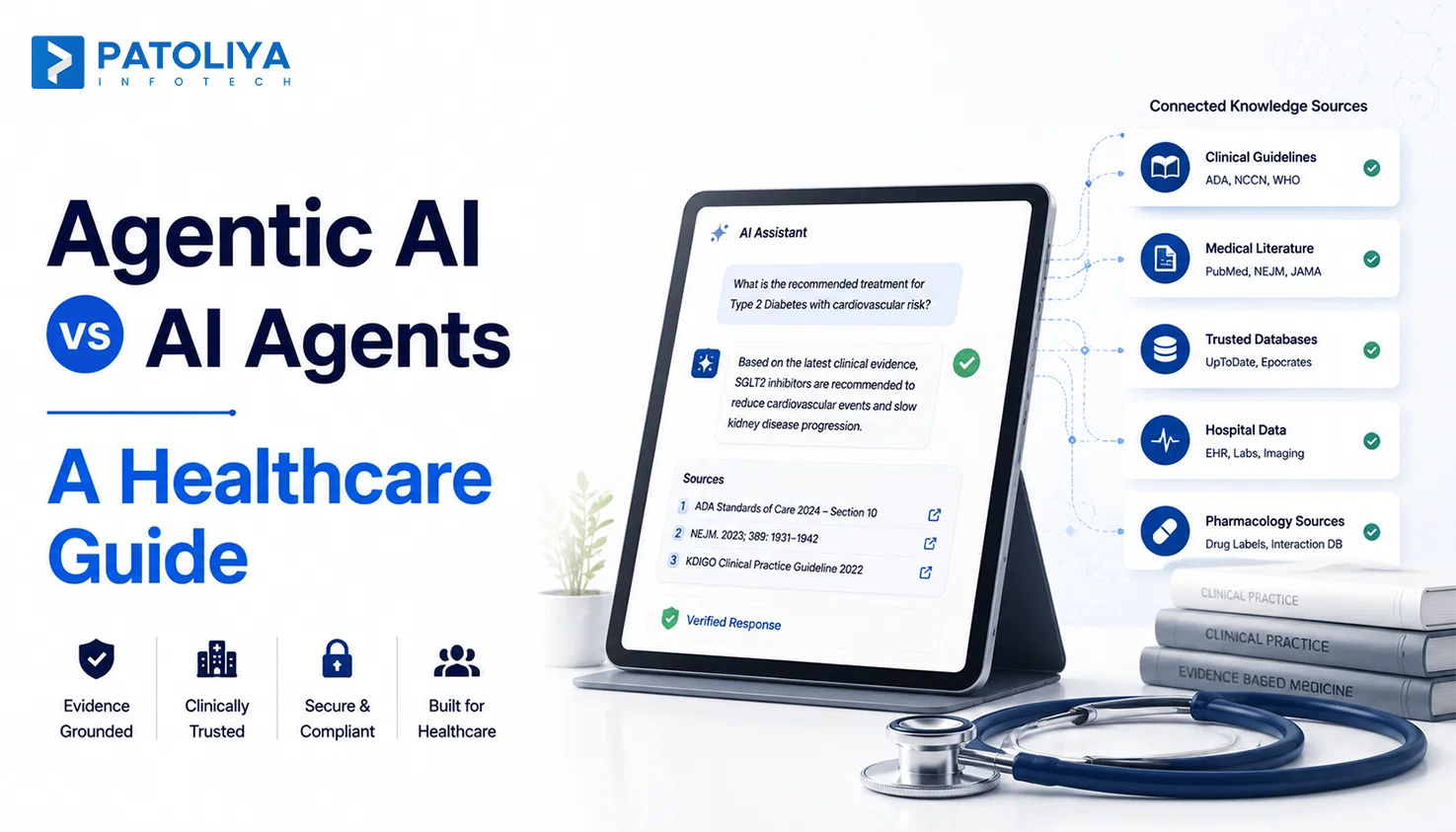
TL;DR: Grounding alone does not guarantee accuracy in healthcare AI. The key decision is agentic AI vs AI agents, because that choice determines how much complexity and risk your clinical workflows carry. A well-designed clinical knowledge assistant architecture reduces unsupported answers by building verification and refusal logic directly into the system.
Most healthcare leaders assume a system that cites sources is automatically safe to deploy. That assumption gets teams into trouble faster than any other in clinical AI procurement. Citations tell you where an answer came from. They do not tell you whether the system checked itself before speaking.
This is where the real conversation starts. Understanding agentic AI vs AI agents matters because these two approaches behave differently under pressure, differently when evidence conflicts, and differently when no reliable answer exists at all. A strong clinical knowledge assistant architecture treats grounding as one layer among several, not the entire safety net.
This guide will explain how architecture choices affect accuracy, what changes once a pilot moves toward production, and what buyers should demand before approving a clinical AI purchase.
Clinical Knowledge Assistant Architecture: What Determines Trustworthiness
Retrieval, Grounding, and Citation Layer
A trustworthy clinical knowledge assistant architecture starts with a well-designed RAG pipeline built around curated, version-controlled sources, not open web retrieval.
Understanding agentic AI vs AI agents helps clarify why reliable knowledge retrieval matters: fresh guidelines, precise context, and traceable citations help clinicians verify every answer against the correct document, section, and revision.
|
Element |
Weak Design |
Strong Design |
|
Source set |
Open web crawl |
Curated, versioned corpus |
|
Freshness |
Static, rarely updated |
Scheduled revalidation |
|
Citation |
Generic reference |
Document, section, date |
Verification and Refusal Layer
Grounding alone cannot prevent hallucinations. Confidence thresholds, unsupported-answer detection, and clear refusal behavior strengthen hallucination risk mitigation in clinical AI.
When evidence is insufficient, the system should say so and escalate rather than guess. This is also where agentic AI vs AI agents becomes a practical risk decision: more autonomy requires stronger verification controls.
When Straightforward RAG Is Enough
Not every use case needs orchestration. Clinical knowledge lookup, policy assistance, and some clinical decision support system workflows often work well with a single retrieval-and-generation loop.
When workflows have one clear source of truth and low ambiguity, a simpler architecture reduces failure points and overhead. The agentic AI vs AI agents decision should favor simplicity when the clinical risk is limited.
When Multi-Agent Orchestration Makes Sense
Complex evidence synthesis may require multiple specialized sources, such as specialty guidelines, drug interaction databases, and patient-specific context.
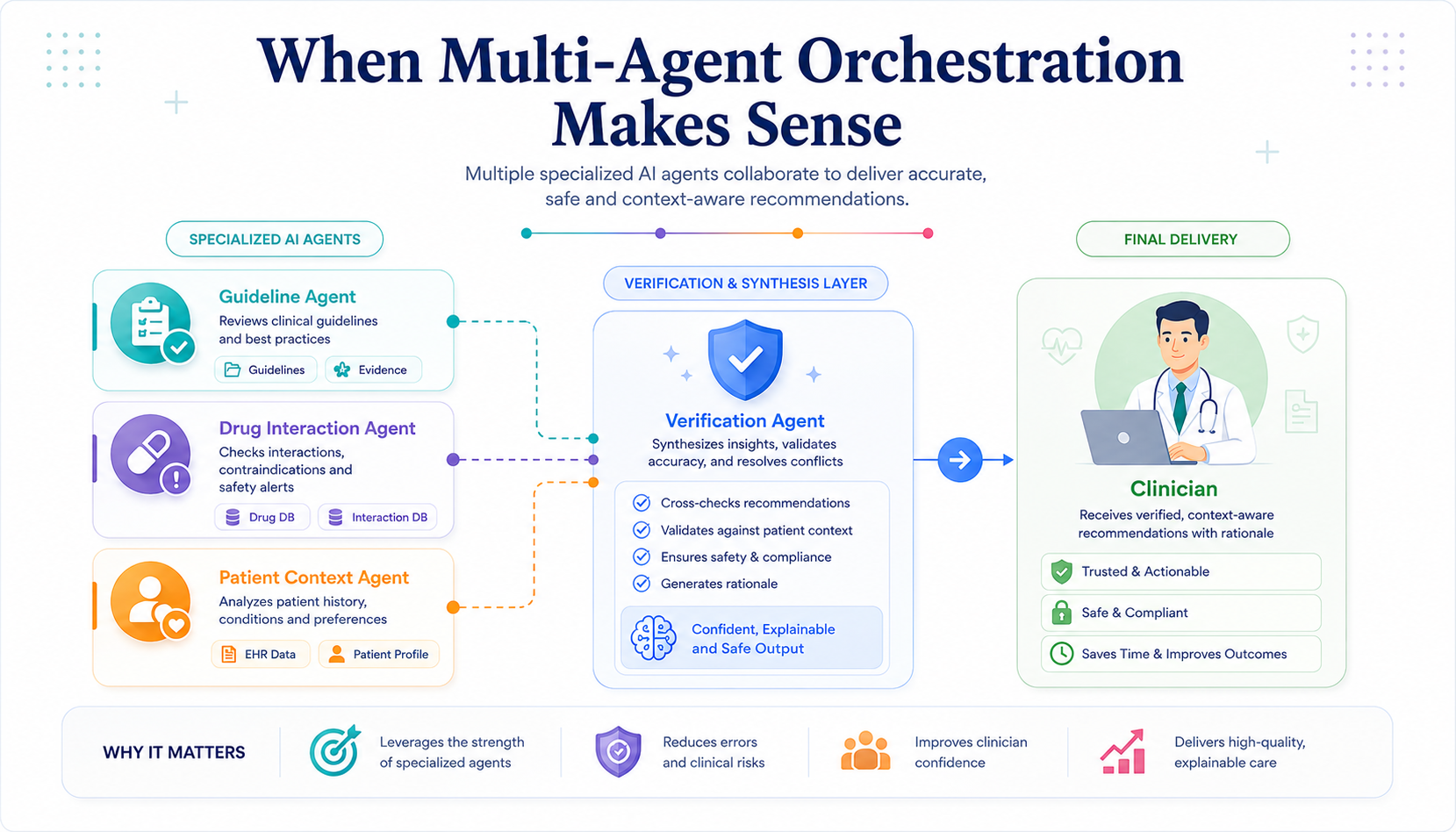
Multi-agent orchestration can assign each source or task to a specialized agent, while a coordinating layer verifies outputs before they reach the clinician. Here, agentic AI vs AI agents becomes a risk-based engineering decision.
|
Clinical Scenario |
Recommended Architecture |
Why |
|
Single source, low ambiguity |
Single-agent RAG |
Fewer failure points and lower complexity |
|
Multiple sources, conflicting evidence possible |
Multi-agent orchestration |
Specialized agents can compare and verify evidence |
|
Patient-specific reasoning across domains |
Multi-agent RAG with verification |
Enables cross-domain analysis with an additional safety check |
This keeps the choice focused on clinical risk, source complexity, and verification needs.
Prove Clinical Accuracy Before You Deploy
Demand Domain-Specific Evidence
Test against your clinical data: Generic AI benchmarks do not prove performance on your formulary, protocols, or patient population. For agentic AI vs AI agents, Request testing using your actual or representative clinical documents.
Validate by specialty: Oncology, primary care, and other specialties can expose different weaknesses in a clinical knowledge assistant architecture. Test across the workflows that matter most.
Include clinician evaluation: Have physicians or nurses review answers against the sources. Human validation provides stronger evidence than automated scores alone.
Test How It Fails
Test retrieval failures: Use questions where the knowledge corpus has limited or no relevant evidence and check whether the system recognizes the gap in agentic AI vs AI agents.
Test conflicting sources: Evaluate how the system handles disagreements between clinical guidelines instead of forcing a single unsupported answer.
Check unsupported answers: Determine whether generated claims stay within the retrieved evidence or introduce information that the sources do not support.
Verify citation accuracy: Review citations against the source text and measure how often they genuinely support the answer. This provides practical evidence of hallucination risk mitigation and clinical AI performance.
Implementation, Cost, and Risk: What Changes After the Demo
Integration and Time to Production
Live integration matters. A demo running on sample data looks very different from a system connected to your live EHR and EMR environment through reliable healthcare data integration. For agentic AI vs AI agents, Integration effort depends on system openness, API availability, data mapping, and the amount of custom work required when implementing generative AI development services in a live healthcare environment.
Security gates add time. Healthcare software security, role-based access, audit logging, and data-handling reviews are essential before production approval. A pilot may take 4 to 8 weeks, while production can take several additional weeks once security reviews, clinician training, workflow integration, and monitoring are included.
Total Cost of Ownership
Pricing models differ. Per-query pricing scales with usage and can increase sharply during high-demand periods. For agentic AI vs AI agents, Per-seat pricing offers more predictable budgeting, while infrastructure-based pricing can suit large deployments with steady, high-volume usage.
Hidden costs accumulate. Integration, monitoring, evaluation, maintenance, and corpus updates can add 20 to 40% or more to the initial implementation cost over time. A clinical knowledge assistant architecture also requires recurring evaluation and reindexing as guidelines, documents, and models change.
Cost creep happens when teams add new EHR integrations, expand the knowledge corpus, increase monitoring requirements, or need additional evaluation and engineering support after launch.
What Happens When It's Wrong
Safe failure matters. Error handling should trigger automatic refusal when confidence falls below a defined threshold, with a clear escalation path to a human reviewer.
Auditability starts early. Audit trails and incident review processes should exist before production so teams can trace what the system retrieved, generated, and presented when an error occurs, especially when evaluating agentic AI vs AI agents.
Accountability must be clear. Liability and responsibility should be defined contractually. Ask who owns the outcome when the system produces a confident, cited, but incorrect answer. This is essential for hallucination risk mitigation clinical AI, and responsible deployment.
Business Case for a Clinical Knowledge Assistant
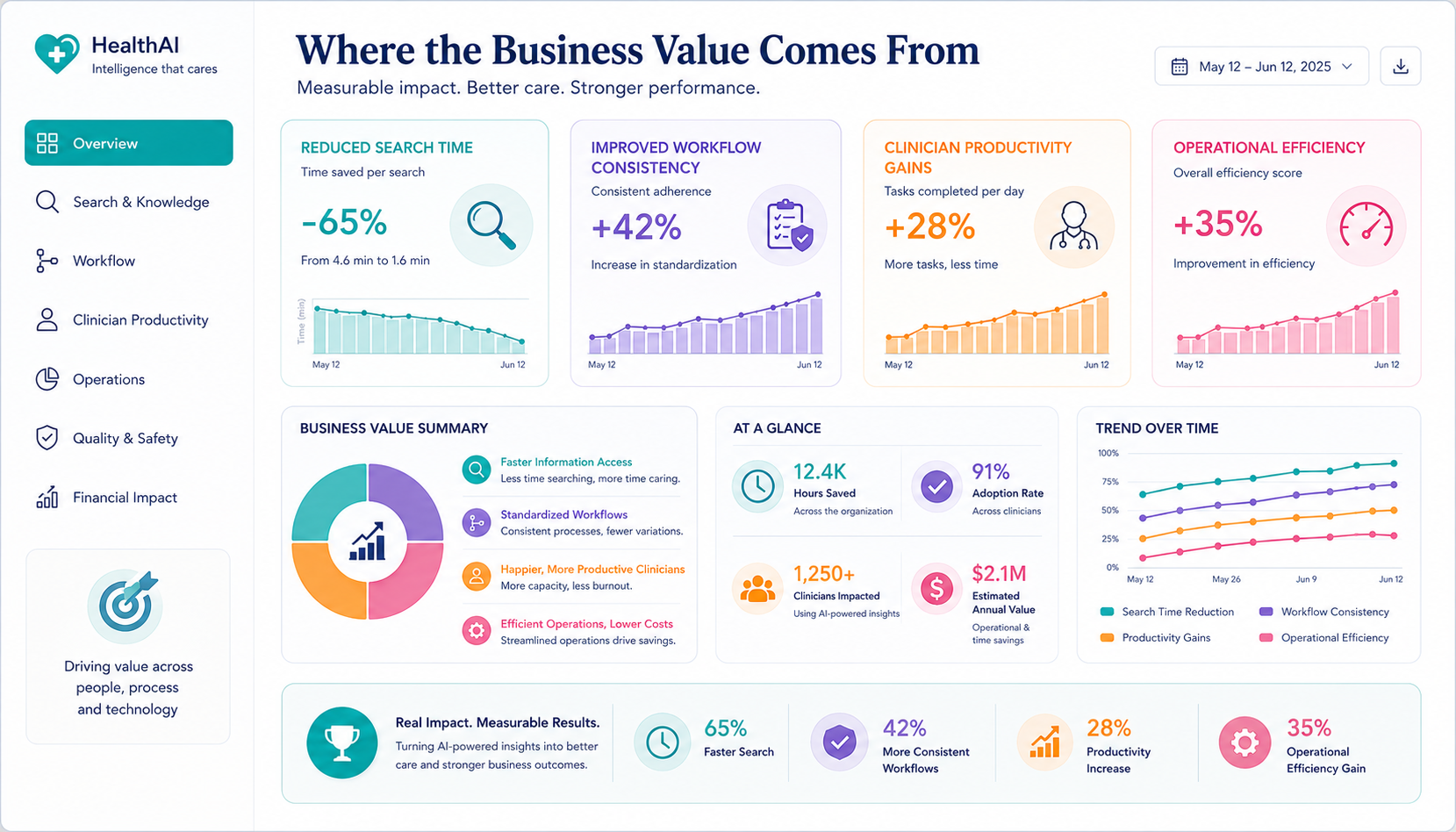
Where the Business Value Comes From
- Faster access to trusted information reduces the time clinicians spend hunting through shared drives and outdated PDFs. Reduced manual knowledge search effort translates directly into more time with patients.
- More consistent workflows emerge when every clinician pulls from the same verified source instead of relying on memory or word of mouth practice.
- Better operational efficiency follows naturally once knowledge retrieval stops being a bottleneck, alongside broader AI automation and predictive analytics in healthcare initiatives.
- This is the practical payoff that makes the agentic AI vs AI agents conversation worth having at the leadership level, not just the engineering level.
How to Measure ROI Before Scaling
- Time saved per query, tracked against a baseline of manual search time, gives you your first real number.
- Adoption and utilization rates tell you whether clinicians actually trust the system enough to use it daily.
- Accuracy and escalation rates matter more than raw usage numbers. In agentic AI vs AI agents, a system used heavily but escalating constantly signals low trust dressed up as adoption.
- Operational and financial outcomes, tied back to the original business case, close the loop and justify further investment.
How to Evaluate a Healthcare RAG Partner
Evidence to Request Before Signing
Request a full architecture walkthrough before any contract discussion begins, particularly when evaluating artificial intelligence consulting partners for a clinical deployment. A vendor who cannot explain their retrieval, grounding, and verification layers in plain language is not ready for a clinical deployment.
Evaluation and accuracy results on domain specific data matter more than general benchmark scores. Ask for real failure examples, not polished success stories.
Security and data handling documentation should be available on request, not promised after signature. Pilot methodology should be documented step by step with clear success criteria attached when evaluating agentic AI vs AI agents.
Questions That Separate Real Capability From Marketing
Ask these directly and watch how confidently the vendor answers:
- How is retrieval evaluated against your specific corpus?
- How are citations enforced at the generation step?
- How does the system handle conflicting evidence between two sources?
- What happens when no reliable source exists for a question?
- How is performance monitored after deployment goes live?
A vendor with a real clinical knowledge assistant architecture answers all five without hesitation. A vendor without one starts talking about their model instead of their system.
What to Require Before Production Approval
Technical and Clinical Acceptance Criteria
Set an accuracy threshold before testing begins, not after results come in. Citation requirements should mandate document, section, and date on every answer without exception.
Refusal behavior needs to be tested directly, confirming the system declines when evidence is weak instead of guessing when evaluating agentic AI vs AI agents.
Clinician validation, done by actual practicing staff reviewing real sample answers, should be mandatory before sign-off, alongside Good Machine Learning Practice principles where applicable. Integration readiness checks confirm the system works inside your live environment, not just a sandbox.
Governance and Operational Readiness
Data ownership terms need to be explicit in the contract. Auditability means every answer can be traced back to its source and its confidence score after the fact. Incident response plans should exist before the first user touches the system.
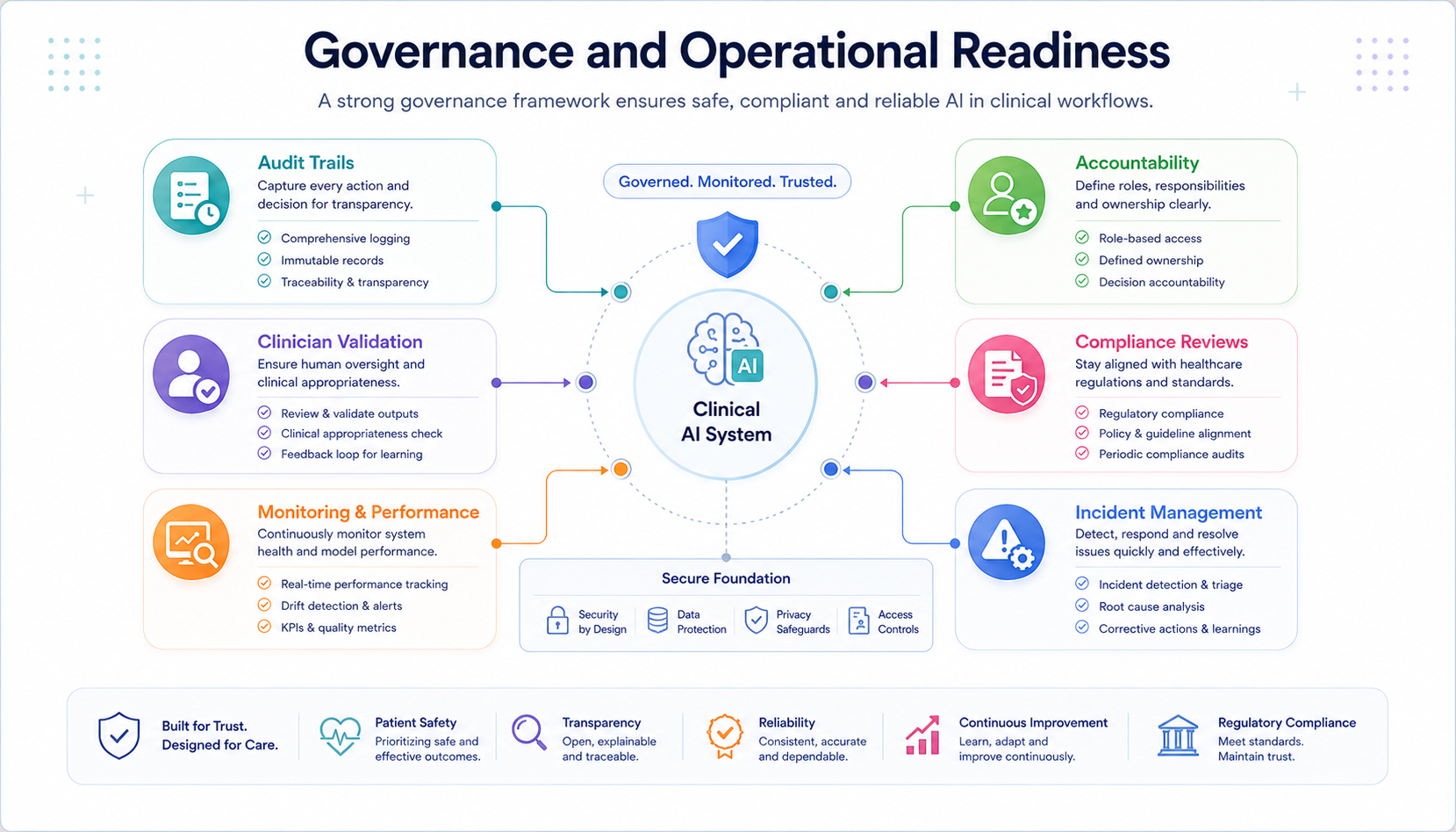
Continuous evaluation, run on a fixed schedule rather than once at launch, keeps the clinical knowledge assistant architecture accurate as guidelines shift and aligns with current FDA AI/ML medical device guidance where applicable. Clear accountability, written down and agreed by both sides, prevents finger pointing when something goes wrong.
Pilot to Scale: Prove It Before You Expand
Start Narrow, Validate Clinically
Start with one workflow or department and define success metrics before the pilot begins. Measure accuracy, escalation rate, clinician satisfaction, and workflow impact. Clinician validation can expose issues that a general accuracy score misses.
Scale Only After the Evidence Is There
Use clear stage gates before expanding. A strong agentic AI vs AI agents deployment should progress only when each stage meets predefined clinical, technical, and operational criteria.
|
Stage |
What to Validate |
Expansion Gate |
|
Pilot |
Accuracy, retrieval quality, workflow fit. |
Core metrics meet target. |
|
Clinical validation |
Clinician feedback, citation accuracy, escalation rate. |
Clinicians approve performance. |
|
Controlled production |
Reliability, security, monitoring, adoption. |
Stable production performance. |
|
Expansion |
Business impact, scalability, ongoing safety. |
Proven value at larger scale. |
Why Patoliya Infotech for Healthcare RAG Applications
Patoliya Infotech combines healthcare software expertise with practical AI engineering to build clinical knowledge assistants around real workflows.
The focus is on creating systems that are grounded, verifiable, secure, and production-ready.
- Architecture planning: Determine whether single-agent RAG or multi-agent orchestration fits the use case.
- Healthcare integration: Connect with existing EHR, EMR, and knowledge platforms while supporting current workflows.
- End-to-end engineering: Build retrieval, grounding, evaluation, and monitoring into one clinical knowledge assistant architecture.
- Controlled scaling: Move from pilot to production through defined validation and governance stages.
Patoliya Infotech helps healthcare teams turn RAG concepts into governed, scalable production systems. Talk to the team to evaluate your use case and architecture.
Conclusion
Healthcare RAG applications should be evaluated on more than how well they retrieve information. A reliable clinical knowledge assistant architecture combines accurate retrieval, verification, refusal logic, clinician validation, and continuous monitoring.
The agentic AI vs AI agents decision should depend on clinical risk, workflow complexity, and the number of sources involved. Before scaling, validate accuracy, integration, cost, and failure handling in a controlled environment. The right architecture turns RAG from a promising technology into a dependable clinical capability.
FAQs:
AI agents perform one scoped task, like retrieving and answering a single clinical question. Agentic AI coordinates multiple agents across retrieval, verification, and escalation, handling more complex questions at the cost of more places where errors can enter.
No. Simple lookup tasks with one clear source work fine on single-agent RAG. Orchestration earns its complexity only when a question genuinely spans multiple sources or requires cross-checking between conflicting evidence in agentic AI vs AI agents.
Ask for results tested on your own clinical documents, not a general benchmark. Request failure examples alongside success examples, and have a clinician review a sample of answers against source text directly.
A well designed system should have flagged it as low confidence and refused or escalated instead of answering. If it did answer, your contract should define exactly who reviews the incident and who owns the outcome.
Pilots typically run four to eight weeks. Full production readiness, including security review, clinician validation, and monitoring setup, usually takes several months beyond that depending on integration complexity when evaluating agentic AI vs AI agents.
Per seat pricing gives predictable budgeting for steady user bases. Per query pricing fits organizations with variable, spiky usage but carries more risk of cost creep during high demand periods.