AI MVP Development Cost: What Startups Should Know
 By Hitesh SUpdated on: 01/01/7010 min read
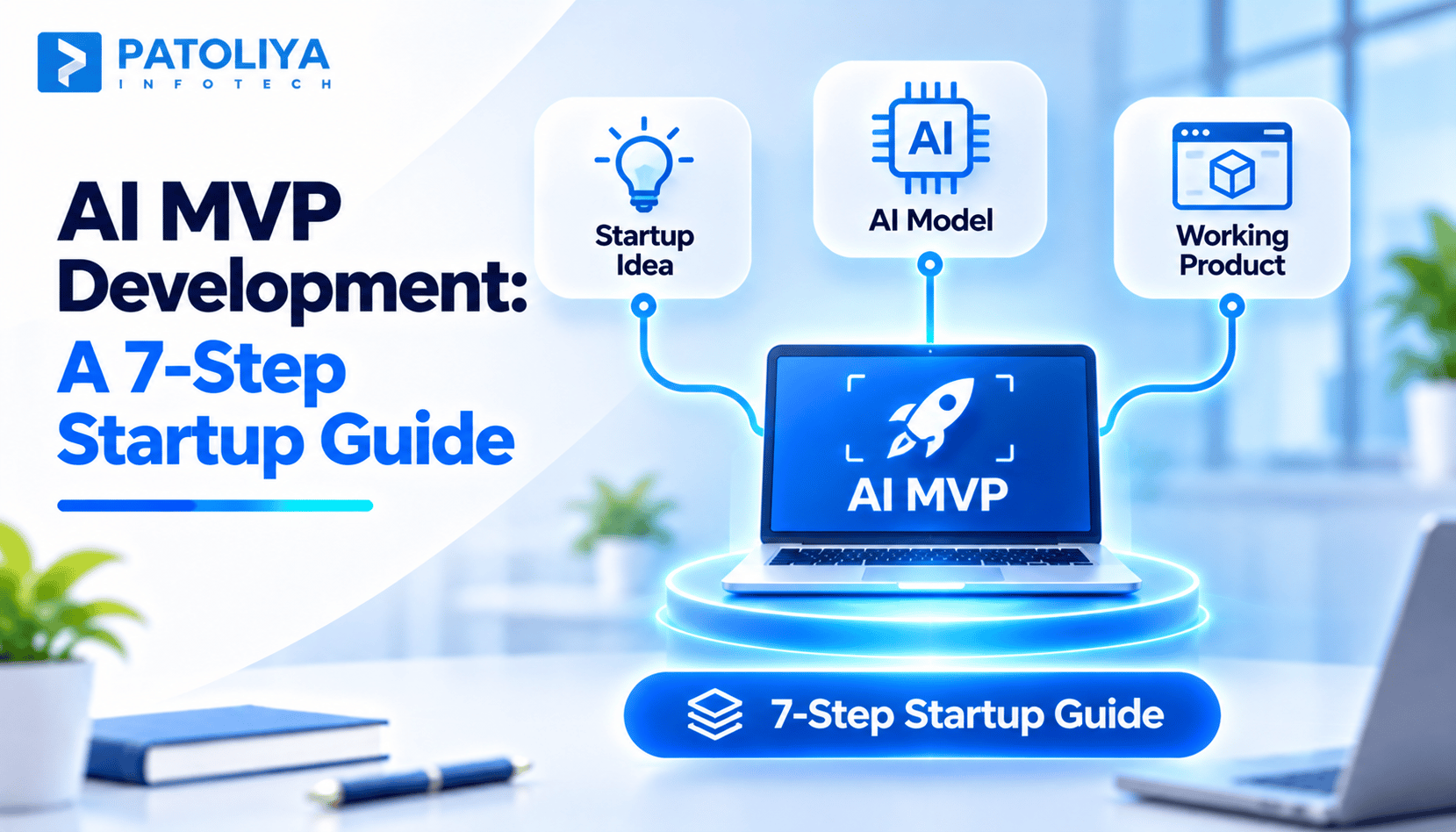
TLDR: Successful AI MVP development happens as an experiment, testing your AI solution on a single user need in terms of workflow, quality, number of users, and pricing with a pilot group and real metrics. A founder who scopes an AI MVP properly develops a viable pilot and makes decisions based on results.
There is a difference between a demo and reality. Many startup companies demonstrate a fancy solution and watch how people stop using it by the third week. Successful AI MVP development depends on three aspects: is there any desire among users to have the result, can you provide this result with AI, and will it be affordable enough.
It is the process of developing a minimum viable product that helps to check whether one AI workflow solves a user problem. A good AI MVP is always small because it means a lot of learning.
Consider 8 to 12 weeks to be a planning period for a proper scope of work. A bad dataset and integration make this time longer. This blog will help you learn about seven steps of AI MVP development.
Before You Build an AI MVP: Validate the Problem and Set the Scope
Define the User Problem and Riskiest Assumption: The process of AI MVP development must always begin with a known user, a regular pain point, and the one assumption that makes the entire venture go down if proven wrong. Divide your knowledge into two groups.
Demand is found through interviews and current workarounds that users are paying for. Feasibility deals with whether a model can generate something people can use.
Let’s take a shipping company where dispatchers type invoices manually for many hours. This is clearly the demand. Extracting data from blurry scans is the riskiest assumption.

One Core AI Workflow: When teams create AI MVP scope on one core AI workflow, they receive true feedback several weeks ahead of time. The process is outlined as follows: input, AI work, output, and the following step by the user.
When an AI system is created for legal tasks, the lawyer uploads the vendor contract, the AI extracts the relevant data (renewal dates, penalties), and the lawyer evaluates and exports the findings.
Success Criteria of MVP: Define success criteria before any coding begins. Evaluate task completion, output quality, weekly usage, response time, and cost per successful task.
Then agree on the validation rule: hit the targets and continue, miss one and adjust, miss most and stop. Our MVP development guide covers thresholds.
Decide What Not to Build: Scope control shapes AI MVP development budgets more than any rate negotiation. Founders who release around a full wishlist never learn which feature mattered.
Additional workflows, dashboards, complicated permissions, and custom model training will come later. Protect this boundary fiercely. Narrowing your scope ensures quick AI MVP development and a faster build AI MVP proof of concept.
How to Build an AI MVP in 7 Steps: From Use Case to Production
Step 1: Define the Use Case and User Journey
Write the use case as one sentence with a trigger, an AI result, and the human decision that follows. For support: when a refund ticket arrives, the AI drafts a reply that follows policy, and the agent edits and sends it. Teams planning AI chatbot development can reuse that exact format.
Then, apply pressure to the solution. If 80% of tasks are covered by a rules engine or a template, using AI will bring costs but no added value. AI MVP development is worth its budget when there are too many variables for fixed logic and when there is a distinct decision that allows for a narrow focus.
Step 2: Validate Data and Feasibility of AI
Dirty data kills more AI projects than bad modeling. Collect 50 to 100 examples and look at them realistically. Are the records full and up to date? Are there agreements and privacy regulations allowing model processing? Does the sample contain the nasty edge cases sent by your users daily?
Feed this data into a pretrained model, an API, or RAG, and note down all failures. Founders build AI MVP strategies based on ten pristine examples have their plans ruined by the 500th messy example. This one-week testing period is worth more for AI MVP development than months of further optimizations.
Step 3: Choose an API-First Architecture
An API-first approach validates the hypothesis using reliable model APIs before committing to expensive custom training. In most cases, the tech stack remains quite straightforward.
You require a single web application organized around a single journey, a single backend service, a managed database with a vector store for RAG, a managed authentication system with some roles, and an abstraction layer over the model provider.
This layer is particularly important. Model prices and performance are constantly changing, and an abstraction layer allows for switching providers in a few days. Use only proven tools everywhere else. Custom infrastructure will only slow down AI MVP development and bring no user value.
Step 4: Develop the Core AI Workflow
Release the entire workflow, from input through to the output, before polishing it. Include structured outputs with field names, error handling, a retry mechanism, and a manual review screen for low-confidence outputs. An incomplete but working workflow will be more valuable than a nice interface that just leads to an end. Good AI MVP development starts with releasing the task.
Most AI MVP development delays come from teams designing screens users never reach. Teams that build AI MVP versions this way see real usage patterns by week eight. Our MVP development process breakdown shows how to sequence these sprints.
Step 5: Evaluate AI Quality and Add Guardrails
Develop an evaluation dataset comprising 100 to 200 actual inputs with anticipated outputs and re-run them every time you change the prompt or the model. Ensure that the test set consists of usual queries, weird edge cases, safe failure cases, and repeated inputs that show inconsistent answers. Founders who build AI MVP quality checks do this very early on.
Guardrails for the AI MVP include output checks, access controls, sensitive data masking, and a safe handoff to a human. The Wikipedia guide to prompt injection explains how malicious inputs can manipulate AI model behavior, making this a risk worth testing before any pilot. Skip this stage, and AI MVP development turns into a public trust risk.
Step 6: Run a Pilot With Real Users
Place your product in the hands of 10 to 30 end-users performing tasks. Look out for task completion rates, drop rates, and manual corrections. Request feedback from your users about their perception of the product's usefulness, accuracy, friction, and trustworthiness.

A steady AI product management rhythm turns this data into weekly decisions for the AI MVP development team. In every AI MVP development review, pilot data should outweigh opinions.
Step 7: Roll Out, Monitor, and Decide What Comes Next
Deploy with logging, usage tracking, cost alerts, and a tested rollback plan. Compare pilot results against your success criteria, and let user feedback outrank the original wishlist. The UK Government’s guidance on evaluating AI interventions explains how to assess whether an AI system delivers its intended outcomes.
|
Focus |
Exit check |
|
Feasibility, scope, data checks |
Sample tests pass |
|
Architecture, UX, first AI evaluation |
Quality baseline set |
|
Core workflow, integrations, testing |
Full flow works |
|
Pilot, refinement, deployment, monitoring |
Decision made against criteria |
There is an overlap between phases in reality. Data inconsistency and existing integrations will extend your AI MVP development beyond twelve weeks; thus, consider having some buffer from the start. Teams that build AI MVP timeline with a two-week buffer never miss their pilots. Use the last week to determine your next steps.
AI MVP Development Cost: What Drives the Budget?
The costs associated with your AI MVP development go up with the help of four components, and workflow complexity tends to be the major one. With each additional user journey, branch, and role comes the need for more design, testing, and evaluation activities. Data follows due to the need for its cleaning and integration with third-party systems being costly.
Answer four questions before asking for quotes. How many user journeys does your pilot require? How good is your data quality? How many tasks can each user perform daily? What regulations do you have to follow? This information will help you get comparable AI MVP development quotes.
How to Keep AI MVP Costs Under Control
Smart scope control cuts the AI MVP development cost faster than any vendor discount. Start with one workflow and existing model APIs. Set usage caps and review cost per successful task weekly. Push custom training and nonessential integrations to a later release. Our breakdown of AI agent development cost shows how usage patterns reshape monthly bills after it ends.
Defend evaluation and security efforts. Reducing them reduces the quote and inflates the real AI MVP development cost down the road. Founders who include an AI MVP budget based on usage limits prevent unpleasant surprises in the second month.
Estimate Cost From Scope and Avoid Broad Price Ranges
For an accurate cost estimate, you will need five factors: target workflow, data readiness, integration, expected usage, and release requirements.

Allocate the cost into build cost to create design, development, evaluation, and release, and run cost for model calls, hosting, monitoring, and maintenance. Broad price ranges do not consider your data and workflow, thus distorting every AI MVP development cost estimate.
Do the math on cost per unit early on. If each task costs $0.60 and customers pay $0.50 for it, the business model won’t work at any scale.
Our software cost estimation guide explains how to scope each line. Review the development cost per task again after the pilot, because real usage always differs from estimates. That habit keeps AI MVP development tied to a business model investors trust.
Validate Your AI MVP With Patoliya Infotech
Patoliya Infotech helps founders validate business hypotheses through focused AI MVP development. Our AI product engineering services align scope, user needs, and success metrics before development begins. We prioritize real-world validation, measurable AI quality, and pilot feedback over investor demos. Our artificial intelligence consulting services help plan integrations, scalable architecture, and future releases while keeping AI MVP development cost aligned with business goals.
Conclusion
AI MVP development starts with one business problem, one complete AI workflow, and measurable success criteria. A focused minimum viable product helps founders test real data, validate AI quality, and gather pilot feedback before expanding features.
Define adoption, quality, and cost thresholds before development. Track cost per successful task and retain only essential features and integrations. These metrics help founders decide whether to refine, scale, or stop. Let’s scope your AI MVP development plan around measurable business outcomes and validate its potential before committing further budget.
FAQs:
MVP development using AI necessitates secure data storage and management, and control over sensitive data handling. Ensure privacy policies from the start and ensure that the model vendors satisfy your data safety requirements.
Task completion, user retention, errors, response time, and cost per success are some of the metrics an MVP based on AI should be tracking to show that it creates value.
If founders experience poor adoption, low task completion rate, and high operating costs during AI MVP development through testing, it is time for a pivot.
The ideal AI MVP should consider aspects such as output validation, error management, confidence thresholds, and human verification for uncertain output to identify patterns of failure.
In readiness for production, there is need to monitor, control access, automate tests, and have deployment processes and incident handling in place.