Prior Authorization Software: Cutting the Wait Without Cutting Corners
TLDR: Prior authorization software speeds up submission, not necessarily approval. A payer decision on submissions still depends on documentation quality and current payer rules, so automated prior auth submission software only cuts the real wait when it handles the entire lifecycle, well beyond the upload step.
Faster submission does not mean faster approval. Prior authorization software can push a request out in seconds while the payer still takes days to respond, because submission speed and turnaround time are separate problems that most buyers of software never separate.
What Prior Authorization Software Does
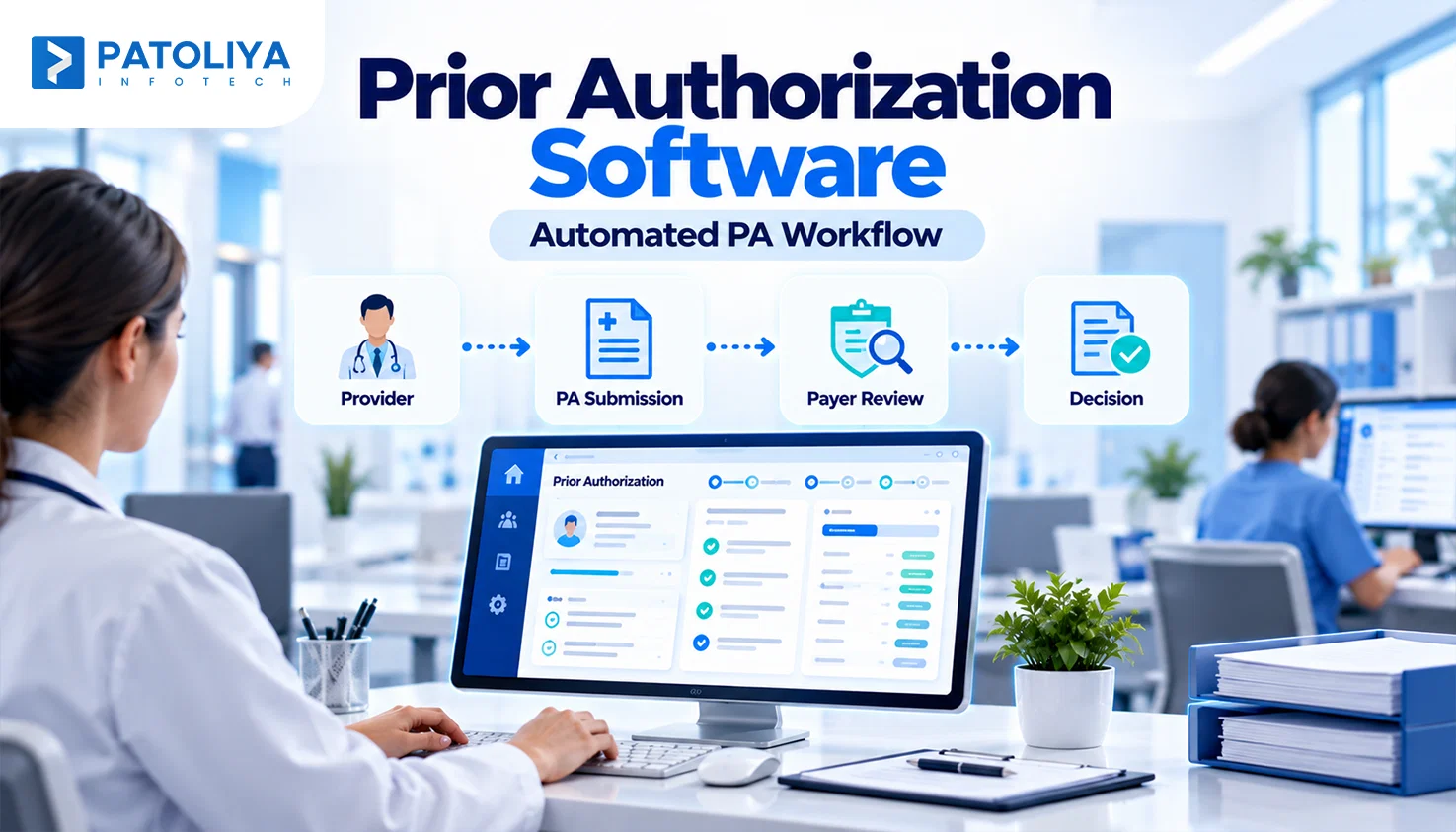
- Prior authorization software checks requirements, builds the documentation packet, submits the request, and tracks the response back into the ordering workflow, closing the loop through healthcare workflow automation without a manual status check.
- Clinical judgment, appeals, and unusual payer exceptions still need a trained person, not a machine guessing at medical necessity on a rare or complex case.
- Electronic prior authorization (ePA) only moves the request between systems faster; it says nothing about whether the request was ready, complete, or correct before it left the building.
- Automated prior auth submission software handles the filing step specifically, which is one piece of a larger four part automation stack that most buyers assume is a single feature.
- Vendors selling prior authorization software often blur these pieces together in marketing copy, and separating them early is exactly what protects a buyer of prior authorization software during evaluation.
What Prior Authorization Software Needs to Handle End to End
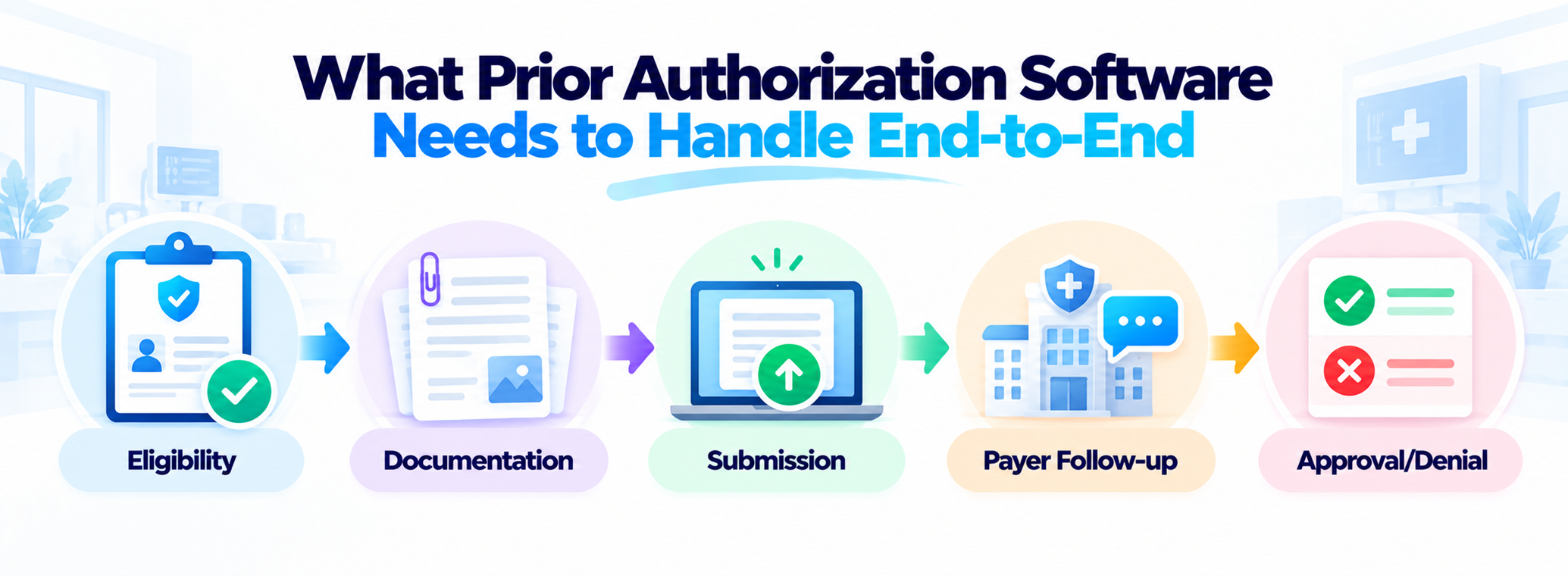
Determine whether PA is required:
A capable platform checks payer, plan, and procedure level requirements before an order is even placed.
Prior authorization software that skips this step lets staff discover the requirement only after scheduling, which is exactly the delay this prior authorization software exists to remove, and it is the single most common gap buyers overlook during a demo.
Prepare the authorization packet:
The system should pull data straight from electronic health records applications, flag missing fields, and format the packet the way each payer expects.
Automated prior auth submission software earns its cost right here, since manual data entry is where most rework begins and where staff loses the most time on a case by case basis.
Submit through the right payer channel:
Payers accept API, FHIR, clearinghouse, portal, and occasionally fax submissions, making an API-first healthcare approach valuable when the platform needs to support multiple payer channels. Automated prior auth submission software limited to a single channel is a partial fix, not full automation.
Track and follow up:
Prior authorization software should monitor pending, approved, denied, and additional information states automatically, triggering follow up without a staff member logging into a separate portal every morning to check on a case that might still be sitting untouched.
Return the outcome to the workflow:
The final decision needs to land back inside the ordering system directly, closing the loop through healthcare data integration so scheduling and billing teams see it the moment it happens, not a day later through a manual check.
Where Prior Authorization Delays Actually Come From
Changing payer rules
- Payer policies change frequently across specialties and procedures.
- Outdated rules can cause prior authorization software to submit incorrect requirements or outdated payer information.
- These errors often appear as staff mistakes when the underlying problem is stale automation.
- Manual weekly audits of payer policies can quickly eliminate the efficiency gains expected from automation.
Incomplete documentation
- Missing clinical notes, supporting documents, or incorrect payer fields can trigger rework.
- Errors discovered after submission can lead to resubmissions and additional delays.
- Automated prior auth submission software should validate required information before a request is submitted.
- Pre-submission checks help prevent avoidable rework and protect the time savings automation is expected to deliver.
Submission is not completion
- A request being marked “submitted” does not mean the authorization process is finished.
- Requests may remain in payer queues for days before a decision is made.
- Measuring only submission speed can hide the actual delay experienced by patients and providers.
- Prior authorization software should track the full turnaround time from request initiation through payer decision.
Exceptions and manual queues
- Automation will still generate exceptions that require human intervention.
- Without proper context and prioritization, exceptions can turn into stagnant manual queues.
- Staff may end up spending time chasing statuses instead of resolving cases that genuinely require clinical or operational judgment.
- Exception routing should provide the right context, priority, and next action to support effective prior auth denial prevention.
The Payer Rules Engine Is the Core of Reliable PA Automation
|
Rules Approach |
What Actually Happens |
|
Static checklist |
Updated occasionally, drifts out of date fast. |
|
Continuous rules feed |
Synced against live payer policy. |
|
Passive database |
Shows a requirement; staff still act manually. |
|
Operational engine |
Triggers the next workflow step automatically. |
Evaluate the full authorization context
- A capable payer prior auth rules engine should evaluate payer, plan, procedure, diagnosis, specialty, and site of care together.
- These factors can change the authorization requirement when considered in combination.
- Connecting them within one decision reduces fragmented checks across staff, spreadsheets, and systems.
- This connected decision-making is what differentiates meaningful prior authorization software from a digitized checklist.
Keep rules continuously updated
- A stored checklist is not true automation if staff still have to verify whether the requirements are current.
- Payer policies can change frequently, particularly in high-volume specialties.
- A quarterly update cycle can leave automated prior auth submission software working from outdated requirements for weeks.
- Rules should be continuously monitored and updated so the system uses the current payer requirements at the point of submission.
Turn rules into workflow actions
- A rules database that only tells staff what to do still leaves the work to humans.
- An operational prior authorization software engine should use the rule outcome to trigger the next workflow step automatically, creating opportunities for agentic AI in healthcare to handle predictable non-clinical actions.
- That could mean requesting missing documentation, routing an exception, selecting the appropriate submission path, or flagging a case for review.
- The key question for buyers is not simply “Does the platform have payer rules?” but “What does the platform do when a rule is triggered?
Measuring PA Turnaround Time Beyond Submitted to Approved
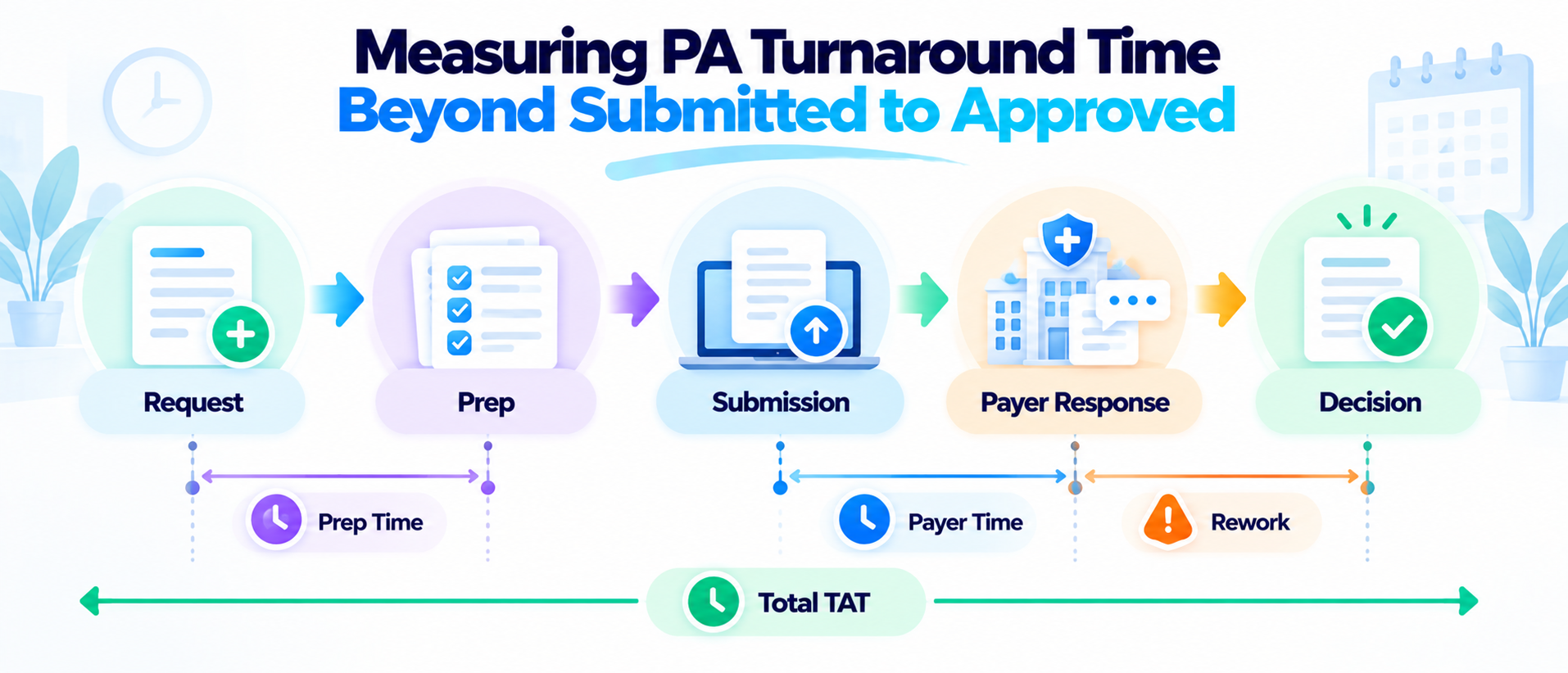
Metrics that matter: Track requirement identified, packet ready, submitted, additional information requested, payer response, and final determination as six separate stages, since a single average number hides exactly where prior authorization software is losing time for your specific payer mix.
For certain impacted payers, CMS requires prior authorization decisions within 72 hours for expedited requests and seven calendar days for standard requests, making stage-level measurement more meaningful than a single submission-to-approval figure.
Finding the actual delay: Break every result down by payer, specialty, and authorization type, because one or two payers usually create most of the drag, and a blended number hides that completely from leadership.
This is where genuine PA turnaround time reduction gets identified with real numbers, not a guess dressed up as an average, and it is exactly the report a serious prior authorization software evaluation should produce within the first ninety days.
Why leadership should care
Delayed approvals cancel appointments, block treatment starts, and drive denials nobody appeals, and a finance leader cares less about days saved than the revenue those days actually represent across the full patient volume.
Automated prior auth submission software that cannot connect its own turnaround numbers to revenue is presenting an incomplete case.
Tie every turnaround number to a dollar figure before presenting it in a board meeting, because a raw day count rarely moves budget decisions, and a strong prior authorization software business case always speaks in revenue first.
How to Evaluate Prior Authorization Automation Before Buying
Automation depth
Ask whether the platform only displays instructions to staff, completes predictable steps on its own, or handles qualifying requests without any staff touch at all.
Prior authorization software vendors rarely volunteer which tier they actually sit in, so push for a real answer backed by a client reference, not a slide deck claim.
Most platforms sold as touchless are actually workflow automation wearing a stronger label.
Payer coverage
Coverage across a generic payer list means nothing; what matters is coverage across your actual payer mix, which should be assessed as part of broader healthcare IT consulting and workflow planning.
Automated prior auth submission software that skips your top five payers by volume delivers close to zero real value regardless of its feature list, so ask for coverage numbers specific to your own contracts before signing anything.
A platform can look impressive on a national coverage map and still be useless for your specific book of business.
EHR and workflow fit
The platform needs native, in-workflow data exchange with appropriate healthcare software security, not a separate login staff have to remember to check every single day of the week.
Prior authorization software that lives outside the ordering system gets ignored within a month, no matter how capable it is on paper, because staff default back to whatever screen they already have open.
Exception handling
Look for human escalation with full context attached, not a dead end queue where a flagged case quietly disappears.
Prior authorization software without genuine exception routing simply moves the manual work somewhere less visible, and that hidden work still costs the same staff hours it always did; it just stops showing up on the dashboard leadership actually looks at.
This gap is where most prior authorization software deployments quietly fail within the first year.
When Prior Authorization Software Will Actually Deliver ROI
High volume, repetitive payer requirements and frequent staff follow-up point to a fast return on prior authorization software, especially in imaging, infusion, and high-volume specialty practices where the same payer rules apply across hundreds of cases a week.
These practices see payback inside the first year in most cases where volume is genuinely high, and automated prior auth submission software pays for its license within a handful of months.
Very low request volume, irregular workflows, and heavy clinical judgment requirements shrink the return automated prior auth submission software can realistically deliver, no matter how strong the platform looks in a demo built around a best-case scenario.
A small practice with a handful of weekly requests should question the entire business case before signing a multi-year contract.
Multiply volume by manual touches by staff time per touch by loaded labor cost, then compare that number against total platform and implementation cost before calling it ROI.
A vendor quoting savings without this math is quoting a guess, not a business case leadership should approve, and no prior authorization software deserves a signature without that math attached.
Prior Authorization Software Comparison: What Buyers Should Compare
Evaluating prior authorization software side by side against one consistent list beats scattered vendor claims every time.
|
Evaluation Area |
What to Look For |
|
Rules engine |
Current, continuously synced payer logic. |
|
Payer coverage |
Matches your actual payer mix. |
|
Submission channels |
API, FHIR, clearinghouse, portal, fax. |
|
Documentation |
EHR retrieval plus missing field detection. |
|
Automation depth |
Assisted, workflow, or touchless. |
|
Exception management |
Human escalation with full context. |
|
EHR integration |
Native, in-workflow data exchange. |
|
Analytics |
Full lifecycle, payer-level visibility. |
|
Governance |
Audit trail and rule change history. |
Rank prior authorization software by how much manual work remains after implementation, not by the length of the feature list on the sales deck.
A prior authorization software platform with nine strong rows and one weak exception handling row can still leave your staff doing the same manual chase they did before signing the contract.
What a High-Value Prior Authorization Automation Strategy Looks Like
Automate the predictable work, requirement checks, documentation prep, routing, and status monitoring across reliable cloud infrastructure, and let the machine carry that entire load. Escalate judgment-based work, clinical review, unusual payer requests, and appeals to trained staff who get full context and a real case history, not a blank case number.
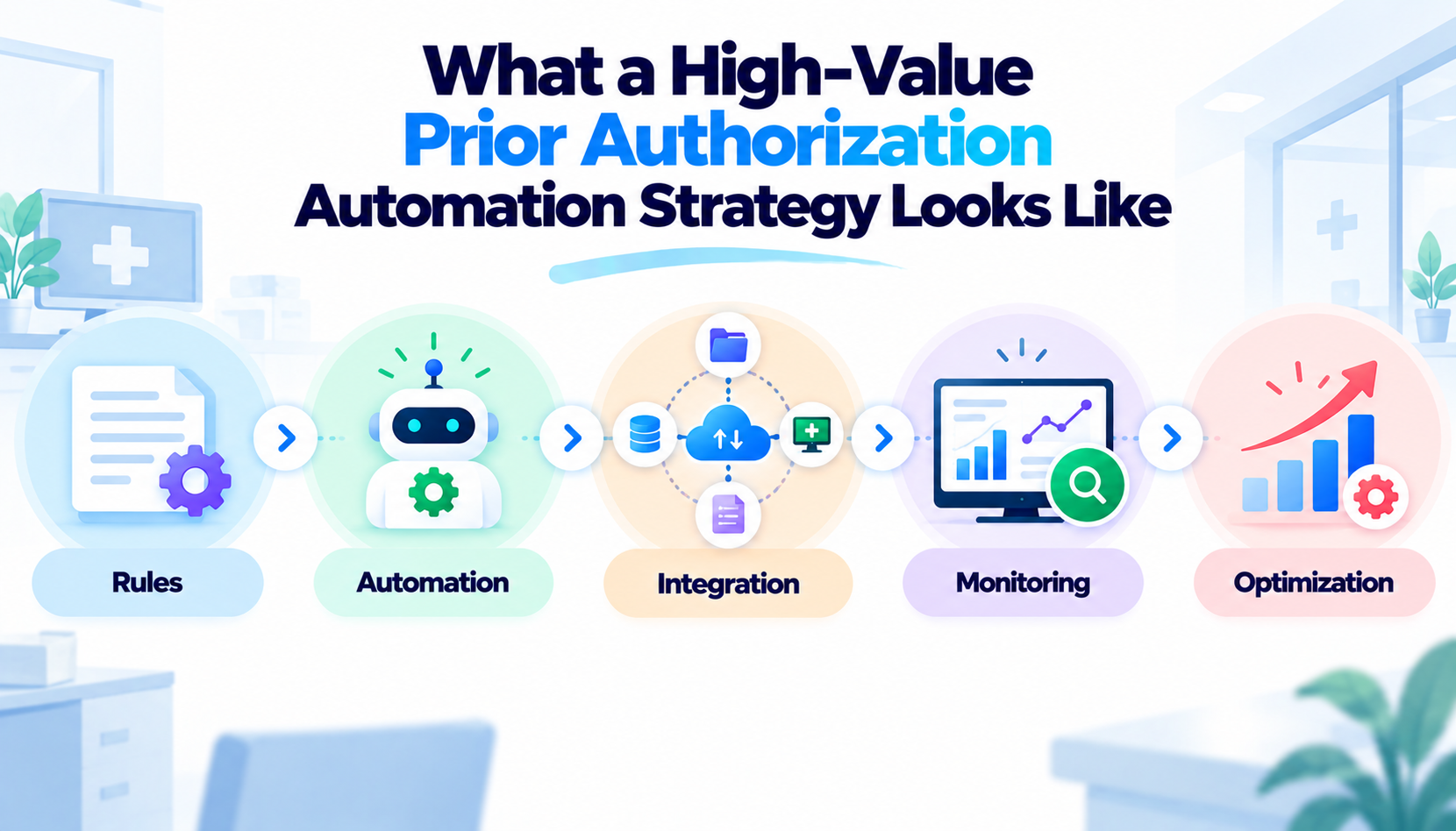
Measure the entire lifecycle, well beyond submission speed alone, because that is the only way prior authorization software proves its value with real numbers and not a vendor promise.
The strongest automated prior auth submission software strategy treats manual intervention as something proportional to complexity, and never as something to eliminate. This is the single distinction that separates mature automated prior auth submission software programs from ones still chasing a headline automation percentage.
Prior authorization software earns its budget when it removes real waiting, well beyond paperwork alone. The goal of any prior authorization software purchase was never one hundred percent automation; it was eliminating the unnecessary rework, follow-up, and manual intervention sitting inside the authorization lifecycle.
A platform proves that goal with turnaround data, and a feature list backs up nothing on its own, so that proof is what should decide the purchase.
How Patoliya Infotech Can Support Prior Authorization Automation
Patoliya Infotech’s healthcare engineering experience and custom software development services can be applied to PA workflows where teams manage large volumes of repetitive authorization requests across disconnected systems.
For instance, a typical implementation could connect an EHR with payer APIs/FHIR endpoints, automatically pull clinical and patient data, validate required fields against payer-specific rules, and route incomplete cases before submission.
In an illustrative 500-request monthly workflow, reducing just 4 manual touches per request could eliminate 2,000 repetitive staff interactions each month. Adding automated status tracking and exception routing can further reduce portal checking and give teams a clearer view of pending cases.
Conclusion
Prior authorization software should be evaluated by how much unnecessary work and waiting it removes, not by how quickly it can submit a request. The strongest approach connects payer rules, documentation, submission, status tracking, exception handling, and final decisions into one measurable workflow.
Buyers should therefore look beyond feature counts and test automation depth against their actual payer mix, EHR environment, request volume, and staffing model. The goal is not to eliminate every human touch.
It is to reserve human effort for cases that genuinely require judgment while letting automation handle predictable work consistently. That is where PA turnaround time reduction becomes measurable operational value rather than a vendor promise.
FAQs:
No. Prior authorization software only speeds approvals when it detects requirements early, prepares complete documentation, and applies current payer rules. A platform that only digitizes submission still leaves the waiting stage untouched.
ePA moves a request between systems electronically and nothing more. A full automation platform also checks requirements, prepares documentation, routes exceptions, and tracks the outcome back into the clinical workflow.
Look at volume, repetition, and manual touches. High volume, repetitive payer requirements, and frequent staff follow-up point to strong returns, while automated prior auth submission software rarely pays off at very low volume.
A reliable engine stays current with payer policy changes and triggers the next workflow step automatically, without waiting on a manual quarterly review.
No, and that is the point. The strongest platforms automate predictable cases and route genuine exceptions to trained staff with complete context, without forcing every case through the same automated path.
Calculate volume multiplied by manual touches multiplied by staff time multiplied by labor cost, then compare that figure against total platform and implementation cost. This keeps the decision financial and specific to your own case mix.