Population Health Management Software for Care Teams
TL;DR: A population health management software platform only earns its budget when it turns raw population data into a prioritized action list before a patient reaches the emergency room. Most platforms flag risk. Very few connect that flag to a workflow that actually changes the outcome.
A hospital can own the most complete patient dataset in its region and still miss the one call that prevents an admission. That is the real failure point in healthcare technology today. Organizations buy population health management software expecting foresight, but most implementations deliver longer risk lists, not earlier intervention.
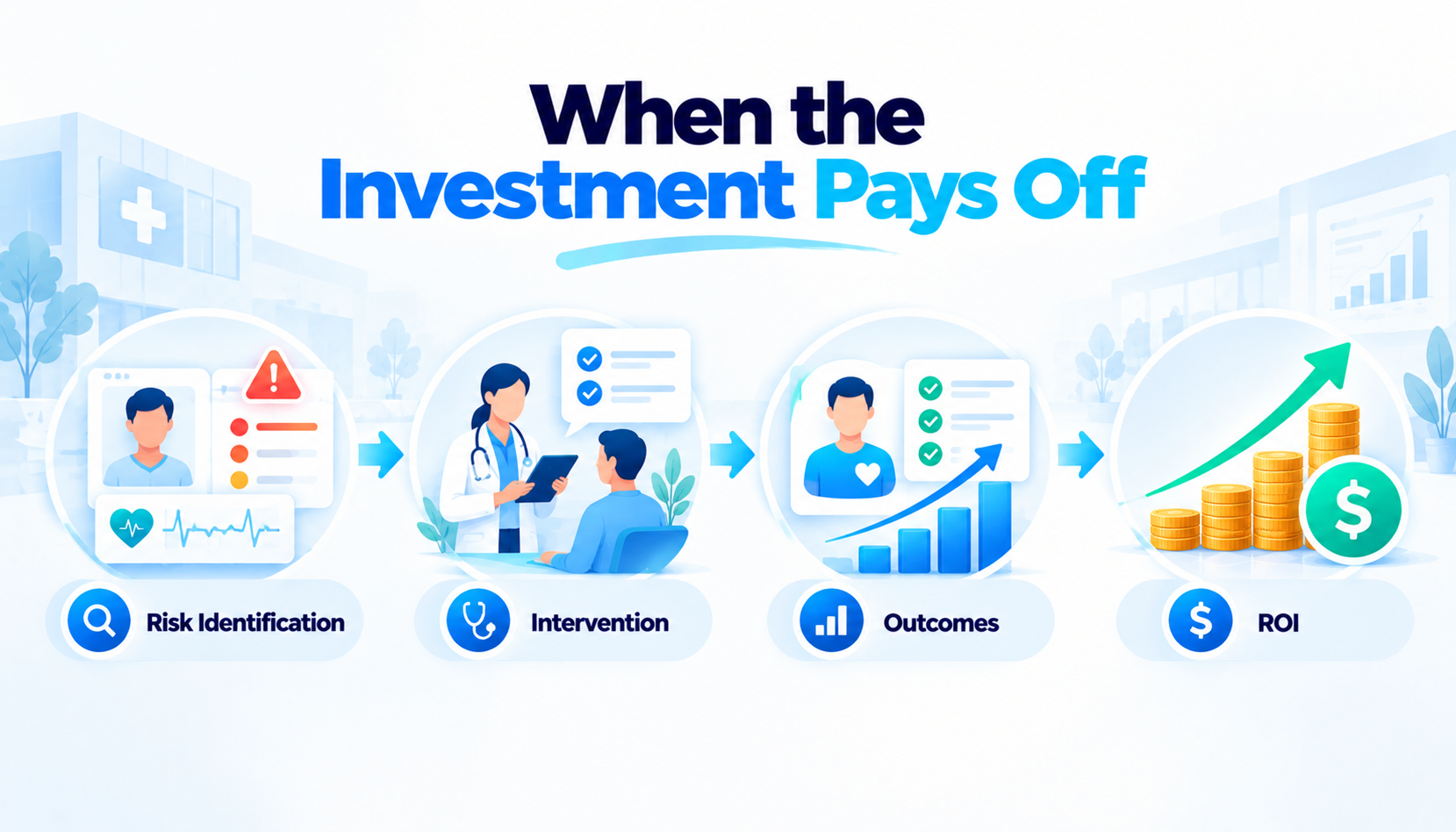
Risk lists do not change outcomes. Action does. The chain that matters looks like this: Data leads to Risk. Risk leads to Priority. Priority leads to Intervention. Intervention leads to Outcome. Break any link in that chain and the platform becomes an expensive reporting tool.
This guide is written for leaders evaluating population health management software on its ability to support at risk patient identification with enough precision and speed to act before a hospitalization happens, not after.
What "At Risk" Actually Means
Every population carries three distinct risk groups, and treating them as one bucket is the single most common mistake in population health management software deployments.
|
Patient Group |
Definition |
Typical Error Vendors Make |
|
High cost, high need |
Already consuming significant resources. |
Easy to flag, hard to influence. |
|
Rising risk |
Trajectory worsening but not yet costly. |
Frequently missed by static models. |
|
Impactable |
Likely to respond to intervention. |
Rarely scored separately at all. |
Why the Highest Risk Patient Is Not Always the Highest Priority Patient
A terminal cancer patient may carry the highest numerical risk score in a panel, yet no care management program changes that outcome.
A diabetic patient with rising A1C and two missed refills carries a lower score but a much higher return on outreach.
Effective at-risk patient identification separates the probability of a bad event from the probability that action changes it. That distinction is where most platforms stop thinking and where care teams should start.
How Risk Stratification Models Identify Patients at Risk
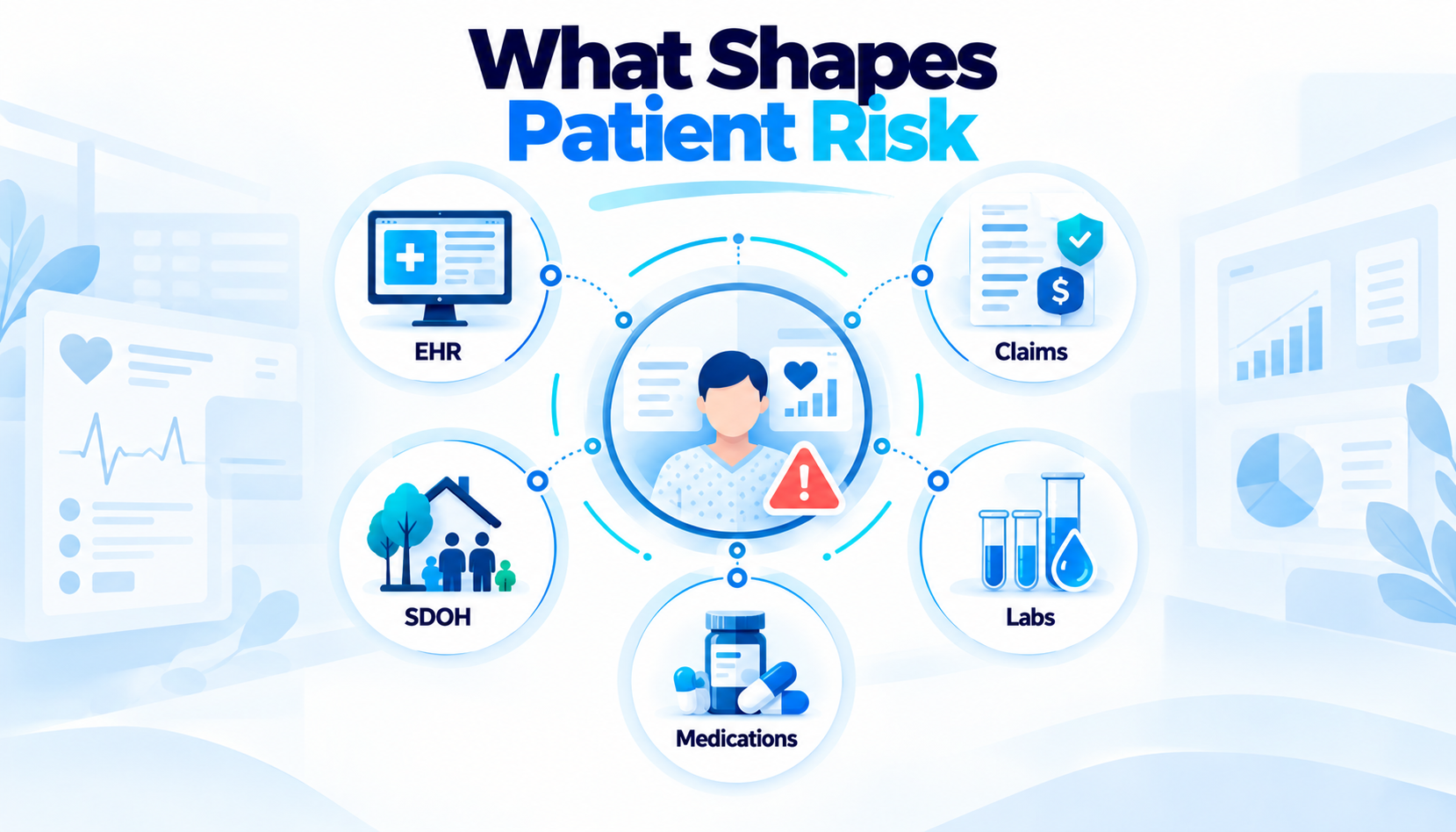
Risk stratification models pull from claims, EHR clinical records, pharmacy fills, lab trends, admission, discharge, transfer feeds, and patient reported data, creating the foundation for predictive analytics in healthcare.
No single source tells the full story. A platform relying only on claims data delivers population health management software that is accurate about the past and blind to the present.
Rules-Based Registries Versus Predictive Risk Models
Early population tools used static rules. A diabetes diagnosis code triggered a flag regardless of control status.
Statistical models added weighting. Predictive models now score continuously as new data arrives, expanding the range of machine learning use cases in healthcare.
The operational shift matters more than the technical one. Continuous scoring means a care team sees deterioration the week it starts, not the quarter it gets reported.
A Risk Score Needs Context to Be Useful
A number alone tells a nurse nothing actionable. Useful output from population health management software includes the risk level, the direction the risk is moving, the specific drivers behind the score, open care gaps, and a recommended next step.
Anything less forces the care team to build context manually, which defeats the purpose of the platform.
Where Population Risk Models Quietly Fail
Low healthcare utilization does not always mean low risk. Population health models can miss patients whose needs remain invisible in claims data.
Cost-Based Models Can Underflag Underutilizers
- Models built around historical spending can assume low utilization means low risk.
- This fails for patients who avoid care because of cost, transportation, access barriers, or distrust.
- Their unmet clinical needs may never appear in claims data because they rarely seek care.
- As a result, at-risk patient identification based mainly on cost can miss patients who need proactive intervention.
- Better models combine utilization with clinical signals, care gaps, and SDOH data to strengthen healthcare data analytics.
Utilization Alone Does Not Explain Emerging Risk
- Patient risk can change rapidly before a major utilization event.
- Worsening labs, medication changes, missed follow-ups, and new social barriers can signal deterioration weeks before an ER visit.
- Historical utilization alone may miss these changes until the patient has already reached acute care.
- Population health management software should combine utilization with current clinical and behavioral signals to identify rising risk earlier.
Chronic Disease Status Does Not Equal Near Term Risk
- Having diabetes, CHF, COPD, or another chronic condition does not automatically indicate near-term risk.
- Population health management software that flags every chronic condition equally can create panels too large for care teams to prioritize.
- The focus should be on whether the patient's condition is changing, not simply whether it exists.
- Clinical deterioration, medication changes, missed care, and recent utilization can help distinguish immediate risk from stable chronic disease.
Static Risk Scores Become Stale Fast
- A risk score calculated weeks or months ago may no longer reflect the patient's current condition.
- Its usefulness depends on data freshness, recalculation frequency, and model monitoring.
- New diagnoses, medications, encounters, or SDOH barriers can quickly change risk.
- Effective risk stratification models should continuously reflect patient trajectory rather than rely on historical snapshots.
- A platform that updates too slowly may report risk instead of enabling early at-risk patient identification.
SDOH Integration From Checkbox to Actionable Signal
Clinical charts and claims describe what happened inside the healthcare system. They say nothing about whether a patient has a ride to their appointment or food security between visits. Population health management software without social context is scoring half a patient.
Which SDOH Data Actually Improves Prioritization
Not every social field adds value. Screening responses, payer-supplied social risk indicators, community referral outcomes, and patient-reported barriers need consistent SDOH data standards to become useful signals.
A zip code level poverty statistic sitting unused in a database does not. SDOH data integration only matters when it changes what the care team does next.
Connect the Social Barrier to the Intervention
The chain looks simple in practice. A transportation barrier causes a missed appointment. The missed appointment becomes a care gap.
The care gap triggers outreach or a referral to a community resource. The referral gets tracked to resolution. Skip any step and the social data becomes a field nobody reads.
Add Impactability Scoring on Top of Risk
At risk patient identification improves sharply once a platform scores whether a patient is reachable, whether their barriers are addressable, and whether available resources match their need.
A high-risk patient who cannot be reached is not a priority. A moderate risk patient who will respond to one phone call often is.
From Risk Score to Care Team Action
Identifying ten thousand high-risk patients accomplishes nothing if care managers can only work three hundred cases a month.
This is the gap where most population health management software investments quietly fail. Volume without capacity planning creates a backlog, not a program.
An effective worklist gives a care manager everything needed to act in one screen:
- Current risk level and recent change.
- Specific drivers behind the score.
- Open care gaps tied to the patient.
- Recent utilization events.
- Active social barriers.
- Recommended intervention.
- Assigned owner and outreach status.
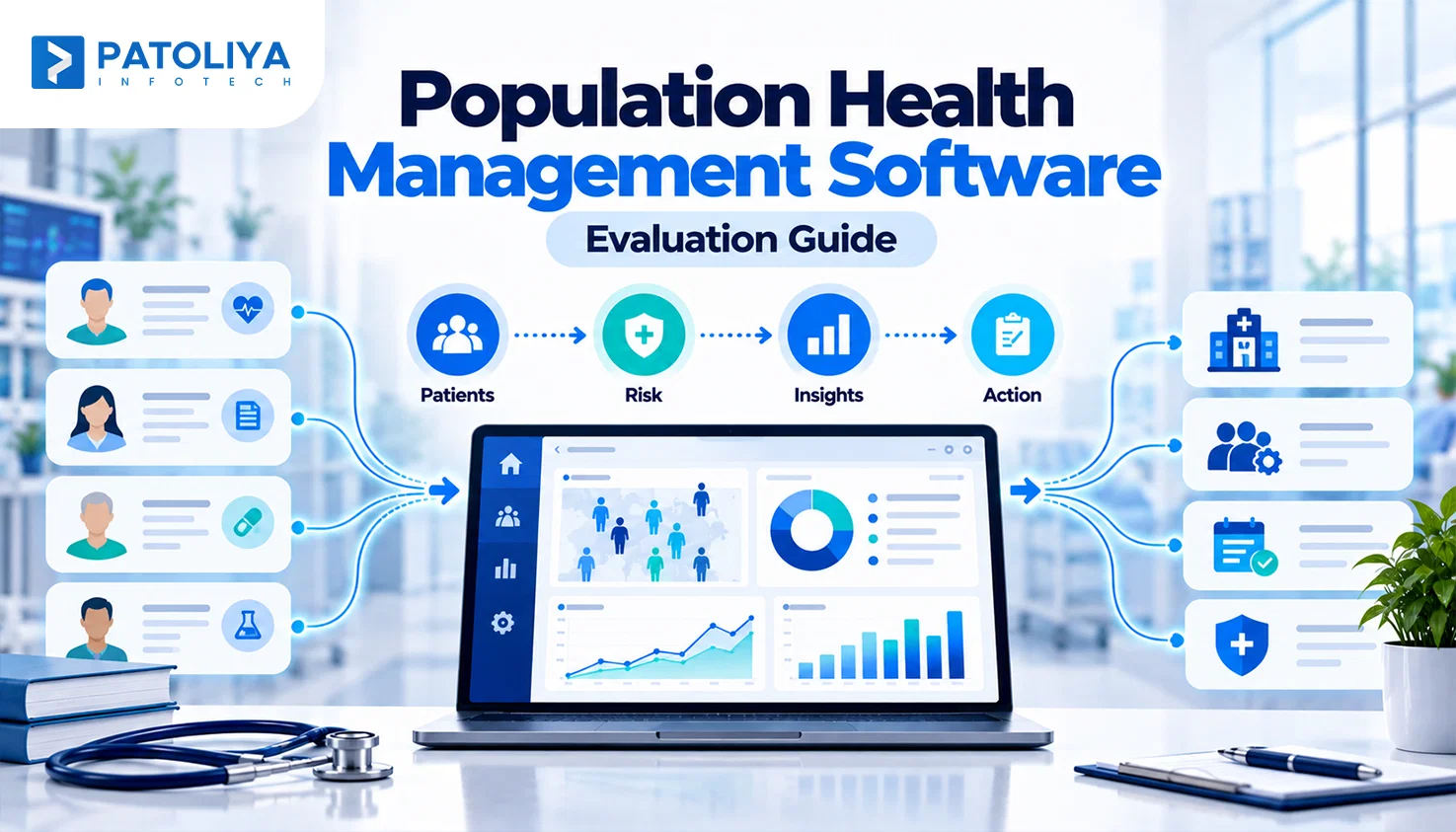
The full sequence runs from identify to prioritize to assign to outreach to intervene to track to measure, creating the operational foundation for healthcare workflow automation.
A platform that stops at identify is a reporting tool wearing a care management label. At-risk patient identification only earns its value once the loop closes and the outcome gets recorded against the original flag.
Alert Fatigue Undermines Adoption Faster Than Anything Else
Over flagging produces the opposite of the intended result. Care managers facing hundreds of low value alerts start ignoring the platform entirely, including the alerts that matter.
The goal of population health management software is not more flags. It is fewer, better prioritized ones that a human being can actually act on within a workday.
The Data Foundation Behind Reliable Population Health Analytics
One Patient Can Have Multiple Versions of the Truth
A single patient can exist as different records across the EHR, claims system, pharmacy, lab vendor, and regional health information exchange, making healthcare data integration essential for creating a complete patient view.
Poor identity resolution can create incomplete patient histories, causing the same person to appear as multiple profiles.
Population health management software built on fragmented records may produce contradictory risk scores for the same patient, which is why architectures such as healthcare data fabric can help connect data across systems.
Data Freshness Often Matters More Than Model Sophistication
A simple model using daily data can outperform a sophisticated model relying on quarterly updates.
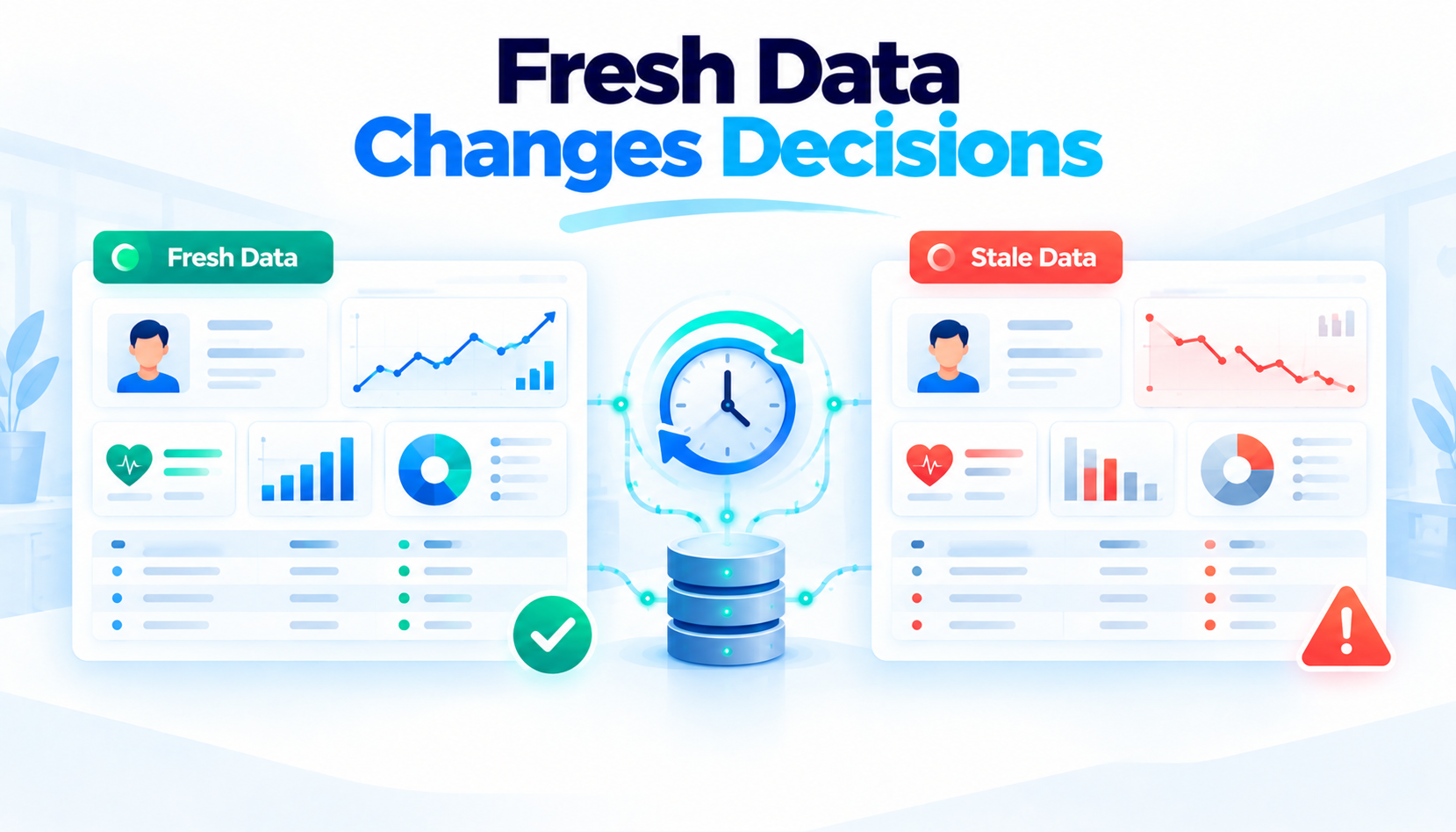
Claims data may lag by weeks, while encounter data from electronic health records applications can update the same day.
Each source’s refresh cycle should influence score confidence, especially when leadership uses risk scores for care decisions.
Patient Matching Quality Is a Model Input
Duplicate records, missing encounters, and inconsistent terminology can weaken at-risk patient identification before the model even runs.
Poor patient matching can hide important clinical signals and reduce the accuracy of risk scores, even when the underlying healthcare data warehouse contains data from multiple clinical sources.
Clean identity resolution directly affects score accuracy, making it part of the model input rather than a background IT task.
Can the Platform Explain Why a Patient Was Flagged
Explainability and source attribution help distinguish a trustworthy platform from a black box.
Care teams should see which data points contributed to a patient’s risk score.
Leadership should be able to trace every flag to its source data and allow documented clinician overrides when appropriate.
What to Validate Before Choosing Population Health Management Software
Verify How the Risk Model Performs: Ask vendors for precision and recall figures, calibration data, false positive rates, and performance broken out across different patient groups within your population.
A vendor unwilling to share model validation numbers for their population health management software is asking you to buy on faith.
Ask Why a Patient Received a High Risk Score: The platform should show what changed, which data sources contributed, how current the score is, and what action it recommends.
Verify Data Freshness and Integration Depth: Confirm which sources update in real time versus batch, how long claims data takes to arrive, how often risk recalculates, and what happens operationally when a data source goes down.
These details determine whether at-risk patient identification reflects this week or last quarter.
Test Real Patient Scenarios: Bring your own cases into the evaluation. Test a rising-risk chronic patient, a patient with repeated ED visits, a missed follow-up case, an active social barrier, and a patient with conflicting records across two systems.
A demo built on curated data tells you nothing about how the population health management software performs on your actual population.
When Population Health Software Is Worth the Investment
Signs Your Current Approach Is No Longer Enough
- Manual chart review is still identifying most high-risk patients.
- Registries update quarterly instead of continuously.
- Care gaps stay open for months without visibility.
- Social risk data sits outside clinical workflows entirely.
- Nobody can say whether last year's outreach changed outcomes.
Establish a Baseline Before Calculating ROI
Measure current time spent identifying patients, care manager caseload, outreach success rate, care gap closure rate, and baseline ED and readmission volume before signing any contract.
Ask the Better ROI Question
Cost per license tells you nothing about value. The question that matters is how many additional patients the platform lets you identify early, intervene on, and successfully manage compared to your current process. A population health management software platform earns its price through that number, not its feature list.
Risk, ROI, Equity, and Accountability
Connect Risk Identification to Financial Outcomes
- Every value-based contract, shared savings arrangement, and readmission penalty ties directly back to how early and how accurately the organization identifies risk.
- Population health management software that improves at risk patient identification by even a small margin moves total cost of care numbers that finance leadership tracks closely.
Treat Algorithmic Bias as a Business Risk
- A model that systematically under identifies certain patient groups creates unequal resource allocation, regulatory exposure, and reputational damage.
- This belongs on the same risk register as financial and clinical exposure, reviewed with the same rigor using an AI risk management framework alongside healthcare software security and other technology risks.
Build an Audit Trail Leadership Can Actually Use
- Leadership should be able to answer four questions on demand: why a patient was prioritized, what data drove that decision, what intervention followed, and whether it worked.
- Population health analytics platform decisions without this trail cannot survive a compliance review or a board question, making healthcare compliance software and documented auditability important parts of the broader governance strategy.
Define Success in the First Two Quarters
- Success across the first two quarters should be measured on four dimensions together: model performance, care team adoption, clinical outcomes, and financial indicators.
- A platform strong on one dimension and weak on the other three is not succeeding, regardless of what the dashboard shows.
Executive Evaluation Checklist
Risk: Rising risk identification, impactability scoring, explainable flags.
Data and Workflow: Data freshness, EHR and claims connectivity, actionable worklists, closed loop tracking
Governance and ROI: Model validation evidence, bias monitoring, full auditability, measured outcomes
Use this checklist as the final filter before signing any population health management software contract.
Designing Population Health Around Real Care Workflows
Patoliya Infotech approaches population health management software as an operational system, not another analytics layer.
We connect fragmented healthcare data, risk stratification models, SDOH signals, explainable scoring, and care-management workflows into one traceable decision path.
A risk score should tell teams more than who is high-risk; it should show why the patient was flagged, what action is appropriate, and whether that intervention changed the outcome.
This architecture-first approach helps healthcare organizations build population health capabilities that remain actionable, measurable, and adaptable as data and care models evolve.
Conclusion
Population health management software creates value when risk identification leads to earlier, more targeted action. The goal is not to produce larger patient lists or more complex dashboards. It is to identify the right patient, understand what is driving their risk, route them to an appropriate intervention, and measure whether the outcome improved.
That requires reliable data, current risk stratification models, actionable workflows, and enough explainability for care teams and leadership to trust the result.
Evaluate every platform against those standards, and the buying decision becomes clearer. The strongest population health analytics platform is ultimately the one that turns risk intelligence into measurable change.
FAQs:
An EHR documents care for one patient at a time. Population health management software aggregates data across an entire panel, scores risk continuously, and drives outreach workflows that an EHR was never designed to support.
Accuracy varies by population, but any vendor should provide precision, recall, and calibration data specific to patient groups like yours before deployment, not general marketing benchmarks.
Models trained mainly on historical utilization or cost data often miss patients who avoid care due to cost or access barriers, even though their clinical need is high.
Scores should update as new clinical, claims, or social data arrives rather than on a fixed quarterly cycle, since patient conditions change faster than static registries can capture.
Impactability scoring measures whether a patient is reachable and likely to benefit from intervention, which separates true priorities from patients who are high risk but not currently actionable.
Leadership should track additional patients identified early, successful interventions completed, and downstream reductions in ED visits and readmissions rather than judging the platform on cost alone.