AI Medical Scribe Software: Evaluation Framework
TL;DR: AI medical scribe software earns its budget line only when it fits your EHR, your specialty mix, and your review workload, not when it posts the highest transcription score in a vendor demo. Organizations that skip workflow fit end up buying an expensive dictation replacement instead of real capacity.
Every health system leader has sat through a demo where the note writes itself in seconds. That moment is not the buying decision. It is the easiest part of the entire evaluation. AI medical scribe software has moved past simple transcription into fully automated clinical documentation, and the market now rewards vendors who can prove clinical usability, not just speech accuracy.
The real question a buyer must answer is whether the system produces documentation a clinician can sign with confidence, inside the EHR they already use, without adding a second job called "reviewing the AI."
This guide explains what these platforms actually cover, where they create measurable value, how to judge note quality before signing anything, and what a defensible business case looks like at the executive level.
AI Medical Scribe Software in Brief: What Buyers Actually Need to Know
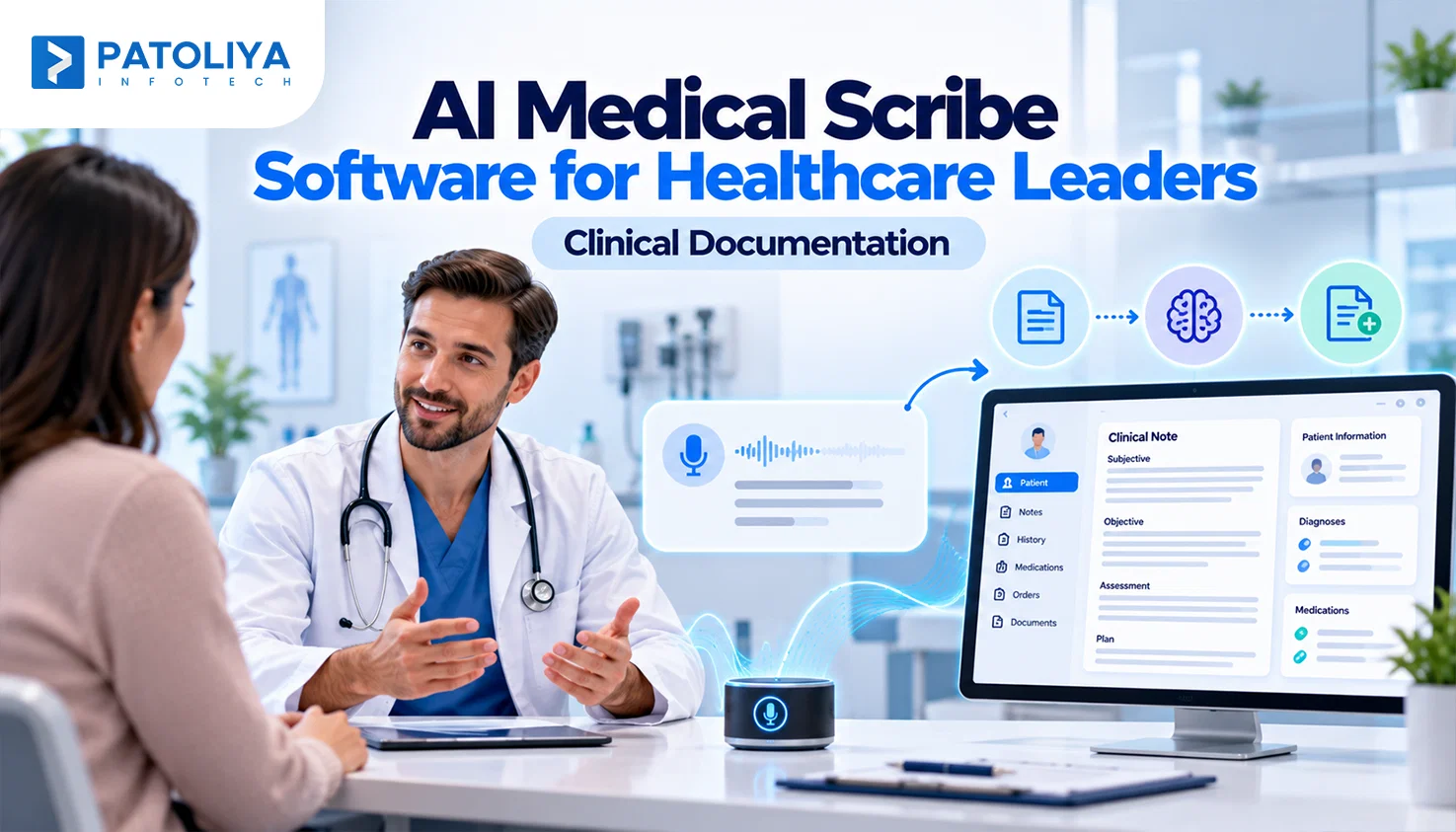
The workflow is short: capture the encounter, convert speech into structured clinical data, generate a draft note, push it into the EHR, and let the clinician review and sign. AI medical scribe software does the heavy lifting on steps one through four. The clinician remains accountable for step five, and that accountability never transfers to the vendor even when the AI medical scribe software performs well.
AI Scribe vs. Traditional Dictation
|
Factor |
Traditional Dictation |
AI Medical Scribe Software |
|
Who authors the note |
Clinician |
System drafts, clinician edits |
|
Documentation effort |
High, manual typing or transcription review |
Lower, review and correct |
|
Speed to chart closure |
Slower |
Faster when integration works |
Ambient documentation is the listening layer. Speech to text is the conversion layer. Clinical note generation is the drafting layer. EHR integration is what turns all three into finished, signed documentation instead of another window to manage.
What Current AI Medical Scribe Solutions Actually Cover
Most AI medical scribe software platforms now cover ambient encounter capture, voice to text charting, SOAP and H&P formats, specialty-specific templates, and both real-time and post-visit note generation.
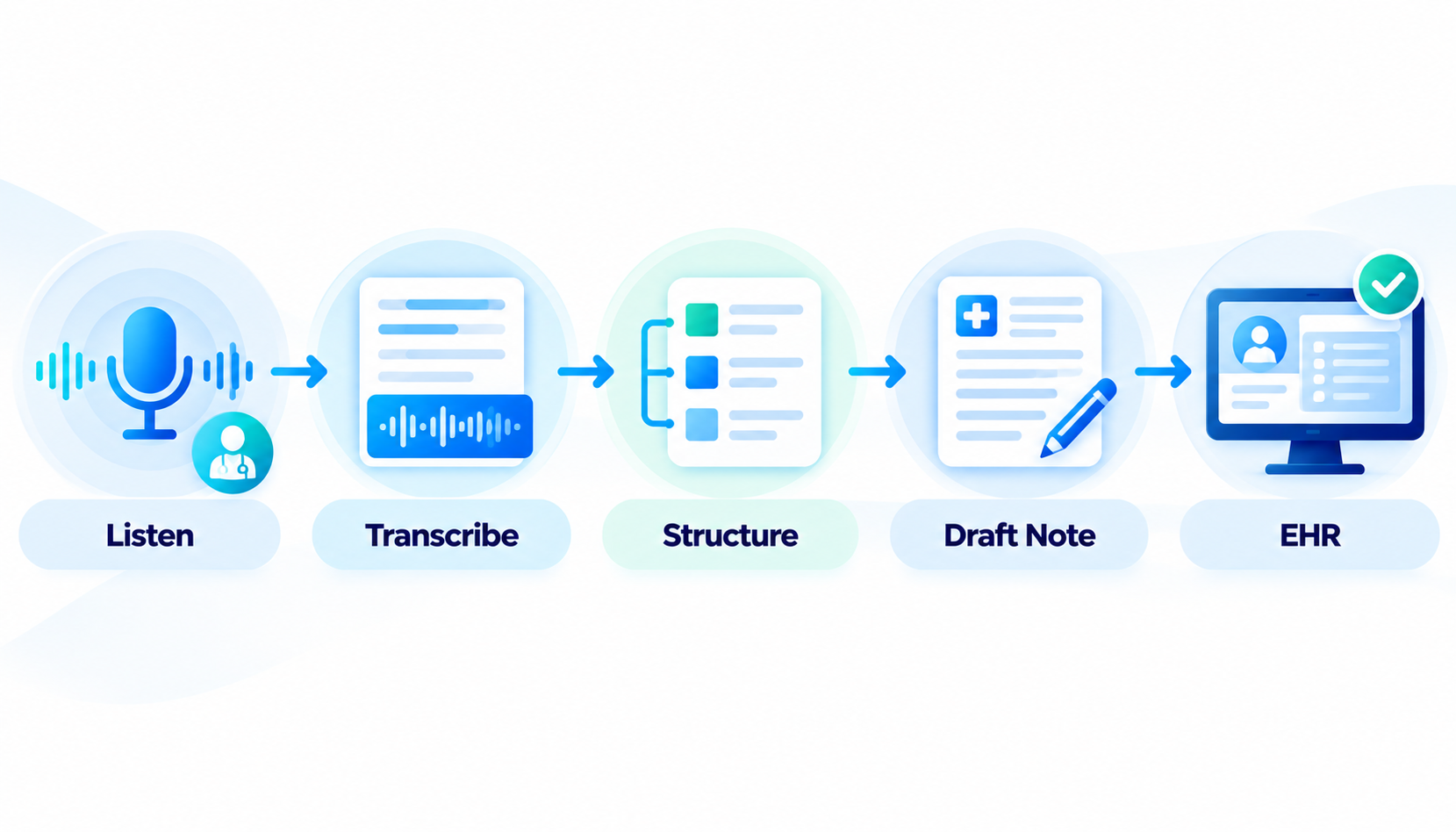
Availability of a feature says nothing about whether the AI medical scribe software performs well inside your specialty mix.
EHR and Workflow Integration
Buyers should separate direct EHR write back from copy paste workflows. FHIR and API based integration allows the note to land inside the correct encounter automatically.
AI medical scribe software that only produces a transcript for manual pasting is not automated clinical documentation; it is a faster dictation box, and buyers should price it accordingly.
Security, Privacy, and Governance
Every serious evaluation covers HIPAA and BAA terms, PHI handling rules, audio and transcript retention windows, security and privacy, access controls, audit trails, and patient consent workflows.
These are not optional line items. A scribe that cannot answer every one of these clearly should not reach a second demo.
Specialty and Language Coverage
Primary care, emergency medicine, behavioral health, cardiology, and oncology all place different demands on note structure and terminology.
Multilingual encounters add another layer of complexity that many vendors quietly underperform on.
Listing a specialty as "supported" does not mean the AI medical scribe software is suitable for that specialty's documentation load, and buyers who treat the feature list as the finish line are the ones stuck renegotiating contracts a year later.
Where AI Scribing Creates Value and Where It Doesn't
AI scribing works best when the real problem is documentation, not EHR configuration, templates, workflow automation, or coding.
Start With the Documentation Bottleneck
- Identify the actual bottleneck before touching a vendor list. After hours charting, slow documentation turnaround, uneven note quality, heavy transcription dependency, EHR friction, and coding gaps are five distinct problems with five distinct fixes.
- Buying AI medical scribe software to fix an EHR configuration problem wastes budget, and automated clinical documentation cannot repair a broken template library on its own.
Match the Scribe to the Encounter Environment
- Routine outpatient visits behave nothing like an emergency department encounter with multiple speakers and constant interruption. High-volume primary care rewards speed.
- Specialty consultations reward structured accuracy. Telehealth and multi-provider encounters each carry their own audio and consent complications that a single generic tool rarely handles well across all of them.
Identify Workflows Where Automation Can Create Negative Value
- High-risk documentation that demands extensive legal review, complex multi-speaker encounters, weak EHR integration, and specialties requiring rigid structured notes are all places where automation can add review time instead of removing it.
- This is the section most vendor content skips entirely because it undercuts the sales pitch.
Documentation time saved is the headline metric vendors lead with, but the real value of automated clinical documentation sits in reduced after hours work, released clinician capacity, correction time, turnaround time, patient facing time, and adoption rate.
AI medical scribe software that saves five minutes per note but adds ten minutes of correction has produced negative value, no matter what the marketing deck claims.
How to Evaluate Clinical Note Quality Before Buying
A single accuracy percentage hides more than it reveals. Score speech recognition accuracy, speaker identification, clinical fact extraction, omission rate, hallucination rate, note completeness, and specialty specific accuracy separately.
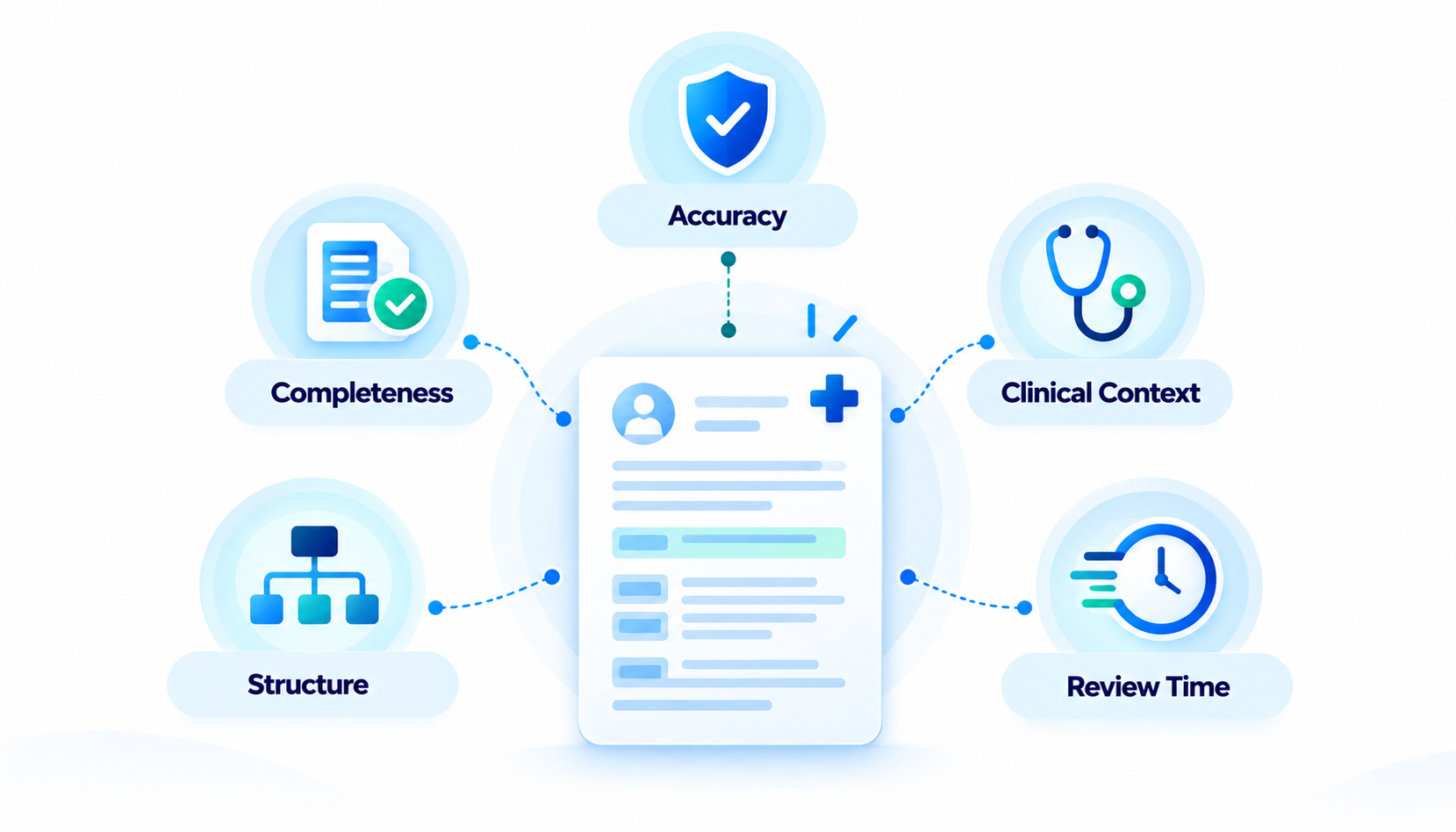
AI medical scribe software can score 95 percent on transcription and still miss a critical allergy, which is the failure mode that actually matters in a clinical setting.
Measure Editing Burden: Ask exactly how much of the generated note needs correction, which sections require the most editing, and how long clinician review actually takes.
For instance, if a cardiology group finds that the assessment and plan section needs rewriting in eight out of ten notes, the AI medical scribe software is not saving documentation time; it is relocating the work.
Test Against Real Clinical Scenarios: Pilot the AI medical scribe software against routine encounters, complex encounters, noisy rooms, multiple speakers, dense medical terminology, and regional accents.
A demo built on a clean, quiet, single speaker sample tells you almost nothing about performance on a Monday morning clinic with three interruptions per visit.
Keep the Clinician as the Final Authority: The system should generate a draft, never the author of record. This broader evaluation approach also aligns with the ONC's HTI-1 framework, which establishes transparency requirements for AI and predictive algorithms in certified health IT and emphasizes factors such as validity, effectiveness, and safety.
The EHR Integration Question Buyers Often Underestimate
Vendors use the phrase loosely. It can mean a transcript sitting outside the EHR, a note copied in manually, API based write back, an embedded workflow, or a near native documentation experience. Ask which one you are actually buying before signing anything.
Check authentication, note routing, template mapping, encounter association, clinician editing rights, sign-off, and audit trail completeness. Automated clinical documentation that skips any one of these steps forces staff to manually reconcile the healthcare data integration gap, which erases the time savings the AI medical scribe software promised.
Ask What Happens When Integration Fails
- Does documentation queue safely during an outage?
- Can clinicians recover an unsent draft?
- Is duplicate documentation a risk during EHR downtime?
A technically strong AI medical scribe software platform with weak integration becomes one more application clinicians manage rather than one less task on their plate.
AI Medical Scribe Security and Governance: Questions Procurement Should Ask
What Happens to the Encounter Data?
Ask directly whether audio is stored, for how long, where it lives, who can access it, whether transcripts are retained, and whether PHI trains the underlying model behind the AI medical scribe software. Vague answers here are a red flag procurement should not accept.
What Governance Controls Exist?
Evaluate healthcare compliance requirements including consent workflows, role-based access, audit logging, retention and deletion controls, incident response procedures, and model version traceability. Governance maturity separates enterprise-ready AI medical scribe software from a well funded pilot project.
What Evidence Can the Vendor Provide?
"HIPAA compliant," "encrypted," and "enterprise security" are marketing phrases, not evidence. Ask for the actual contractual language, the BAA terms, and technical documentation behind each claim.
Compliance language can obscure real differences in data use, retention, and auditability, and the buyers who accept the phrase without the paperwork are the ones who inherit the risk later.
Build the Business Case: When Does AI Scribe Software Pay Off?
Calculate Value From the Full Workflow
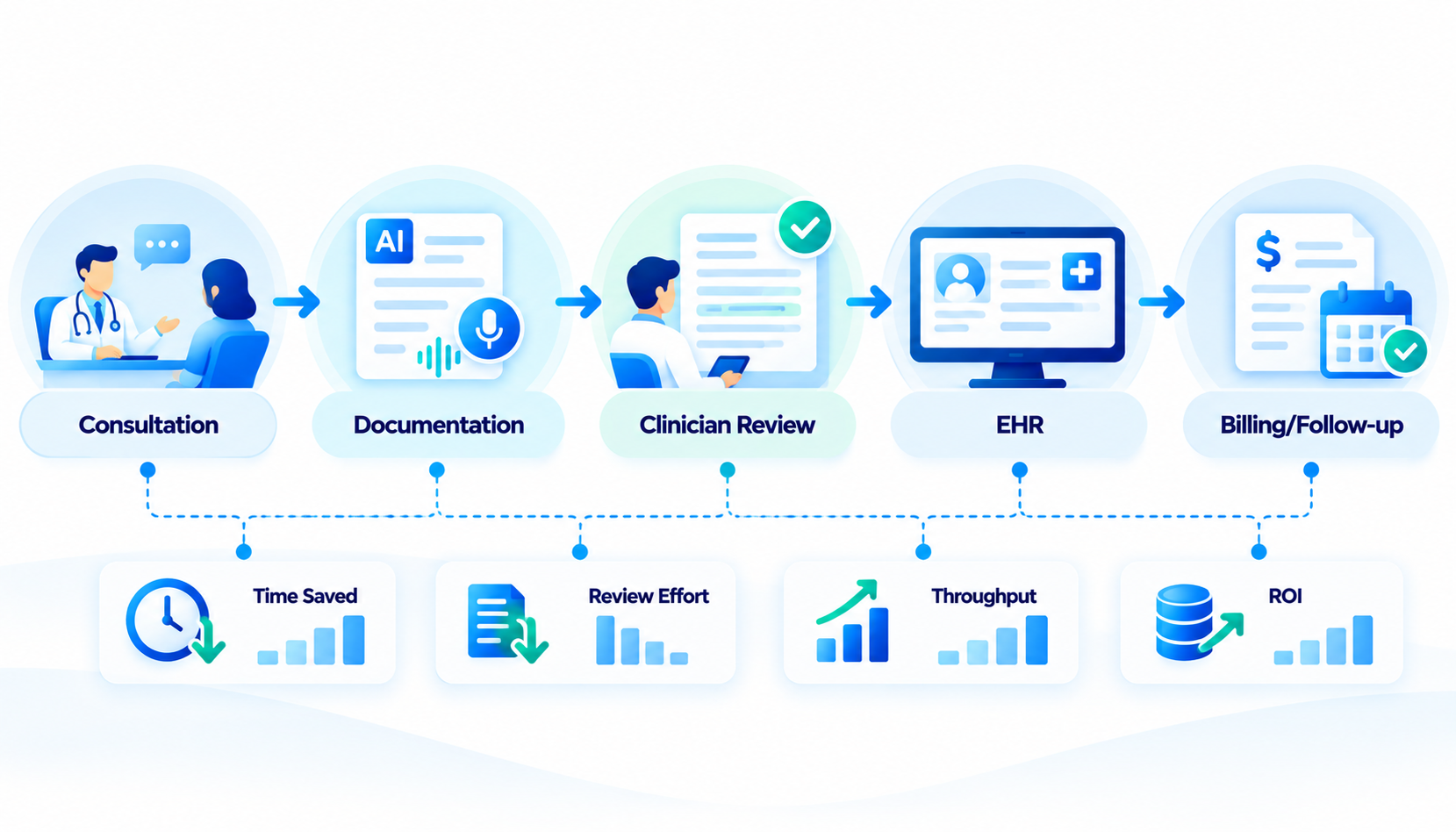
- Documentation time saved minus review and editing time, minus implementation effort, minus training cost, minus subscription cost equals the true operational value of AI medical scribe software.
- Skip any term in that equation, and the business case for automated clinical documentation is fiction.
|
Value Component |
Direction |
|
Documentation time saved |
Positive |
|
Clinician review and editing time |
Negative |
|
Implementation and training cost |
Negative |
|
Subscription cost |
Negative |
|
Net operational value |
Result |
Measure Capacity
- Organizational outcomes worth tracking include completed encounters per clinician, reduced after-hours documentation, clinician retention, reduced administrative burden, increased patient-facing time, and faster note completion.
- Capacity gained is the metric that survives a board-level review; productivity anecdotes rarely do.
Separate Soft ROI From Hard ROI
- Clinician satisfaction, perceived workload, and patient experience are real but soft outcomes of automated clinical documentation.
- Documentation time, encounters per clinician, overtime hours, note completion time, and staffing requirements are hard, measurable outcomes.
- HIMSS highlights this exact distinction between clinician reported value and measurable financial ROI, and recommends building a solid baseline before scaling any deployment.
A Practical AI Medical Scribe Evaluation Framework for Healthcare Leaders
Score every AI medical scribe software vendor across five dimensions instead of relying on a feature checklist.
Clinical Fit
Score specialty coverage, note quality, complexity handling, and review burden.
Technical Fit
Score EHR integration depth, interoperability, reliability, scalability, and latency.
Operational Fit
Score clinician adoption rate, training requirements, workflow disruption, implementation effort, and support model.
Risk Fit
Score privacy controls, consent handling, data retention policy, auditability, and governance maturity.
Financial Fit
Score provider-level cost, implementation costs, expected utilization, measurable capacity gains, and total cost at scale.
|
Dimension |
Weight |
|
Clinical and documentation quality |
25% |
|
EHR and workflow integration |
20% |
|
Security and governance |
15% |
|
Clinician adoption |
15% |
|
Operational scalability |
10% |
|
Financial value |
15% |
When an AI Medical Scribe Is the Wrong Investment
Don't Buy If the Core Problem Is Elsewhere: Broken EHR workflows, poor documentation templates, insufficient clinician training, and fragmented clinical processes are not problems AI consulting or AI medical scribe software can solve.
Fix the foundation first, or the new AI medical scribe software inherits every existing weakness.
Don't Buy on Burnout Claims Alone: If the organization cannot measure baseline documentation burden, adoption rate, review time, or workflow improvement, proving ROI afterward becomes nearly impossible.
A burnout narrative without a baseline is a story, not a business case.
Don't Scale Before the Pilot Proves Clinical Fit: A polished demo is not evidence of enterprise readiness. Scale only after a controlled pilot proves the AI medical scribe software performs across your actual specialty mix and patient volume, not a curated sample encounter.
What a Strong AI Medical Scribe Implementation Should Look Like
Phase 1, Workflow Assessment: map the current documentation process, EHR workflow, specialty mix, bottlenecks, and baseline metrics before any AI medical scribe software contract is signed.
Phase 2, Controlled Clinical Pilot: measure note quality, editing time, adoption rate, documentation time, and clinician satisfaction across a defined pilot group using the AI medical scribe software.
Phase 3, Integration and Governance: establish EHR integration, consent workflows, access controls, data retention policy, and ongoing monitoring before wider rollout of the automated clinical documentation platform.
Phase 4, Scale Based on Evidence: expand the AI medical scribe software only where clinical quality is acceptable, workflow friction has measurably dropped, adoption is sustainable, and ROI is documented, not assumed.
How Patoliya Infotech Approaches AI Medical Scribe Software
Workflow-first design: Map clinical workflows before selecting the scribe architecture.
EHR integration: Connect ambient documentation with existing EHRs through APIs and interoperability standards.
Clinical accuracy: Validate note generation across specialties, terminology, and real encounter conditions.
Governance by design: Build privacy, access control, auditability, and retention into the platform.
Outcome-focused scaling: Measure editing time, adoption, documentation turnaround, and operational value before expanding an AI product engineering solution.
Conclusion
AI medical scribe software is valuable when it reduces documentation friction without shifting that workload into review, correction, or reconciliation. The right solution should fit existing EHR workflows, specialty requirements, governance policies, and clinical expectations.
Automated clinical documentation should ultimately be judged by measurable outcomes: shorter documentation cycles, lower after-hours work, improved clinician capacity, and sustainable adoption.
A successful implementation is therefore less about choosing the most advanced AI model and more about custom software development that builds a dependable workflow around it, one that clinicians can trust, organizations can govern, and technology teams can scale.
FAQs:
Yes. However, performance depends on specialty-specific terminology, templates, encounter complexity, and documentation requirements. Each specialty should be validated independently before organization-wide deployment.
Many solutions can support telehealth, but buyers should evaluate speaker separation, consent handling, audio quality, workflow compatibility, and whether generated notes map correctly to the virtual encounter.
They can improve consistency when templates, note structures, clinical terminology, and review workflows are properly configured. Automation alone cannot fix poorly designed documentation standards.
The clinician should identify and correct the issue before signing. Strong implementations also track correction patterns to identify recurring model, workflow, or template problems.
Some platforms offer multilingual capabilities, but language performance can vary significantly. Healthcare organizations should test accents, terminology, mixed-language conversations, and specialty-specific documentation before adoption.
Track note correction rates, review time, adoption, documentation turnaround, workflow exceptions, and specialty-level performance continuously. Ongoing monitoring helps identify issues that pilots may miss.