Healthcare OCR: Cost, ROI & Vendor Evaluation
TL;DR: Healthcare OCR delivers real value when it reduces manual touches, accelerates document processing, and reliably moves validated data into downstream healthcare workflows. The right solution must prove field-level accuracy, handle exceptions, integrate with existing systems, protect PHI, and produce measurable ROI.
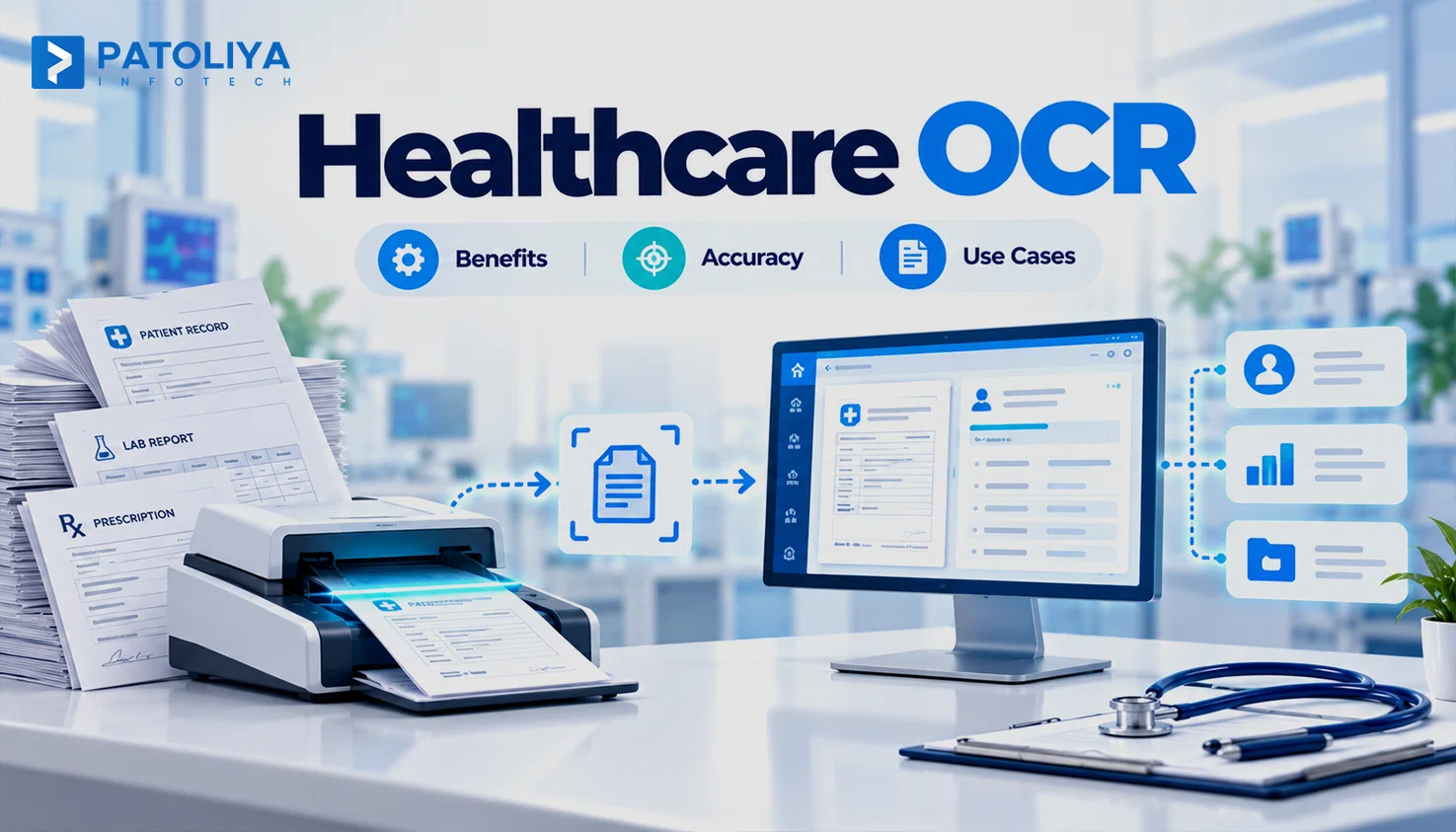
Healthcare organizations still process intake forms, insurance cards, claims, EOBs, referrals, faxes, and scanned records through manual data entry. Modern Healthcare OCR can classify documents, extract fields, validate information, and trigger workflows automatically before sending validated information into electronic health records applications.
The real measure of OCR success is not demo accuracy, but how much manual work it removes without creating downstream errors. This guide covers accuracy, exception handling, integration, security, and ROI.
Where Manual Healthcare Document Intake Still Costs Money
Four workflows absorb most of the manual burden in a typical clinic or payer office: patient intake and registration, insurance card and claims OCR entry, and referral or authorization paperwork. Staff time here goes well beyond typing.
Every document requires opening a file, locating the right field, switching between two or three systems, correcting mismatches, and routing the record to the next person. A single insurance card touch point can involve three separate applications before the data lands in the right patient file or downstream medical billing software.
How Intake Errors Become Operational Costs
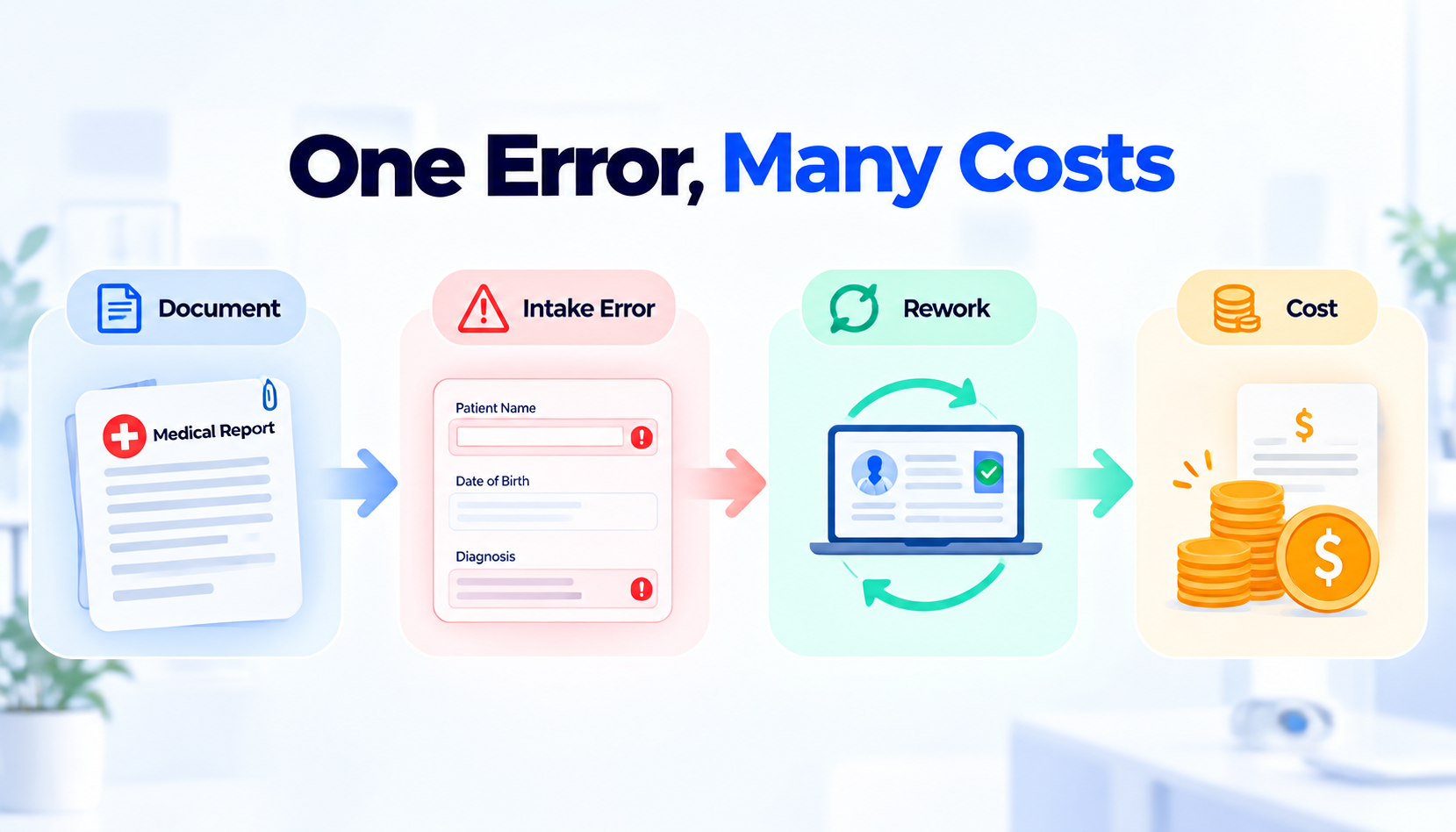
A misread member ID or date of birth during manual card entry does not stay a small error. It can become an eligibility failure, affect electronic healthcare claims, or an issue that requires additional work in medical claims software.
|
Error Source |
Downstream Impact |
|
Wrong patient ID |
Eligibility check fails. |
|
Wrong payer ID |
Claim rejected before review. |
|
Wrong date of birth |
Registration mismatch, repeat verification. |
|
Missed authorization number |
Claim held for manual research. |
Healthcare OCR that ignores this chain of consequences and reports only "accuracy" as a single number is measuring the wrong thing. Next, look at what these systems can actually automate and where they consistently break.
What Healthcare OCR Can Automate and Where It Still Breaks
Document type determines how hard extraction actually is. Structured forms like insurance cards follow a predictable layout. Semi-structured documents like claims and EOBs shift by payer. Fully unstructured clinical records, referral letters, and physician notes carry almost no consistent layout at all.
Healthcare OCR built for one category rarely performs the same way on another. A platform strong at reading printed insurance cards may struggle badly with a five-page insurance card and claims OCR packet from an unfamiliar payer, because the extraction logic that works for a fixed template breaks the moment field positions move.
The Documents That Expose Weak OCR
Healthcare OCR must handle real-world document challenges. These include handwritten physician notes, low-quality scans, fax artifacts, skewed pages, merged documents, mixed-format claim packets, and payer forms with constantly changing layouts.
The real test of Healthcare OCR is your own document population. A platform that scores 99% on polished PDFs can drop sharply once it meets your actual fax queue. That gap is exactly where the accuracy conversation needs to start.
How Accurate Is Accurate? Reading Past the 99% Claim
Field Level Accuracy vs Document Level Accuracy
A single accuracy number hides more than it reveals. Healthcare OCR accuracy can be measured at the character level, the field level, the document level or the workflow level, and each tells a different story.
If a 30 field intake form has 29 correct fields, calling it 96.7% accurate sounds impressive. It does not tell you whether the one missed field was the patient ID, the payer ID, or the date of birth, and those three errors carry very different consequences.
Before signing anything, ask which fields matter most, what the accuracy is for each critical field individually, and what percentage of documents still need a human to step in.
How to Test a Healthcare OCR Vendor Before Signing
Run a real pilot before you commit budget. A methodology that actually protects you looks like this:
- Pull representative historical documents, both clean and poor quality.
- Include multiple payers and multiple form versions.
- Add handwritten and faxed material if your intake includes it.
- Define the critical fields before testing begins.
- Measure field level accuracy against manually verified ground truth.
- Measure the exception rate and the straight through processing rate.
Set the success criteria before the pilot starts. A vendor should never be allowed to define what counts as a pass after seeing the results.
Design Human Review Around Exceptions
The strongest model uses healthcare workflow automation to route documents by confidence: high-confidence documents go straight through, low-confidence fields trigger targeted human review, and validation failures land in an exception queue.
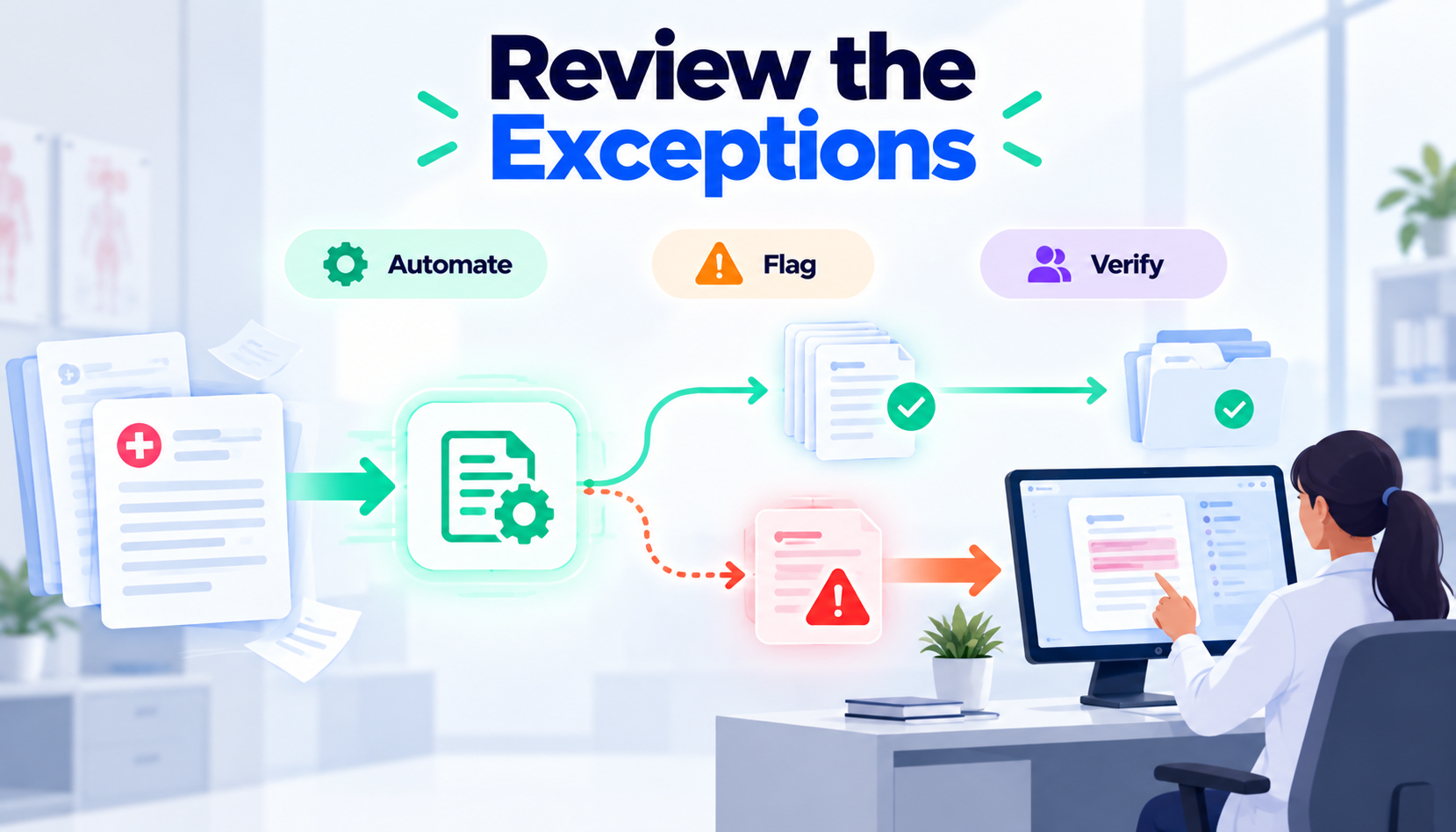
The goal of Healthcare OCR is never a human checking every output. The goal is a human handling only the fields the system genuinely cannot resolve on its own, a model that can also support broader agentic AI in healthcare workflows. Once that routing logic works, the next question is how the extracted data actually reaches your systems.
From Extracted Text to Trusted Healthcare Data: The Integration Reality
Classification Comes Before Extraction
- Mixed document streams need sorting before extraction even starts.
- Strong Healthcare OCR classifies each incoming file first: insurance cards, claims, EOBs, intake forms, referrals, and clinical records, then applies extraction logic built for that specific type.
- Better classification improves downstream extraction directly, because the system already knows which fields and structures to expect before it starts reading.
- Skip this step, and your extraction accuracy drops across every document category at once.
Three integration paths dominate this space, and each fits a different environment, with API-first healthcare integration particularly useful for modern system-to-system workflows.
|
Integration Type |
Best Fit |
Trade Off |
|
API |
Modern system to system workflows. |
Requires clean endpoints on both sides. |
|
HL7/FHIR |
Environments already built on healthcare interoperability standards. |
Setup effort is higher upfront. |
|
RPA or file-based |
Legacy or constrained systems. |
More maintenance, less reliability long term. |
Pick based on what your EHR and RCM systems already support, with healthcare data integration serving as the foundation for moving validated OCR data into the right systems and handling health care claims attachments electronically.
Where PHI Actually Travels
“HIPAA compliant” means little without specific answers. Ask:
- Where are source documents stored?
- Where is extracted data stored temporarily?
- Is PHI encrypted in transit and at rest?
- Who can access the extracted data?
- Are user and system actions logged?
- How long are documents retained?
- Can the vendor use your data to train its models?
Those answers turn security from a checkbox into a real architecture decision, making healthcare software security critical when OCR systems process and transfer PHI. With integration and security settled, the next test is financial: what does Healthcare OCR actually return?
What Does Healthcare OCR Actually Return?
Build a Cost Per Document Baseline
Start with a simple comparison your finance team can verify on its own. Current manual cost equals handling time per document multiplied by loaded labor cost. Healthcare OCR cost equals platform cost plus implementation cost plus the ongoing cost of exception review, which vendors frequently leave out of their pitch entirely.
That missing line item, exception handling, is where inflated savings claims usually fall apart under scrutiny.
Measure ROI Through Operational KPIs
Measure the impact using cost per document, manual touches per document, straight-through processing rate, average processing time, exception rate, registration turnaround time, claim rework and denial impact, and staff hours redirected to higher-value work.
Where the Business Case Usually Appears First
Skip any pitch promising a flat 30 to 50 percent savings figure out of the gate. Real ROI from Healthcare OCR tends to show up first in reduced data entry workload, faster registration, a shrinking document backlog, less rework, and quicker claims turnaround.
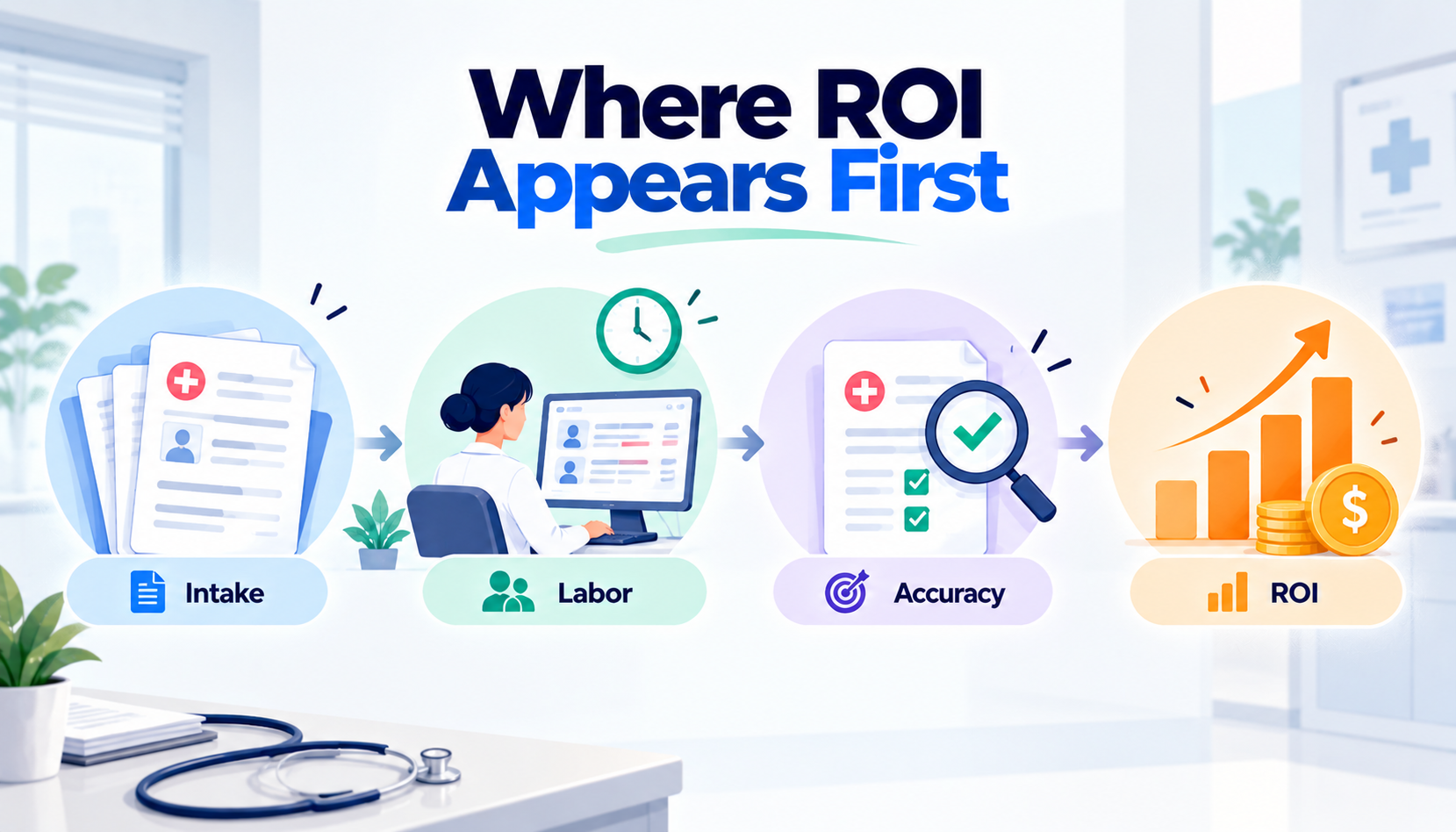
Build your business case from your own document volume and your own labor baseline, not a vendor's generic slide. Once the numbers work, the next decision is which vendor earns the contract.
How to Evaluate a Healthcare OCR Vendor Before You Commit
|
Evaluation Criteria |
Why It Matters |
|
Field-level extraction accuracy |
Document-level accuracy can hide errors in critical fields such as member IDs, dates, amounts, and provider information. |
|
Document variety and edge-case handling |
Test handwritten notes, poor scans, faxes, mixed packets, and changing payer layouts. |
|
Confidence scores and exception handling |
Low-confidence fields should be flagged for human review instead of silently entering unreliable data into downstream systems. |
|
EHR, RCM, and interoperability integration |
Healthcare OCR creates value only when extracted data reaches the right system without adding another manual step. |
|
PHI security and data handling |
Verify encryption, access controls, audit logging, retention policies, processing locations, and whether your data is used for model training. |
|
Performance and downtime handling |
Understand processing times, throughput, service availability, and what happens to documents when the Healthcare OCR service is unavailable. |
|
Total cost per processed document |
Compare licensing, implementation, human review, exception handling, storage, and integration costs. |
|
Pilot performance on real documents |
A strong vendor should let you test historical documents and measure results against agreed success criteria before full deployment. |
A Low Risk Path From OCR Pilot to Production
Choose a workflow with high volume, repetitive structure, and measurable manual effort. Insurance card and claims OCR for registration and EOB processing, along with standardized intake forms, make strong starting points. Save your most complicated document type for later, once the platform has already proven itself.
Lock these down before any implementation begins. Define the document sample, critical fields, accuracy threshold, maximum exception rate, target straight through processing rate, integration requirements, security requirements, and your ROI baseline.
Move to production only when the workflow is proven. Production approval should follow measured operational performance, never a strong demo alone. If the pilot numbers hold up against your own baseline, you have earned the right to scale.
Patoliya Infotech: Engineering Healthcare OCR Around the Workflow
Patoliya Infotech builds Healthcare OCR around the complete path from document to validated data to healthcare system to operational action, not around recognition alone.
- Document intelligence healthcare pipelines covering ingestion, classification, and confidence based routing.
- Insurance card and claims OCR extraction with human review built directly into the exception path.
- EHR, EMR and RCM integration through API and HL7/FHIR, with secure PHI handling and full workflow auditability.
If your team is stuck rekeying insurance cards and claims by hand, book a working session with Patoliya Infotech and bring your own documents to the conversation.
Conclusion
The real question was never whether Healthcare OCR can read a document. It is whether the technology removes manual work from a measurable workflow without creating new problems downstream. Validate field level accuracy, exception workload, integration feasibility, PHI security, and financial return before you sign anything.
A Healthcare OCR implementation that actually works does not just digitize paperwork. It turns document heavy processes into controlled, measurable operations. Let's talk through your current intake volume and find the right starting workflow.
FAQs:
Basic OCR converts an image into text. Healthcare OCR classifies the document type first, extracts specific fields, validates them against rules, and routes low-confidence results to a human before the data ever reaches your EHR.
Field level accuracy on critical fields like member ID and payer ID matters far more than an overall document score. Set your own threshold per field and test it against your actual document population before deployment.
Strong platforms use contextual extraction instead of rigid templates, so layout changes across payers do not break the system. Confirm this during your pilot with real documents from at least three different payers.
Exception handling gets left out of most vendor pricing conversations. Budget for the ongoing human review time on low confidence documents, not just the platform and implementation fees.
Length matters less than proof. Run the pilot until you hit your predefined accuracy threshold, exception rate ceiling, and straight through processing target on your own documents, then move forward.
No. It shifts staff away from repetitive data entry toward exception review and higher-value patient-facing work, while the system handles the documents it can confidently process on its own.