Nurse Scheduling Software: Features, Cost & ROI
 By Hitesh SUpdated on: 08/17/2615 min read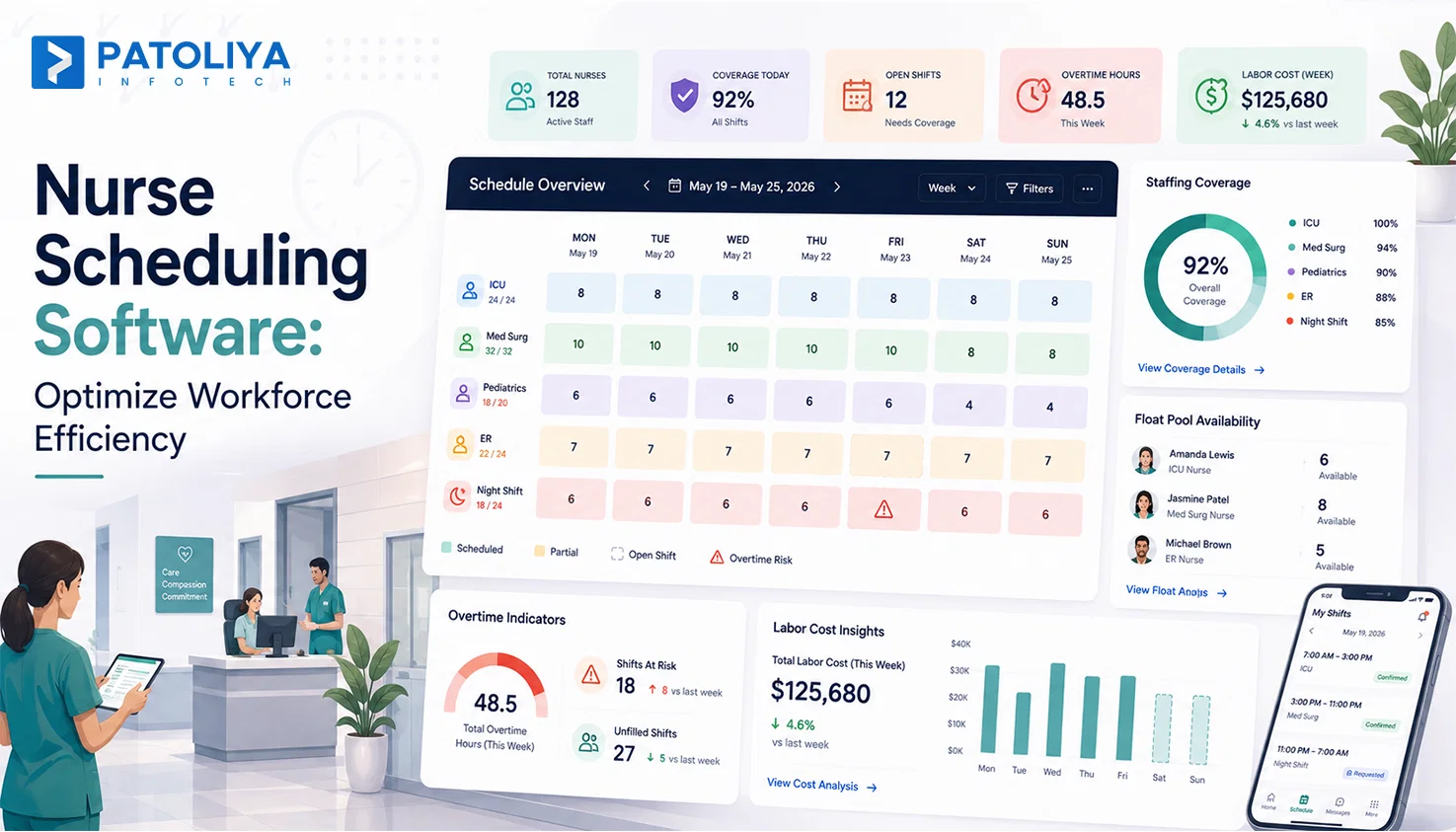
TLDR: Buying nurse scheduling software is not a scheduling decision. It is a labor cost decision. Leaders who treat it as pure automation miss the bigger opportunity: turning unused internal capacity into measurable savings across overtime, agency spend, and coverage gaps.
The real challenge in hospital staffing isn’t always a lack of nurses; it’s knowing where available skills and capacity exist. One unit may have qualified nurses available while another pays agency rates to cover the same shift. The right nurse scheduling software helps connect those gaps, improve coverage, and control labor costs.
This guide explains what the Healthcare workforce management platform should optimize, how algorithms balance competing staffing rules, what to test before buying, and how to build a strong ROI case.
What Is Nurse Scheduling Software?
Nurse scheduling software manages nurse availability, shift patterns, credentials, competencies, staffing ratios, preferences, and the rules that govern how a schedule gets built as part of broader healthcare workforce management software.
It stores every constraint a scheduler used to track on paper or in spreadsheets, then applies those constraints automatically every time a shift needs coverage.
Scheduling vs workforce optimization
|
Basic Schedule Builders |
Healthcare Workforce Management |
|
Focus on filling shifts |
Optimizes coverage, cost, skills, and fairness. |
|
Primarily saves scheduling time |
Supports patient safety and labor efficiency. |
|
Assigns available staff |
Recommends the best-fit assignment. |
|
Limited optimization |
Balances workforce needs without inflating labor spend. |
Benefits of Nurse Scheduling Software
Reduce scheduling administration: Automated rule enforcement removes the manual cross checking that eats a charge nurse's week.
Improve staffing coverage: Real-time demand data closes open shifts before they turn into a coverage emergency.
Control overtime and agency dependency: Nurse scheduling software flags premium labor triggers before a shift is even posted, giving managers a chance to reassign internally first.
Improve workforce utilization: Idle competent staff gets matched to open needs across units, not just their home floor.
Support fairness and workforce visibility: Every nurse sees the same rules applied the same way, which cuts grievances tied to perceived favoritism.
Before Buying Software, Identify Where Your Workforce Is Losing Money
Is the problem coverage, cost, or capacity
These are three different problems with three different fixes. Coverage problems show up as open shifts. Cost problems show up as overtime and agency invoices.
Capacity problems hide inside a workforce that already has enough skilled staff, just not in the right place at the right time. Nurse scheduling software only pays off when you know which problem you are actually solving.
Where are overtime and agency costs coming from
Overtime rarely comes from one bad week. It comes from repeated patterns, the same unit, the same shift, the same three or four nurses covering the gap every time.
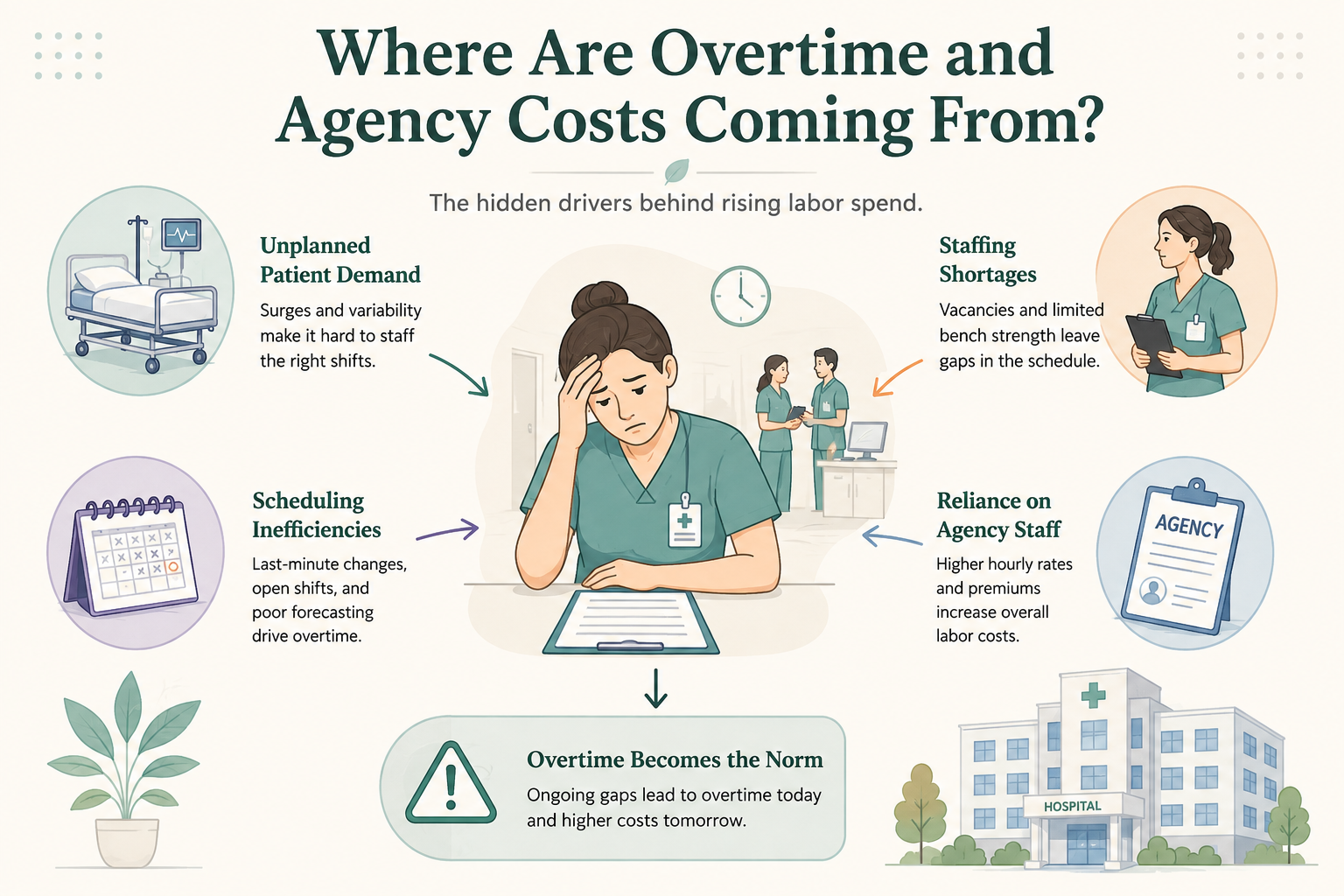
Agency spend follows the same pattern once internal options run out. Track the pattern before you shop for a platform, because the wrong tool solves the symptom and ignores the source.
Are qualified internal staff being fully utilized
Fragmented data across units hides available capacity. A nurse cleared to float between med surg and telemetry might sit unused because no one connected her credentials to an open shift three floors away.
That gap is pure margin loss, and it grows every pay period Healthcare workforce management platform stays siloed by department.
What should you measure before implementation
|
Metric |
Why It Matters |
|
Overtime hours per pay period |
Shows repeat cost patterns. |
|
Agency spend |
Shows external labor dependency. |
|
Open shifts at 48 hours out |
Shows coverage risk. |
|
Scheduler hours per week |
Shows administrative drag. |
|
Float utilization rate |
Shows unused internal capacity. |
|
Schedule change frequency |
Shows planning accuracy. |
|
Time to fill an open shift |
Shows response speed. |
What Should Nurse Scheduling Software Actually Optimize?
Patient demand and required coverage
- Census, acuity, admissions, and discharges change by the hour, not the week, which is why nurse staffing and patient safety must be evaluated against changing patient needs.
- Scheduling based only on historical averages can lead to inaccurate staffing.
- Nurse scheduling software should use current demand and acuity signals to adjust coverage by unit and shift.
Skills, credentials, and staffing ratios
- Every assignment should match the nurse’s qualifications and unit requirements.
- Competency-aware scheduling helps prevent assigning nurses to specialties they are not certified for.
- Staffing ratio enforcement should be automatic rather than a manual double-check.
Availability, preferences, and scheduling fairness
- PTO, rest periods, weekend rotations, and consecutive-shift limits all affect scheduling.
- The system should prioritize clinical safety while considering employee preferences.
- Fairness should also be tracked and reported so managers can explain scheduling decisions.
Overtime, float pools, per diem, and agency labor
- Nurse scheduling software should check lower-cost internal options before recommending overtime or agency staff.
- A typical escalation order prioritizes core staff, followed by the float pool, per diem staff, overtime, and finally agency staff.
- This helps reduce unnecessary agency spending while making better use of existing staff.
For instance, A 300 bed hospital sets its escalation order as core staff, float pool, per diem, overtime, agency. Every open shift runs through that order automatically, cutting agency reliance without a single manual phone call.
How Scheduling Algorithms Balance Coverage, Cost, and Staff Preferences
|
Constraint Type |
What It Covers |
How It’s Handled |
|
Hard constraint |
Nurse-to-patient ratios |
Cannot be overridden |
|
Hard constraint |
Licenses and required credentials |
Cannot be overridden |
|
Soft constraint |
Preferred shifts |
Can be adjusted when necessary |
|
Soft constraint |
Requested days off |
Can be changed with manager approval |
Hard constraints vs soft constraints
Principles for Nurse Staffing emphasize that ratios, licensure, mandated rest periods, and other safety requirements must be treated as non-negotiable constraints. Soft constraints are preferences that improve satisfaction but can flex when coverage is at risk. Good nurse scheduling software never lets a soft constraint override a hard one, no matter how good the intent.
Multi-objective scheduling
Real scheduling is not one problem; it is six problems solved at once: coverage, skills, compliance, cost, fairness, and preference.
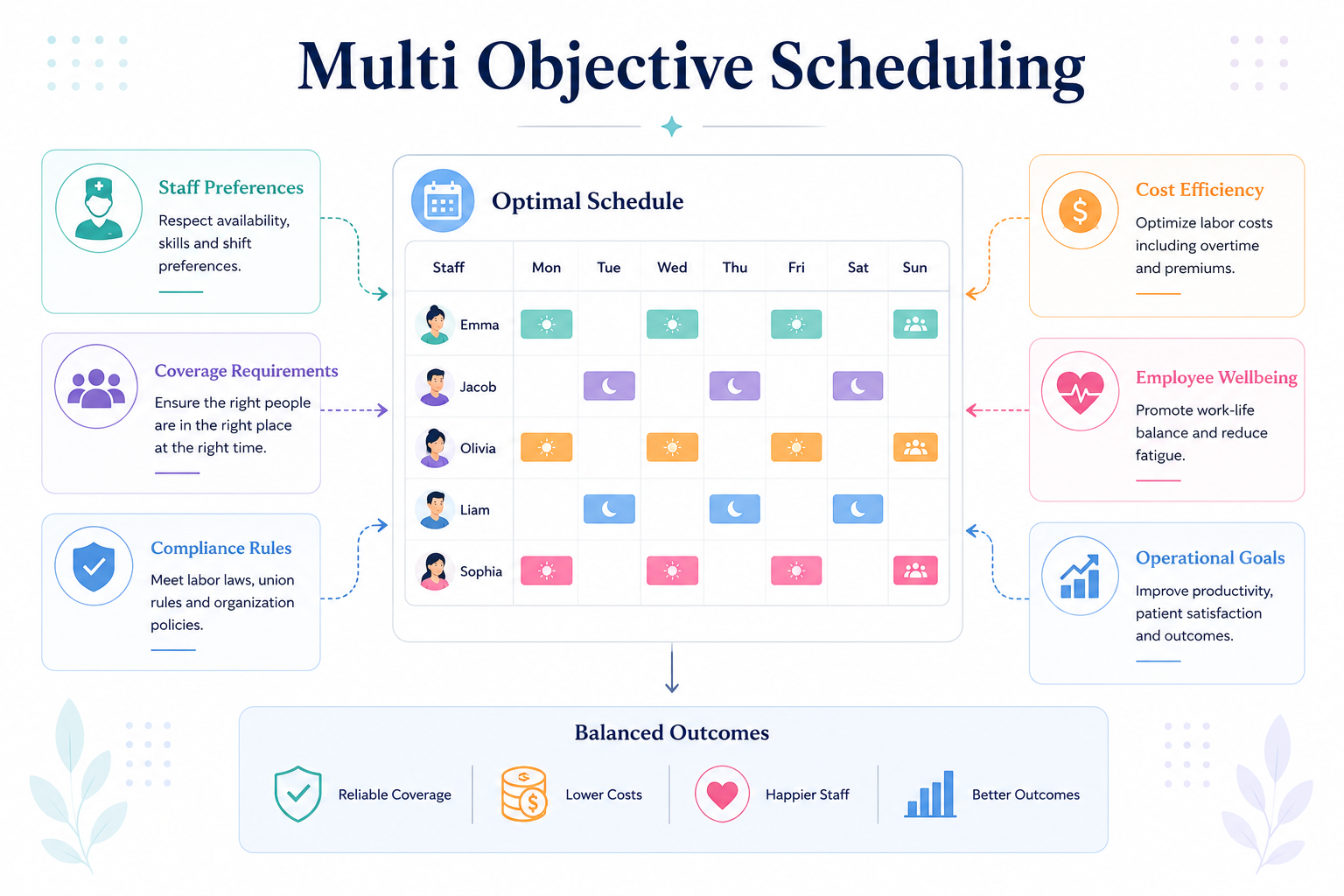
The algorithm scores every possible assignment against all six and picks the combination with the best overall balance, not just the cheapest or the fastest option.
Handling conflicting staffing requirements
Sometimes no schedule satisfies every rule. A strong system does not fail silently. It surfaces the exact conflict, shows which constraint is blocking the fix, and offers the closest valid alternative so a manager can make an informed override.
Human overrides and manager control
Algorithms recommend. Managers decide. Every Healthcare workforce management platform needs a clear override path with a logged reason, because clinical judgment on the floor will always outrank a formula.
What AI-powered scheduling should actually mean
Real optimization runs constraint math across thousands of combinations. Marketing language alone does not move an open shift. Ask any vendor to show the logic, not just the label.
Float Pool Management: Use Internal Capacity Before External Labor
Identify qualified internal capacity: Every float eligible nurse should have a live profile showing unit clearance, certifications, and recent competency checks, so a scheduler can see who is deployable in seconds, not after a phone tree.
Match float nurses by competency and unit requirements: A float match is only safe if the nurse's certifications line up with the receiving unit's actual acuity level. Nurse scheduling software should block any match that fails this check automatically.
Create an internal to external staffing escalation model: The order should run core staff, then float pool, then per diem, then overtime, then agency.
Float pool management built correctly is the single biggest lever most hospitals have against agency spend, and most never fully activate it.
Measure float utilization and agency savings: Track float hours used against float hours available every pay period. A rising utilization rate paired with falling agency invoices is the clearest proof the escalation model works.
How Nurse Scheduling Becomes Workforce Optimization
Connect scheduling with EHR, HRIS, payroll, and time data
A schedule that lacks healthcare data integration with payroll and time tracking creates duplicate data entry and payroll errors. Integration turns four separate systems into one accurate source of truth for every shift worked.
Combine workforce availability with patient demand data
Pairing available staff with real-time census data is what separates static scheduling from a genuine healthcare data fabric and workforce management platform. The schedule reacts to the floor instead of waiting for a manager to notice a gap.
Move from static schedules to continuous staffing optimization
Forecast, schedule, monitor, adjust, and analyze through healthcare workflow automation. That cycle repeats daily in mature organizations, not once a month during schedule creation.
Nurse scheduling software that only builds a schedule and stops has already fallen behind the organizations running this loop continuously.
How to Evaluate Nurse Scheduling Software
Scheduling intelligence
Test constraint handling under pressure, demand based scheduling, ratio enforcement, and preference weighting, all in the same demo, not in isolation.
Workforce orchestration
Confirm the platform manages float pools, per diem, overtime, and agency escalation as one connected workflow, not four separate manual steps bolted together.
Integration capability
Ask exactly which EHR, HRIS, payroll, time and attendance, and credentialing systems the vendor has live production integrations with today, not on a roadmap.
Configuration and scalability
Confirm the system supports unit-specific rules across multiple departments and facilities without requiring a separate instance for each one.
Analytics and executive visibility
Coverage, utilization, labor cost, overtime, and agency dependency should sit on one healthcare dashboard portal a director can read in under two minutes, supported by a healthcare data warehouse when historical workforce analysis is required.
Governance and control
Permissions, audit trails, rule management, and override logs are essential parts of healthcare software security when a staffing decision gets questioned later.
Vendor Selection: How to Choose the Right Nurse Scheduling Platform
Build a weighted vendor scorecard
- Evaluate vendors on scheduling and optimization, healthcare workflow fit, integrations, float pool management, analytics, scalability, and security.
- Give each category a weight based on what drives costs in your organization.
- Score every vendor using the same criteria to keep comparisons objective.
Test vendors with real scheduling scenarios
- Avoid relying only on scripted demos.
- Ask vendors to demonstrate real situations, such as:
- Uncovered specialty shifts.
- Sudden demand spikes.
- Conflicting scheduling constraints.
- Float pool assignments.
- Agency escalation triggers.
- Manager overrides.
- Multi-unit scheduling.
- Nurse scheduling software should perform reliably under real-world conditions, not just during a polished demo.
Ask what happens when an ideal schedule cannot be created
- A strong Healthcare workforce management platform should identify the unmet constraint.
- It should also provide ranked alternatives instead of showing a generic error message.
Evaluate implementation and support
- Confirm data migration requirements and configuration timelines.
- Review integration steps, training, support response times, and SLA terms before signing.
Check references and technical documentation
- Request references from healthcare organizations similar to yours.
- Review security and integration documentation, uptime history, and the total cost estimate in writing.
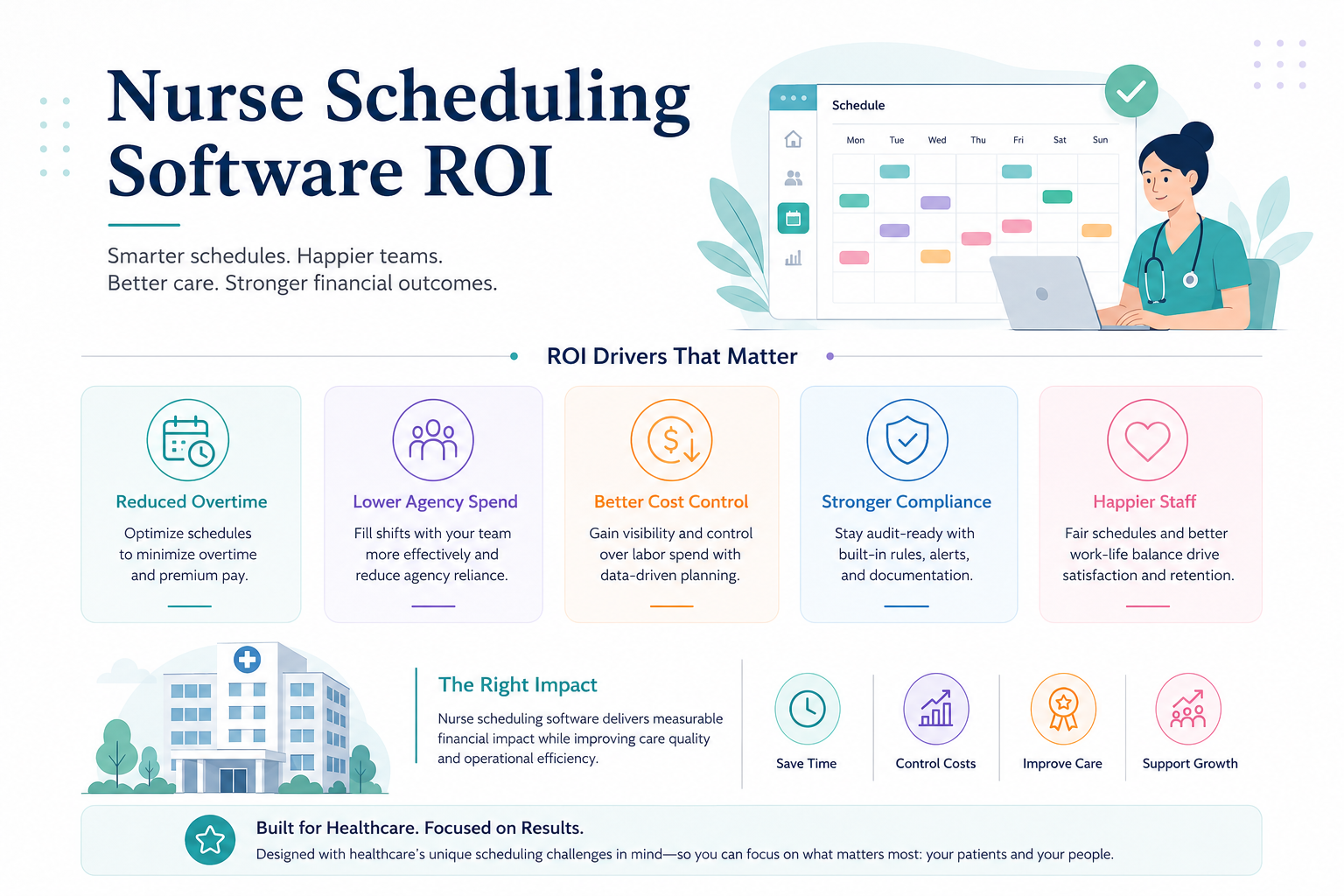
Nurse Scheduling Software ROI: How to Prove the Investment
Establish your current state baseline
Document overtime hours, agency spend, open shift count, scheduler labor hours, float utilization, schedule change frequency, and time to fill, all before implementation starts, so post-launch results have something real to compare against.
Identify measurable savings opportunities
Potential ROI equals overtime reduction plus agency reduction plus administrative savings plus workforce utilization gains. Build each number from your own baseline data, never from a vendor's generic case study.
Separate direct savings from operational gains
Direct savings are dollars: lower overtime, lower agency invoices. Operational gains are real but softer: faster scheduling, better coverage, more visibility. A CFO wants the direct number first and the operational story second.
Calculate the payback period
Divide total implementation investment by annual measurable savings. Most healthcare organizations should expect a payback window measured in months, not years, if the baseline was captured accurately.
Build a three-year ROI model
Compare current state workforce costs against software, implementation, integration, and ongoing operating costs across three years, not one, since year one always carries the heaviest setup cost.
Model conservative, expected, and upside scenarios
Present all three to leadership. A credible business case survives scrutiny because it shows the downside case still works, not just the best case.
How Much Does Nurse Scheduling Software Cost?
|
Cost Driver |
Impact on Price |
|
Number of users |
Higher user count raises license cost. |
|
Number of facilities |
Multi-facility deployment adds configuration cost. |
|
Integration count |
Each integration adds setup time and cost. |
|
Customization level |
Deep customization raises implementation cost. |
What drives software costs
Pricing scales with users, facilities, scheduling complexity, integration count, customization depth, analytics tier, and implementation scope, all of which influence software development cost estimation.
Two hospitals the same size can pay very different amounts based purely on complexity.
Implementation and integration costs
Migration, configuration, integration build, training, and deployment all carry separate cost lines.
Ask for each one broken out, not bundled into a single number that hides where the money goes.
Why license price is not total cost of ownership
Recurring support fees, integration maintenance, and future upgrade costs add up over three years. Nurse scheduling software priced low on license alone can still cost more than a higher-priced platform once total ownership is calculated.
For instance, A vendor quotes a license fee of $40,000 annually but adds $15,000 in integration maintenance and $8,000 in required upgrades every year, pushing true annual cost well past the original number.
What should be included in a vendor proposal
Licensing, implementation, integrations, support, upgrades, training, and any additional usage based fees should all appear in writing before signature.
Implementation Readiness: Is Your Organization Ready?
Is workforce data accurate?
Bad data in produces a bad schedule out, regardless of how strong the platform is.
Are staffing rules documented?
Undocumented tribal knowledge cannot be configured into a system that someone else has to maintain later.
Are credential requirements standardized?
Inconsistent credential tracking across units creates compliance risk the software cannot fix on its own.
Can existing systems support required integrations?
Legacy systems with limited APIs can slow implementation timelines significantly, particularly when organizations are moving toward cloud technology in healthcare.
Who owns scheduling rules after implementation?
Assign clear ownership before launch, not after the first rule conflict appears.
How will success be measured after launch?
Tie success criteria back to the baseline metrics captured before implementation began.
Buy, Upgrade, or Build? A Decision Framework
Keep your current system when
The existing platform meets operational requirements and workforce inefficiency stays limited enough that a new investment cannot be justified financially.
Upgrade when
The underlying platform works but lacks automation, analytics, integration depth, or true optimization logic, and a targeted upgrade closes the gap faster than a full replacement.
Buy specialized nurse scheduling software when
Scheduling complexity has outgrown what general HR, payroll, or EHR tools can effectively manage, and the cost of that gap now exceeds the cost of dedicated nurse scheduling software.
Build custom when
Unique workforce models, complex scheduling logic, deep integration needs, multi-facility orchestration, or strategic Healthcare workforce management platform goals may justify custom software development built specifically for your organization.
Five questions leadership should answer before investing
- What problem are we solving?
- What does it cost today?
- Can an existing platform solve it?
- What must integrate?
- What outcome justifies the investment?
Why Enterprises Trust Patoliya Infotech
As a healthcare software development company, Patoliya Infotech builds nurse scheduling software around real healthcare staffing needs, helping organizations manage coverage, compliance, and labor costs.
- Smart escalation: Prioritizes internal staff before overtime or agency labor.
- Built-in compliance: Considers ratios, credentials, and unit requirements.
- Flexible configuration: Fits your existing workforce structure.
- Cost optimization: Helps reduce unnecessary labor spend.
See how it works with your staffing model.
Conclusion
The right Healthcare workforce management platform solves a measurable workforce problem. It does not just automate the act of building a schedule. Nurse scheduling software earns its cost when it moves an organization from constraint to capability, to evaluated vendor, to proven ROI, to confident implementation, to a decision leadership stands behind.
If your current process cannot answer where overtime comes from or why agency spend keeps climbing, that is the signal to act. Let's talk through what your workforce data is already telling you.
FAQs:
It applies staffing rules, credentials, and demand data automatically to build and adjust shift assignments, replacing manual spreadsheet-based scheduling with rule-enforced, data-driven coverage decisions.
Cost depends on user count, facility count, integration depth, and customization level. Total ownership includes license, implementation, integration, and ongoing support fees, not license price alone.
Ratio enforcement, credential matching, float pool escalation, integration with payroll and EHR systems, real-time analytics, and manager override capability with full audit logging.
Yes. Strong platforms treat ratios as hard constraints that cannot be overridden by preference or convenience, protecting both patient safety and regulatory compliance automatically.
Most established Healthcare workforce management platforms offer direct integrations with major EHR, HRIS, and payroll systems, allowing census, credential, and pay data to sync without manual entry.
Yes. It matches float-eligible nurses to open shifts based on unit clearance and competency, prioritizing internal float coverage before per diem, overtime, or agency staff.
It reduces both by escalating open shifts through cheaper internal options first, float pool, then per diem, then overtime, then agency, instead of defaulting straight to premium labor.
Healthcare staff scheduling software builds shift assignments. Healthcare workforce management platforms connect scheduling with payroll, credentialing, and demand forecasting for continuous, organization wide staffing optimization.
Score vendors on scheduling intelligence, integration depth, float pool capability, and analytics using live scenario testing, not scripted demos, and confirm references from similarly sized organizations.