Healthcare Workforce Management Software: Solving Staffing With Custom Tools
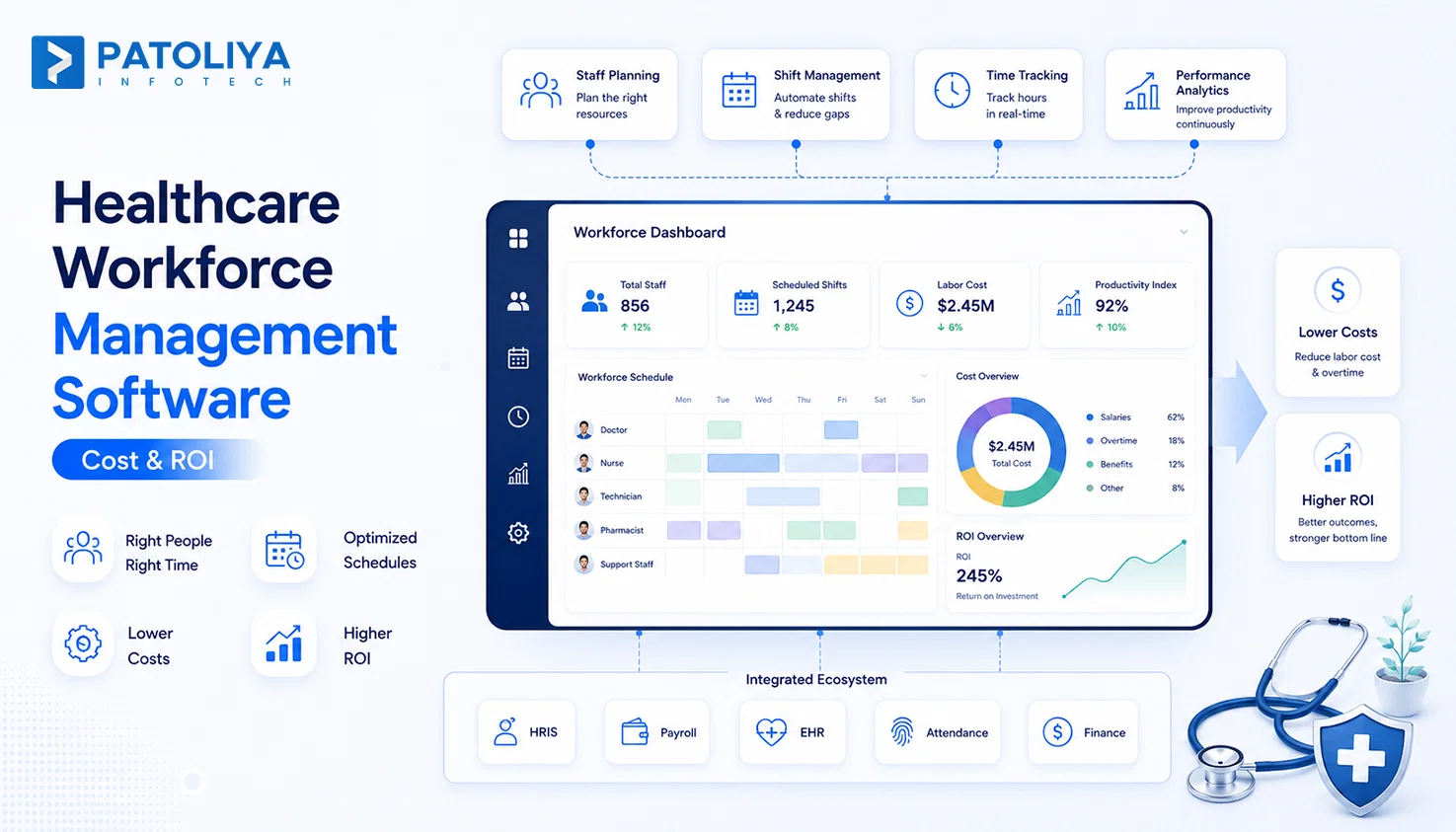
TL;DR: Healthcare workforce costs span overtime, agency spend, open shifts, scheduling, compliance, and turnover. Healthcare workforce management software connects these gaps to improve efficiency, control costs, and guide technology decisions.
Healthcare labor inefficiency rarely shows up as one clear budget item. It is spread across overtime, agency spending, open shifts, unused staff capacity, scheduling work, compliance risks, and turnover. Healthcare workforce management software brings these costs together to improve workforce efficiency and control labor spend.
The decision comes down to measurable value: whether to invest in healthcare workforce management software, improve existing systems, use better nurse scheduling software, or build a solution that fits your specific workforce needs.
This guide helps healthcare leaders evaluate workforce cost leakage, scheduling, staffing compliance, float pool efficiency, ROI, vendor risk, implementation, and the build versus buy decision for staffing ratio compliance software.
The Workforce Problem Executives Should Quantify Before Buying
Where Workforce Inefficiency Actually Appears on the P&L
Overtime, agency and premium labor, unfilled shifts, administrative scheduling hours, excess staffing, and turnover with its replacement costs all sit on separate lines of the budget, invisible to anyone without healthcare workforce management software pulling them together.
Workforce inefficiency is distributed across these multiple cost centers at once, which is exactly why the total economic impact stays hard to see until someone connects every line to one view.
Why Healthcare Creates a Different Workforce Optimization Problem
Executives need to account for a specific stack of complexity for staffing ratio compliance software:
- Patient acuity that changes hour to hour.
- Skill mix tied to the unit.
- Credential requirements by role and state.
- Staffing ratios carrying legal weight.
- Coverage needed 24/7 across every shift.
- Multiple facilities sharing one budget.
- Union and work rule constraints.
- Variable demand nobody can predict a week out.
Generic nurse scheduling software rarely holds up against this stack, which is why healthcare buyers outgrow simple tools fast and move toward true healthcare workforce management software instead.
The Cost of Solving Symptoms Instead of the Workforce Model
Calling staff to fill gaps, increasing overtime, hiring agency workers, and adding administrative staff can look like progress in the moment.
Repeated often enough, these moves treat symptoms without ever addressing the underlying workforce allocation problem, which is why healthcare workflow automation can help organizations reduce repetitive scheduling and staffing processes at the source. Healthcare workforce management software exists precisely to break that cycle at its source rather than patch it weekly.
Where Scheduling Algorithms Create or Fail to Create Economic Value
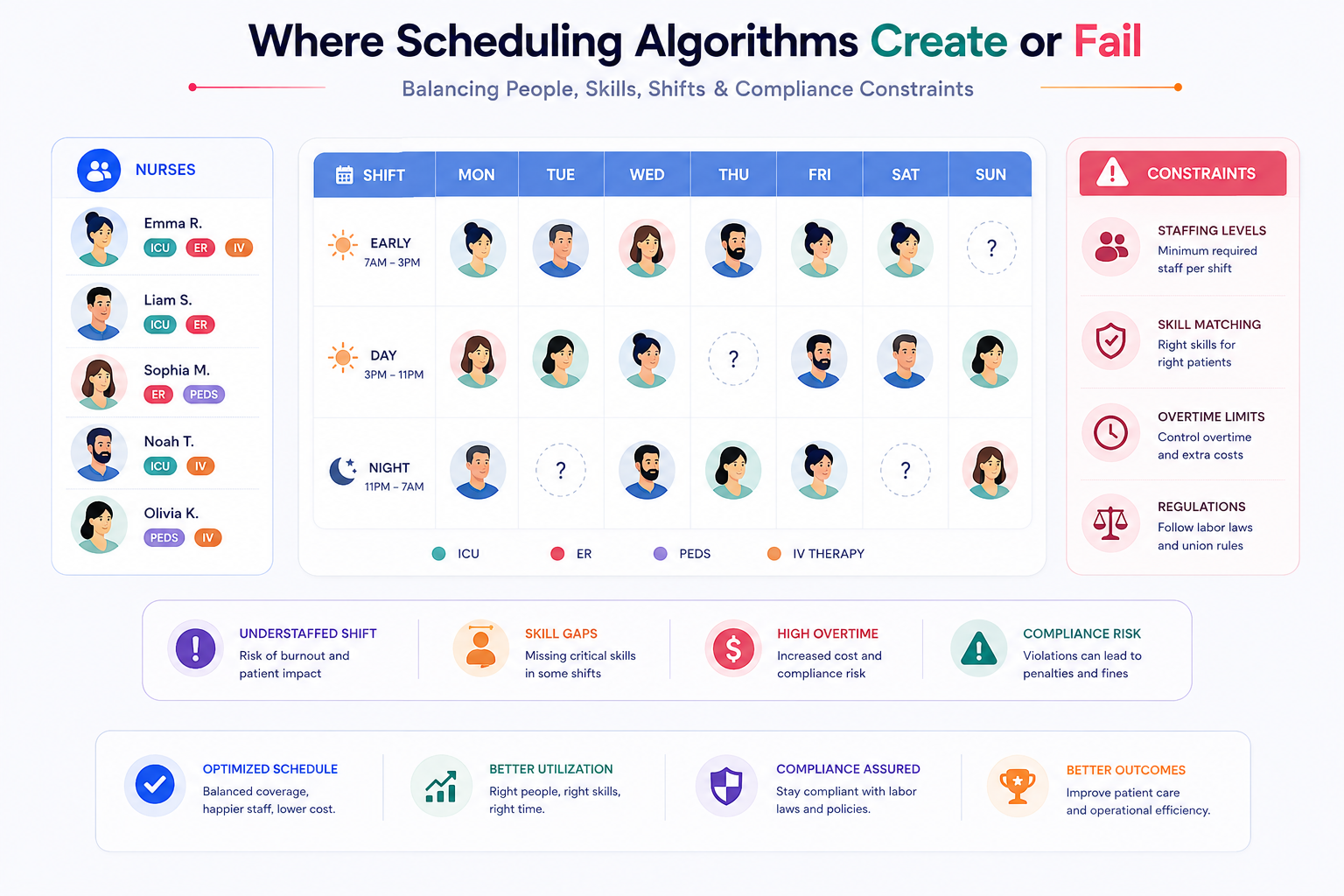
From Availability Matching to Constraint Optimization
Older tools match staff to open shifts by availability alone. A real healthcare workforce management software engine may need to optimize simultaneously for demand, skills, credentials, ratios, overtime, rest, preferences, and cost.
For instance, an ICU short overnight needs a nurse who satisfies demand for coverage and the skills for a ventilator patient at the same time, not one after the other. The important question is not whether the vendor uses AI in healthcare, but whether its AI development services can deliver scheduling intelligence that handles real-world workforce constraints and produces measurable outcomes.
It is what constraints the scheduling engine can actually optimize, and what measurable decision staffing ratio compliance software improves.
Where Automation Stops Being Intelligent
Algorithms, including machine learning in healthcare applications, can still produce poor outcomes when the workforce data feeding them is incomplete, inaccurate, or poorly structured. Incorrect workforce data, incomplete credential information, poor demand forecasts, incorrect staffing rules, and unrealistic optimization priorities all break good shift scheduling algorithms, no matter how sophisticated the underlying model claims to be.
What Buyers Should Ask Vendors to Demonstrate
Instead of accepting a scripted demo, buyers should ask vendors to prove the platform under real conditions. The following points make the evaluation practical:
- A complex staffing scenario.
- A last-minute absence.
- A credential constraint.
- An overtime constraint.
- A shortage across departments.
Watching a healthcare workforce management software platform handle these live tells a buyer more than any polished walkthrough, and it exposes weak nurse scheduling software fast.
Staffing Compliance Should Be Evaluated as a Risk Control System
Can the Platform Prevent a Problem Before the Schedule Is Published?
The staffing ratio compliance software should identify staffing ratio violations, credential gaps, excessive working hours, rest period conflicts, and skill mix problems before the schedule ever reaches the floor, while organizations should also account for applicable CMS staffing requirements.
Is Compliance Logic Configurable and Auditable?
Executives should ask who defines the rules, whether rules vary by department, whether rules change by location, whether exceptions get tracked, and whether an audit trail exists for every override made along the way.
A true staffing ratio compliance software layer answers every one of those questions with evidence, not an assurance from a sales rep during a demo.
The Risk of Treating Compliance as a Checkbox
Compliance support on a vendor feature sheet is not enough on its own, no matter how confidently it reads. The buyer needs to understand the full path from rule to validation to exception to escalation to audit trail, which is a far stronger enterprise perspective than a checkbox on a proposal.
For instance, a nurse gets scheduled past a legal rest period. A strong healthcare workforce management software platform flags it before publication, logs the exception automatically, and routes it to a manager for approval on the spot within minutes.
A weak system only reports it afterward, buried inside a monthly summary once the risk has already happened on the floor and the exposure is real. That single gap separates real healthcare workforce management software from a scheduling app wearing a compliance badge.
Float Pool Management: The Underused Labor Cost Lever
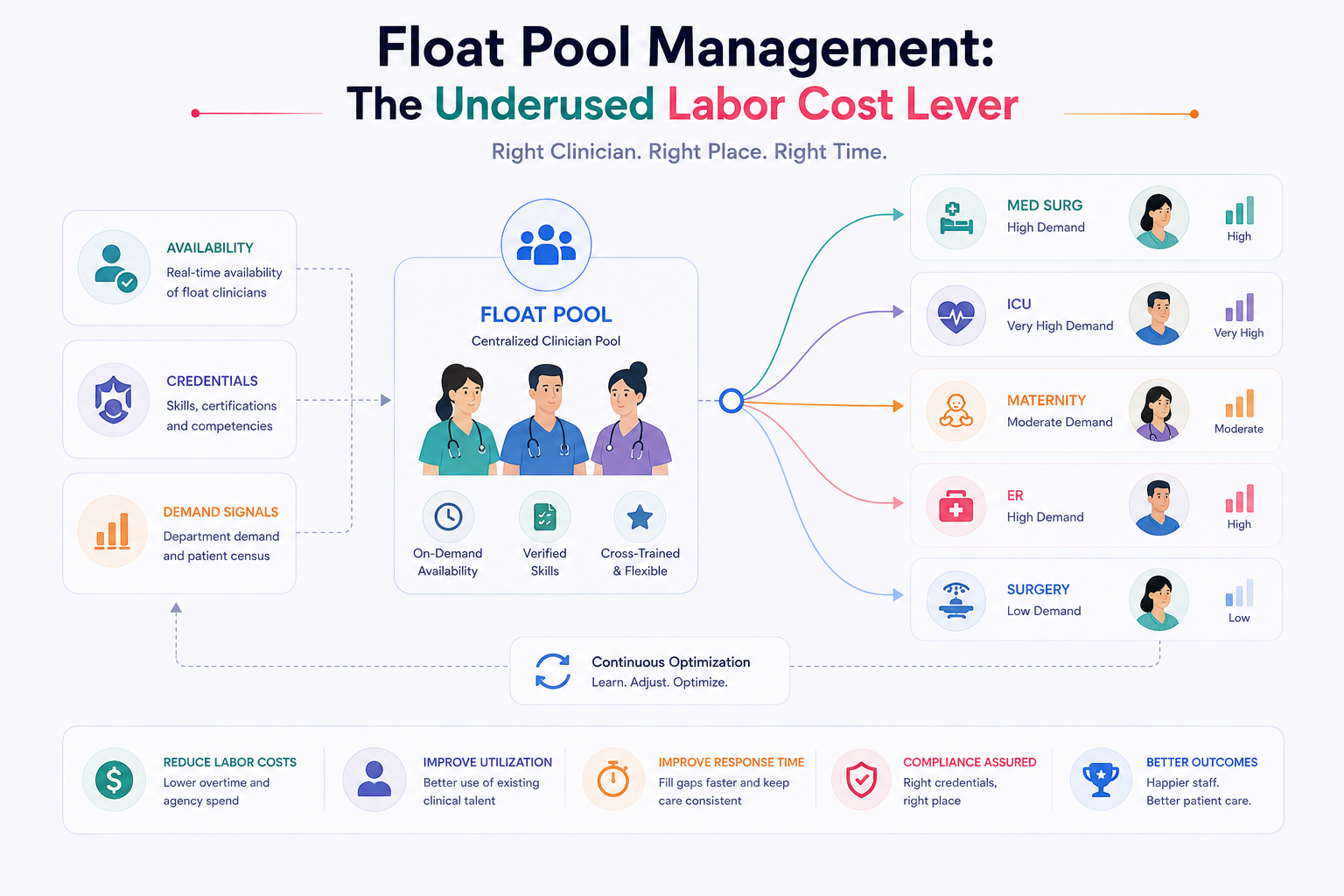
Why Internal Capacity Can Be More Valuable Than External Coverage
The economic logic runs in a clear chain: available internal clinician, credential matching, appropriate deployment, fewer uncovered shifts, potentially lower premium labor. Float pool management works exactly this way when it gets treated as a strategy rather than a feature buried inside a vendor's product list, and most hospitals still treat it as the latter.
What Makes Float Pool Optimization Difficult
Matching float staff correctly requires tracking skills, credentials, location, department, availability, shift timing, and patient demand together in real time, which is precisely why manual coordination breaks down once a hospital system grows past one or two facilities and coordinators start relying on memory instead of data.
The Executive Metrics That Matter
The numbers worth watching:
- Float utilization.
- Internal shift fill rate.
- Agency substitution.
- Cost per covered shift.
- Unused workforce capacity.
Turning float management into a capital efficiency discussion changes how a CFO reads the healthcare workforce management software business case, and it is the single strongest proof point inside most healthcare workforce management software pitches.
A hospital that raised float utilization from 60 percent to 85 percent on high-demand days cut its agency substitution rate in the same window, proving the shift in real numbers rather than a projection.
Clinician Scheduling and Retention: What Can Actually Be Measured?
Separate Burnout Claims From Measurable Scheduling Outcomes
Instead of claiming software reduces clinician burnout scheduling problems on its own, evaluate schedule predictability, overtime exposure, shift distribution, rest period compliance, the frequency of schedule changes, and how often employee schedule preferences actually get honored in the published roster.
These are the outcomes a healthcare workforce management software platform should report on demand, not a promise repeated during a sales pitch by a nurse scheduling software vendor.
Connect Scheduling to Workforce Economics
The chain runs from poor scheduling to workforce dissatisfaction, from dissatisfaction to turnover pressure, from turnover pressure to replacement and recruitment cost.
Nurse scheduling software should be measured against this relationship rather than assumed to cause it, tracked across several quarters instead of one pilot month before anyone draws a conclusion a board can rely on.
Build the Business Case Before You Build the RFP
Establish the Current State Baseline: Before talking to vendors, calculate annual overtime spend, agency spend, premium labor, scheduling administration, open shift volume, turnover, absenteeism, and float pool utilization. Write the numbers down before a single demo happens for staffing ratio compliance software.
Identify the Largest Economic Leak: Don't attempt to optimize everything simultaneously. Ask which workforce problem is costing the most today. For one organization it may be agency labor. For another, overtime. For a third, fragmented scheduling across facilities that never share data.
Define Success Before Selecting Technology: Potential KPIs include agency spend reduction, overtime reduction, open shift fill rate, scheduling administration hours, internal workforce utilization, compliance exceptions, and time to fill.
This creates the baseline against which every vendor proposal for healthcare workforce management software or nurse scheduling software can be evaluated fairly.
Should Your Organization Buy Workforce Management Software?
Buy When the Problem Is Large, Recurring, and Measurable
Strong buying signals for staffing ratio compliance software include material agency spend, high overtime, complex multi-site staffing, large float pools, significant scheduling administration, frequent staffing gaps, poor workforce visibility, and existing systems that cannot solve the problem on their own no matter how they get configured.
Don't Buy Yet When the Economics Don't Support It
Buying healthcare workforce management software is premature if the workforce is relatively simple, existing technology already performs adequately, workforce inefficiency stays financially immaterial, data quality is too poor to trust, or leadership has not established measurable outcomes before shopping.
The Three Questions Before Approval
What problem are we solving?
How much does that problem cost today?
What evidence will prove the investment worked?
This framework is far stronger than telling every healthcare organization it simply needs workforce management software without evidence to back up the claim. A board approves healthcare workforce management software spending once the math is clear, not after a vendor promises it will appear later.
How to Evaluate Vendor ROI and Total Cost of Ownership
Look Beyond the License Price
Calculate the full picture: license plus implementation plus integration plus migration plus training plus change management plus ongoing administration, not just the number on the first quote.
Compare Against the Cost of Inaction
Compare the investment against overtime, agency labor, turnover, administrative workload, unfilled shifts, and inefficient workforce deployment, all of which keep costing money every month a decision gets delayed.
Don't Accept Vendor ROI Without Your Own Baseline
Require vendors to show assumptions, baseline metrics, calculation methodology, customer evidence, and expected time to value before trusting any ROI figure attached to healthcare workforce management software.
|
TCO Component |
Question to Ask the Vendor |
|
Implementation |
What is the realistic timeline for our size? |
|
Integration |
What does EHR and payroll integration cost? |
|
Training |
How much staff time does this require? |
|
Ongoing admin |
What staffing does the platform need after go-live? |
This table fixes the gap most vendor pitches leave open around buy-side ROI and payback.
The Executive Vendor Scorecard: What Actually Determines the Right Choice?
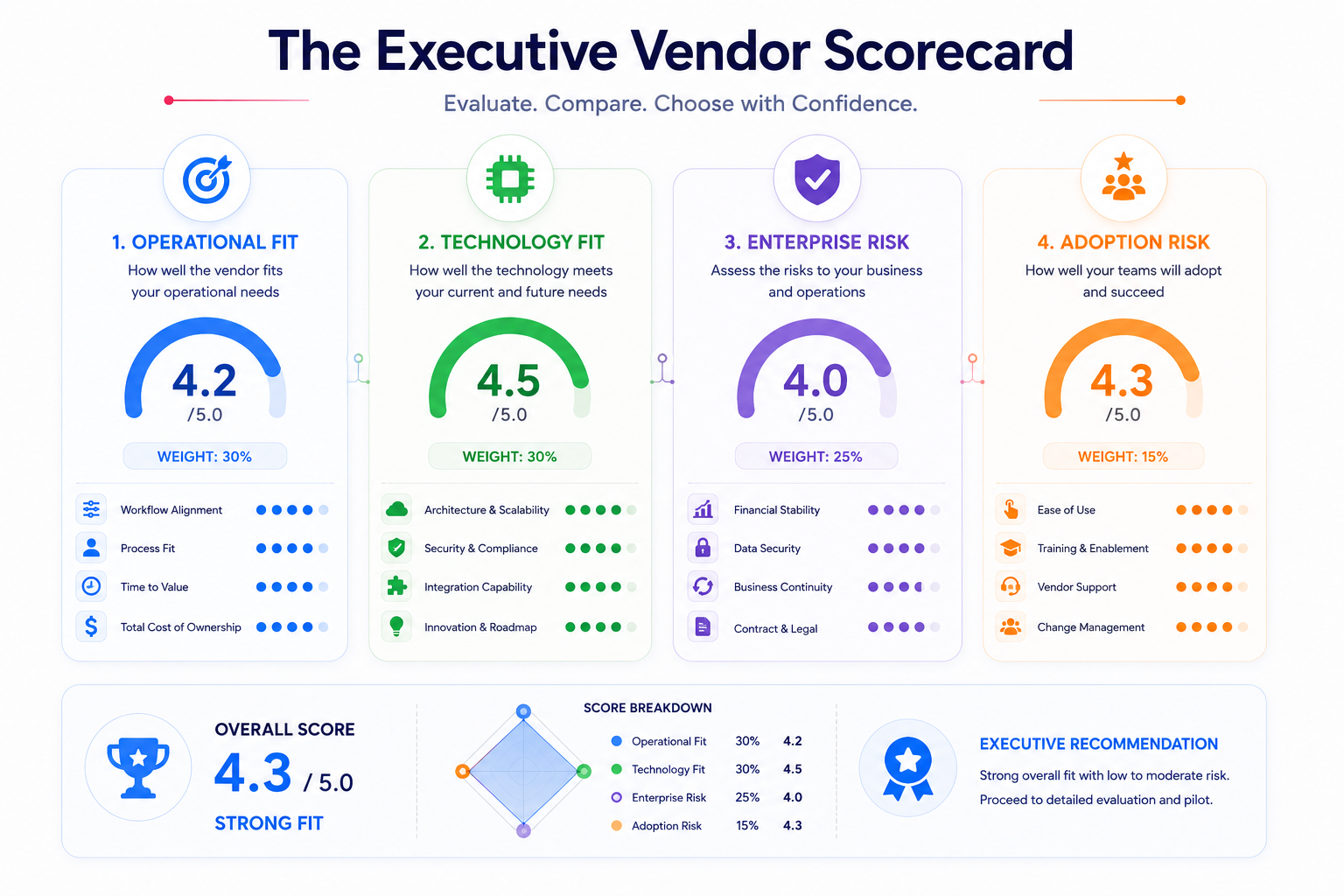
Operational Fit
Evaluate scheduling complexity, workforce rules, float pool requirements, forecasting accuracy, and employee-facing workflows across every department, not just the one shown in a polished demo.
Technology Fit
Check EHR integration, HRIS, payroll compatibility, healthcare API integration, healthcare data integration, data architecture, and identity and access management, since these determine how much internal engineering time a rollout actually consumes.
Enterprise Risk
Evaluate healthcare software security, vendor financial stability, data ownership, contract terms, exit strategy, and multi-year TCO before signing anything longer than a single fiscal year.
Adoption Risk
Ask how much behavior change is required, how much work shifts to managers, and what happens if clinicians don't adopt self-service tools. Healthcare workforce management software only pays off once staff actually use it every day, and adoption risk sinks more healthcare workforce management software rollouts than any technical gap ever does.
Implementation Risk: What Vendors Don't Show in the Demo
Data and Integration Risk: Assess EHR and HRIS integration, employee data quality, credential data, historical schedules, and payroll dependencies before assuming a smooth go-live date.
Change Management Risk: Consider nurse manager workload, clinician adoption, training and workflow redesign, since these hidden costs rarely show up in a vendor's proposal.
Questions to Ask Existing Customers: Ask reference customers whether implementation took as long as promised, what required the most internal effort, what didn't work as expected, and whether adoption matched the original business case for their healthcare workforce management software rollout, and how their prior nurse scheduling software compared once the new platform went live.
Build, Buy, or Customize: Which Path Fits Your Organization?
|
Path |
Best When |
Main Advantage |
Watch Out For |
|
Buy |
Needs are standard and speed matters. |
Faster deployment, proven integrations. |
Limited customization. |
|
Customize |
Workforce logic is unique or strategic. |
Fits complex workflows and can support a healthcare labor optimization platform. |
Higher upfront cost. |
|
Hybrid |
Existing systems work but lack workforce intelligence. |
Adds healthcare workforce management software capabilities without replacing EHR, HRIS, or payroll. |
Requires integration expertise. |
|
Measure First |
ROI needs to be proven before investment. |
Establishes a baseline for overtime, agency spend, and fill rates. |
Requires accurate workforce data. |
Payback comes from stacking smaller gains: fewer agency hours, lower overtime, faster fill rates, and better float utilization.
The Final Executive Decision Framework
The right workforce technology decision depends on the size of the problem, the limitations of existing systems, and the value the organization can realistically achieve.
- Buy now when workforce complexity is high, cost leakage is measurable, and existing systems cannot address the problem effectively.
- Improve existing systems when the problem is clearly defined and your current technology can solve it through better configuration, integration, or data.
- Build or customize when workforce requirements are strategically unique and standard platforms cannot support critical workflows or optimization rules.
- Delay the investment when the problem is poorly defined, baseline data is unavailable, or the expected value does not justify the total cost of ownership.
The goal isn’t to choose the most feature-rich platform, but the option that delivers the highest measurable workforce value at acceptable risk, whether that means healthcare workforce management software, nurse scheduling software, or a custom solution.
Why Choose Patoliya for Healthcare Workforce Management Software
Healthcare workforce management requires more than scheduling features. It needs solutions built around clinical workflows, compliance, integrations, and measurable workforce outcomes.
Patoliya helps organizations with:
- Healthcare-focused engineering for complex staffing workflows.
- Custom workforce intelligence to improve visibility and decision-making.
- EHR, HRIS, and payroll integration without unnecessary system replacement.
- Workforce optimization targeting agency spend, overtime, compliance, and float pool efficiency.
- Flexible build, buy, or hybrid approaches based on business needs.
Patoliya combines healthcare software development expertise with engineering capabilities to create scalable workforce solutions.
The focus is simple: measurable value, practical implementation, and technology leaders can defend.
Conclusion
Healthcare workforce management software should be treated as an operating model investment, not simply a scheduling upgrade. The right decision depends on the size of the workforce problem, measurable cost leakage, compliance exposure, technology readiness, and expected return.
For some organizations, buying an established healthcare workforce management software platform will create the fastest value. Others may need customization or a hybrid approach. The strongest business case is the one leadership can defend with baseline data, measurable outcomes, realistic implementation assumptions, and a clear total cost model.
FAQs:
Measure overtime, agency spending, open shifts, scheduling administration, workforce utilization, turnover, absenteeism, and compliance exceptions to establish a baseline for healthcare workforce management software ROI.
It is worth considering when workforce inefficiencies are financially significant, recurring, difficult to manage manually, and measurable through clear operational and financial performance targets.
Compare total ownership costs against potential savings from reduced overtime, agency labor, administrative workload, turnover, and improved workforce utilization using your organization's baseline data.
Ask vendors to demonstrate complex scheduling scenarios, explain integrations, disclose implementation requirements, provide customer references, and substantiate claims for healthcare workforce management software or nurse scheduling software.
Neither is universally better. Buying suits standardized needs, while customization works better for unique workflows, integrations, optimization rules, or requirements standard nurse scheduling software cannot support.
Choosing based primarily on features or demos while ignoring baseline costs, ROI, implementation risks, total ownership costs, adoption requirements, and measurable success criteria.