Agentic AI vs Generative AI: Maximize Business ROI
 By Hitesh SUpdated on: 11/04/2612 min read
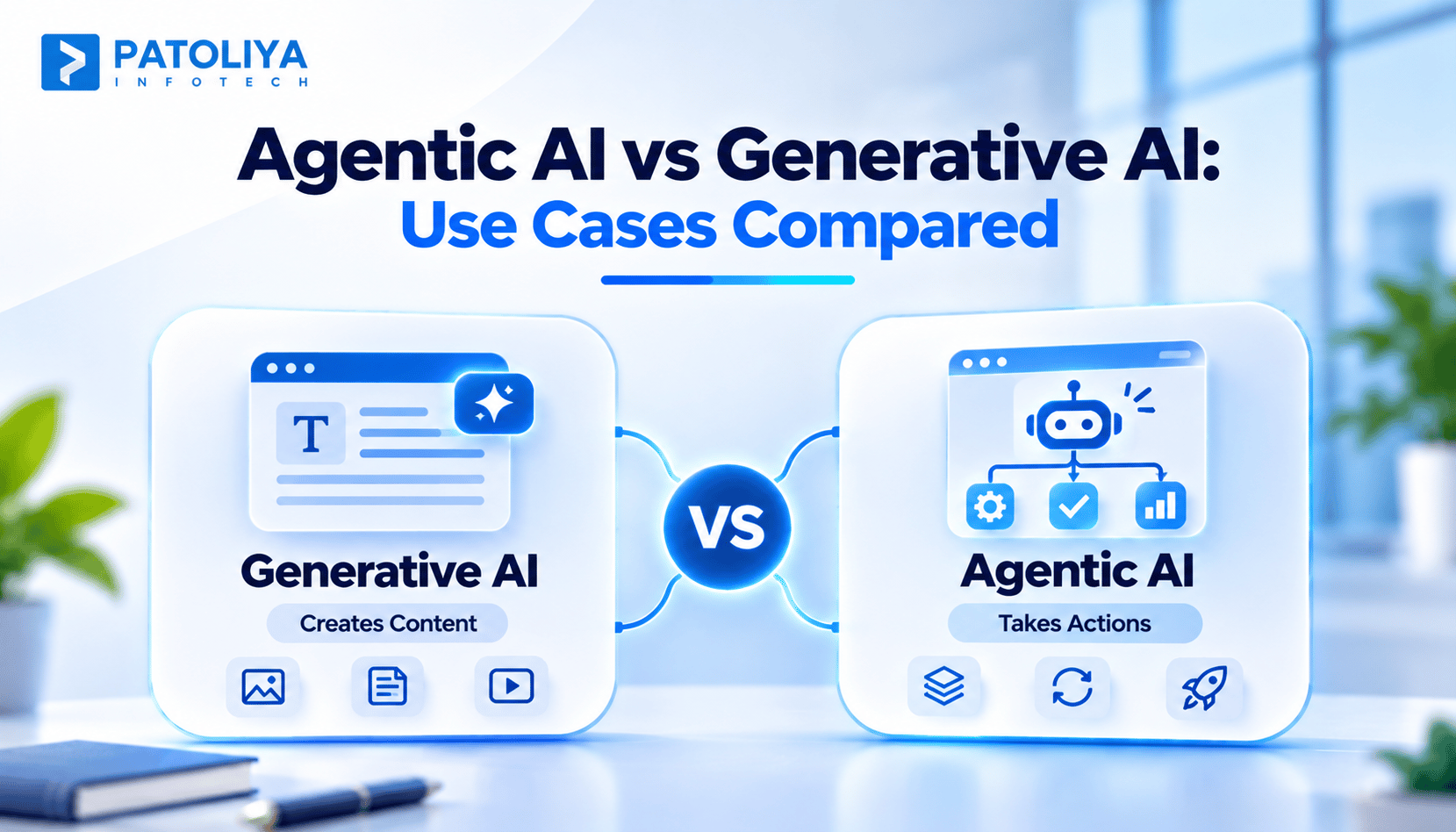
TLDR: The agentic AI vs generative AI debate revolves around one word: agency. Generative AI creates content when asked. Agentic AI has a goal in mind, leverages resources, and takes action within your organization’s processes. Any intelligent roadmap starts from generation and builds its way to controlled agency.
Teams often describe agentic AI vs generative AI as a choice between two technologies. In fact, it is a decision about two purposes.
It distinction is quite straightforward. While generative AI produces content in the form of text, code, images, or summaries, agentic AI acts towards a certain goal and relies on a series of planned actions, tool usage, and decisions within multiple steps.
Here’s what most vendors fail to consider. The agent will operate under an LLM identical to that used by a chatbot. The underlying model remains unchanged. It’s the surrounding system that is different, and it’s the system that determines how autonomous the AI will be.
That means the agentic AI vs generative AI discussion is one of process and workflow, not necessarily models. This guide looks at the workings of each, their differences, applications to business, the associated risks, and how to develop a roadmap starting small.
What Are Generative AI and Agentic AI, and How Do They Work?
Generative AI predicts and creates output based on a prompt as well as context you provide. The large language model processes your command, documents found via search, and the conversation so far and generates an answer one token at a time.
Such a workflow is applicable for various tasks, including writing emails, posts, product descriptions, document summarization, call summarization, ticket classification, extraction of form fields, and answering knowledge base questions using RAG pipeline.
When comparing agentic AI vs generative AI, the result still requires verification. Both can produce incorrect outputs with high confidence; therefore, facts, figures, and policies should be validated before taking any action.
Example: A support assistant processes a 40 message thread, summarizes the problem, and composes a response. An employee revises it and sends. This is a clear example of generative AI vs agentic AI: helpful words, no action at all.
Now, here’s how agentic AI breaks down into components. An agentic system has goals and acts towards them in multiple phases.
An agent's ability to interact with external tools and enterprise systems also introduces security considerations. AWS outlines several security practices for agentic AI, including access control, threat modelling, and limiting agent capabilities.
For instance, a request is made for a refund. The agent retrieves the order information, looks up the company’s refund policy, processes the refund, and asks the manager for approval before doing anything.
It’s that approval process that makes agentic AI vs generative AI different in practice. In any fair comparison, oversight should be considered. Here’s a list of agentic AI features to keep in mind.
How the two approaches relate
Generative AI is a feature found in most agents. Agentic behavior is an effect of the architecture surrounding the model: tools, control flows, and permissions. Using a larger LLM doesn’t turn a chatbot into an agent. This is the heart of the distinction between agentic AI and generative AI.

The same holds when several agents share one goal. Multi-agent systems add coordination between agents, but each one is still an LLM wrapped in tools, rules, and permissions.
Agentic AI vs Generative AI: Key Differences Explained
This table shows the difference between agentic AI and generative AI across eight dimensions that matter to a business owner. Bookmark it for your next vendor call.
|
Dimension |
Generative AI |
Agentic AI |
|
Primary purpose |
Generate content or responses |
Achieve a defined goal through actions |
|
Typical input |
Prompt, question, or context |
Goal, constraints, context, and tools |
|
Workflow |
Generate, review, refine |
Plan, act, observe, continue |
|
Tool use |
Optional |
Usually central |
|
Autonomy |
Responds to requests |
Runs several steps within set permissions |
|
Output |
Text, images, code, summaries, data |
Completed tasks, changed records, decisions |
|
Human role |
Reviews or uses the output |
Approves, supervises, or steps in at set points |
|
Main risk |
Wrong, biased, or misleading output |
Output errors plus wrong actions and chain failures |
Treat these as typical patterns. Plenty of generative AI apps call tools, and many agents run on a very short leash. When people search for agentic AI vs generative AI, this table is usually what they need first. The generative AI vs agentic AI line blurs at the edges, and that’s fine.
Planning, tool use, and autonomy
In agentic AI vs generative AI terms, generating a response is one step. Running a workflow is many steps, each depending on the last. Invoice processing shows the gap clearly.
Generative AI version: The model reads a PDF invoice, extracts vendor, amount, and line items, and writes a summary for the finance team.
Agentic version: The agent pulls the matching purchase order, compares it with receiving records, flags a quantity mismatch, and routes the exception to a reviewer. If permitted, it updates the record and starts the payment step.
That’s agentic AI explained through one real task. Notice the extra moving parts: three systems, a comparison rule, and a routing decision. The agentic AI vs generative AI cost gap is real too: three integrations versus one model call. Finance feels the change on day one, with fewer emails and more decisions waiting in a queue.
A plan never guarantees correct execution. Each action needs validation, and a structured LLM evaluation process shows how often each step actually gets it right. Anything that moves money should wait for a human. The difference between agentic AI and generative AI shows up most clearly here, in what happens after the words are written.
Can a system be both generative and agentic?
Yes, and the most useful ones are. In the case of the agent, the LLM continues to write text, receive instructions, and summarize results.

It is also important to make a distinction between the capability of the model, which dictates what the model can produce or comprehend; the application behavior, which dictates how the software utilizes the model and tools; and the autonomy of operation, which defines what is allowed to be done by the system.
One vendor may sell “agentic” software that drafts emails for users, while another may offer a “chatbot” service that issues refunds. The agentic AI vs generative AI comparison should focus on the system’s level of autonomy and decision-making, never on its product label. This is the most useful test.
Generative AI vs Agentic AI: Which Business Use Cases Need Each?
When you want to generate or comprehend information without altering your business processes, use generative AI. The **Generative AI vs Agentic AI** approach will be appropriate for jobs like marketing texts, product descriptions, document summaries, knowledge assistants, code completions, responses, reports, and form data extraction.
These deliver value with a human reviewing the output and zero write access to business systems. That’s a safe, fast first win. Teams that want this phase shipped quickly often use generative AI development services to launch a first bounded use case. In early agentic AI vs generative AI planning, these use cases often fund the next phase.
Agents fit work that spans several steps and systems, which is where agentic AI vs generative AI stops being theory. Here’s agentic AI explained through five business use cases, each with its goal, tools, and approval point.
|
Use case |
Goal |
Tools and data |
Human approval |
|
Customer support |
Resolve tickets end to end |
Order records, ticketing system |
Before refunds or credits |
|
Procurement |
Match orders, invoices, deliveries |
ERP, receiving logs |
Before releasing payment |
|
IT operations |
Investigate and fix alerts |
Monitoring, runbooks |
Before changing production |
|
Sales operations |
Keep accounts current |
CRM, research sources |
Before emails go out |
|
Supply chain |
Handle exceptions fast |
Inventory, shipping data |
Before rerouting orders |
The difference between agentic AI and generative AI in this table is clear: every row ends in a system change. The approval column matters most. Start every agent with approval on, then relax it only where logs show months of clean runs. If your team lacks integration capacity, AI agent development services can wire up the tools, permissions, and approval gates these flows depend on.
When hybrid strategy works
The majority of actual projects require a combination of both. Generation performs reading and writing tasks, and the agentic layer chooses the next action.
Think of customer feedback. In the agentic AI vs generative AI context, a system might analyze feedback, draft a reply, retrieve the order from a database, and generate a refund request. The request then requires approval based on its amount and your company’s policies.
Some low amount refunds can get automatically approved by the system once more data becomes available. Set this automatic approval threshold in your policy but not in the prompt. This is where the majority of discussions of generative vs agentic AI end up.
How to select the right approach
Use four quick questions:
Need content or answers? Start with generative AI.
Need repeatable actions across tools? Assess agentic AI.
Need both content and controlled actions? Go hybrid.
Need fixed, predictable steps? Try conventional automation first. Our guide on AI agents vs workflow automation covers that call.
Answering these settles most agentic AI vs generative AI decisions in one meeting. Question 4 matters most, since the difference between agentic AI and generative AI means little when a simple rule engine does the job.
How to Prioritize Your Agentic AI Roadmap
Score each of your candidates against these two criteria before you select:
- Frequency of execution and current cost.
- Measurable business impact.
- Availability and quality of data.
- Number of systems involved and number of integrations required.
- Cost of an error.
- Whether success criteria are well defined.
Frequent execution, clear metrics, high-quality data, and low risk of damage from mistakes make for the best first implementation. Select a limited-scope case where you can measure impact and limit the consequences of failure. The scoring will tell you that agents score better in both categories, but for impact and because of their higher risk of failure. For most companies choosing between agentic and generative AI, the first project will be generative.
Move from assistance to controlled execution
Think of autonomy as something the system earns in three stages.
Stage 1, Recommend: AI produces summaries, insights, or suggested next steps.
Stage 2, Draft and prepare: AI gathers context and prepares an action for a human to approve.
Stage 3, Execute with controls: The system performs approved actions within explicit permissions, limits, and monitoring.

Advance to the next stage only when testing proves reliability. For example, a procurement agent should prepare payment holds for review before receiving limited execution permissions. Document these rules in your AI governance framework. This staged approach clarifies agentic AI vs generative AI, building trust through evidence rather than assumptions.
Agents need least-privilege access, human approvals, input validation, action limits, rollback procedures, logging, and monitoring. Test prompt injection and tool failures before deployment.
How Patoliya Infotech Can Help Businesses Plan and Build AI Systems
The agentic AI vs generative AI decision starts with the business outcome, not labels. Patoliya maps workflows to identify whether content generation, retrieval, automation, agentic execution, or a combination fits best. Read our guide to custom AI software development.
Implemention requires approved data sources, API integrations, quality metrics, access controls, approval rules, action logs, failure tracking, and reliability targets. Clear monitoring ownership and LLMOps practices help maintain performance after launch.
Patoliya starts with one use case, clear metrics, and a limited pilot, expanding only when results justify it. That is agentic AI explained in practice: earn autonomy step by step.
Patoliya builds generative solutions with review steps and agents with permissions and audit trails, helping you choose the right generative AI vs agentic AI approach. Bring one workflow to improve, and let’s discuss what it needs.
Conclusion
The generative AI vs agentic AI debate is not an either/or decision. Generative AI produces content. Agentic AI arranges that capability, along with other tools and decisions, to achieve an objective. Both approaches are better when combined. The generative AI vs agentic AI paradigm calls for layers, not competitors.
Choose an approach depending on the value you get, what integration looks like, the risk you can tolerate, and the autonomy you really require. It should be about results, not labels. The distinction between agentic AI and generative AI becomes important in case of failure; design for it from the start. Teams that approach agentic AI vs generative AI as a roadmap issue progress more quickly than those that see it as a technology acquisition.
Take one high-value workflow, test its success, and then determine how much autonomy it requires. Let’s meet and figure out which one first.
FAQs:
The difference between agentic AI and generative AI comes down to output versus action. Generative AI creates text, images, code, or summaries. Agentic AI plans steps, calls tools, and changes records to reach a goal, usually within permissions and human approvals.
A plain chat answering questions is generative AI. When the same assistant browses, runs code, or completes tasks, it behaves agentically. In every agentic AI vs generative AI discussion, the label depends on what the system may do.
Here’s agentic AI explained in one line: software that pursues a goal by planning steps, using tools, checking results, and deciding what to do next. It usually runs on an LLM, plus permissions and approvals that keep its actions safe.
Most businesses should start with generative AI on a bounded, measurable task. Once outputs prove reliable, add tools and approvals step by step. The agentic AI vs generative AI decision should follow evidence from pilots, never hype about autonomy.
Yes, because agents take actions. A wrong summary misleads a reader. A wrong action changes records, sends emails, or moves money. Least privilege access, approval gates, audit logs, and rollback plans keep agentic AI vs generative AI risks in proportion.
No. Agentic systems use generative models inside them for reasoning and writing. The generative AI vs agentic AI framing treats them as rivals, but they work as layers. Generation creates the content. The agentic layer decides what to do with it.