AI Development Outsourcing: Models Compared
 By Hitesh SUpdated on: 11/05/2611 min read
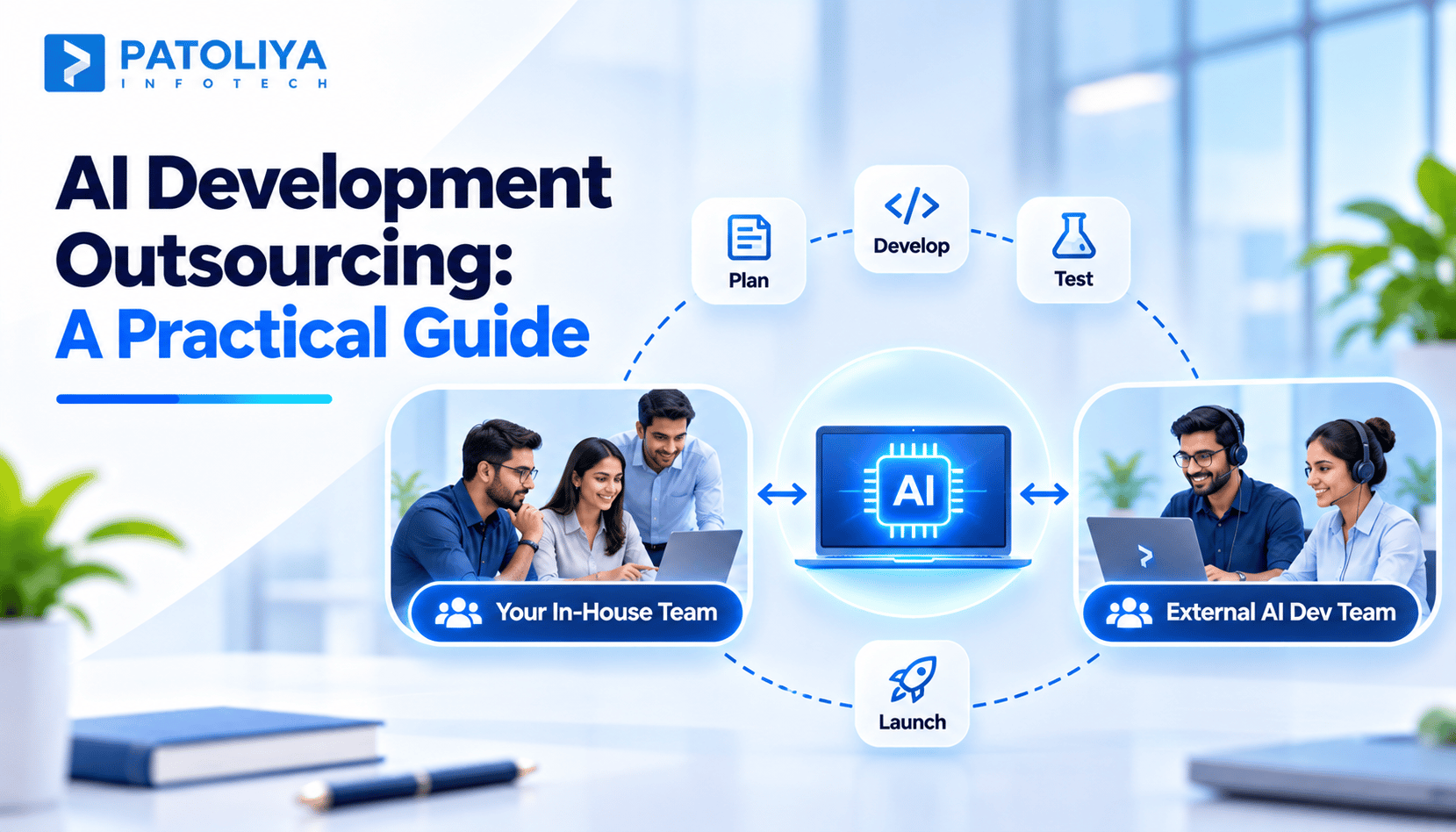
TLDR: AI development outsourcing is most effective if you outsource the execution while retaining ownership. Invite external engineers in case of skills or speed gaps, but retain the strategy, data choices, and release control in-house. Select the engagement model based on the scope stability, and secure the IP rights before writing any code.
AI Development Outsourcing is about assigning an AI project or part thereof to an external vendor who owns the deliverables. It’s not like hiring someone by the hour to work on an AI project. In other words, a contractor occupies a chair, while an outsourced team owns an outcome.
When should you consider outsourcing AI development? Consider outsourcing if you need specific expertise, more resources, and speed that you can’t get with just hiring. Keep strategy, governance, and decision-making within your organization.
The majority of outsourcing AI development failures happen because of a lack of control, not code quality. Done right, it enables you to hire top AI expertise without a year of hiring. This article provides guidance on making three critical decisions: what to outsource, engagement models to use, and how to maintain control from the start.
In House vs Outsourcing AI Development: How to Make the Right Choice
If AI is your product or your competitive advantage because customers prefer it to that of your competitor, then you need to build your in-house team because the expertise will be with you as your models keep improving every month.
The same applies when your team needs constant access to proprietary data, business context, and daily decisions. An ecommerce recommendation engine is a good example. Outsiders can help build it, yet your team must own it. That’s the strongest case against AI development outsourcing for core work.
The timing of AI outsourcing
AI development should be outsourced if the competencies are not available and time is not on your side in terms of recruiting. Hiring a senior ML engineer will take you several months. An offshore AI development vendor will get started in just weeks.

This is also a good option if the task is clearly specified: a prototype, a single production feature, or a well-defined project. A logistics company building a document extraction pipeline does not necessarily require an AI department to achieve the goal.
In house vs outsourced vs hybrid AI teams
The in-house vs outsourcing AI development decision gets clearer side by side.
|
Factor |
In house |
Outsourced |
Hybrid |
|
Cost structure |
Salaries, benefits, tooling |
Contract fees |
Mix of both |
|
Time to start |
Months of hiring |
Weeks |
Weeks |
|
Control |
Full |
Shared by contract |
Strategy internal, delivery shared |
|
Expertise |
Limited to hires |
Broad, on demand |
Broad where needed |
|
Scalability |
Slow |
Fast up and down |
Flexible |
|
Knowledge retention |
High |
Depends on handover |
High, if planned |
|
Long term ownership |
Yours by default |
Yours by contract |
Yours by design |
Hybrid often wins the in-house vs outsourcing AI development comparison. Your product lead sets direction and owns the data, while outside engineers bring depth you’d struggle to hire. Our take on in-house vs outsourced product engineering covers the same trade off for full products.
Tally four metrics: strategic importance, duration of demand, internal capabilities, and data sensitivity. Strategic importance with long duration suggests the need to build in-house. On the other hand, either short duration of demand or lack of internal capabilities suggests AI development outsourcing. The most organizations settle on a hybrid model, which ends up settling the debate for them.
What to Outsource and What to Keep In House in an AI Project
Responsibilities relating to AI that you can outsource
Engineered tasks with defined inputs and outputs are well suited for AI development outsourcing. These include building data pipelines, cleaning data, and integrating models into applications and APIs.
Other tasks involve engineering RAG systems over documents, evaluating and testing models, and managing MLOps, deployment, and monitoring. Businesses can also outsource specialized roles, such as hiring a computer vision specialist for six months.
Differentiate between deliverables and ongoing obligations. “Build a RAG search over our policy library” is a deliverable. “Maintain answers’ quality to meet our target every month” is an obligation, and it requires a separate agreement. For each deliverable, you should develop acceptance criteria before outsourcing your AI development work.
Business Responsibilities that Should Not Be Outsourced
Whoever writes the software, your organization still owns the business responsibilities for product strategy, business needs, access approval, data management, privacy choices, risk assumptions, and release decisions.

Execution may be outsourced, but responsibility cannot be. If there is an incorrect credit decision by a model, it will be your business that regulators and customers reach out to, not your vendor. Good outsourcing partners for developing AI models encourage you to assign an internal owner to each of these.
Dedicated AI team vs staff augmentation
A dedicated AI team is an outside group that plans and delivers together, usually with its own lead. With staff augmentation, external specialists join your team and work under your direction.
|
Dedicated AI team |
Staff augmentation |
|
|
Who sets priorities |
Shared, with a vendor lead |
Your manager |
|
Who owns quality |
Vendor, against agreed criteria |
You |
|
Best for |
A full workstream or product |
Filling specific skill gaps |
|
Management load |
Lower for you |
Higher for you |
Pick a dedicated team if there is nobody internally capable of handling the AI engineers on an everyday basis. Pick augmentation if a good technical leader requires more manpower. In either case, AI development outsourcing is only successful if an internal stakeholder handles the priorities and dependencies. Our guides on staff augmentation and staff augmentation vs managed services go deeper.
How to Structure AI Development Outsourcing: Costs, Contracts, and Delivery
The contract type defines everything in the context of AI development outsourcing. In the classic discussion between fixed price vs time and materials, the situation is further complicated by AI since experiments are not always smooth.
In the case of fixed price, we get high predictability, low flexibility, and low involvement post-kickoff. The risks in this scenario are very high for changes requests. On the other hand, with time and materials, we get medium predictability, high flexibility, medium involvement, and low change request risks.
Fixed Price applies where the scope, deliverables, and acceptance criteria are crystal clear, such as incorporating a well-proven model in a well-known process. Time and Materials is the best approach in cases where data or new technical insights might shift the course of action. Dedicated Teams are ideal for a growing roadmap. Whatever option you choose, document your change request process in the contract.
One useful model: have a brief period of fixed price discovery, and then switch to time and materials for the development stage. You get a fixed price for discovery and flexibility in development. A retailer working on demand forecasting could have two weeks of fixed price discovery, spot problems in their sales data, and switch to time and materials until they clean up their data. Read more in our guide to the dedicated development team model.
Evaluate total cost, beyond developer rates
However, hourly rates represent but one side of the coin. The total cost of AI development outsourcing includes discovery and requirements, data preparation, cloud computing and model API usage, evaluations, security assessments, as well as future maintenance and retraining.
Estimates of AI costs have their uncertainties. Until someone actually opens the data, nobody knows what shape it is in. Be skeptical about any rigid estimates offered before the data assessment and ask how vendors deal with uncertainty.
The low cost rates for outsourcing AI development and three iterations of rework eliminate any benefits from savings in the first place. Request the cost estimates from each AI development outsourcing provider on a per phase basis, not on an overall cost basis. In-house vs outsourcing AI development cost calculations will be completely different.
If you’re comparing offshore AI development partners, our list of IT outsourcing companies in India and the guide to nearshore vs offshore software development help frame the choice.
Protect IP ownership, data, and confidentiality
AI IP includes not only source code. AI development outsourcing is fraught with many troubles because of uncertain terms related to the protection of intellectual property, since models and prompts are hardly mentioned in standard contract templates. Here is what you need to include in your agreement in detail:
- Source code and scripts of the infrastructure;
- Models created and weights finely adjusted;
- Prompts and system instructions;
- Evaluation dataset and test results;
- Documentation and other deliverables;
sign an NDA before disclosing any data and then ask for the IP assignment in writing, a list of third-party and open-source components with licenses, data processing clauses, access conditions, and the list of tools of AI that can be used on your code. Offshore AI development brings up cross-border data issues, so consider India's DPDP Act and your own.
AI and IP law is still moving. The WIPO page on AI and intellectual property tracks open questions on authorship and ownership. Have a lawyer review the IP and data clauses before you sign.
Set up onboarding and communication cadence
Onboarding is successful if there is a product owner, technical lead, scoped access, documentation, samples, and milestone criteria. Decide on a communications schedule that includes updates, sprint reviews twice a week, decision logbooks, escalation plans, and milestone measures. For overseas AI development, consider scheduling overlapping work times for quicker decision-making, particularly when Indian teams are working with European or American clients.

Plan for knowledge transfer before engagement comes to an end
Knowledge transfer must be part of the contract and not something that will be thought of after engagement. Architecture diagram, deployment procedure, run books, evaluation reports, and handover session must be part of the package. Then do a test. Ask your internal team to deploy a release just based on handover documentation. If they can’t, then you have got weak AI development outsourcing.
Define exit support, credential transfer, access revocation, and who keeps the system running during the handover. Teams that plan to outsource AI development long term and later bring it in house should look at the build operate transfer model, which bakes the handover into the deal.
Why Consider Patoliya Infotech for AI Development Outsourcing?
Patoliya Infotech integrates AI into existing workflows and infrastructure, focusing on practical applications and measurable business value.
We assess scope, skills, and integrations to recommend the right model. Our artificial intelligence consulting services guide strategy, while generative AI development services support implementation.
Expect documented decisions, defined deliverables, and knowledge transfer. You can hire a dedicated development team. For offshore AI development, we plan team overlap and ownership early. Have an AI project in mind? Let’s map the right engagement model together.
Conclusion
A successful AI development outsourcing strategy retains business context, governance, and acceptance within the organization while tapping into outside experience for time and skills.
It begins with problem definition, internal capability assessment, data readiness assessment, selection of the engagement model, terms of IP protection, security, and setting milestones. Whether you opt for full AI development outsourcing or a hybrid model, these steps will ensure that the process remains under control.
The decision of in-house versus AI development outsourcing may be revisited, yet the ownership terms become more difficult to negotiate once the contract is signed. Choose a vendor that values the acceptance criteria over the cost per hour. Want to define the first milestone? Let's talk about your AI development project with Patoliya Infotech.
FAQs:
Outsource when specialist skills are missing, hiring takes too long, or the project scope is clear. AI development outsourcing suits prototypes and integrations. Unsure about in-house vs outsourcing AI development? Start hybrid.
With AI development outsourcing, retain product strategy, requirements, access approvals, data governance, risk acceptance, and release decisions internally. External teams build and test, but your company remains accountable for outcomes.
For AI development outsourcing, fixed price suits defined scopes and acceptance criteria. Time and materials work better when experiments or data quality may change requirements. Many projects combine both.
Before you outsource AI development, sign an NDA and IP assignment covering code, models, prompts, fine-tuned weights, evaluation data, and documentation. Define third-party components, data protections, and access controls.
Offshore AI development can be safe with scoped access, strong contracts, audit logs, and secure environments. Check cross-border data requirements, including India's DPDP Act, before sharing personal information.
In AI development outsourcing, dedicated teams deliver workstreams against agreed criteria, while staff augmentation supplies specialists managed by your team. Dedicated teams reduce management overhead; augmentation offers greater daily control.