AI ROI: A Financial Framework for Business Leaders
 By Hitesh SUpdated on: 10/23/2613 min read

TLDR: Measure AI ROI against a baseline you record before launch, and count every recurring cost. Teams that skip either input overstate their return. This guide shows the formula, the hidden costs, and the decision rules finance expects, so you can test your numbers before approving the budget.
A saved hour only becomes money when it leaves a cost line or lets the business earn more. Most teams celebrate time savings without tracing where those hours go. That habit explains why AI ROI looks strong in a pilot deck and weak in the budget review, because teams count activity and skip cash.
Finance leaders need three inputs to trust the number: a baseline recorded before launch, a full cost that includes run expenses, and a dated schedule for when benefits arrive. This guide shows how to build each input, walks through a worked calculation, and gives you calculator logic to test before you approve a larger budget.
Build a Business Case Finance Will Trust
Separate direct budget reductions from reclaimed capacity, counting freed hours only when they support revenue, avoid overtime, or replace planned spending.
Separate Hard Savings From Capacity Gains
Hard savings leave the budget, and finance accepts them without debate. Capacity gains carry value only after your team moves those hours into revenue work, avoided overtime, or planned spending. Strategic value, such as faster decisions and fewer errors, stays in its own column until you can measure it.
Picture a team that saves 1,000 employee hours in one quarter. Only 300 of those hours replace overtime or move into billable work. The other 700 feel productive, yet they touch no budget line, so they add nothing to the AI ROI calculation.
Hard savings: canceled licenses, lower vendor fees, and reduced overtime.
Capacity gains: hours redeployed into work that earns money.
Strategic value: faster decisions, fewer errors, and better customer experience.
Finance reviews each category separately, so a sound AI ROI report keeps them apart. Your AI business case should open with these three categories, because they set the tone for every number that follows. My advice is to report only hard savings in year one. Treat capacity and strategic value as upside until your data supports them, because a conservative AI ROI survives audits better than an optimistic one.
Record the Baseline Before Launch
Your baseline is the before picture, and it decides every number that follows. Capture cost per task, handling time, monthly volume, and error rate for at least eight weeks before any user touches the new system.
Seasonality distorts results. Invoice volume spikes at quarter end, so compare matching weeks across years or adjust for volume. For each metric, name an owner, a data source, and a measurement frequency. A baseline without an owner falls apart the first time a skeptical CFO challenges it.
Here is the baseline our invoice example uses:
Cost per invoice: $6.00, owned by finance.
Handling time: 12 minutes, owned by the operations lead.
Monthly volume: 4,000 invoices, owned by the accounts payable manager.
Error rate: 4 percent, owned by the quality team.
Locking these figures before launch protects your AI ROI, because nobody can redefine a metric after results arrive. Learning how to measure AI ROI starts with figures that a named owner signs.
Isolate What AI Actually Changed
Credit AI only for the change it caused. A control group that keeps the old process during the same weeks reveals the true effect with the least guesswork.
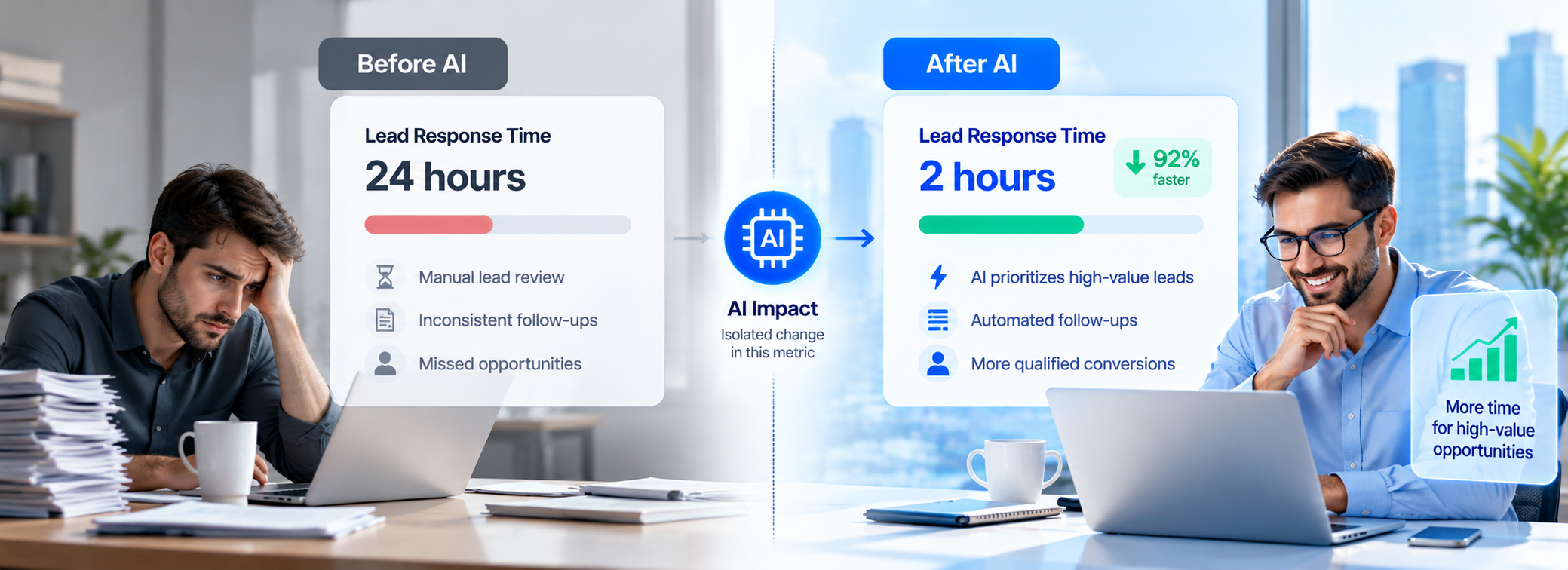
When a control group is impossible, roll out in phases and compare the first team with teams still waiting for access. Write the credit rule down before results arrive, and remove gains that came from staffing changes or seasonal demand. A clean credit rule keeps your AI ROI honest and stops anyone from inflating the result. Strong attribution is the heart of how to measure AI ROI under scrutiny.
Our guide on AI cost attribution explains how engineering teams split usage costs across projects, which makes the credit rule easier to write. Documentation expectations match the transparency principles in the OECD AI Principles, which ask organizations to keep AI systems accountable.
Calculate the Return and Every Cost Behind It
The Formula and What It Measures: AI ROI equals net benefit divided by total cost, multiplied by 100. Net benefit is total benefit minus total cost, so a result of zero percent means you recover your spend exactly.
Keep benefits and costs on the same time period. A mismatch of even one quarter can turn a healthy result into a misleading one. Before you publish any figure, confirm the period, the currency, and the cost base, and read our guide on AI ROI for value realization.
Take a simple case: a project with $120,000 in benefits against $80,000 in total cost returns an AI ROI of 50 percent, because $40,000 divided by $80,000 equals 0.5.
Full Cost Goes Beyond the Build: The full cost covers the build, the run, and the growth. Most teams budget only the build and forget the run, which is where overruns begin. Finance calls this complete figure the total cost of ownership, so use that number in every AI ROI you present. Teams that skip the run cost often present an AI ROI that falls apart in year two.
The total cost includes three stages. Build costs cover discovery, data preparation, integration, security reviews, and change management. Run costs include model usage, hosting, licenses, monitoring, and human review. Growth costs arise as usage increases and require additional spending on exception handling, retraining, and expanded controls.
Assign each hour and each platform fee to exactly one line. If a shared data platform already sits in your IT budget, leave it out of the project cost, so you never count the same dollar twice.
Initial build spend follows the planning steps in our AI development cost guide, and recurring spend after launch follows the patterns in our AI product costs breakdown. Budget run costs for three years, because a one year view flatters your returns and hides the real answer to how to measure AI ROI.
Payback Period and Discounted Value: The payback period shows how many months the benefit takes to recover the upfront investment. Discounting adds a time penalty, because a dollar saved in year three is worth less than a dollar saved today. Discount each year’s net cash at your cost of capital, add those figures, then subtract the upfront cost.
A project can show a strong AI ROI and still take four years to pay back. Discounting the benefit stream also gives a more honest AI ROI than a simple percentage. My rule is to approve only projects that pay back within 24 months.
Worked Example From Hours to Dollars
All figures below are illustrative assumptions, and you should replace each one with your own baseline.
|
Metric |
Calculation / Assumption |
Monthly Value |
|
Monthly invoices |
Given |
4,000 |
|
Handling time before AI |
12 minutes per invoice |
800 hours |
|
Verified time reduction |
50% of 800 hours |
400 hours saved |
|
Financially productive hours |
40% of 400 saved hours |
160 hours |
|
Labor value |
160 hours × $30/hour |
$4,800 |
|
Avoided outsourcing spend |
Assumed savings |
$2,000 |
|
Total monthly benefit |
Labor value + outsourcing savings |
$6,800 |
|
Build and integration cost |
One-time cost |
$60,000 |
|
Monthly run cost |
Ongoing cost |
$3,500 |
|
Monthly net benefit |
$6,800 − $3,500 |
$3,300 |
Payback arrives in about 18 months, because $60,000 divided by $3,300 equals 18.2 months. Over 36 months, benefits total $244,800 against a total cost of $186,000, which produces an ROI of 31.6 percent.
Year one runs at a loss of about 20 percent, since the build cost lands before the savings build momentum. The AI ROI of this project looks weak in year one and strong in year three, so set those expectations with leadership before launch. Following this sequence shows how to measure AI ROI from the first invoice to the final dollar.
Validate Your AI ROI Assumptions
Inputs That Drive the Result
- Your calculator needs six inputs, and each one moves the answer. Enter monthly volume, time per task, verified time reduction, monetized share, implementation cost, and monthly run cost.
- Add an evaluation period, such as 36 months, because that horizon decides how much recurring cost the model counts.
- Each input changes the AI ROI you report, so label each one with its source. Clear inputs make how to measure ROI repeatable for every new project.
- Model usage costs follow the logic in our cost per query analysis. Teams comparing AI agents with simple automation should read that comparison first, since agent workflows usually make more model calls. The AI agent implementation costs guide shows what that build looks like.
Outputs That Support the Decision
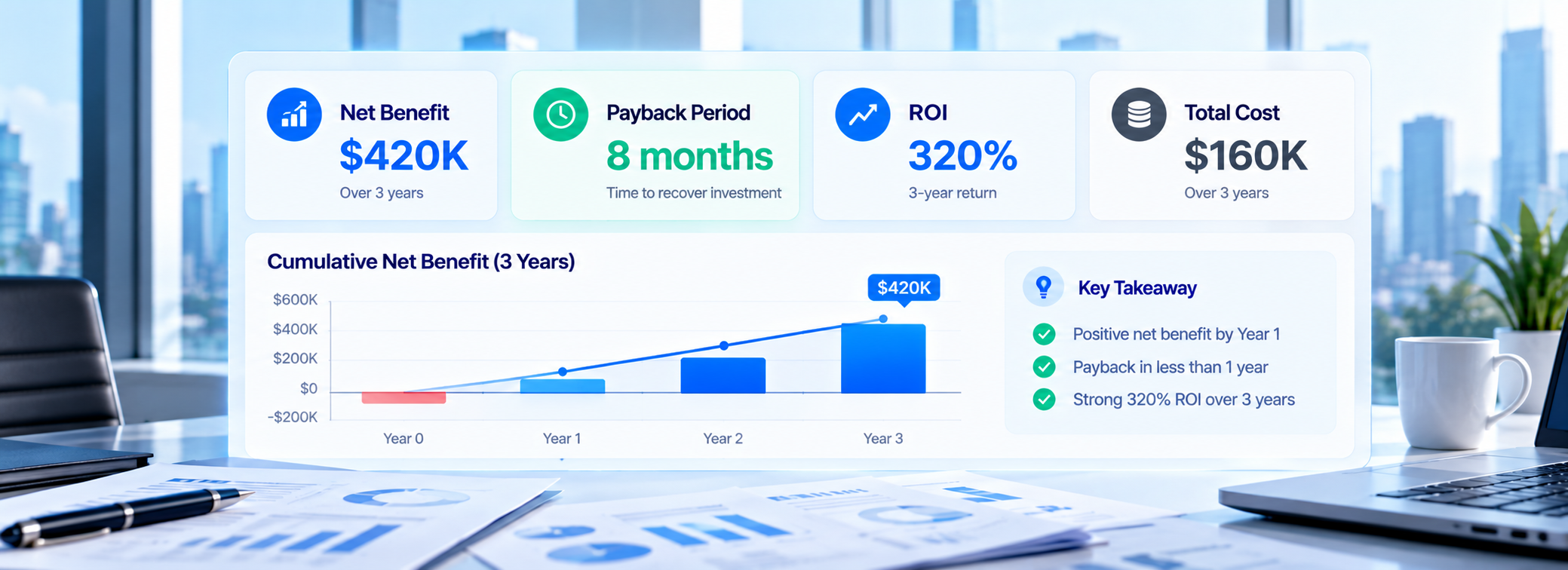
- The calculator turns how to measure AI ROI into a repeatable process, returning six outputs for every scenario.
- The four key decision metrics are a monthly net benefit of $3,300, an AI ROI of 31.6% over 36 months, a payback period of 18.2 months, and a breakeven volume of approximately 2,917 invoices per month, counting labor value only.
- Breakeven volume shows the minimum monthly invoice count that covers the run cost. Use that threshold to judge whether your team reaches it. The outputs feed your AI ROI narrative directly.
Make Assumptions Visible and Stress Test Them
Separate typed values from calculated outputs, and shade each type in a different color. A reviewer then spots every assumption within seconds. Visible assumptions are the core of how to measure AI ROI credibly.
Build three scenarios: conservative, expected, and upside. Only part of the projected gain often arrives in year one, so the table below shows how results change at each realization rate.
|
Scenario |
Benefit realized |
Monthly net |
Payback |
Three-year return |
|
Conservative |
60 percent |
$580 |
103 months |
Minus 21 percent |
|
Expected |
80 percent |
$1,940 |
31 months |
5.3 percent |
|
Upside |
100 percent |
$3,300 |
18 months |
31.6 percent |
Approve on the conservative row and plan on the expected row. A project that clears its conservative case earns trust, and that trust protects the AI ROI when results come in lower than hoped. Prevent double counting by valuing each hour once. If you count the full salary of saved hours, skip any separate labor line for those same hours.
Turn Results Into a Decision Plan
Track operational, financial, and adoption metrics together to connect AI activity with measurable business outcomes and investment decisions.
Metrics That Link Activity to Money
Track metrics at three levels: operational, financial and adoption. Token counts and login totals show that people use the tool, and they stop there. Each level answers a different question about whether the workflow earns its cost. Choosing the right mix is central to how to measure AI ROI across departments.
- Operational: cycle time, first pass resolution and escalation rate. Question: is the work faster and cleaner?
- Financial: cost per completed task, realized savings and operating cost. Question: is cash moving the right way?
- Adoption: usage of eligible workflows, override rate and sustained use. Question: will the gains last?
Measure cost per successful outcome before you measure cost per run, because a cheap run that fails still costs you money. Finance should co-own the financial metric, since that number decides whether your AI ROI survives review. Our guide to AI success metrics lists the metrics teams track during testing, and those lessons carry over to rollout reviews.
A Cadence From Launch Through Review
Before launch: lock the baseline, target, credit rule, and cost owner.
During rollout: track reliability, adoption, exceptions, and cost per success each week, and report the AI ROI monthly.
After launch: reconcile realized benefits with finance at 90 days and again at six months.
Early reviews catch broken integrations, and later reviews reveal whether the AI ROI holds once novelty fades. Learning how to measure AI ROI across teams means repeating this cadence every quarter.
Monitoring after deployment follows the lifecycle guidance in the NIST AI Risk Management Framework, which calls for ongoing measurement. Our AI adoption metrics guide covers how to track usage across teams.
Scale, Fix or Stop Using Thresholds Agreed Early
Scale when value holds, fix when adoption or reliability blocks value, and stop or narrow when verified benefit falls short of total cost. Set those thresholds before launch, because choosing them after results arrive invites bias.
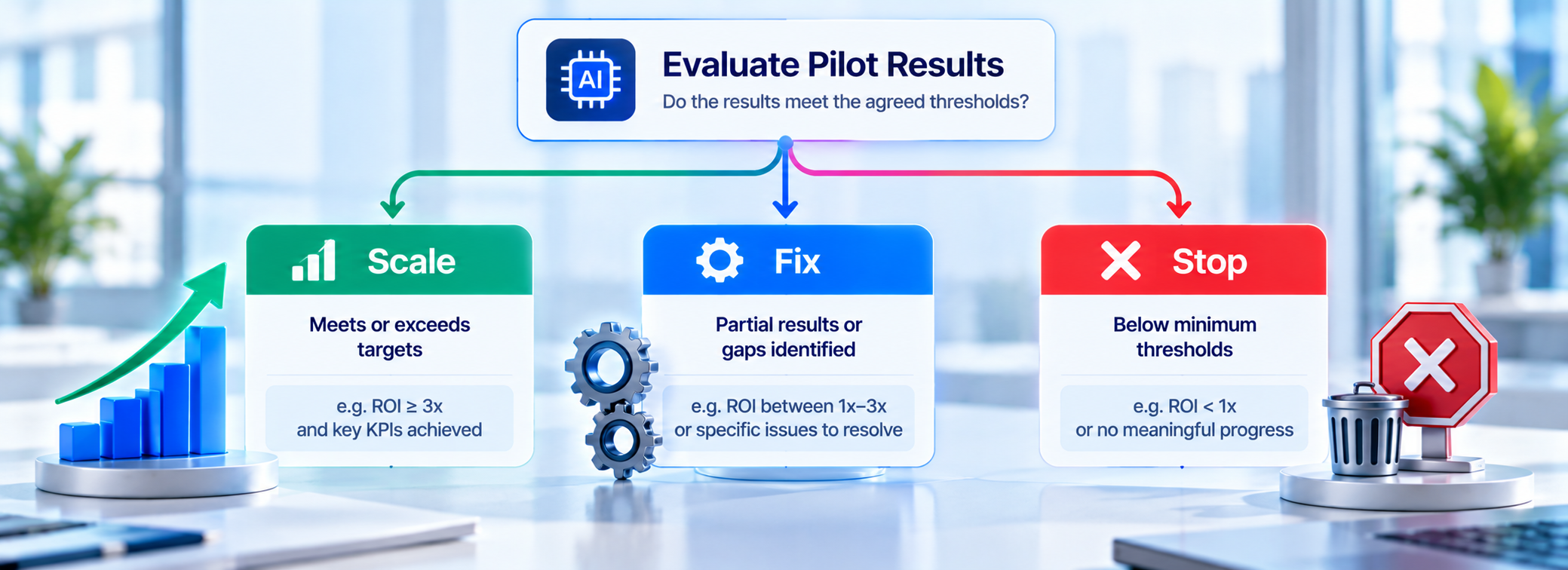
Scale only when AI ROI remains consistent for two consecutive quarters and actual costs stay within 10% of forecasts. Choose to scale when returns are repeatable and human review and other controls work as intended.
Fix the implementation when the business case remains positive but integration or training gaps limit results. Stop or narrow the initiative when verified benefits fall below total costs and no practical fix closes the gap.
Narrowing usually beats stopping, because a smaller scope keeps the learning alive and keeps the business case credible.
Measure Realized Value Before You Celebrate
At Patoliya Infotech, we help businesses evaluate AI ROI against measurable business outcomes, not projected savings alone.
Our approach connects defensible baselines, auditable attribution rules, and complete recurring costs to actual financial performance. Productivity counts as a return only when it reduces expenditure, releases capacity for higher-value work, or improves margins.
Understanding how to measure AI ROI requires validating assumptions against operational and financial evidence before expanding a pilot.
Patoliya helps decision-makers establish the baseline, assess total costs, and define measurable success criteria before committing to a larger AI investment.
Conclusion
Measuring AI ROI is an ongoing financial discipline, not a one-time calculation at the end of a pilot. Business leaders need verified benefits, complete costs, consistent attribution, and evidence that results persist under conservative assumptions. Track realized value alongside adoption, quality, and operational performance to understand whether an AI initiative deserves further investment.
Scale when returns are repeatable, and controls work as intended; fix gaps when potential remains, or stop when evidence no longer supports the business case. Patoliya Infotech helps businesses connect AI initiatives with measurable outcomes and informed investment decisions.
FAQs:
Compare each initiative using risk-adjusted returns, implementation effort, strategic relevance, and resource requirements. Prioritize projects with defensible benefits, manageable risks, and clear ownership of outcomes.
Use finance-approved labor costs, invoices, infrastructure bills, software subscriptions, and operational records. Reconcile these against project assumptions to establish a consistent, auditable view of financial performance.
Compare results against a documented baseline and account for staffing changes, demand fluctuations, and process improvements. Attribute benefits only when evidence supports a reasonable connection to the AI intervention.
Review accuracy, exception rates, user adoption, processing time, and compliance indicators. These measures explain whether financial gains reflect sustainable improvements or depend on unacceptable quality or operational trade-offs.
Redesign when evidence identifies fixable issues such as poor integration, low adoption, or unreliable outputs. Set corrective targets and a review deadline; discontinue the initiative if validated benefits remain insufficient.