Restaurant POS Security: A Complete Guide to PCI Compliance in the Cloud
TL;DR: A compliant POS is not the same thing as a secure one. Restaurant POS security depends on architecture, not paperwork. Operators who treat PCI compliance for restaurants as the finish line usually discover the gap only after a breach.
A restaurant can pass every PCI audit and still get breached the same week. That single fact separates operators who understand restaurant POS security from operators who only understand PCI compliance for restaurants.
Compliance proves that certain controls exist on a checklist. Security proves those controls actually stop an attacker. Cloud POS systems have pushed this gap wider because the boundary of what needs protecting no longer stops at the terminal on the counter.
This guide explains what genuinely matters for restaurant POS security in a cloud environment, what PCI DSS 4.0.1 changes for operators, and how to evaluate whether your architecture can survive a real incident, not just an audit.
Understanding PCI Compliance for Restaurants
Good restaurant POS security starts with a working grasp of the PCI DSS requirements that apply to organizations storing, processing, or transmitting cardholder data.
|
PCI Area |
Restaurant Relevance |
|
Network security |
Protects the payment environment |
|
Secure configurations |
Hardens POS infrastructure |
|
Stored cardholder data |
Minimizes and protects stored data |
|
Encryption |
Secures data in transit |
|
Malware protection |
Reduces endpoint threats |
|
Secure development |
Protects applications and code changes |
|
Access control |
Restricts sensitive systems |
|
User identification |
Makes actions traceable |
|
Physical security |
Protects terminals and infrastructure |
|
Logging and monitoring |
Detects suspicious activity |
|
Security testing |
Finds weaknesses early |
|
Security policies |
Keeps governance consistent |
Which Compliance Level Applies to Your Restaurant
Level 1 covers over six million transactions a year and requires a full onsite assessment.
Level 2 and 3 sit in the middle bands and typically require a Self Assessment Questionnaire plus quarterly scans.
Level 4 covers most independent restaurants under twenty thousand transactions and still requires an SAQ.
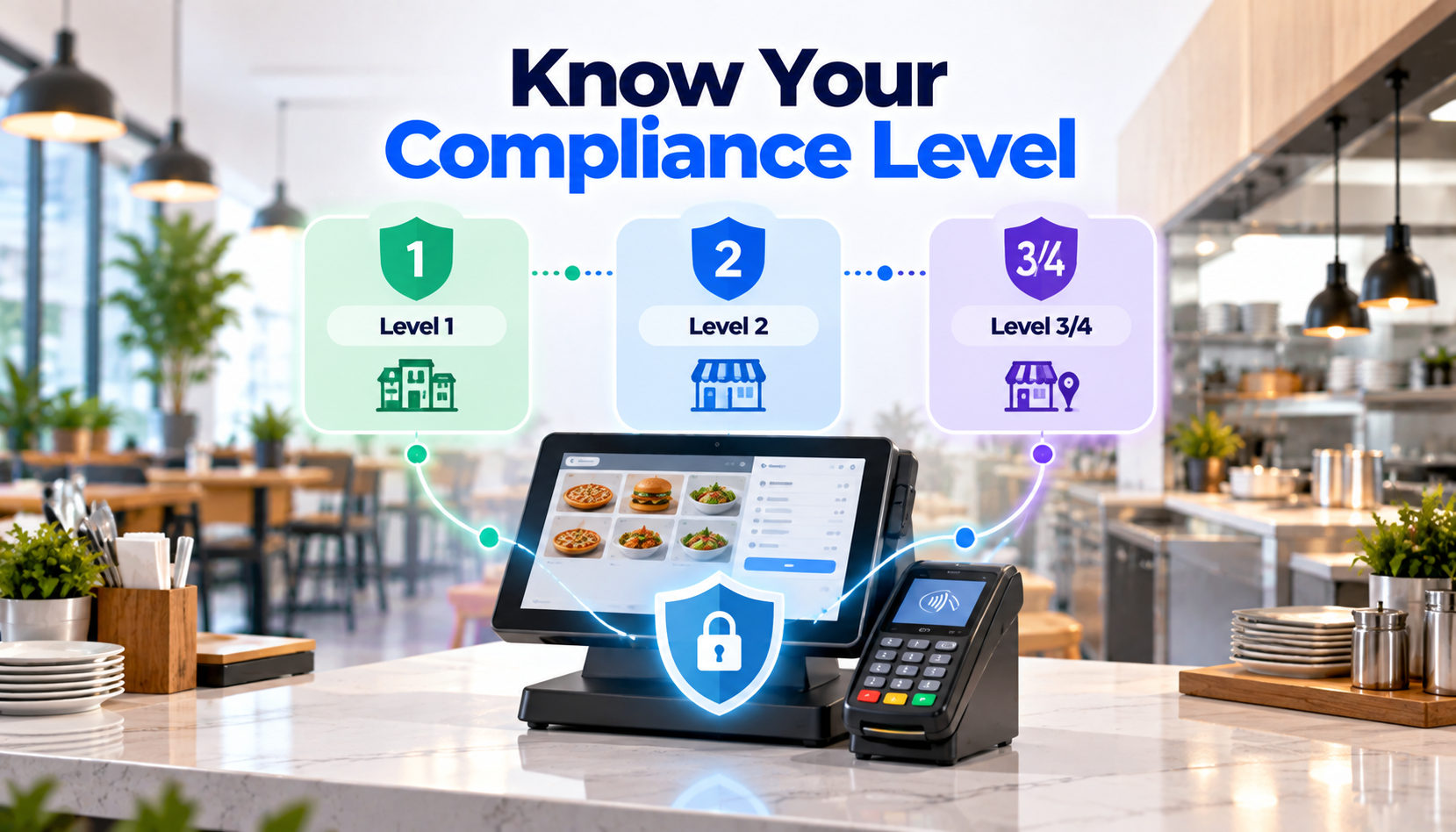
Confirm your level with your processor rather than assuming Level 4 by default. Knowing your level is the entry point for PCI compliance for restaurants, not the whole picture.
What Changed With PCI DSS 4.0 And What Actually Matters for Restaurants
For restaurants, PCI DSS 4.0.1 is less about adding paperwork and more about strengthening authentication, monitoring, and payment security where it matters.
The Controls That Matter Most in a Cloud POS
PCI DSS 4.0.1 did not rewrite the purpose of restaurant POS security. It raised the floor on authentication, monitoring, and vendor accountability, three areas busy kitchens tend to skip under pressure.
- Cloud POS multi-factor authentication for any account that can reach payment systems or back office functions.
- Individual user identification for every staff login.
- Stronger password and authentication requirements across all POS accounts.
- Targeted risk analysis instead of a generic annual checklist.
- Continuous vulnerability management rather than a once a year scan.
- Active logging and monitoring on systems that touch cardholder data.
- Payment page protection for restaurants running online ordering or ecommerce checkout.
Compliance Is Not the Same as Security
PCI compliance means the required controls exist and are documented. Security means your architecture can prevent an attack, catch it early, contain it, and recover fast.
A restaurant can satisfy every control on paper while stolen credentials, POS malware in restaurants, a compromised integration, a flat network, or unmonitored vendor access sit quietly in the background.
PCI compliance for restaurants is the floor, not the ceiling, and treating it as the ceiling is where most incidents start. Restaurant POS security requires you to build past the checklist.
The Business Cost of Getting It Wrong
Skip the fear tactics and look at what actually happens after an incident. You absorb remediation costs, forensic investigation fees, and payment brand penalties.
POS downtime during service kills transactions in real time, and multiple locations going dark at once multiplies the damage. Customer trust takes longer to rebuild than any system does.
Restaurant data breach cost is rarely one line item. It is remediation plus downtime plus the slow bleed of guests who quietly stop coming back. Weak restaurant POS security turns a technical problem into a revenue problem within days.
The Cloud POS Shared Responsibility Problem Nobody Explains
Cloud infrastructure is the vendor’s responsibility. Your restaurant POS security still depends on how you manage local systems and access.
PCI compliance for restaurants has limits. Compliance does not automatically define every security responsibility between you and the vendor.
Your local environment remains yours. Wi-Fi, networks, staff accounts, devices, and permissions require your own controls, while properly designed cloud infrastructure services can strengthen centralized security, monitoring, and access management.
Vendor security has boundaries. Shared passwords, unsegmented networks, and inactive employee accounts can still expose your POS.
Map responsibility system by system. Review every integration, data flow, and access point instead of treating the vendor contract as blanket protection.
P2PE vs Tokenization vs Encryption
|
Approach |
Primary Purpose |
Buyer Consideration |
|
P2PE |
Protects card data across the entire payment path. |
Can reduce your applicable PCI scope. |
|
Tokenization |
Replaces card data with a token after the first transaction. |
Useful for saved cards and recurring payments. |
|
Encryption |
Protects data from being read by unauthorized parties. |
Does not remove your other security obligations. |
Should be highlighted: hearing "we're PCI compliant" from a vendor tells you almost nothing about your own remaining responsibilities. That sentence is a marketing line, not an architecture diagram. Ask for the diagram before you trust any claim about restaurant POS security.
Network Segmentation in a Cloud Hybrid Restaurant Environment
Separate every networked system. Guest Wi-Fi, staff devices, payment systems, KDS, cameras, printers, and admin devices should not share the same network space.
Isolate payment traffic. Put payment systems behind a dedicated VLAN so compromised guest Wi-Fi or kitchen devices cannot reach card data.
Limit attacker movement. Segmentation contains breaches and reduces how far an attacker can move across your environment.
Reduce PCI scope. Proper segmentation can shrink the systems that fall within PCI requirements.
Prioritize segmentation. It remains one of the highest-return controls for restaurant POS security.
Third Party Integration Risk
Every integration expands your attack surface. Online ordering, delivery apps, loyalty, CRM, accounting, and analytics add credentials, API access, and third-party risk, making an API-first approach important for controlling how systems exchange data.
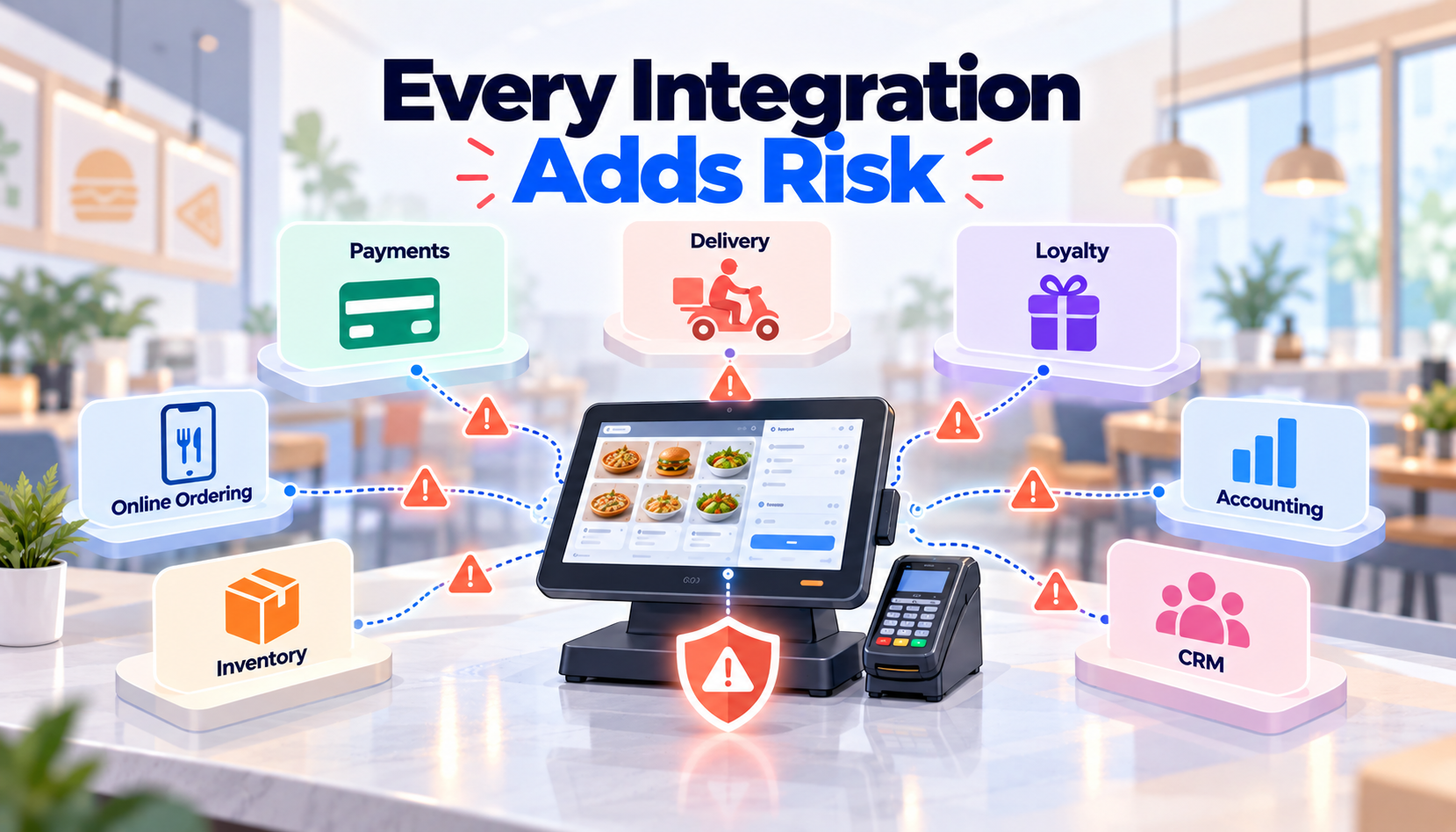
Map data access clearly. Cardholder data protection for restaurants requires knowing which integrations can access payment data versus order information.
Third-party security is outside your control. Each connected vendor brings its own security practices, permissions, and potential vulnerabilities.
Close the visibility gap. If you cannot identify who can access payment data, that uncertainty itself becomes a major restaurant POS security risk.
Remote Vendor Access Is Another Security Boundary
Treat vendor access like employee access. Support accounts, remote sessions, and temporary permissions need the same security controls.
Control every session. Require MFA, least-privilege access, session monitoring, and immediate access revocation after the task ends.
Know who has access. Your team should be able to see who currently has remote access to the POS, rather than relying on a vendor’s hidden access records.
Why Multiple Location Governance Breaks at Scale
- Manual security breaks at scale. What works for one restaurant quickly becomes unreliable across 20 locations.
- Standardization gets harder. POS versions, devices, employee access, vendor permissions, patching, and PCI evidence can vary by site.
- Centralize visibility. Multi-location operations need one view of configurations, devices, access, updates, and compliance evidence, which becomes increasingly important when planning restaurant management software development for multiple locations.
- Treat security as governance. At scale, restaurant POS security depends more on consistent oversight than individual location checklists.
How to Assess the Security Architecture Behind a Cloud POS
Follow the Cardholder Data, Not the Feature List
Map the full path: card, terminal, POS, processor, token storage, connected systems. At every stop, ask five questions.
- Is card data present here?
- Is it encrypted or tokenized?
- Who can access it?
- Where does it live?
- What happens if this exact point gets compromised?
This exercise exposes exposure that a feature brochure will never mention, and it is the fastest way to test restaurant POS security claims against reality.
Measure the Security Boundary
Evaluate every touchpoint separately: POS terminals, back office systems, employee devices, guest networks, kitchen technology, online ordering, loyalty systems, APIs, and remote support access.
Strong architecture keeps clear boundaries between each of these so a failure in one does not become a failure everywhere across your restaurant POS security setup.
Evaluate Security by Failure Scenarios
Skip the checklist questions and ask what actually happens when something breaks:
- Employee credentials get stolen.
- A POS terminal gets infected with malware.
- A vendor account gets compromised.
- Guest Wi Fi gets breached.
- A third-party integration gets compromised.
- Payment services go down mid-service.
- One location has an incident while nineteen others keep running.
Containment and recovery are the real measure of restaurant POS security, not features on a sales sheet.
Look for Evidence
A provider should demonstrate applicable PCI validation, a clear payment data flow diagram, defined responsibility boundaries, access controls, active logging, software testing and QA records, and a documented incident response plan.
A compliance statement on a website is not architectural transparency. Ask for the documentation directly, since real restaurant POS security always leaves a paper trail.
Score the POS on Exposure
|
Area |
Strong Position |
|
Cardholder data |
Minimized or fully isolated. |
|
PCI scope |
Clearly defined and documented. |
|
Access |
Individual accounts, fully auditable. |
|
Network |
Segmented across every system. |
|
Integrations |
Explicitly governed and permissioned. |
|
Vendor access |
Restricted, monitored, and time-limited. |
|
Monitoring |
Centralized across every location. |
|
Incident response |
Defined, tested, and documented. |
What Should You Actually Measure
Liability: Who Is Responsible When Something Goes Wrong
Restaurant POS security decisions belong at the executive table, not buried in an IT ticket queue.
Trace responsibility across the restaurant, the POS vendor, the payment processor, the cloud provider, and every integration partner. Contracts should state this clearly.
Outsourcing a system does not automatically transfer liability, and assuming it does is one of the most expensive assumptions an operator can make.
Audit Burden: How Much Security Must Your Team Continuously Prove
Look at how much manual work goes into PCI evidence collection, access reviews, log management, vulnerability tracking, vendor documentation, and location level compliance reporting.
A well-built architecture reduces this burden automatically. If your team spends weeks each quarter assembling evidence by hand, the architecture is working against your restaurant POS security goals, not for them.
Time to Remediate: How Quickly Can You Fix a Security Gap
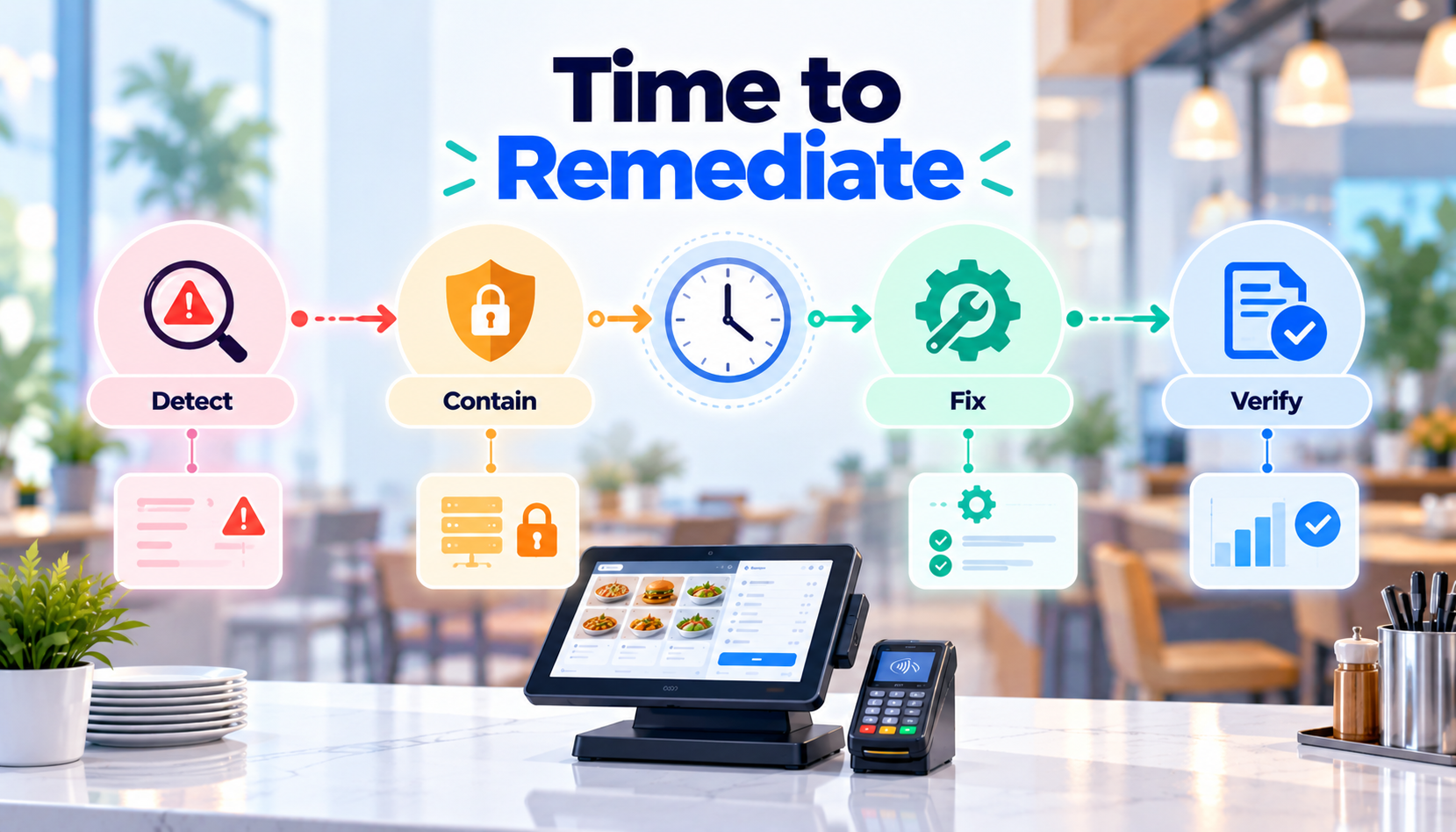
- Who identifies vulnerabilities first, you or the vendor?
- Who owns the fix?
- How fast do patches actually deploy?
- Can policies push out centrally across every location, or does someone visit each site manually?
- Can compromised access get revoked in minutes rather than days?
These answers separate operators who recover quickly from operators who spend months cleaning up one incident, and speed is the truest test of restaurant POS security.
The Five Minute Restaurant POS Security Self-Review
Payment
Cardholder data: Know where payment data exists and minimize unnecessary exposure.
Payment environment: Keep payment systems properly isolated from other restaurant networks.
Access
Privileged accounts: Use individual accounts with appropriate permissions.
Vendor access: Keep third-party access controlled, monitored, and time-limited.
Infrastructure
Network security: Separate POS traffic from guest and operational networks.
Device security: Keep POS devices updated, patched, and properly managed.
Integrations
Connected systems: Maintain visibility into every system connected to the POS.
Third-party permissions: Limit integration access to only the data and functions required.
Governance
PCI evidence: Keep current security and compliance records organized and accessible.
Incident readiness: Maintain a documented and tested response process.
These checks provide a quick view of your restaurant POS security posture but do not establish formal PCI compliance for restaurants.
When Restaurant POS Security Needs Engineering
As restaurant systems grow, security gaps become harder to manage. These signs show when POS architecture needs a stronger engineering approach.
Signs Your Existing POS Architecture Has Outgrown Its Security Model
Legacy POS infrastructure and unsupported devices often remain in service longer than they should, making legacy system modernization an important consideration when security controls can no longer keep pace. Flat networks, shared administrator accounts, and uncontrolled vendor access add further exposure.
Meanwhile, growing integrations go unmapped, PCI evidence is collected manually, and security settings vary across locations. The result is a recurring cycle of the same security gaps and remediation work.
Any two of these together signal that the current setup has outgrown what PCI compliance for restaurants was originally built to handle, and that restaurant POS security now needs a fresh design.
What Modernization Should Actually Achieve
Modernization should raise restaurant POS security on every measurable front, not just refresh the hardware, with custom software development used where existing platforms cannot provide the required security and integration controls. Reduce cardholder data exposure across every system that touches it.
Shrink unnecessary PCI scope wherever possible. Strengthen identity controls for every account with payment access.
Segment critical infrastructure properly. Secure every API and integration point. Centralize visibility across all locations.
Standardize security configuration everywhere instead of location by location guesswork. Speed up remediation timelines. Build genuine operational resilience that survives a bad week, not just a good audit.
When Security Architecture Becomes the Bigger Problem
The real problem is no longer a missing POS feature. It emerges when multiple systems share sensitive data without clear boundaries, while legacy and cloud platforms operate side by side.
Undocumented integrations create hidden data flows, security controls vary across locations, and compliance requires excessive manual effort every quarter.
At that point, architecture assessment and integration engineering matter more than another security add-on purchase, and custom software development services may be required to address security boundaries at the system level.
Patoliya Infotech: Engineering Secure Restaurant POS Environments
Restaurant technology should be engineered with security from day one, with POS security built into the architecture rather than added after launch. Patoliya Infotech brings expertise across cloud POS architecture, payment integrations, secure APIs, identity and access management, cloud infrastructure, POS modernization, multi-location architecture, and PCI-oriented system design.
Our approach is direct: payment, identity, infrastructure, integrations, and daily operations should function as one engineered system, not separate controls stitched together under pressure.
We help operators move beyond checkbox PCI compliance for restaurants toward architecture built to withstand real operational risks. Book a walkthrough to map where your current environment actually stands.
Conclusion
Cloud does not automatically mean secure, and passing an audit does not automatically mean resilient. The real question every operator should ask is how much sensitive infrastructure they are still responsible for protecting themselves.
Strong restaurant POS security minimizes cardholder data exposure, limits PCI scope, controls access, segments systems, governs every integration, and responds fast when something breaks.
PCI compliance for restaurants should be treated as an ongoing operational architecture decision, with security built into the POS environment rather than reviewed once a year.
FAQs:
Yes. PCI validation confirms required controls exist on paper. It does not test whether your architecture stops an attacker or recovers fast, the real measure of restaurant POS security.
No. Your local network, staff accounts, and integrations still carry PCI scope. PCI compliance for restaurants still requires you to map and control what remains on your side.
No. P2PE protects the payment path and can shrink PCI scope, but it does not cover employee accounts, network segmentation, or the rest of your restaurant POS security posture.
Review vendor access quarterly at minimum, and immediately after any staffing change on the vendor side. Stale vendor accounts are a common gap in restaurant POS security reviews.
Scope can expand the moment a new integration touches cardholder data. Every new connection needs a scope review before launch, not after, as part of ongoing PCI compliance for restaurants.
Yes. Centralized governance closes the configuration drift and inconsistent access control that manual, per location management creates once a franchise group passes a handful of sites.