Restaurant Franchise Management Software: What It Actually Takes to Standardize 50 Locations
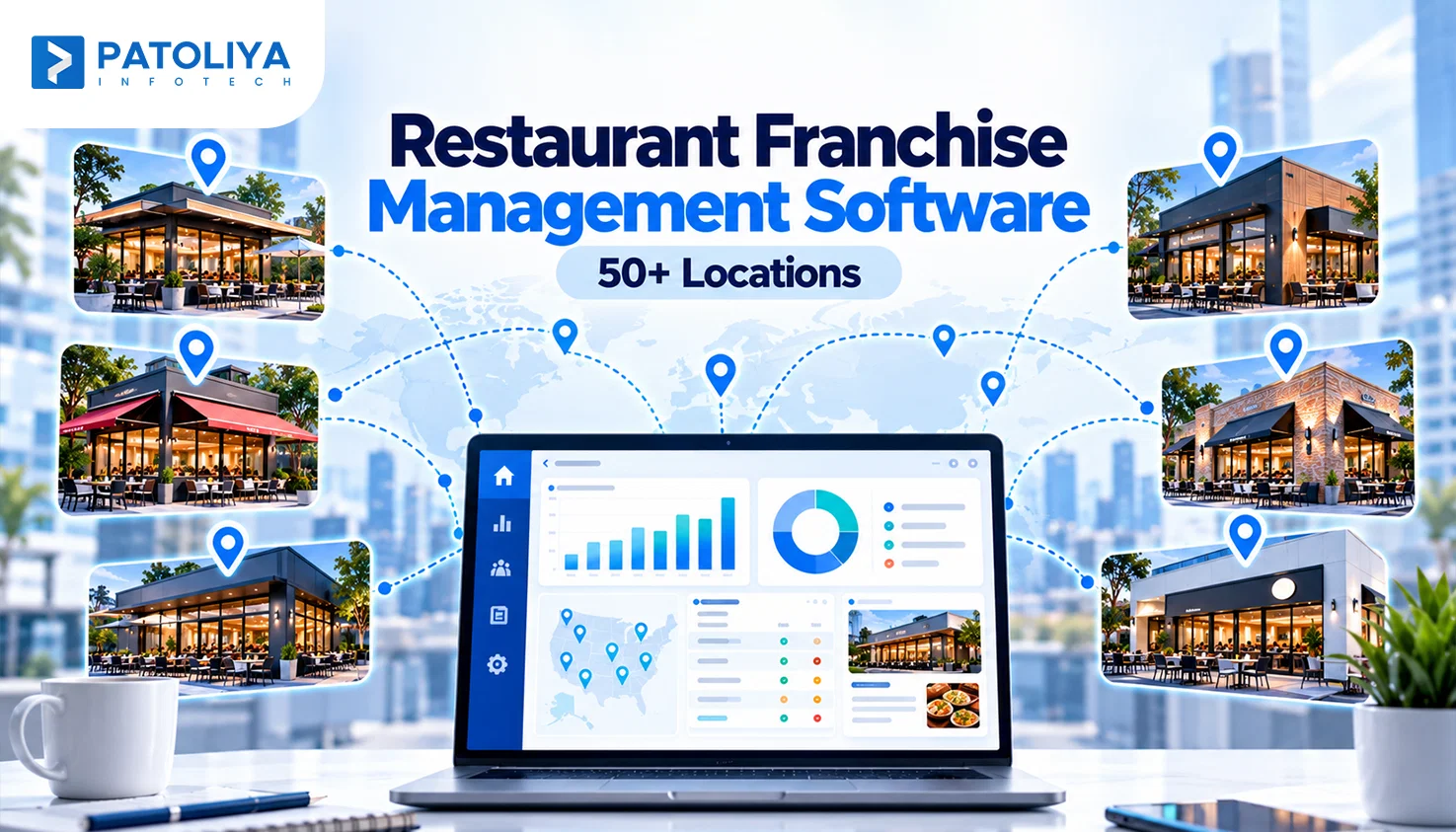
TL;DR: Running 50 locations on spreadsheets is not a system; it is organized guesswork. Restaurant franchise management software turns SOPs, inspections, royalties, and performance data into one governed model, so headquarters sees drift before it becomes a financial problem.
50 restaurants generate 50 versions of the truth once reporting lives in disconnected spreadsheets and inboxes. Manual reporting collapses at this scale because no single person can reconcile fifty sets of numbers by hand every week.
The real objective at this stage is consistent execution combined with controlled local flexibility, not identical restaurants. This article explains what buyers actually need from restaurant franchise management software to run a network that behaves like one business, not fifty separate ones sharing a logo.
What Restaurant Franchise Management Software Actually Needs to Standardize
A serious restaurant franchise management software platform standardizes five layers: SOPs and operating standards, execution and compliance, people and training, financial controls, and performance data.
 Each layer feeds the next, so a gap in training almost always shows up later as a compliance failure or a food cost problem. Franchise inspection software connects layer two to layer one directly, turning written standards into measurable behavior on the floor, not a filed document nobody checks again.
Most franchisors already own pieces of all five layers scattered across different tools, and the actual work is not buying new capability but forcing those five pieces to talk to each other under one restaurant management software
What Should Remain Flexible
Staffing decisions, local supplier relationships, regional promotions, and location specific configurations should stay with the operator on site. Locking these down under one rigid system creates resentment and slows decisions that need local context.
Good restaurant franchise management software draws a clear line between what corporate controls and what the location owns, and buyers should ask vendors to show that line explicitly.
Why 50 Locations Create a Standardization Problem
A document library full of SOP PDFs proves nothing about what happens on the line. The standard needs a full lifecycle: published, acknowledged, performed, verified, corrected.
Restaurant technology should track every stage of that lifecycle per location, per SOP, per employee, so headquarters sees adoption, not just distribution.
Franchisors running this lifecycle inside real restaurant franchise management software catch a broken habit within days, well before it turns into a customer complaint or a health citation.
Standardize the Process
Franchise operators often confuse standardization with uniformity, and the confusion is expensive.
A workable model separates the corporate standard, the regional rule, and the location exception into distinct tiers with clear ownership at each level.
Multi-unit restaurant standardization means every location follows the same process to reach a decision. It does not mean every location reaches the identical decision, and restaurant franchise management software should enforce exactly that distinction.
A location manager who deviates from the process gets flagged. A location manager who chooses a different local vendor within an approved process gets logged, approved, and left alone.
Build One Operating Model Across Every Location
Centralize the Master Data
Every location should pull from the same source inside one restaurant franchise management software record:
The platform maintains a centralized structure for menu and item masters, recipes, vendors, SOP versions, training requirements, inspection templates, and location hierarchies as part of a connected restaurant technology environment.
When master data lives in seven different tools, no two locations are actually running the same restaurant, no matter what the sign outside says.
Version Control Matters
Restaurant franchise management software should answer five questions instantly, for any document, at any moment:
- What changed?
- Who changed it?
- Which locations received it?
- Who acknowledged it?
- Who is still using an older version?
The last question usually predicts a compliance failure before it happens, and it is the single question most legacy tools cannot answer, which is exactly why version control belongs inside dedicated restaurant franchise management software, never a shared folder.
Manage Exceptions Without Creating Separate Systems
Every exception should be tied to the record it modifies, carry a clear approval trail, remain visible in corporate reporting, and never be managed through a private spreadsheet.
An exception that sits outside the system becomes invisible risk that nobody at headquarters can see coming, which is exactly the gap restaurant franchise management software is meant to close.
Connect POS, Inventory, Workforce and Franchise Data
The Data That Needs to Connect
POS data flows into sales and royalty calculations. Inventory data flows into food cost and purchasing accuracy. Workforce data flows into labor cost and training completion. Compliance data flows into inspection scores and corrective actions. Finance data flows into reconciliation and statement accuracy, closing the loop back to the top line.
Every one of these five streams should sit inside the same restaurant franchise management software record, not five separate exports stitched together by hand.
Why Disconnected Systems Hide the Real Problem
A location's profitability drops ten percent in one quarter. Is the cause weak sales, labor overspend, food waste, purchasing errors, a shift in menu mix, or a compliance failure driving refunds? Without a connected cloud franchise operations platform, the answer takes weeks of manual pulling across five separate tools.
With one, it takes minutes because every data point already sits against the same location record. The cost of that delay is rarely the analysis time itself. It is the extra month a struggling location keeps losing money while headquarters is still arguing about which team owns the investigation.
What the Integration Architecture Should Support
The right architecture supports API integrations, open APIs, webhooks, and event driven updates, native POS, HR, and accounting integrations, a central data layer, and role based access by function and region. A cloud franchise operations platform built on scalable cloud infrastructure can grow without adding a new spreadsheet for every new location the franchisor opens.
Turn Franchise Compliance Into Exception Management
From Periodic Inspections to Continuous Visibility: The FDA Food Code provides a model framework for food safety requirements and inspections in retail and foodservice operations.
Restaurant SOP compliance automation shifts the question from whether an inspection happened to which locations show a pattern of deviation right now, based on live data, not a snapshot taken once a season.
Connect Findings to Corrective Action: Every finding needs a clear path: finding, owner, deadline, evidence, verification, closure.
A finding with no assigned owner and no deadline is a note nobody ever acts on, and restaurant franchise management software should never let that gap exist.
Prioritize Locations by Risk: Risk scoring should weigh repeated violations, severity, recency, overdue actions, food safety issues, and training gaps.
Franchise inspection software built around this scoring model tells a regional director exactly which three locations need a visit this week, out of fifty on the books. This scoring logic is the difference between generic restaurant franchise management software and a system that actually earns its place in the weekly operations meeting.
Measure Franchise Onboarding by Time to Readiness
A location needs documentation, training completion, technology setup, POS configuration, vendor agreements, inventory systems, compliance clearance, and staff readiness confirmed before day one, not discovered missing on it.
Restaurant franchise management software should confirm every item on this list automatically, removing reliance on a manager's memory the morning of opening.
|
Category |
Readiness |
|
Technology |
100% |
|
Training |
92% |
|
Compliance |
85% |
|
Staff |
90% |
Classify every location as Ready, At Risk, or Not Ready before locking the opening date, using the same scorecard your restaurant franchise management software already tracks for every other location in the network.
Restaurant franchise onboarding software should report how long a location takes to actually run at standard, not how long it took to finish a checklist.
That number, tracked inside a single cloud franchise operations platform, predicts first year performance far better than a completion percentage ever will, and it belongs on the same dashboard as every other metric your restaurant franchise management software already reports.
Treat Royalty Management as a Data Integrity Problem
For U.S. franchise operations, the FTC Franchise Rule requires franchisors to provide prospective franchisees with specific disclosure information, including information about the franchise and its costs.
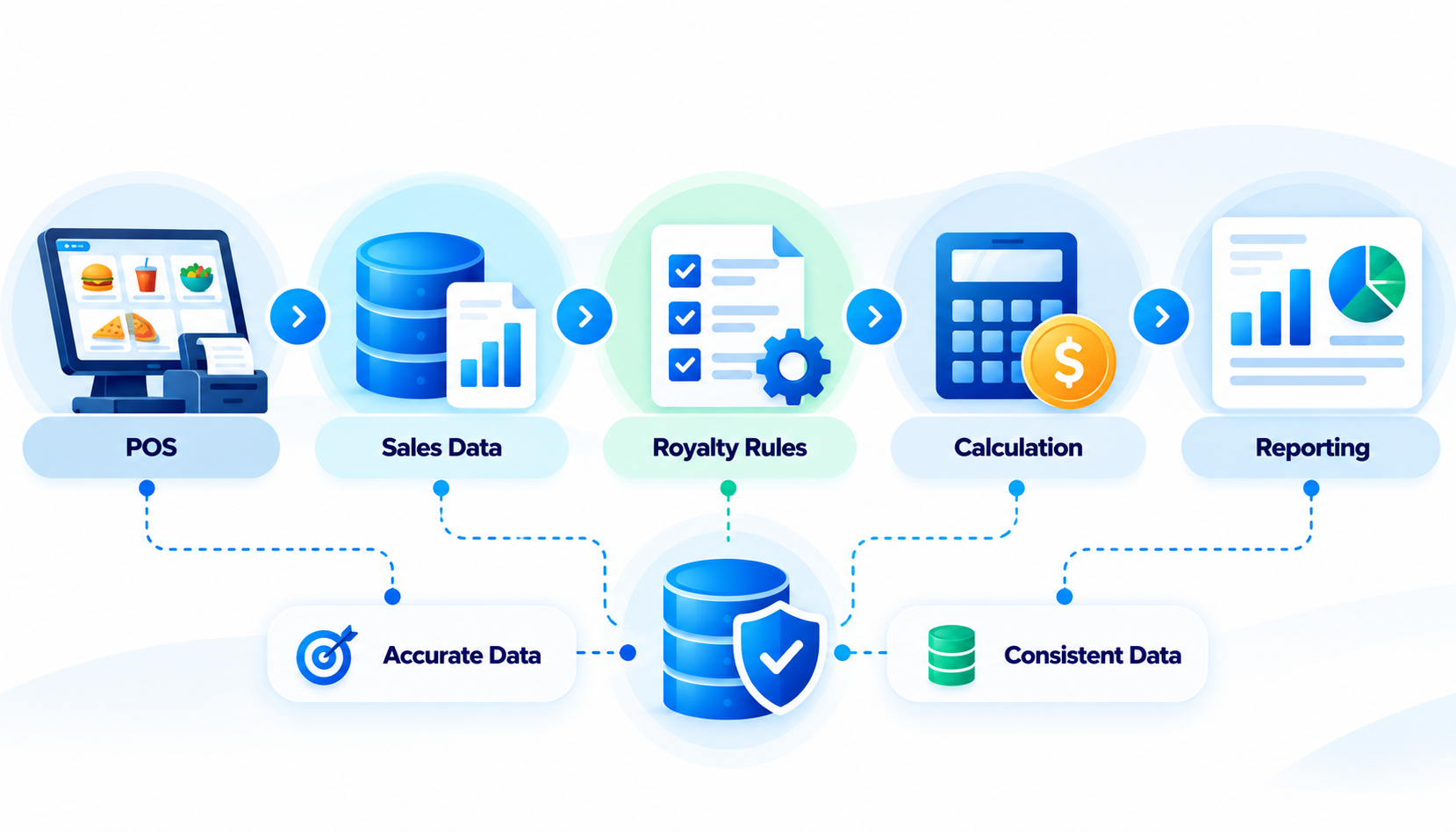
By then, the correction involves back payments, an uncomfortable franchisee conversation, and a legal review nobody budgeted for that quarter.
Connect Royalties to Source Transaction Data
- The calculation should trace a clean path: POS transaction, eligible revenue, contract rule, calculation, statement.
- Franchisor royalty management software applies the correct rule automatically at the transaction level.
- For instance, a 50 unit franchisor running three royalty tiers cut its monthly closing cycle from four business days to under one by automating this exact pipeline end to end inside its restaurant franchise management software.
Maintain an Audit Trail
- Every statement should show source data, rule applied, adjustment, approval, and payment status, for every location, every period, with no manual step in between.
- This is where restaurant franchise management software earns trust with franchisees, since a clean audit trail settles a dispute in minutes, not weeks.
What Should an Executive Actually See?
|
Area |
Metric |
|
Operations |
SOP compliance, inspection score, corrective action aging. |
|
Finance |
Food cost variance, labor cost, royalty collection, revenue leakage. |
|
People |
Training completion, certification gaps. |
|
Growth |
Time to open, time to readiness. |
A restaurant franchise management software dashboard, built on a proper cloud franchise operations platform, should surface every one of these by default, not as a custom report someone builds once a quarter.
Compare Exceptions
Show top performers, declining locations, high-risk locations, and locations requiring direct intervention, side by side, updated continuously, never once a quarter. A single cloud franchise operations platform makes this comparison routine, not a special project someone runs before a board meeting.
Give Executives the Why
A dashboard reporting "Location 27 has 82% compliance" tells an executive almost nothing. A dashboard built correctly reports "Compliance dropped 14% because of repeated food safety failures and overdue corrective actions." That sentence is the difference between generic analytics and restaurant franchise management software that actually drives a decision.
The first version invites a meeting. The second version invites a phone call to the regional director before the meeting is even scheduled, which is the entire point of putting this data in front of an executive in the first place.
How to Know If Your Franchise Is Ready for This Software
Spreadsheet-based reporting becomes a warning sign when regional teams still depend on manual reports to run day-to-day operations.
Inconsistent inspection tracking shows that the network has outgrown manual processes when managers use different tools and methods to monitor compliance.
Email-driven onboarding becomes a problem when opening a new location still depends on long chains of emails that are difficult to track or archive properly.
Manual royalty reconciliation creates unnecessary operational effort when franchise fees still have to be calculated and reconciled by hand every month.
Multiple SOP versions create execution risk when different regions are working from different versions of the same operational standards.
Inconsistent KPI definitions make performance difficult to compare when the same metric means something different across markets or locations.
Delayed problem visibility is often the biggest warning sign because issues become visible only after they have already affected revenue, compliance, operations, or brand consistency.
Three or more of these signs appearing together is a strong indication that the network should prioritize restaurant franchise management software sooner rather than later.
When You May Not Need a Full Platform
A full platform may not be necessary for a small network with a simple royalty structure, direct headquarters control, connected systems, and low compliance complexity.
Buying before complexity demands it can create unnecessary costs and operational overhead, so the technology investment should match the network's actual needs.
The Real Readiness Question
The real readiness question is whether headquarters can identify execution drift early enough to prevent financial, operational, or brand impact.
If headquarters cannot identify that drift early, manual processes are no longer sufficient to manage the network effectively, and restaurant franchise management software becomes a practical operational requirement.
How to Evaluate Restaurant Franchise Management Software Before Buying
Ask every custom software development vendor to demonstrate the platform live, using a realistic 50-location scenario, rather than relying on a feature checklist or presentation.
The evaluation should cover adding a new location, publishing an SOP, updating a recipe across affected locations, running a full inspection, creating a corrective action, calculating royalties for a mixed-rate portfolio, comparing performance across locations, and integrating live POS data.
This approach shows how well the platform handles real franchise operations, cross-location workflows, and the complexity that headquarters teams manage every day.
Push every vendor to demonstrate API availability, real-time synchronization, and data migration support.
Ask how the platform handles integration failures, supports flexible location hierarchies, manages multiple brands, and provides granular permissions for different teams and roles.
A vendor selling a genuine cloud franchise operations platform answers all seven without hesitating on any of them.
Evaluate the Exception
Give this scenario: Location 18 has repeated inspection failures, expired certifications, declining food cost performance, and an overdue corrective action.
Can the restaurant franchise management software identify the problem, explain why it matters, and trigger the right action on its own? Most dashboards look impressive when empty. Few pass this test in front of a live audience.
The Business Case: What Should Improve After Implementation?
Operational Outcomes
Higher SOP compliance, faster corrective action closure, better inspection performance, and faster onboarding across every new location opened that year, all driven by the same restaurant franchise management software record following each location from day one.
Financial Outcomes
Lower royalty leakage, reduced food cost variance, less manual reconciliation, and lower administrative overhead once every team works off one cloud franchise operations platform, not five disconnected tools.
This is usually the fastest line item finance points to when justifying restaurant franchise management software internally.
Management Outcomes
Faster issue detection and fewer manual reports reduce operational delays. Better executive visibility enables faster intervention when a location starts to slip.
These gains come from a reliable restaurant franchise management software deployment running on one stable cloud franchise operations platform.
The ROI Question That Matters
Operational leakage adds up when headquarters cannot maintain the same operating model across every location.
Most franchisors have never measured this leakage, and those that do often find a significant gap between expected and actual performance.
Measuring that gap makes the business case clear for restaurant franchise management software because it shows exactly where inconsistent execution is costing the network money.
What a Scalable Franchise Technology Architecture Should Look Like
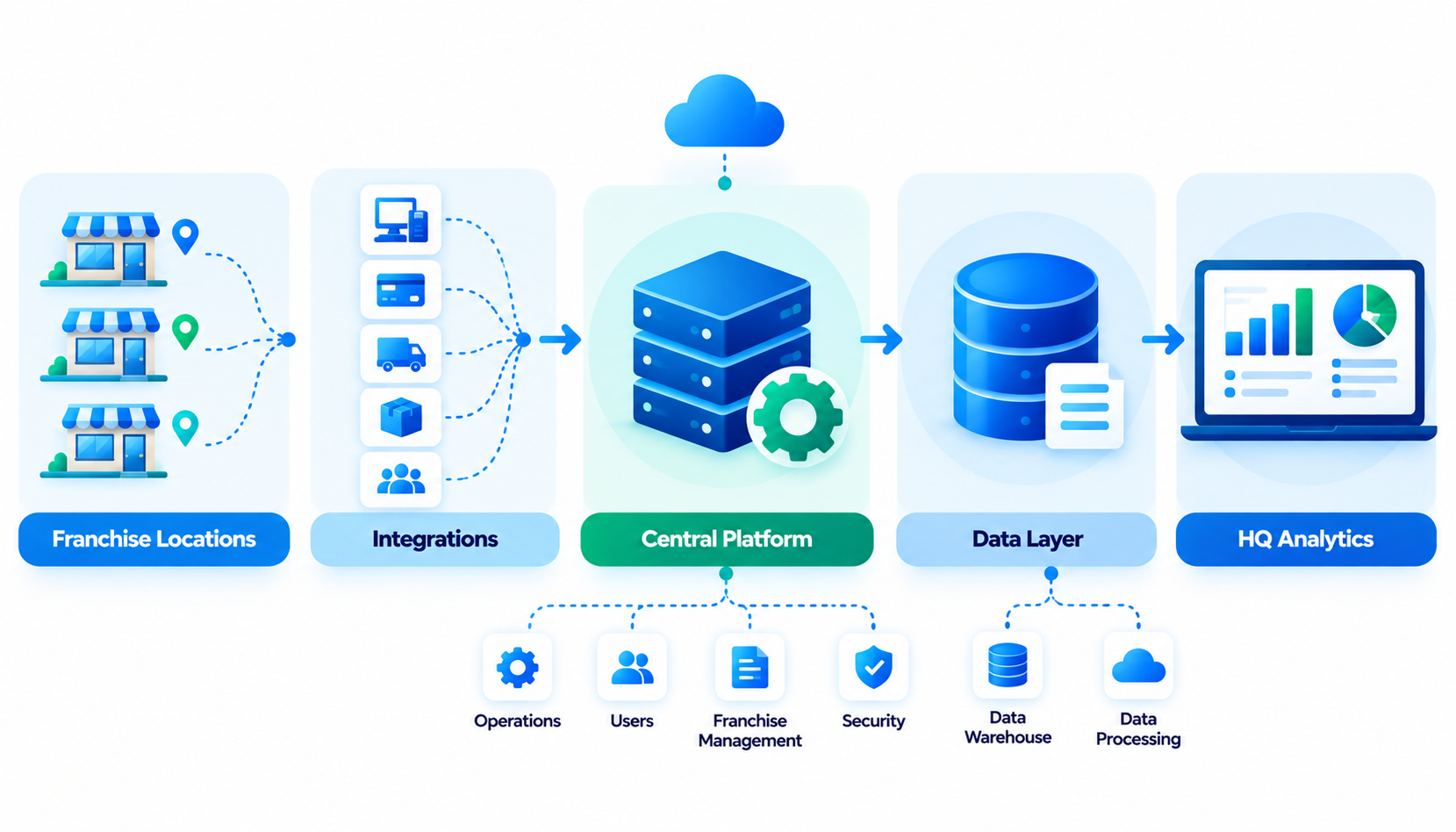
The cleanest way to picture a working restaurant franchise management software stack is as four stacked layers, each one feeding the next:
- Franchise Management Layer
- Central Data Layer
- POS / Inventory / HR / Payroll / Accounting / LMS
- Analytics + Alerts + Executive Dashboards
Essential Technical Capabilities
The right restaurant technology for franchise management is cloud native, API first, multi-tenant, role-based, and capable of full audit trails, configurable workflows, and analytics that scale as location count grows.
Why Multi-Tenant Architecture Matters
Fifty isolated location accounts behave like fifty separate businesses that happen to share a logo, which is why scalable cloud infrastructure matters as the franchise network grows.
A true multi-tenant cloud franchise operations platform treats the network as one governed system with fifty views into it, and that is what separates real restaurant franchise management software from a set of connected spreadsheets.
The practical test is simple. Ask whether adding location 51 requires new infrastructure or just a new record inside the one that already exists.
50 Location Franchise Readiness Checklist
Before scaling to 50 locations, verify that your franchise systems, data, and technology can support consistent operations without creating new complexity.
Operational: Confirm each of these lives inside the core restaurant franchise management software record, not a side tool.
- Central SOP library.
- Standard inspection process.
- Corrective action workflow.
- Controlled exception handling.
Data and Financial: Keep this data inside one cloud franchise operations platform, never scattered across regional spreadsheets and personal laptops, since that is the only way restaurant franchise management software can report on it accurately.
- Standardized KPIs across regions.
- POS integration at every location.
- Royalty automation.
- Central reporting.
Technology: Verify the vendor's cloud franchise operations platform covers every item below before signing anything.
- API capability.
- Security controls.
- Permission management.
- Scalability and clean data migration.
How Patoliya Infotech Approaches Franchise Platform Development
At Patoliya Infotech, we approach restaurant management software development and franchise platforms as operational systems, not feature collections.
- Unified workflows: Connect SOPs, inspections, royalties, POS, and location data through one governed architecture.
- Scalable foundations: Design APIs, role-based access, and multi-location structures as part of custom software solutions that support growth without rebuilding the platform.
- Practical integrations: Build reliable data flows with failure handling, synchronization, and migration controls from the start.
- Operational visibility: Turn fragmented franchise data into actionable dashboards that help headquarters identify exceptions earlier.
Built for real operations: We design the platform around how franchise teams actually work, reducing manual handoffs and disconnected processes.
Conclusion
Standardizing 50 restaurant locations requires more than putting existing spreadsheets into a cloud application. The platform must connect operating standards, inspections, onboarding, financial controls, workforce data, and performance metrics while preserving the flexibility each location needs.
The strongest implementation starts with a clear operating model, governed master data, reliable integrations, measurable compliance workflows, and executive-level visibility.
Before selecting a vendor, use software testing and QA to test the system against real franchise scenarios and evaluate how it handles exceptions, scale, data integrity, and integration failures. That approach turns technology into a foundation for consistent execution across the entire network.
FAQs:
The platform can serve franchisors, franchisees, regional managers, operations teams, finance teams, and field staff, with each user receiving access based on their responsibilities.
It becomes valuable when growing location counts make manual coordination difficult, operational data is fragmented, or headquarters struggles to maintain consistent visibility across franchisees.
Yes. Franchisees can use dedicated portals to view assigned tasks, access resources, submit information, review performance, and communicate with the franchisor.
Implementation depends on the number of locations, existing systems, workflows, data migration needs, and customization. A focused rollout can start with core operations before expanding to additional modules.
Yes. A well-designed platform can accommodate additional locations, users, brands, territories, and workflows without requiring headquarters to manage each new location through separate systems.
Custom software development can make sense when standard platforms cannot accommodate unique franchise structures, proprietary workflows, complex permissions, or specific operational requirements.