Restaurant Management Software Development: Build or Buy?
TL;DR: Restaurant management software development unifies reservations, waitlists, table management, and turnover tracking in one system. It helps restaurants fill tables faster, reduce no-shows, improve guest flow, and turn real-time seating data into higher revenue across locations.
A restaurant can have a full reservation book and still lose revenue if tables sit empty between guests. Even small delays in seating, slow table turnover, or poorly managed waitlists can reduce the number of covers a restaurant serves during peak hours.
Restaurant technology brings these moving parts into one connected system, linking reservations, waitlist automation, table availability, and turnover tracking. IInstead of relying on separate tools or manual updates, operators get a real-time view of the dining floor and can use connected restaurant technology solutions to improve guest flow, table utilization, and revenue.
What a Unified Restaurant Management System Actually Connects
Reservations, Walk-Ins, and Waitlists
Guests book online, walk in, or join a digital waitlist, and all three feed the same queue. Waitlist automation predicts wait times using live table data, not a host's guess, so guests get accurate texts instead of standing at the door.
Live Table and Floor Management
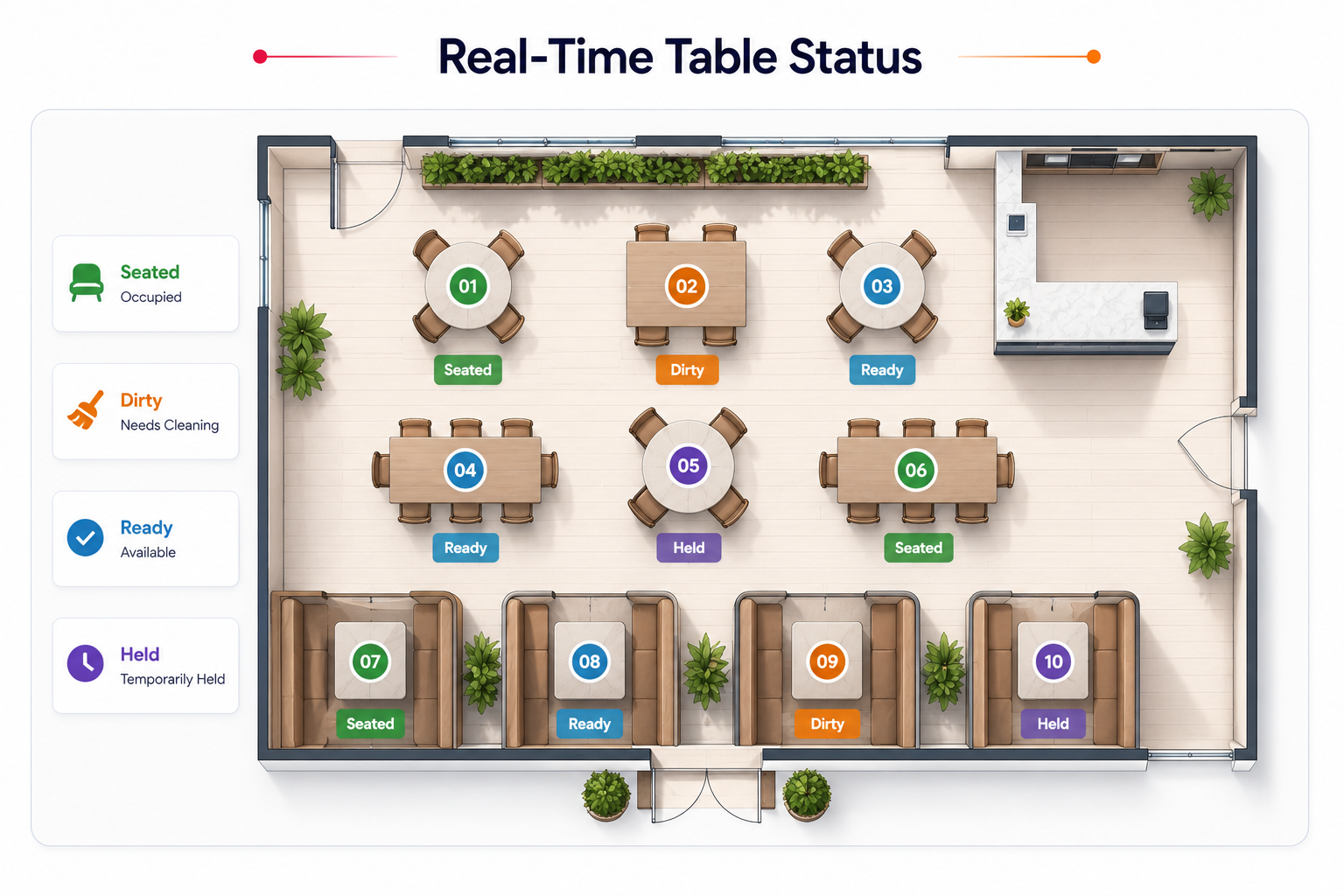
Hosts see every table status in real time: seated, dirty, ready, held. Table turnover speeds up because staff stop walking the floor to check status manually and start reading it from one screen.
POS, Payments, and Guest Data
POS integration links every seated party to its check, tips, and payment history automatically. Guest visit history, allergies, and preferences travel with the reservation, so servers greet regulars by name without a manager briefing them first.
Reservation, Waitlist, or Unified Platform: Which Model Works Best?
Where Reservation Only Systems Work Well
Fine dining rooms with predictable covers and bookings do well on reservation-only tools. Guests plan, kitchens forecast prep accurately, and no-show deposits protect revenue on big party nights.
Where Waitlist Only Systems Fall Short
Busy casual spots that rely on walk-ins lose the planning side entirely. Staff cannot forecast covers an hour out, guest data stays thin, and marketing has almost nothing to work with after the visit ends.
What a Unified Platform Adds
A restaurant reservation and table management system merges both queues into one dataset. Hosts seat booked guests and walk-ins from the same live floor view, and every visit builds one guest profile.
This is the exact gap most restaurant management software development projects are commissioned to close once an owner runs two disconnected tools for a full year and sees the missed data firsthand.
Reservation vs Waitlist vs Unified Platform
|
Model |
Guest Experience |
Data Captured |
Best Fit |
|
Reservation only |
High predictability |
Booking history only |
Fine dining, events |
|
Waitlist only |
Flexible, first come |
Thin, name and phone |
Casual, high walk-in volume |
|
Unified platform |
Predictable and flexible |
Full visit and preference history |
Growing groups, several concepts |
When Point Solutions Stop Scaling With Restaurant Operations
Peak Service Challenges Become Harder to Manage
Friday night at eight is where point solutions break first, since disconnected tools force manual work exactly when speed matters most.
- Hosts reconcile three separate screens: reservations, waitlist, and POS.
- Every manual sync step adds guest wait time at the door.
- Patience runs out fastest right when the line is longest.
Table Turnover Becomes a Coordination Problem
Servers, hosts, and bussers all need the same table status, and gaps between tools leave someone working from stale information.
- A cleared table can still show occupied for several minutes.
- Hosts reseat late, losing minutes on every single turn.
- Staff ends up double checking each other instead of the system.
Several Locations Rules Expose Platform Limits
A single location tool rarely holds up once a brand crosses five or ten sites.
- Tax rules and staffing models differ from market to market, making restaurant scheduling software increasingly important when workforce planning spans multiple locations.
- One configuration cannot fit every location's compliance needs.
- Managers build workarounds that break the moment policy changes centrally.
Outside Dependencies Can Limit the Product Roadmap
Every integration with a delivery app, payment processor, or marketing tool depends on that vendor's own release schedule.
- An API change from an outside partner queues your fix behind every other client.
- Your restaurant management software development partner absorbs the wait, but so does your team.
- Roadmap decisions outside your contract can still delay features you already paid for.
Fragmented Data Limits Intelligence Across Locations
Guest history split across separate tools cannot power loyalty programs, staffing forecasts, or menu decisions, which is why connected restaurant technology becomes increasingly important as restaurant groups scale.
- Comparing performance across sites turns into a manual spreadsheet exercise.
- A restaurant management software development plan should treat one shared dataset as a day one requirement.
- Groups that skip this step pay a restaurant management software development partner to bolt reporting on later, at a higher cost than building it in from the start.
How Table Turnover Translates Into Restaurant Revenue
Use RevPASH to Measure Seat Hour Performance
Revenue per available seat hour, or RevPASH, tells you more than covers per night ever will. It divides total revenue by seat hours available, giving owners one number that reflects both how full the room ran and how much each table earned.
Calculate the Revenue Impact of Faster Table Turns
Shaving five minutes off an average turn during a three-hour dinner service can add an extra seating cycle on busy nights. Multiply that added cycle by average check size across every table, and the number usually justifies the software cost within a single strong season.
For instance, a 30 table dining room running 90 minute average turns across a 4 hour dinner service gains close to one full extra seating once turns drop to 80 minutes. At a 45 dollar average check, that single extra seating adds more than 1,300 dollars in one service alone, before counting a busy weekend run.
Measure the Cost of No Shows and Walkaways
A missed reservation is an empty table nobody could refill in time. An online reservation system with deposits and automated reminders keeps that seat filled far more often than a paper book or a phone line ever could.
Use Real-Time Cover Data to Improve Service Pacing
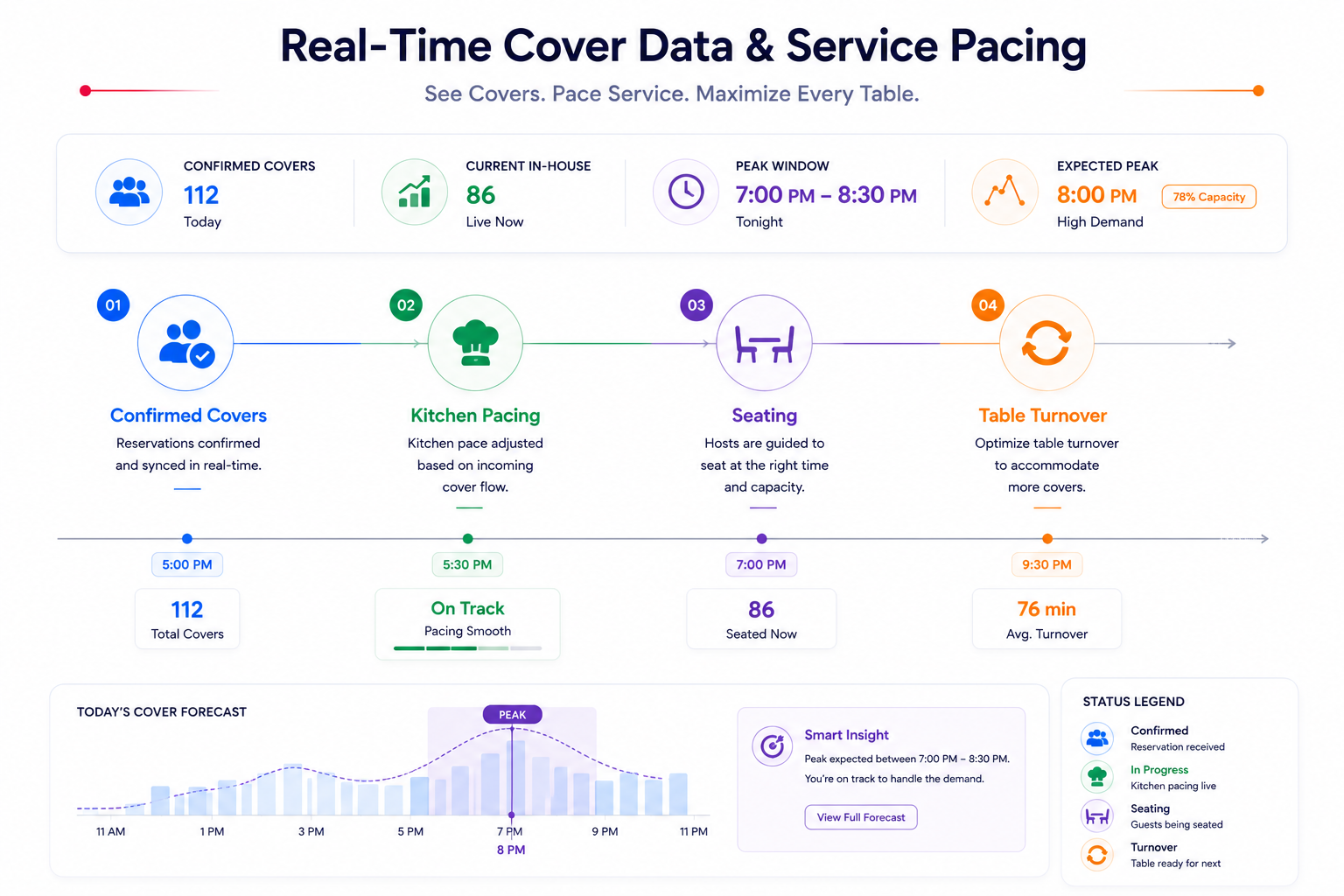
Kitchens plan better when they see confirmed covers by the quarter hour instead of guessing from a printed sheet. Pacing tickets against real cover data keeps the kitchen from getting hit with sixty orders in fifteen minutes.
Track the Metrics That Matter
RevPASH, average turn time, no-show rate, and repeat visit rate are the four numbers worth reviewing weekly. Everything else is detail that supports these four.
Restaurant Management Software Development Cost
What Determines Custom Restaurant Software Cost?
Restaurant management software development cost moves with scope, not guesswork. Key drivers include:
- Number of locations covered.
- Reservation and waitlist complexity.
- POS and payment integrations.
- Real-time table management depth.
- Admin and reporting needs.
- Mobile and web applications.
- AI or predictive features.
- Security, hosting, and compliance requirements.
More locations and more integrations always raise cost before a single design decision gets made. A scope document, not a guess, should set the final number for any restaurant management software development engagement, and a vendor who quotes a fixed price before that document exists is guessing along with you.
Typical Cost Ranges by Development Scope
These ranges are indicative, not fixed quotes, and final pricing depends on your scope document and integration count.
|
Scope |
Cost Range |
What It Typically Covers |
|
MVP |
40,000 to 80,000 dollars |
Reservations, waitlist, basic table view |
|
Mid-level platform |
80,000 to 150,000 dollars |
POS integration, reporting, guest profiles |
|
Enterprise or several locations |
150,000 dollars and up |
Several location logic, custom reporting, deep integrations |
Enterprise-level restaurant management system development adds several location logic, deep POS ties, and custom reporting layers built around your operation, and this tier is where most franchise groups land once a single site proves the concept.
What Ongoing Costs Should You Budget For?
Launch day is not the last invoice you will see. Budget for these line items every year the software stays in production:
- Cloud infrastructure
- Ongoing maintenance
- Outside API fees
- Security updates
- Support hours
- Feature enhancements
- Monitoring and analytics
Most owners underestimate this line by half, and it compounds every year the platform stays live. Any restaurant management software development proposal that lists build cost alone, with no ongoing figure attached, is not a complete proposal.
Why the Cheapest Build Can Become the Most Expensive
A cheap quote often hides poor architecture that cannot handle a second location later.
Weak integrations create technical debt, and technical debt turns into a full rebuild the moment your restaurant expands past the system's original design.
Restaurant management system development done right the first time costs less across three years than a cheap build you end up replacing at year two.
Ask any vendor how the system handles a second location before you sign, since the answer reveals whether they built for growth or for a single demo.
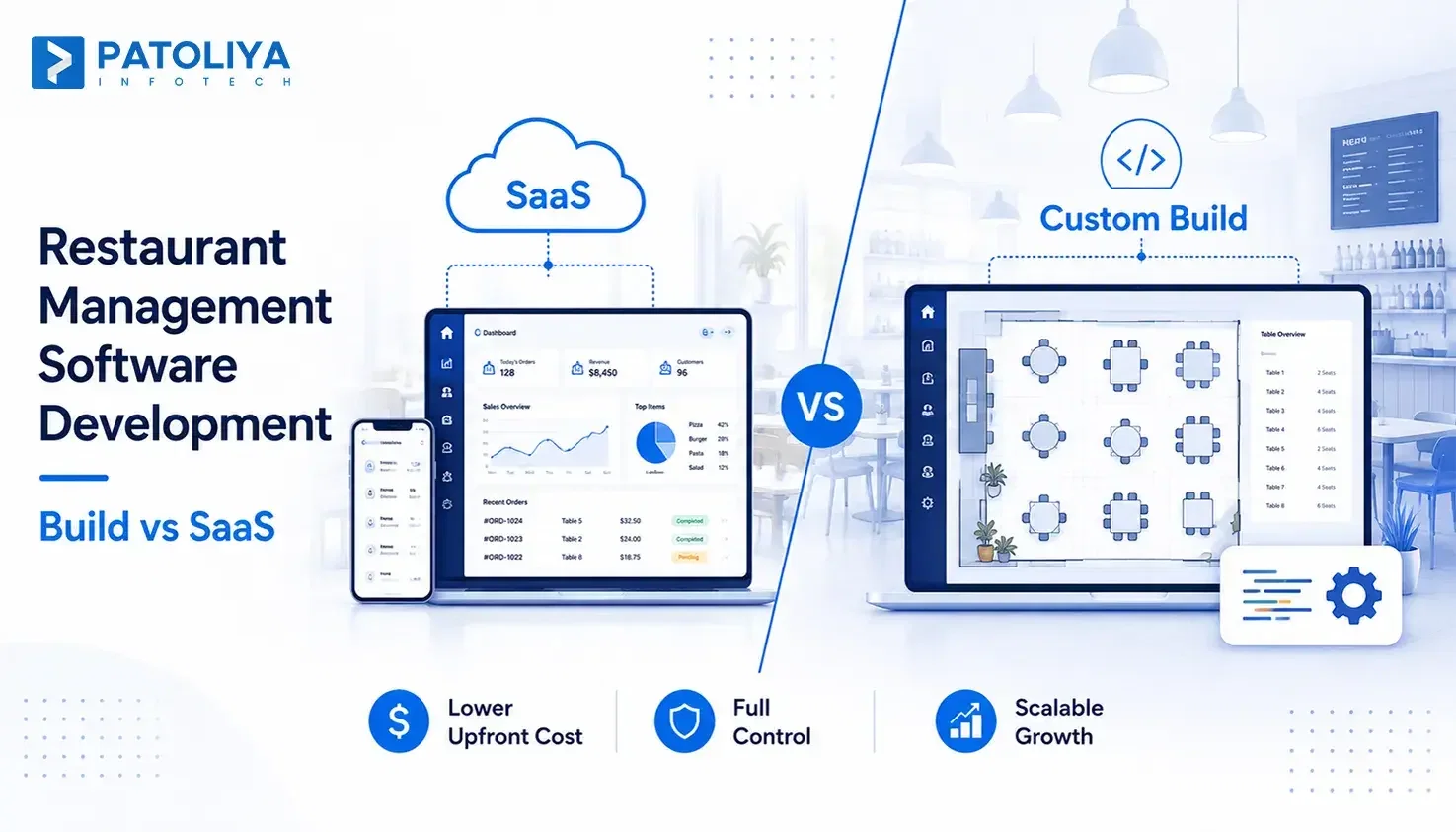
Custom Restaurant Software vs SaaS: Which Is Worth the Investment?
When SaaS Is the Better Choice
A single-location restaurant with a tight budget and a fast launch timeline is often better served by an established platform.
Setup can take days, support is already available, and monthly fees are predictable.
At this stage, restaurant management software development may add unnecessary cost and complexity.
When Custom Development Makes More Sense
The economics change as a restaurant grows beyond eight or ten locations. Franchise groups often have unique booking workflows.
Some brands also rely heavily on proprietary guest data and loyalty programs. In these cases, custom software solutions can deliver more value than a generic platform with recurring per-booking fees.
Compare Three-Year Total Cost of Ownership
SaaS costs typically increase as covers and locations grow. That means your software bill can rise every quarter. Custom restaurant management system development requires a larger upfront investment.
However, annual costs can be lower after launch. At a certain scale, owning the system can become more cost-effective than paying for separate subscriptions across every location.
Consider Data Ownership and Long Term Control
Guest data built inside a SaaS platform often stays partly locked to that vendor's export terms.
A custom restaurant reservation and table management system puts every guest record, every preference, and every booking pattern fully in your hands, with no platform fee attached to your own history.
|
Factor |
SaaS Platform |
Custom Build |
|
Setup speed |
Days |
Months |
|
Upfront cost |
Low |
Higher |
|
Cost as you scale |
Rises with covers and locations |
Flattens after launch |
|
Data ownership |
Partial, vendor terms apply |
Full, no export fees |
|
Customization |
Limited to platform features |
Built around your workflow |
|
Best fit |
Single location, fast launch |
Several locations, proprietary needs |
Restaurant Software Vendor Evaluation Checklist
Confirm Data Ownership and Export Rights
Ask in writing who owns guest data once it lives inside the system. A vendor should hand over a full export in a usable format at any point, with no fee attached and no delay past a few business days.
Verify POS Payment and Outside Integrations
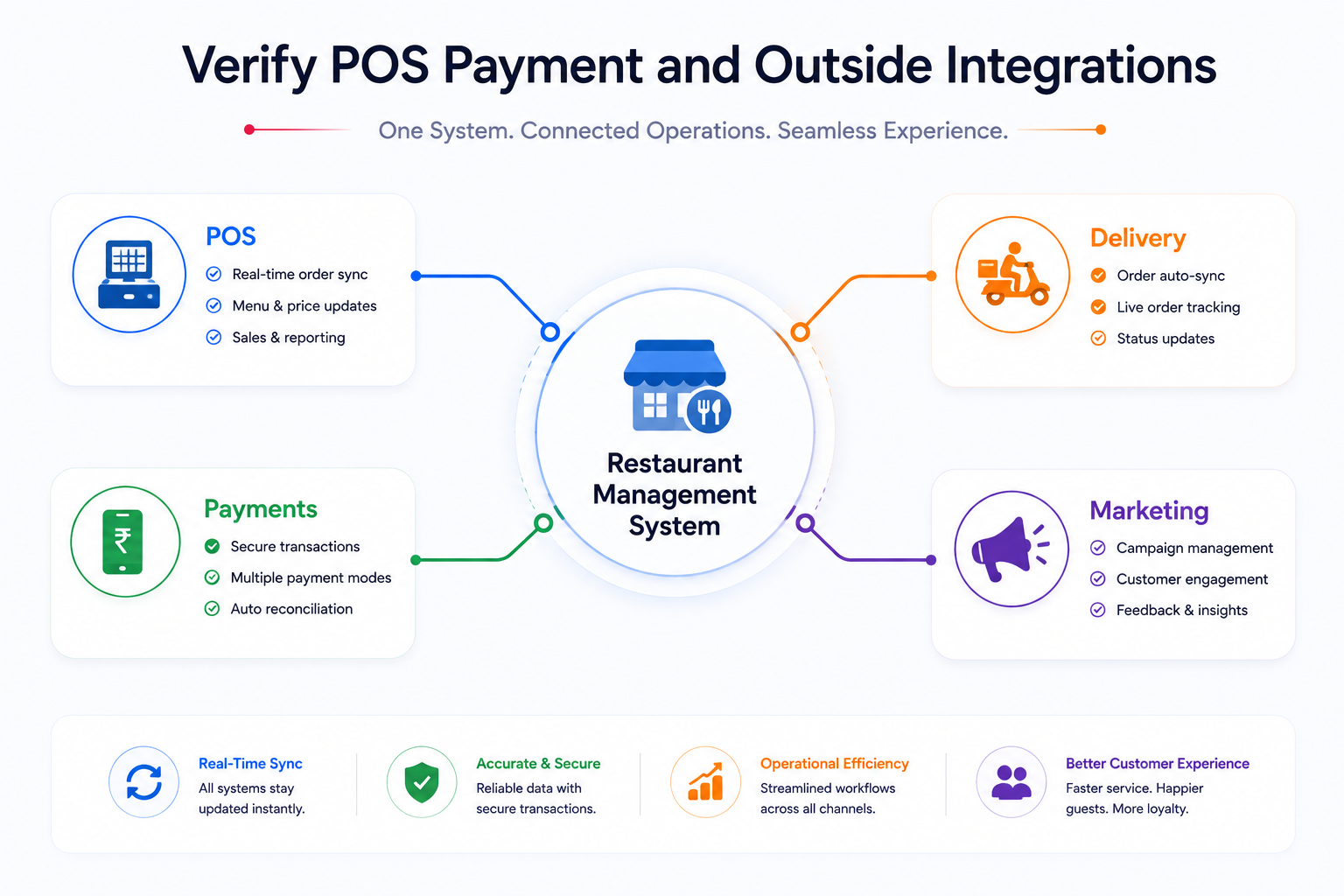
List every tool you currently run: POS, payment processor, delivery apps, marketing platforms. A serious restaurant management system development partner offering application development services confirms each integration before contract signing, not after your first month in production.
Review API Stability and Integration Responsibility
Ask who fixes an integration when a partner changes their API without warning. The answer should name a team and a response window, not a vague promise to look into it.
Compare the Full Three Year Cost
Get every fee in one document: build cost, hosting, support hours, feature requests, and renewal terms. A quote missing any of these five items is an incomplete quote.
Check SLA Security and Support
Uptime guarantees, data encryption standards, PCI DSS considerations for payment environments, and support response times belong in the contract, not the sales deck. A restaurant losing bookings during downtime needs a stated recovery window, not an apology.
Define Migration Training and Launch Support
Ask exactly how existing reservation and guest data moves into the new system, who trains your host staff, how software testing and QA will be handled, and how many days of live support follow launch week.
Clarify Source Code and Product Ownership
Confirm whether you will own the source code or license it. This distinction becomes critical when you switch development partners or need a feature your original vendor will not build.
Clear ownership terms ensure your restaurant management software development investment remains a long-term asset instead of becoming a system you are tied to indefinitely.
When Should You Build Custom Restaurant Management Software?
Your Existing Tools Cannot Support Your Workflow: Private dining, member programs, or a booking flow that no generic platform offers are signs your operation has outgrown off-the-shelf software and needs a purpose-built restaurant reservation and table management system.
You Are Scaling Across Several Locations: Once a brand passes eight to ten sites, generic platforms start charging more while offering less control over local rules and staffing, which is when most owners open a restaurant management software development conversation for the first time.
Your Guest Experience Depends on Proprietary Workflows: Brands built around a signature booking or loyalty experience need software shaped around that experience, not a generic template built for every restaurant on the same platform.
You Need Greater Control Over Data and Integrations: Full ownership of guest data and integration timelines matters most to groups planning to build marketing or loyalty programs on top of visit history collected through a restaurant reservation and table management system.
SaaS Limitations Are Affecting Revenue or Operations: When support tickets, missing features, or per-booking fees start showing up as lost revenue, that cost alone justifies a custom build and a proper restaurant management software development scope.
Enterprise groups choose restaurant management software development because the multi-year savings and full data control outweigh a higher starting price, and every location added after the first only strengthens that math.
Build Custom Restaurant Software With Patoliya Infotech
Generic platforms often force restaurants to change their workflows, while custom software development services allow the platform to be designed around actual reservation, waitlist, table, and guest-data requirements. Restaurant management software development lets you build around your actual reservation, waitlist, table, and guest data requirements.
With Patoliya Infotech, you get:
- Custom reservation and table workflows.
- Unified guest data across locations.
- POS integrations built into the platform.
- Clear scope, timelines, and deliverables.
- Architecture designed for multi-location growth.
- Three-year cost comparison before development.
Patoliya Infotech builds scalable restaurant technology solutions around your operations, helping connect reservation, table, payment, and other hospitality workflows. We help you define the right features, integrations, and architecture before development begins.
Conclusion
The right restaurant technology should improve table utilization, simplify operations, and support growth without adding unnecessary costs. An established platform may be the right choice for a single location or fast launch. But as locations, workflows, and data requirements grow, restaurant management software development can offer greater control and long-term value.
Evaluate the decision using your actual workflows, integrations, scalability needs, and three-year total cost. Patoliya Infotech can help you assess your current setup and identify whether a custom restaurant reservation and table management system is the right investment for your next stage of growth.
FAQs:
Custom restaurant management software development typically ranges from 40,000 dollars for an MVP to 300,000 dollars or more for an enterprise build across several locations, depending on integrations, real-time table features, and reporting depth.
Most builds run three to six months, with an MVP covering reservations and waitlist launching in eight to ten weeks and full restaurant management system development across several locations taking longer to test and integrate.
Upfront, yes, custom software costs more to launch. Past eight to ten locations, ongoing per booking fees on established platforms often exceed the total three year cost of a custom build.
Yes. POS integration is a standard part of any serious build, linking seated parties to checks, tips and payment history automatically, so staff never switch screens mid-service.
A restaurant reservation and table management system with deposits and automated reminders keeps more booked tables filled, since guests confirm ahead of time and get a nudge before their slot.
Usually not right away. An established platform launches faster and costs less for one site, and custom restaurant management software development earns its value mainly at several location scales.