Restaurant Employee Retention Software: Complete Guide
TLDR: Restaurant employee retention software works only when it moves past who already quit and starts flagging who is becoming likely to. Real restaurant employee retention software value comes from combining scheduling, attendance, and feedback data into one working signal, not another dashboard nobody checks.
Restaurant turnover is not simply an HR problem. It drains labor costs, breaks service consistency, overloads managers, and eats training capacity every single quarter.
Most operators still measure who already left, well before asking why good employees were becoming likely to leave in the first place. A retention dashboard reports history; a predictive system flags a pattern while there is still time to act.
This guide explains how restaurant employee retention software should identify churn signals, prioritize interventions, and help leadership decide what technology is genuinely worth the investment. The real question is whether operators can catch the operational conditions that push good staff out before they resign.
What Restaurant Employee Retention Data Actually Needs to Tell You
The metrics operators should actually monitor
Skip the definitions. Operators already understand turnover, burnout, and retention in general terms, so the metrics that actually drive decisions are the ones worth tracking closely inside any serious restaurant employee retention software rollout.
A platform that cannot report these eight numbers cleanly is not ready to support serious restaurant technology for a multi-location group.
Voluntary turnover, the cleanest signal of whether people are choosing to leave, not being let go.
Early tenure turnover, since losses inside the first ninety days point to hiring or onboarding gaps.
Absenteeism and no shows, an early warning sign that usually surfaces weeks before a resignation.
Schedule instability, measured by how often a published schedule actually changes after it goes out.
Employee tenure by role and location, which shows exactly where retention is strong and where it is not.
Manager level turnover, since teams under unstable managers churn faster than the company average.
Training completion, a leading indicator of whether new hires are set up to stay.
Employee engagement and feedback trends, the qualitative layer that explains what the numbers alone cannot.
Why restaurant wide turnover rates hide the real problem
A single company wide number rarely tells the truth. Restaurant employee retention software earns its value by segmenting data through location, role, manager, tenure, and shift pattern, because a 12 location group can post an acceptable overall rate while one manager or one role is quietly bleeding staff.
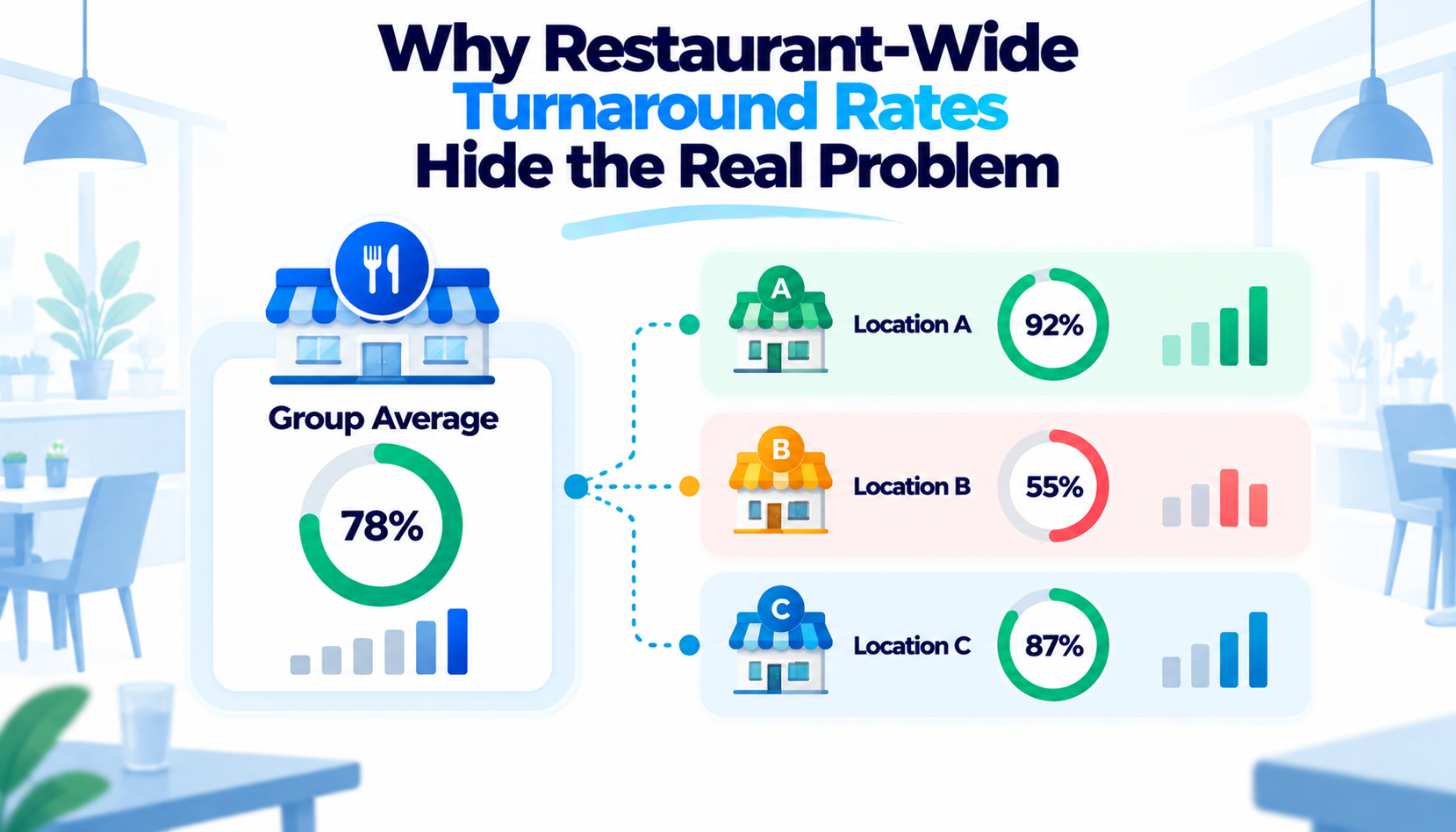
For instance, a 12 location group averaging nine percent voluntary turnover company-wide might have one location running 22 percent while the other eleven sit closer to six percent, a gap the blended number hides completely.
Combining scheduling, attendance, manager, training, and performance data beats watching one turnover metric in isolation, and it is exactly the segmentation most operators skip when they first evaluate restaurant employee retention software.
The Restaurant Employee Churn Signals Worth Detecting
Every list below feeds directly into how restaurant employee retention software builds a working risk score for a specific employee or shift.
Scheduling signals
The CDC's NIOSH guidance on workplace fatigue notes that nonstandard schedules, night shifts, and extended work hours can contribute to work-related fatigue.
Scheduling data is usually the richest source inside restaurant employee retention software because every shift already gets logged somewhere, and restaurant scheduling software can help identify patterns of last-minute changes that often show up weeks before a resignation letter does.
This is exactly the raw material AI staff turnover prediction restaurant models rely on most heavily, since scheduling changes are logged automatically and rarely need manual entry.
Attendance and workload signals
These attendance patterns feed directly into how restaurant employee retention software scores an employee week over week.
Increasing lateness, frequent absences, dropped shifts, no-shows, overtime spikes, and workload concentration among specific employees.
Engagement and management signals
Declining pulse survey scores, repeated complaints about the same manager, reduced recognition, negative feedback after difficult shifts, and declining participation in training or communication.
A cluster of complaints tied to one manager is one of the strongest warning patterns available, and it is also the one most operators are slowest to act on because it feels personal, not operational.
Tenure and career signals
- New hires disengaging within the first 30 to 90 days.
- Employees remaining in the same role without progression.
- High-performing employees showing disengagement.
- Increased turnover following manager changes.
A single signal should never trigger a flight risk label on its own. These same signals only become useful once several patterns line up together, and treating one late shift or one missed survey as a red flag just trains managers to ignore the alerts entirely within a month or two.
Scheduling, attendance, manager quality, training, compensation, and tenure together form the real predictive picture inside restaurant employee retention software.
Any restaurant employee retention software worth buying should already be watching every one of these signals by default.
How AI Can Predict Restaurant Staff Turnover Before the Resignation
AI staff turnover prediction restaurant systems exist to catch a resignation before it happens, not to explain one after the fact. The basic workflow behind these systems moves from historical workforce data to signal detection, then risk scoring, manager alert, intervention, and outcome tracking.
Each stage feeds the next, and a reader does not need the underlying math to understand the sequence, only the loop it creates. This loop is what separates a real prediction system from a spreadsheet with a fancy chart attached to it.
What an AI turnover model can actually analyze
A model built for AI staff turnover prediction restaurant operators can trust needs to combine every one of these sources, well beyond one or two picked for convenience.
Scheduling history, attendance, tenure, role and location, manager changes, training activity, feedback and sentiment, compensation changes, shift workload, and previous turnover patterns.
Prediction is useless without an intervention
An AI consulting approach should go beyond an AI system that only says employee X has a seventy eight percent turnover risk, because that gives a manager nothing to act on. It should answer why the score changed, what shifted recently, and what a manager can realistically do about it today, not a percentage floating with no explanation attached.
A practical example makes this concrete:
Risk: increasing turnover probability.
Signals: three consecutive closing to opening patterns plus declining feedback.
Suggested intervention: stabilize upcoming shifts alongside a direct manager check in.
This is where AI product engineering connects staff turnover prediction to an actual operating decision, well beyond a number sitting quietly on a screen, while burnout detection AI ties fatigue patterns directly to the same shift data driving the score.
From Risk Scores to Manager Retention Alerts
A risk score by itself is not a feature of restaurant employee retention software; it is only a data point until it becomes an alert a manager can use.
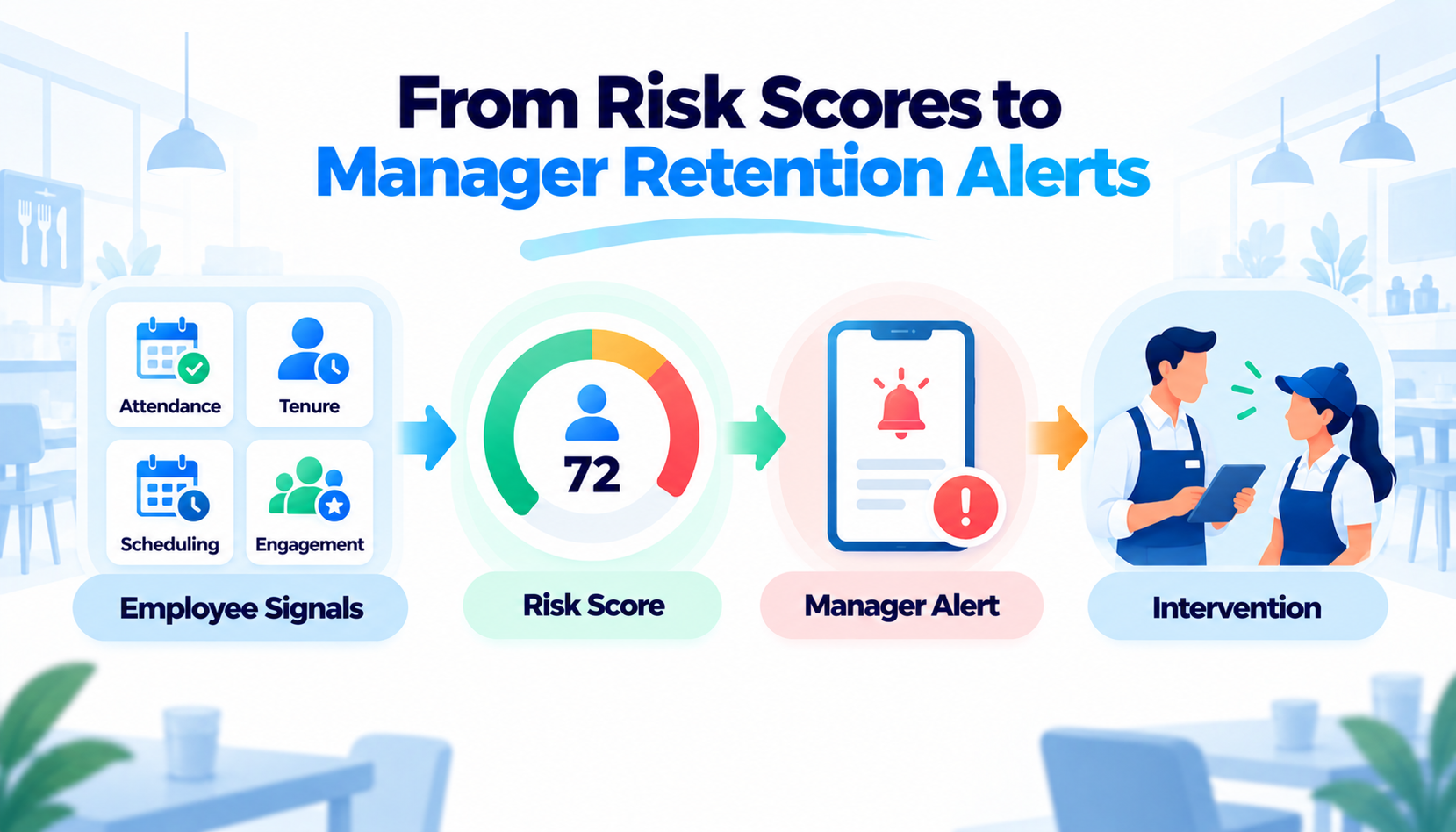
What a useful retention alert looks like
A vague label like high-risk employee detected tells a manager nothing useful.
A working alert shows the logic behind it: employee risk increased 24 percent this month, primary signals are schedule instability plus reduced hours plus negative shift feedback, and the recommended action is a manager check-in within 48 hours.
That level of detail is what separates a genuine retention signal from a generic notification a manager learns to swipe away.
Prioritize Alerts Without Overwhelming Managers
Manager retention alerts: AI should sort output into three levels so a shift supervisor is not drowning in noise.
Monitor: an emerging pattern, worth watching but not yet worth a conversation.
Review: multiple signals stacking together, worth a manager taking a closer look this week.
Act: a strong risk paired with a driver the manager can actually address today.
This tiering is exactly what separates working AI staff turnover prediction restaurant tools from ones that just email everyone constantly. Without this tiering, every alert looks equally urgent, and managers stop trusting the system within weeks.
Track the full loop from alert to intervention to employee outcome to retained or left. That closed loop is what actually improves restaurant employee retention software over time, since a system that never checks its own predictions against reality just keeps guessing with more confidence and no accountability.
The Data Architecture Behind Restaurant Workforce Analytics
Connect the systems that already contain the signals
- POS captures shift-level sales and labor data tied directly to who was working when.
- Scheduling holds the shift patterns that drive most early churn signals.
- Time and attendance shows the gap between what was scheduled and what actually happened.
- Payroll carries pay changes, overtime, and compensation history over time.
- HRIS stores role, tenure, manager assignment, and employment status.
- Employee engagement and feedback capture the qualitative side that surveys and pulse checks reveal.
- Training systems track whether a new hire is actually being onboarded or left to figure it out alone.
None of these systems were built to talk to each other by default, and connecting them with other business systems, including payment gateway integration where required, is usually the hardest part of standing up any serious restaurant employee retention software program. It is also the single most common reason a restaurant employee retention software rollout stalls halfway through implementation.
Why disconnected workforce data limits prediction
If scheduling data lives in one system while payroll, attendance, and feedback sit somewhere else entirely, the restaurant sees individual metrics but never the relationship between them.
This layer only becomes predictive once these sources connect into a single working view, which is where custom software integration services can help join systems and expose patterns across them.
Most operators already own every piece of this data; they simply never combined it into anything a manager could act on, which is precisely the gap AI staff turnover prediction restaurant tools are built to close.
What a scalable architecture should support
Any restaurant employee retention software architecture built for a multi-location operator needs to support:
Location-level analytics that isolate performance store by store, well beyond blending everything into one number.
Role-level segmentation that separates back-of-house from front-of-house churn patterns.
Historical data deep enough to establish a real baseline before flagging anything as unusual.
Real-time or near real-time events so a schedule change this week shows up this week, not next quarter.
Role-based access so a general manager sees their store and a regional director sees the region.
Auditability that records who changed what and when across the whole system.
API integrations that let the platform plug into whatever POS, payroll and HRIS the group already runs.
Data privacy controls that protect employee information the same way payroll data already gets protected.
A single location operator can get by with a lighter setup, but any group running more than a handful of stores needs every item on this list before restaurant employee retention software can actually scale with the business.
When Restaurant Retention Software Is Worth the Investment
Deciding whether restaurant employee retention software is worth the spend usually comes down to a handful of honest questions about how your operation already runs.
You probably need more than spreadsheets when
These are the clearest signs a spreadsheet has stopped working and restaurant employee retention software is the next logical step.
- Turnover varies significantly across locations.
- Managers discover problems only after resignations.
- HR data and scheduling data are disconnected.
- Leadership cannot identify the biggest churn drivers.
- Restaurant hiring cost is rising faster than retention initiatives.
- Managers receive too many manual reports.
- The company has enough workforce data but is not turning it into decisions.
A group hitting three or more of these at once is usually already losing more to turnover than a decent AI staff turnover prediction restaurant platform would cost to run for a full year.
You may not need specialized software when
- You are operating one small location.
- Workforce data is minimal.
- Turnover is not materially affecting operations.
- Managers already have direct visibility into employee issues.
- The problem is primarily compensation or staffing capacity, not information visibility.
Technology should solve a visibility and intervention problem, and it should never become another dashboard nobody actually opens.
Restaurant employee retention software justifies its cost only when it changes what a manager does on a Tuesday afternoon, well beyond what leadership sees in a quarterly report. A single store owner who already knows every employee by name rarely needs a scoring model to tell them who is struggling.
What Should You Look for in Restaurant Employee Retention Software
Shopping for restaurant management software without a checklist usually ends with whichever vendor gave the best demo, not the best fit.
Data and integration capability
Can restaurant employee retention software integrate with scheduling, payroll, HRIS, and attendance systems?
Can it combine historical and current workforce data?
Can data be segmented by location, role, and manager?
A platform that cannot answer yes to all three questions is not ready for a multi-location group.
Predictive capability
Real AI staff turnover prediction restaurant capability identifies leading indicators well before historical turnover shows up after the fact.
Can it explain why an employee or a location is at risk?
Can operators configure relevant signals?
Does it distinguish correlation from genuinely actionable risk?
Vendors that dodge the last question are usually reporting patterns without any real AI staff turnover prediction restaurant capability behind the label.
Manager usability
Can managers understand alerts without analytics expertise?
Are alerts prioritized?
Does restaurant employee retention software recommend next actions?
Can managers record interventions and outcomes?
If a shift supervisor needs a data science background to read the dashboard, adoption will fail within the first month regardless of how accurate the model is.
Enterprise readiness
Multi-location support, permissions, security, audit trails, APIs, scalability, reporting, and data ownership all belong on this checklist for any restaurant employee retention software contract before it gets signed.
Do not buy a platform because it claims to have AI stamped on the label. Buy restaurant employee retention software because it can connect data to risk to explanation to intervention to a measurable outcome, and confirm every link in that chain before signing anything, since a broken link anywhere in that sequence quietly reduces the whole system back to a dashboard.
Build vs Buy: When Custom Retention Technology Makes Sense
Not every operator needs custom-built restaurant employee retention software, and knowing which side of that line you sit on saves months of wasted evaluation.
|
Consideration |
Buy a Packaged Platform |
Build Custom Technology |
|
Location count |
Single location or small multi-unit. |
Many locations across regions. |
|
Data complexity |
Standard workforce data. |
Proprietary or fragmented legacy data. |
|
Signals needed |
Standard alerts, engagement tracking. |
Custom risk scoring, organization-specific logic. |
|
Systems |
Modern, already integration-friendly. |
Legacy systems needing custom connections |
|
Time to value |
Weeks. |
Months, with a longer-term payoff. |
Buy when the problem is standardized
A packaged platform makes sense when the business primarily needs employee feedback, scheduling visibility, basic workforce analytics, standard alerts, and engagement tracking.
Most single-location and small multi-unit operators fit this model without needing anything custom built, and a packaged tool can provide useful retention signals within weeks rather than months.
Consider custom development when retention intelligence must connect to your existing operation
Custom software development becomes worth considering when you operate many locations, need to unify existing systems, rely on proprietary workforce data, require custom risk scoring, or need to integrate with legacy systems.
Custom retention intelligence is also valuable when insights must feed directly into existing operational workflows or when you need organization-specific intervention logic that an off-the-shelf platform cannot replicate.
Larger restaurant groups can outgrow packaged platforms as their location count and data complexity continue to expand.
The real decision is not software versus no software. It is how much of your retention problem is generic and how much depends on your operating model and workforce data.
That distinction should guide the technology decision before a vendor demo, whether the right answer is a packaged platform or custom AI staff turnover prediction restaurant modeling built around your own locations.
How to Measure Whether the Investment Is Actually Working
Every restaurant employee retention software purchase needs a real measurement plan attached to it, not a vague promise about improved culture.
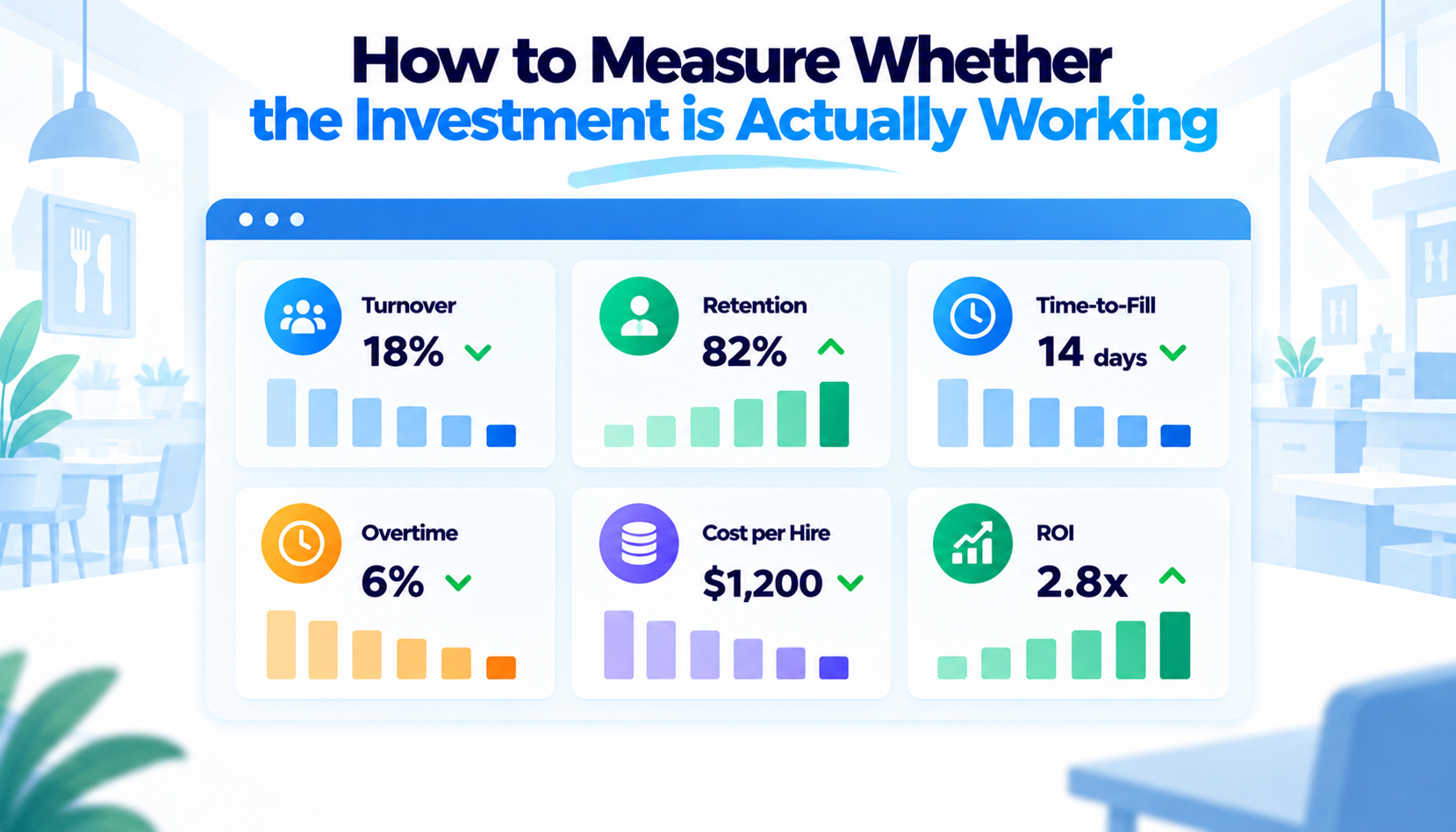
Measure financial outcomes
A finance leader evaluating restaurant employee retention software should track cost per replacement, hiring spend, training cost, overtime caused by vacancies, agency and temp labor, manager hours spent recruiting, and revenue or service impact from understaffing.
Rising hiring cost figures across several locations at once is usually the clearest early warning that retention has quietly become a financial problem and an operational one at the same time.
Measure workforce outcomes
Voluntary turnover, 36 and 90 day retention, manager turnover, absenteeism, schedule stability, time to fill, and internal mobility round out the operational side of the picture, and tracking them together shows whether AI staff turnover prediction restaurant interventions are actually changing behavior or just generating more meetings.
Measure intervention effectiveness
The number of alerts a system generates is a weak KPI. The real question is how many preventable exits were identified early, acted on, and actually avoided, which is the only number that proves restaurant employee retention software paid for itself, well beyond producing another report nobody reads.
The Restaurant Retention Technology Stack: What Should Connect
Workforce data forms the foundation by feeding POS, scheduling, time and attendance, payroll, HRIS, feedback, and training data into one place.
The intelligence layer turns that combined data into insight through data normalization, churn signal detection, risk scoring, and root cause analysis.
The action layer converts those insights into decisions through manager alerts, recommended interventions, follow-up, and outcome tracking.
The mental model a mature restaurant employee retention software deployment should actually follow in practice.
The key question to ask vendors is how these three layers connect. Most vendors will demonstrate only one layer during a demo, so verify how the other two work together before assuming you are getting the full restaurant employee retention software stack.
How Patoliya Infotech Approaches Restaurant Retention Technology
At Patoliya Infotech, we approach retention as an operational intelligence problem, where the value comes from connecting workforce signals to decisions managers can actually act on.
Our experience building data-driven business systems involves bringing fragmented operational data together, normalizing it across roles and locations, and turning it into actionable workflows.
For restaurant use cases, that same approach can connect scheduling, attendance, payroll, HRIS, feedback, and training data to identify emerging churn patterns, trigger explainable manager alerts, and track whether an intervention actually changes the outcome.
Conclusion
Restaurant employee retention software creates value when it turns workforce data into an early, actionable signal. The strongest approach connects scheduling, attendance, workload, manager, engagement, payroll, and training data; identifies patterns by location, role, and tenure; and delivers explainable alerts with interventions.
Smaller operators may find packaged software sufficient, while larger groups with systems or proprietary retention logic may benefit from custom development. The right investment is not the platform with the features, but the one that helps managers intervene, connects with operations, and proves whether interventions reduce turnover over time.
FAQs:
Key features include workforce dashboards, employee profiles, engagement tracking, retention analytics, manager insights, automated alerts, reporting, and integrations with existing restaurant systems.
Yes. Multi-location restaurant retention software can compare workforce trends across locations, roles, and managers while helping corporate teams maintain consistent retention strategies.
It gives managers centralized workforce insights, helping them identify team-level issues, monitor employee patterns, prioritize concerns, and take targeted retention actions.
Yes. It can track onboarding progress, training completion, early engagement, and other factors that help operators identify gaps and improve early-tenure retention.
The software can connect with scheduling, payroll, HR, attendance, POS, and workforce management platforms to consolidate employee data and create a more complete workforce view.
Restaurant HR software manages core employee processes such as records, payroll, hiring, and benefits. Retention software focuses specifically on workforce patterns, engagement, and strategies for improving employee retention.