Remote Therapeutic Monitoring: CPT Codes, Billing & Software
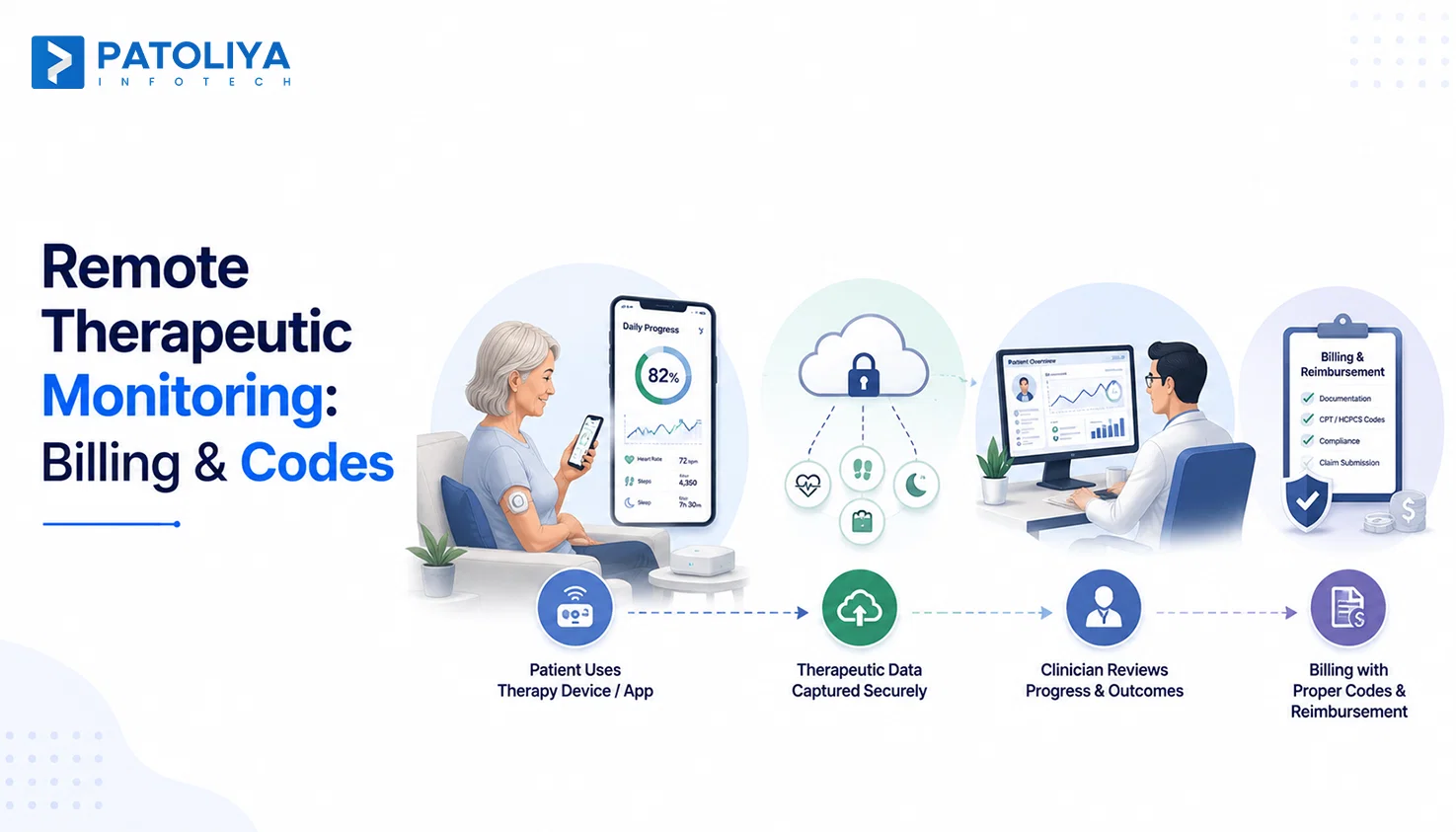
TL;DR: Remote therapeutic monitoring gives physical therapists, occupational therapists, and speech language pathologists a way to bill for therapy adherence tracking without physician oversight. The codes cover setup, device data, and treatment management time, but revenue only holds when documentation, staffing, and digital therapeutics billing software work together as one system.
Most practices treat remote therapeutic monitoring as a coding exercise, and that assumption costs them money every month. The codes were built to reward consistent monitoring and documented communication, not occasional check-ins.
A practice that bills 98975 once and forgets the monthly device data requirement leaves reimbursement on the table without knowing it. This guide will break down the CPT structure, the software decisions that protect revenue, and the financial model executives need before approving a program.
What Remote Therapeutic Monitoring Is and Why It Matters
Remote therapeutic monitoring is a CMS billing category that reimburses providers for tracking therapy adherence, pain response, and functional status outside the clinic using connected apps or devices, creating an important connection between reimbursement workflows and medical device software development. It creates a reimbursement pathway for monitoring and managing patient progress between visits.
Why CMS Created RTM
CMS built this category to pay for care that already happened informally. Providers were reviewing home exercise logs and calling patients about adherence for years without a billing path. Remote therapeutic monitoring codes finally attached revenue to that clinical labor.
RTM vs RPM: The Billing Difference That Changes Everything
Remote therapeutic monitoring tracks therapy adherence and patient reported data, while remote physiologic monitoring tracks vital signs collected automatically by a medical device. The distinction decides who can bill, what data qualifies, and how the codes stack with other programs.
Therapy Data vs Physiologic Data
The two categories look similar on paper and behave completely differently in a billing audit. RPM requires an FDA cleared device transmitting physiologic data automatically.
Remote therapeutic monitoring allows patient reported data on pain, adherence, and function, which opens the door to therapy practices that never owned monitoring devices before.
|
Factor |
Remote Therapeutic Monitoring |
Remote Physiologic Monitoring |
|
Data type |
Therapy adherence, pain, function. |
Vital signs, physiologic readings. |
|
Data source |
Patient reported or app-based. |
FDA-cleared device only. |
|
Who orders |
PT, OT, SLP, or physician. |
Physician or qualified provider. |
|
Physician oversight |
Not required for therapy providers. |
Required. |
|
Typical patient |
Orthopedic, pulmonary, behavioral health. |
Chronic disease, cardiac, diabetes. |
Why RTM Expanded Reimbursement Opportunities
Therapy practices historically had no path to remote billing because RPM required physician direction that they did not have on staff.
Remote therapeutic monitoring removed that barrier by letting PTs, OTs, and SLPs order and bill independently. This single design choice opened remote care revenue to thousands of outpatient practices that were locked out of RPM entirely.
A pulmonology group tracking inhaler adherence and an orthopedic clinic tracking home exercise completion can both build a remote therapeutic monitoring program on the same code set, which is not true for RPM.
RTM CPT Codes Explained for Decision Makers
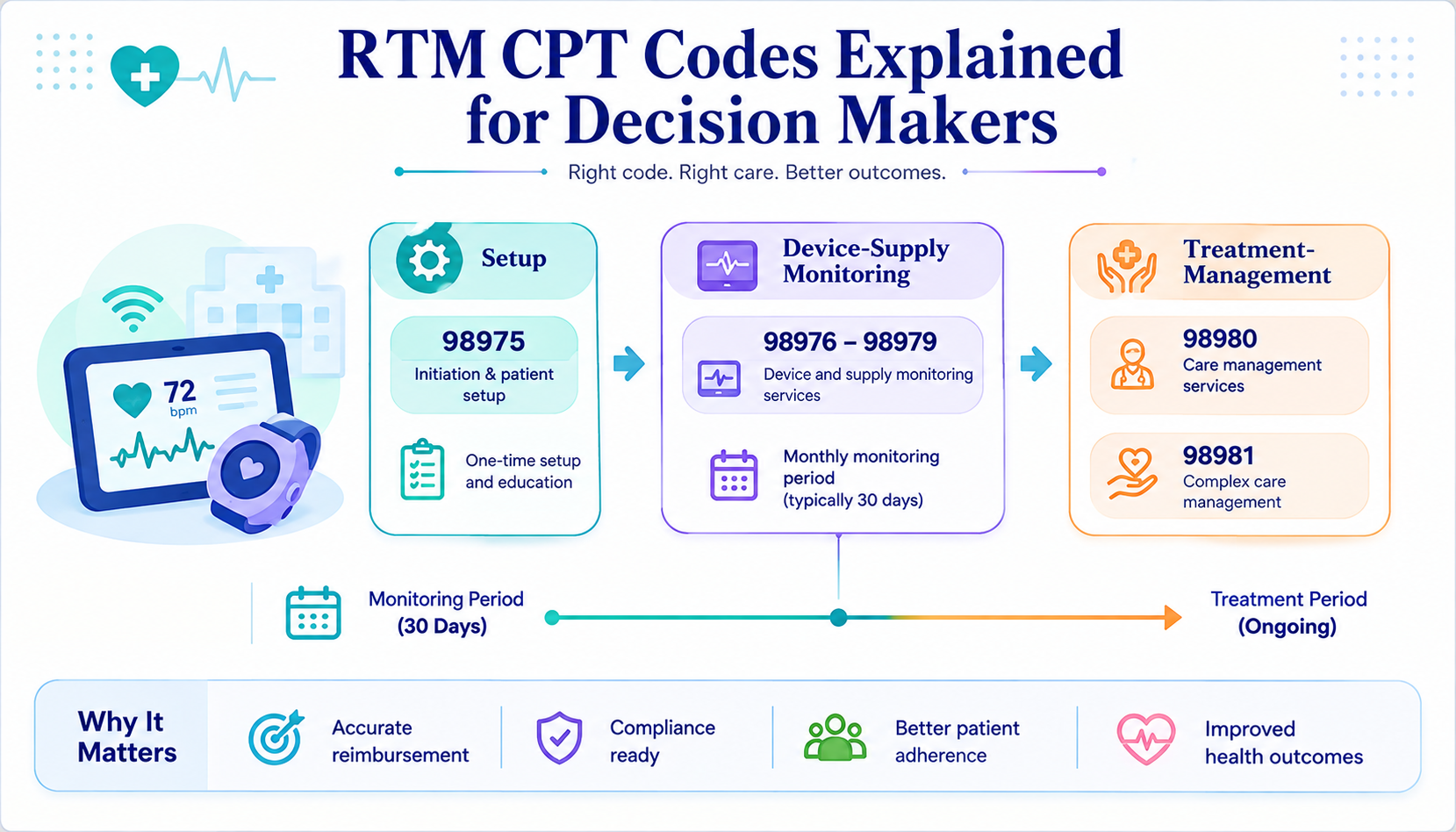
CPT codes for remote therapeutic monitoring fall into three buckets: setup, device data supply, and treatment management time. Executives do not need every code definition, but they do need to know which codes drive volume and which drive margin.
Setup and Onboarding: CPT 98975 covers the initial setup and patient education on the monitoring equipment or app.
It bills once per episode of care, not once per month, so it generates a small one-time payment rather than recurring revenue.
RTM Device-Supply Codes: RTM device-supply codes cover different monitoring periods depending on the applicable code.
CPT 98976, 98977, and 98978 generally apply when data are collected for 16 to 30 days in 30 days, while CPT 98979 covers 2 to 15 days of monitoring. The applicable code also depends on the type of therapeutic monitoring being provided.
Treatment Management and Communication: Treatment management codes 98980 and 98981 pay for the clinician time spent reviewing data and communicating with the patient, and they require at least one synchronous interaction during the calendar month.
This is where most of the recurring revenue in a remote therapeutic monitoring program actually lives.
2026 Updates to Watch
2026 RTM billing requirements include new shorter-duration RTM codes, so executives running a remote therapeutic monitoring program should confirm their software reflects the current thresholds before the next billing cycle. Executives running a remote therapeutic monitoring program should confirm their software already reflects the updated thresholds before the next billing cycle.
|
Code Group |
Purpose |
Billing Frequency |
|
Setup (98975) |
Onboarding and education. |
Once per episode of care. |
|
Device supply |
Data transmission by body system. |
Once per 30 day period. |
|
Treatment management |
Clinician review and communication time. |
Once per calendar month, plus add on time. |
Why RTM Revenue Often Falls Short of Expectations
Practices that launch remote therapeutic monitoring without a documentation system typically capture 30 to 50 percent less revenue than the codes allow. The gap comes from three repeatable failure points that show up in almost every audit.
Documentation and Audit Failures
- Device day counts get logged manually and fall short of the 16 day threshold without anyone noticing until the claim denies.
- Synchronous communication for treatment management codes goes undocumented because staff assumes a text message counts as a real-time interaction.
- Time spent by a PTA or OTA can trigger CQ and CO modifier requirements, so billing under the supervising provider without applying the applicable modifier can create an audit issue.
Low Patient Adherence and Engagement
- Patients stop logging data after two or three weeks once the initial motivation fades, which breaks the device day count.
- Apps with a confusing interface get abandoned faster than apps built around a single daily task.
- Practices that never call patients about missing data lose the episode before month two.
Operational Bottlenecks That Reduce Billable Time
- Staff manually track monitoring minutes in spreadsheets, which underreports the time actually spent and caps 98980 and 98981 revenue.
- No single owner exists for the remote therapeutic monitoring workflow, so device alerts and patient calls fall between clinical and billing teams.
- Billing staff submits claims without confirming the treatment plan order exists, triggering denials that take weeks to resolve.
The Operational Model Behind a Successful RTM Program
A remote therapeutic monitoring program only performs when clinical ownership, billing ownership, and automation are assigned to specific people, not shared vaguely across a department. The programs that scale treat this as an operating model, not a side project.
Clinical Ownership vs Revenue Cycle Ownership
Clinical staff should own patient education, device troubleshooting, and adherence outreach. Billing staff should own claim submission, denial management, and modifier accuracy.
A mid-size orthopedic group that assigned one clinical coordinator and one billing specialist to its remote therapeutic monitoring program saw its clean claim rate improve within the first quarter simply because nobody was guessing who owned the next step.
Staffing Requirements
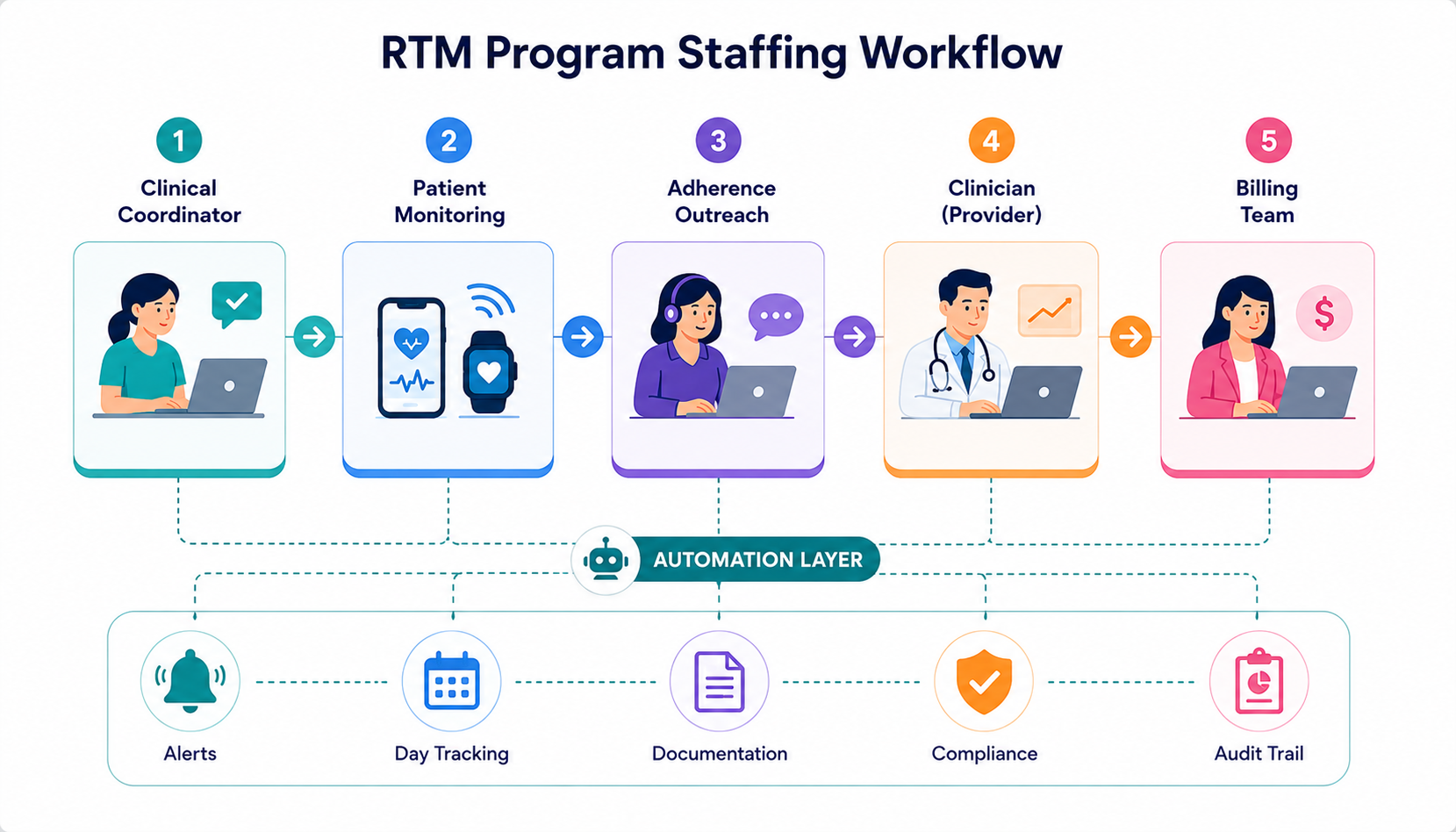
Most practices underestimate the time treatment management codes actually require. A single coordinator can typically manage 60 to 80 active patients if the platform automates alerts and pre-fills documentation. Practices attempting to run this manually cap out closer to 25 patients per coordinator before quality drops.
Workflow Automation Opportunities
Healthcare automation can remove the three failure points listed above by automating day count tracking, communication logging, and time capture in one workflow.
Digital therapeutics billing software that logs synchronous communication automatically prevents the exact documentation gap that causes most treatment management denials.
A pulmonology clinic using automated day tracking cut its manual chart review time by more than half within one billing cycle.
Buying RTM Software: The Framework Executives Should Actually Use
Choosing digital therapeutics billing software and medical billing software development determines whether your remote therapeutic monitoring program generates clean revenue or becomes a recurring denial problem. The decision comes down to four questions, not a feature comparison spreadsheet.
Integrated vs Bolt-On Billing Architecture
Software where the clinical note, the CPT code, and the claim share one database catches errors during documentation. Software where billing runs as a separate module requires data to sync between two systems, and that sync gap is where modifier errors and missed device days hide.
|
Architecture |
How It Works |
Risk Level |
|
Integrated billing |
Note, code, and claim share one database. |
Low, errors caught at documentation. |
|
Add-on billing |
Clinical and billing systems sync separately. |
Higher, gaps surface after claim denial. |
EHR Integration Depth
A vendor claiming EHR integration should be asked exactly what data flows both directions, making healthcare data integration depth more important than simply confirming that a connection exists. Surface-level integrations with electronic health records applications that only push patient names create duplicate data entry for staff, while deep integrations pull device day counts and communication logs directly into the chart.
Build vs Buy vs Bundle
Practices choosing a standalone remote therapeutic monitoring tool get faster deployment and lower upfront cost, while a bundled platform covering RTM alongside RPM and CCM reduces vendor count for larger systems managing multiple programs.
|
Approach |
Best Fit |
Tradeoff |
|
Standalone RTM tool |
Single specialty practices |
Limited if you add RPM or CCM later |
|
Bundled multi-program platform |
Health systems running several programs |
Higher cost, longer implementation |
|
Build internally |
Large systems with development teams |
Long timeline, ongoing maintenance |
Questions to Ask During a Vendor Demo
- Ask the vendor for their average clean claim rate on remote therapeutic monitoring claims, not a generic industry figure.
- Ask how the digital therapeutics billing software documents synchronous communication and whether it applies the PTA and OTA modifier automatically.
- Ask what happens when a patient falls below the device day threshold, since a platform that flags this early prevents a wasted billing cycle.
The Financial Case for RTM
A well run remote therapeutic monitoring program can generate meaningful recurring revenue per patient per month, but the number only holds if adherence and documentation stay consistent. Executives need the full model, not the headline figure vendors advertise.
Revenue Potential Per Provider and Per Patient
Combining setup, device supply, and treatment management codes for one patient produces layered monthly revenue across the episode.
A provider managing 60 enrolled patients with strong adherence generates substantially more monthly revenue than one managing 60 patients with a 40 percent dropout rate, which is why adherence tracking matters as much as code selection.
Costs That Reduce Margin
Manual time tracking, denial rework, and low patient adherence are the three largest margin killers in any remote therapeutic monitoring program.
Staff time spent chasing missing device days often costs more than the platform subscription itself when tracked as a labor expense.
A Practical Payback Model
Model the payback period using enrolled patient count, expected adherence rate and platform cost per patient rather than a vendor's best-case projection.
A program enrolling 100 patients at a realistic 65 percent adherence rate typically reaches payback faster than a smaller pilot chasing 100 percent adherence that never materializes.
|
Input |
Conservative Estimate |
|
Enrolled patients |
100 |
|
Adherence rate |
65 percent |
|
Platform cost per patient per month |
Varies by vendor |
|
Payback window |
Within two to four billing cycles for most practices |
Governance Audit Risk and Executive Accountability
Executives approving a remote therapeutic monitoring program carry audit exposure the same way they do with any CMS billed service. Governance means knowing what auditors check and what leadership should see monthly.
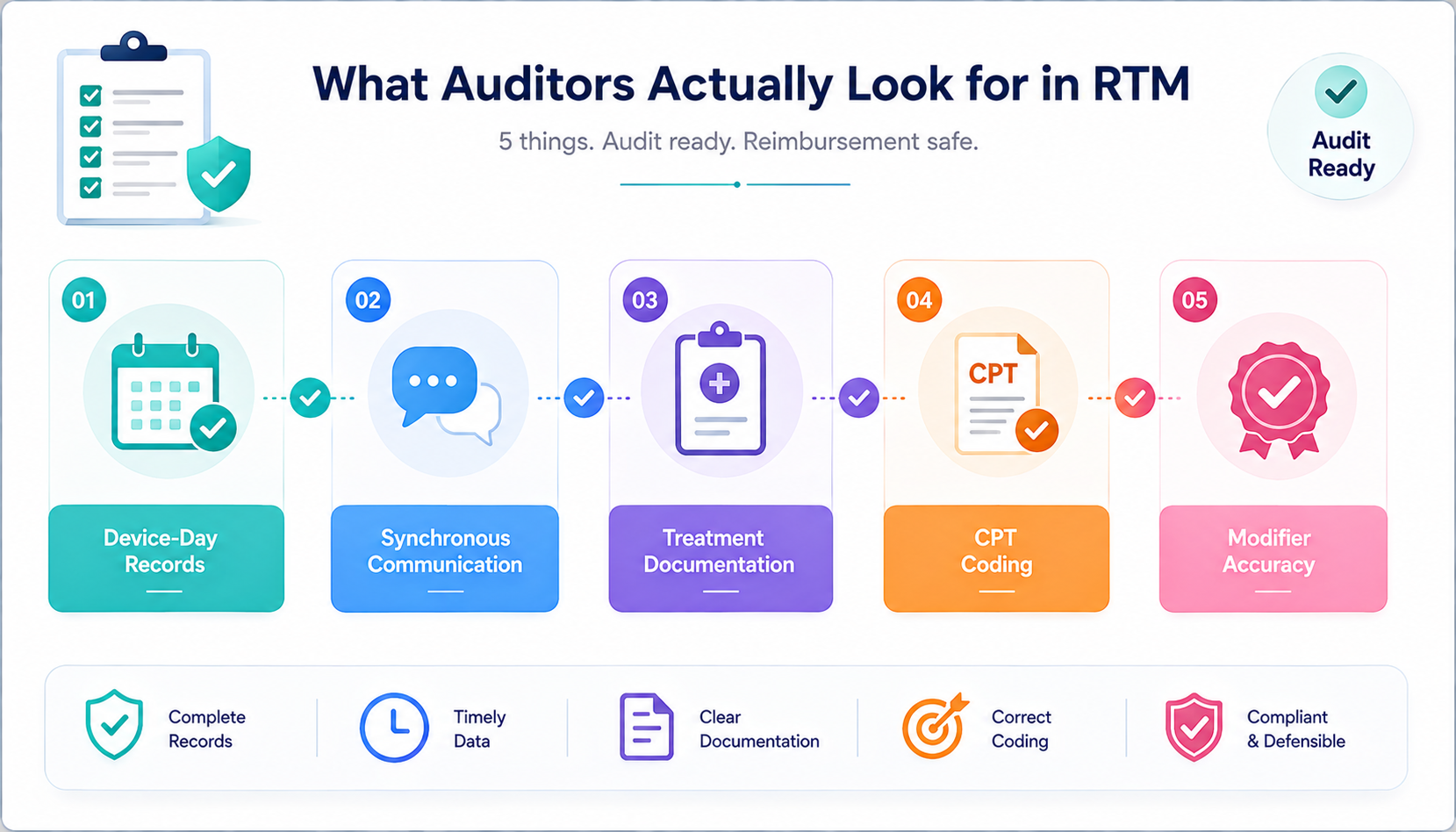
What Auditors Actually Look For
- Proof of synchronous communication for every treatment management claim submitted.
- Accurate device day counts matching the billed threshold.
- Correct modifier application when a PTA or OTA contributed monitoring time.
Reporting Requirements for Leadership
- Monthly clean claim rate specific to remote therapeutic monitoring codes, not blended across all billing.
- Denial reasons broken out by code, since 98980 denials usually point to a different root cause than device supply denials.
- Patient adherence trend across the enrolled population.
Metrics That Should Reach the Executive Dashboard
- Revenue per enrolled patient compared against platform and staffing cost.
- Average device days logged per patient per month.
- Time from enrollment to first billable claim.
What to Require Before Deployment Approval
Operational readiness: Confirm a named clinical owner and a named billing owner exist before enrollment starts.
Technical readiness: Confirm the digital therapeutics billing software integrates with your existing EHR at the data level, not just the login level.
Compliance readiness: It should also include healthcare software security alongside confirmation that the platform logs synchronous communication and applies PTA and OTA modifiers automatically.
Financial readiness: Confirm a payback model exists using a realistic adherence rate, not the vendor's best case number.
Why Patoliya Infotech for RTM Solutions
Successful remote therapeutic monitoring programs depend on more than billing codes. They require connected workflows, accurate documentation, and systems that support reimbursement at scale.
Unified workflows: Connect clinical documentation, device-day tracking, and claim preparation in one platform.
Automated compliance: Track eligibility thresholds and capture required treatment-management interactions.
Revenue-focused design: Reduce manual work that often leads to RTM billing errors and denials.
Scalable integration: Support existing healthcare systems without disrupting daily operations.
As a healthcare software development company, Patoliya Infotech helps organizations implement digital therapeutics billing software that supports compliant, efficient remote therapeutic monitoring programs. The goal is to improve reimbursement performance while reducing administrative burden.
Conclusion
Remote therapeutic monitoring creates a reimbursable pathway for therapy adherence and response tracking while enabling PTs, OTs, and SLPs to bill independently. Success depends on understanding CPT requirements, maintaining complete documentation, and sustaining patient engagement over time.
Most reimbursement challenges come from workflow gaps, low adherence, and manual processes rather than code selection itself. Integrated digital therapeutics billing software can improve claim accuracy and audit readiness. Before investing, evaluate expected revenue, operational costs, and governance requirements to build a sustainable remote therapeutic monitoring program.
FAQs:
CMS allows both programs for the same patient only when the clinical time and data collected are clearly separated and documented under each program's own requirements. Overlapping documentation between the two creates audit risk, so most practices avoid running both concurrently for one patient.
No physician order or oversight is required when a PT, OT, or SLP orders and manages the program within their scope of practice. This is the feature that opened remote billing to therapy practices that never had RPM access.
The device supply code cannot be billed for that period, though a lower threshold code may apply depending on days logged. Remote therapeutic monitoring revenue for that patient simply resets the following month.
Setup and education can bill immediately, while device supply and treatment management codes require the monitoring period and communication requirement to be met first. Most practices see their first full claim cycle within 30 to 45 days.
Look for integrated architecture where documentation and billing share one system, automatic device day tracking, and built-in modifier logic for PTA and OTA time. This combination is what separates clean claim rates from recurring denials.