Medical Device Software Development: Lifecycle, Testing, and Validation
TL;DR: Medical device software development requires a structured lifecycle approach with IEC 62304 processes, verification, and validation built from the beginning. This helps teams reduce regulatory risks, achieve faster approvals, and prevent costly post-launch rework.
Software now decides whether a medical device performs safely, not just how it looks. Insulin pumps, imaging platforms, and remote monitoring tools all run on code that must survive audits, cyber threats, and worst-case clinical use through robust healthcare software security practices. Medical device software development is not standard app building, it requires specialized healthcare software development expertise backed by regulatory and compliance knowledge. It carries legal weight and patient risk that most engineering teams never face elsewhere.
Companies that skip structured medical device software engineering practices end up rebuilding documentation after a failed audit, losing months of runway. This guide explains the lifecycle, testing approach, compliance load, and decision points that separate safe products from recalled ones through disciplined medical device software development.
What Is Medical Device Software Development?
Medical device software development means building embedded firmware, cloud platforms, or mobile applications that control, monitor, or support a regulated medical device. It includes standalone Software as a Medical Device (SaMD) products and telemedicine software that diagnose, monitor, or support patients without requiring dedicated hardware.
A glucose monitor app, surgical robot controller, remote patient monitoring platform, and Software as a Medical Device (SaMD) diagnostic imaging algorithm all fall under this category. Each one needs traceable requirements, tested code, and a documented history that regulators can review line by line.
This is where medical device software development differs sharply from consumer software, where a bug ships a patch, not a recall. Every layer of medical device software development, from firmware to cloud dashboard, carries the same traceability obligation.
The Medical Device Software Lifecycle: IEC 62304 Explained
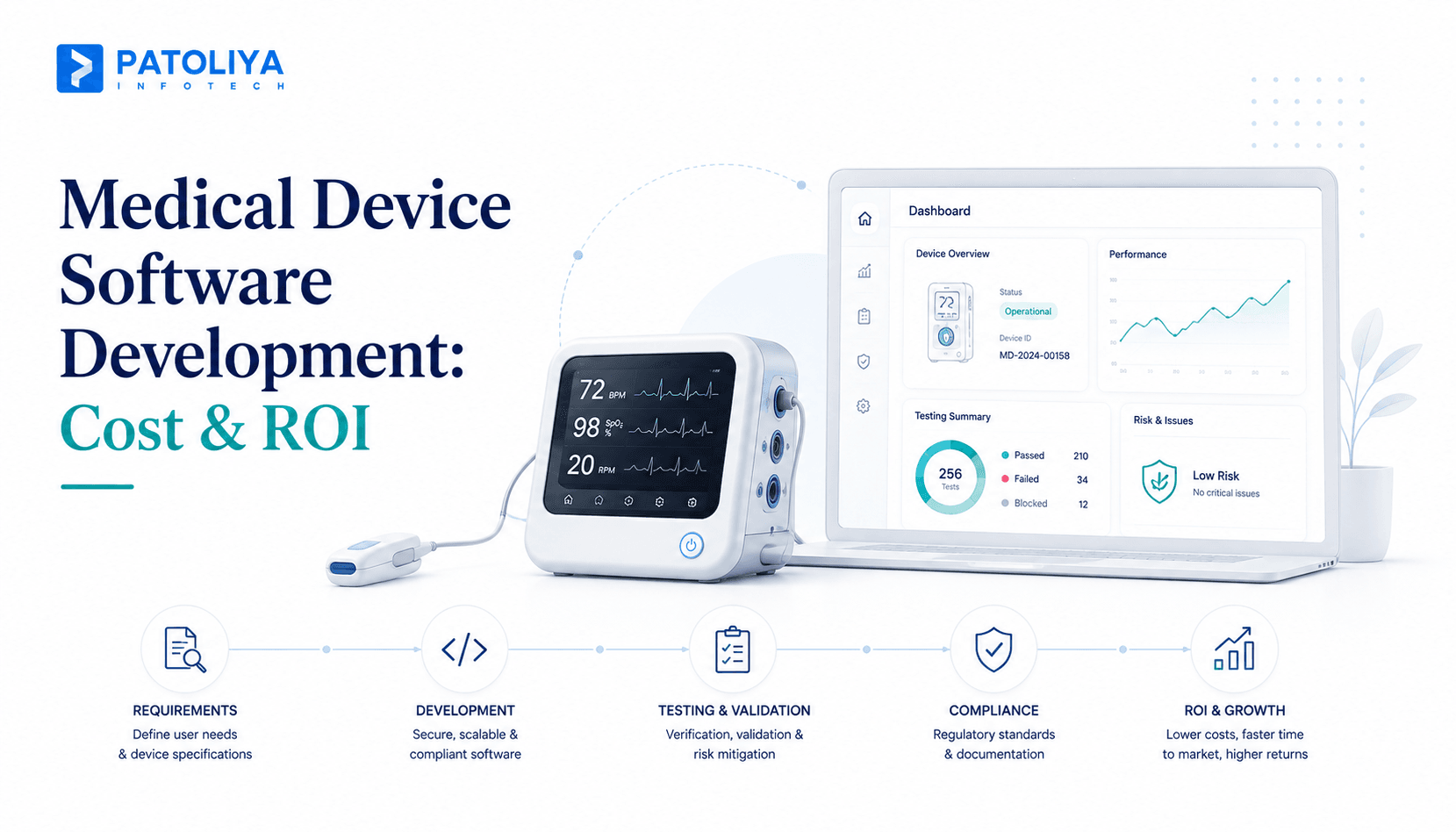
The IEC 62304 standard defines six stages every medical device software development project must follow, and skipping any stage creates gaps auditors catch immediately.
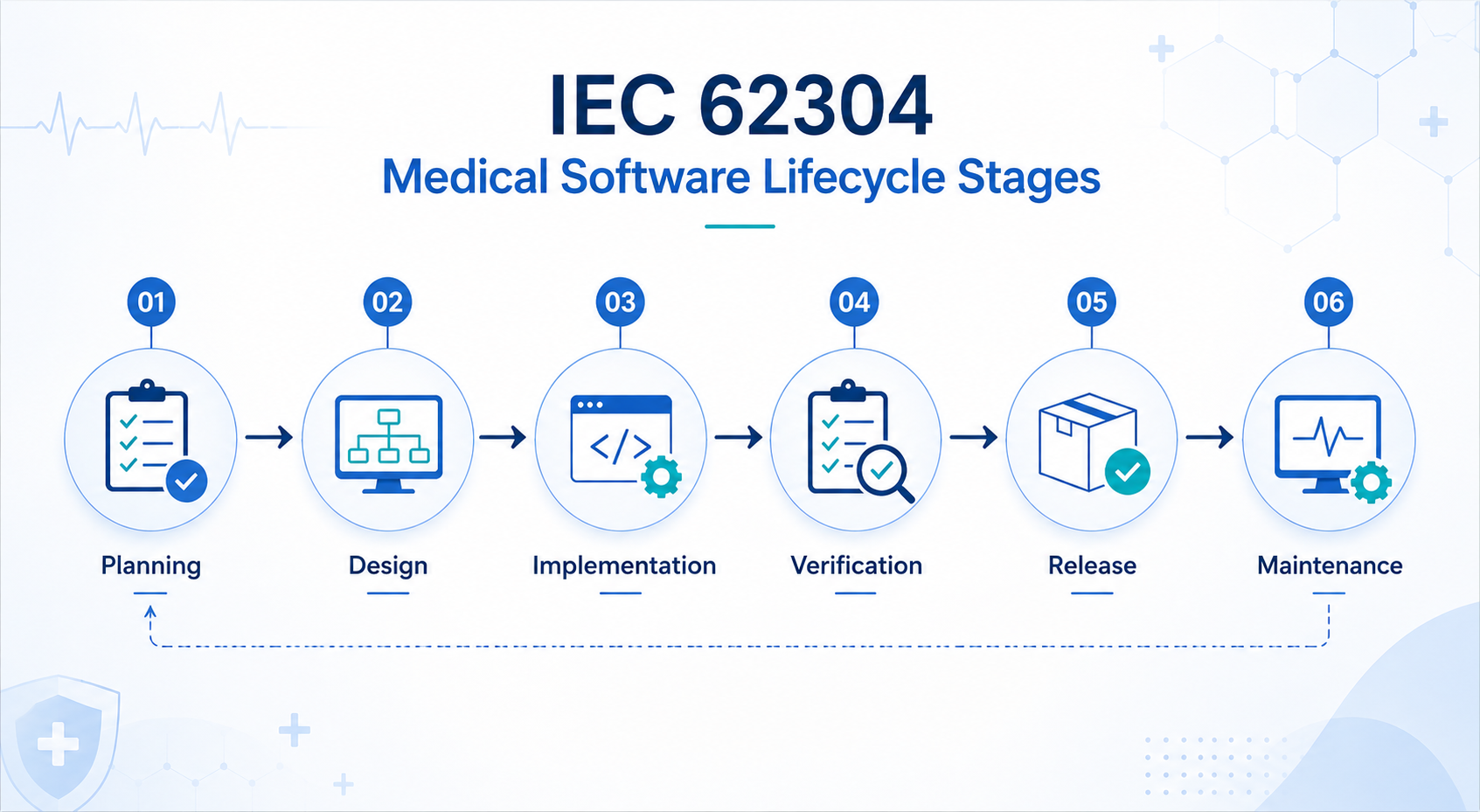
Planning and Requirements: Teams define scope, safety classification, and regulatory pathway before writing a single line of code.
Software Architecture and Design: Engineers map how modules interact and where risk controls sit inside the system.
Implementation: Developers write code against approved requirements, with every change tied back to a documented need.
Verification and Testing: Each requirement gets tested against defined acceptance criteria, closing the loop between design and behavior.
Release Management: Teams freeze the build, complete final checks, and package documentation for submission.
Maintenance and Updates: Post-market changes follow the same rigor, since a patch can introduce new risk as easily as a new feature.
Lifecycle discipline is what separates a device that clears FDA review on the first submission from one that gets sent back for missing traceability, as emphasized by the FDA Digital Health Center of Excellence.
Verification vs Validation: Understanding the Difference
Verification checks whether the team built the software correctly against its written specification. Validation checks whether the team built the right software for the intended clinical use.
|
Question |
Verification |
Validation |
|
Core question |
Did we build it correctly? |
Did we build the right thing? |
|
Method |
Code review, unit tests, static analysis |
Clinical simulation, user testing, field data |
|
Timing |
Throughout development |
Before and at release |
|
Owner |
Engineering team |
Clinical and regulatory team |
Both processes feed the same regulatory submission, and a device can pass verification while still failing validation if it solves the wrong clinical problem. Strong medical device software development teams run both tracks in parallel instead of treating validation as a final gate.
Medical Device Software Safety Classes: Class A, B, and C
Safety classification under IEC 62304 sets how much rigor a medical device software development project needs, and getting the class wrong early costs teams months later.
Class A covers software where injury is not possible, such as a data logging tool with no clinical output.
Class B covers software where non-serious injury is possible, like a dosage calculator with a human review step.
Class C covers software where serious injury or death is possible, such as a closed loop insulin pump.
Higher classes demand deeper testing, more documentation, and tighter change control across every phase of medical device software development.
Why Medical Device Software Testing Needs a Different Approach
Standard software testing and QA services verify whether a feature works, while medical device software testing confirms it operates safely under every foreseeable failure condition. Medical device software testing checks whether a feature works safely across every foreseeable failure mode, with full traceability back to a documented risk.
This means risk-based test planning, full requirement traceability matrices, cybersecurity penetration testing, and documentation built to survive a regulator's audit, not just a sprint retrospective.
Medical Device Software Design Controls and V&V Documentation Checklist
Design controls give medical device software development teams a paper trail that proves every requirement was built, tested, and traced through to release.
- User Requirements Specification (URS): captures what clinicians and patients actually need from the device.
- Software Requirements Specification (SRS): translates user needs into testable technical requirements.
- Risk Management File: documents every identified hazard and the control applied to it.
- Design Specifications: describe how the architecture satisfies each requirement.
- Traceability Matrix: links every requirement to its test case and result, closing gaps before an audit does.
- Verification Protocols: define how each requirement gets objectively tested.
- Validation Reports: confirm the finished product meets real-world clinical needs.
- Change History: records every modification with justification and impact assessment.
Missing even one of these documents during an FDA inspection can stall clearance for months, making HIPAA compliance and regulatory documentation essential throughout development., so mature teams build documentation alongside code rather than after it. This is the single habit that separates smooth medical device software development submissions from ones sent back for rework.
Medical Device Software Testing Strategy: From Unit Testing to System Validation
A layered testing strategy catches defects at the cheapest point to fix them, and modern teams increasingly complement this approach with AI in software testing to improve test coverage and efficiency.
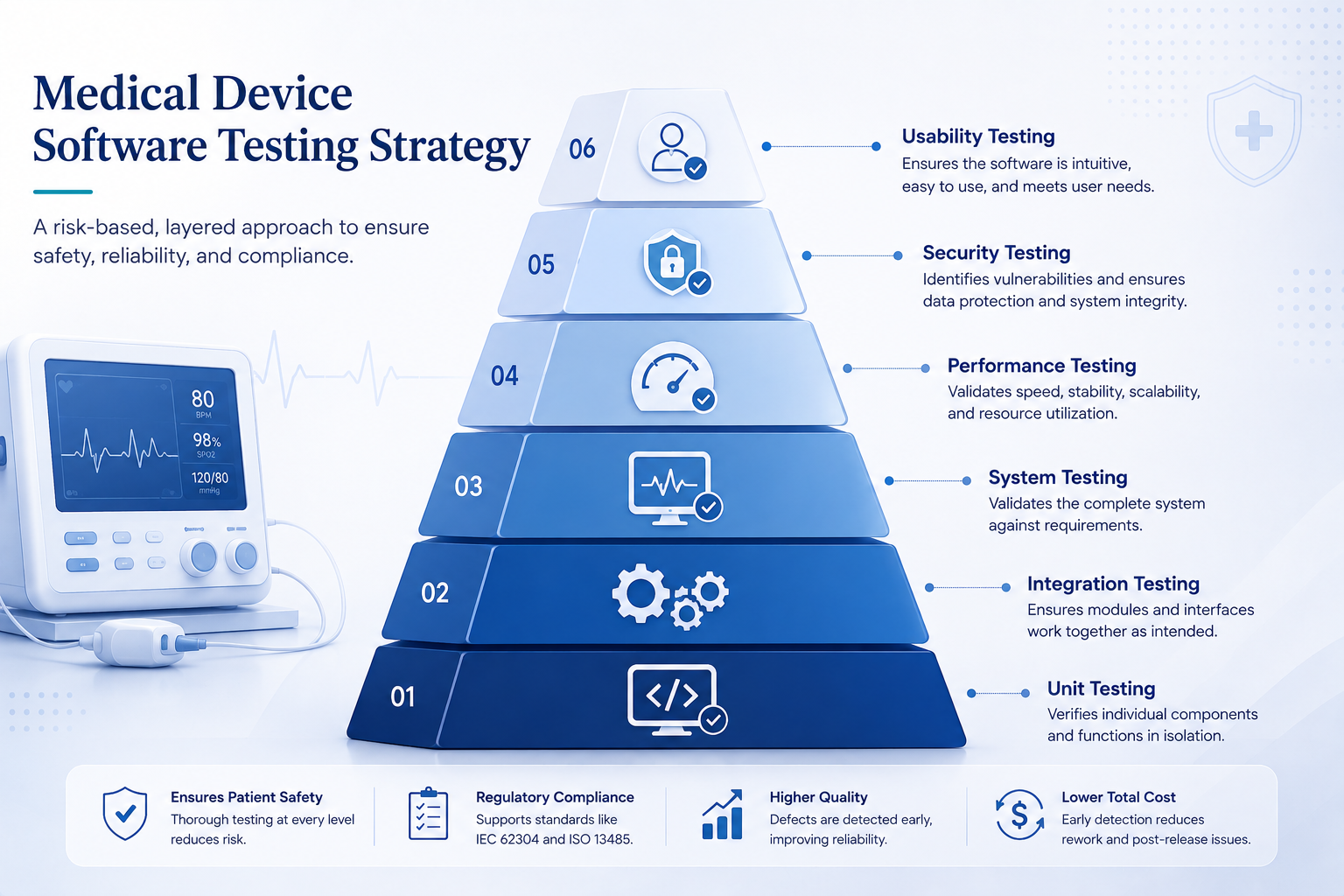
Unit testing: Checks individual functions and software components to ensure they work correctly in isolation.
Integration testing: Confirms different modules communicate and operate properly when combined.
System testing: Validates the complete device against defined functional and performance requirements.
Performance testing: Measures software behavior under real-world usage, load, and stress conditions.
Security testing: Identifies vulnerabilities attackers could exploit in connected medical devices.
Usability testing: Ensures clinicians and patients can operate the device safely and effectively.
Each layer catches a different failure mode, and skipping any one of them shifts discovery from a test bench to a hospital, which is a trade no MedTech company can afford.
Layered testing is the backbone of dependable medical device software development, since a gap at one layer rarely gets caught by the next. Strong medical device software engineering teams treat this layering as non-negotiable.
Benefits of Proper Medical Device Software Engineering
Disciplined medical device software engineering shortens the path to clearance and cuts the odds of an expensive recall later.
Companies that build compliance into the process from day one see faster regulatory clearance, because submissions arrive with complete traceability instead of gaps reviewers have to chase. Reduced recall risk follows naturally, since defects get caught during structured testing rather than after commercial launch. Reliability improves because every requirement ties to a verified test result, not an assumption.
Compliance costs drop over time, since teams stop paying for repeated rework after failed audits. Faster market entry follows from all of the above, giving MedTech companies a real competitive edge over slower-moving competitors that treat medical device software development as a secondary step after hardware engineering.
Maintaining Audit Readiness and Post-Market Software Updates
Compliance does not end at launch. Medical device software development carries obligations that run for the entire commercial life of the product.
Change control processes govern every post-market update, requiring the same documentation rigor as the original release. Software updates need re-verification against affected requirements before rollout, since even a small patch can shift device behavior in unexpected ways.
Complaint handling feeds directly into risk reassessment, giving teams real-world signals about failure modes the original risk file missed. Post-market surveillance closes the loop by tracking device performance across the installed base and identifying issues before they become recalls.
Companies that treat this phase casually often face harder audits, as regulators expect the same discipline that supported initial clearance. Post-market discipline is where mature medical device software development programs build long-term trust with regulators.
In-House vs Outsourced Medical Device Software Development
Selection between building an internal team or partnering externally for medical device software development and Software as a Medical Device (SaMD) solutions comes down to regulatory expertise, speed, and long-term ownership goals.
|
Factor |
In-House Development |
Outsourced Development |
|
Regulatory Expertise |
Built internally over time |
Proven IEC 62304 experience |
|
Development Speed |
Depends on hiring capacity |
Faster project kickoff |
|
IP & Ownership |
Full internal control |
Shared through contracts |
|
Cost |
Higher ongoing overhead |
Flexible project-based investment |
|
Scalability |
Limited by team size |
Easily scales with project needs |
Comparison Table: In-House vs Outsourced Development
|
Factor |
In-House Development |
Outsourced Development |
|
Regulatory Expertise |
Builds over time, inconsistent early on |
Available immediately from prior projects |
|
Development Speed |
Slower start due to hiring |
Faster ramp with existing teams |
|
Cost Efficiency |
Higher fixed cost, lower per project cost long term |
Variable cost tied to project scope |
|
Scalability |
Limited by headcount |
Flexes with demand |
|
Specialized Skills |
Requires ongoing training investment |
Already available across projects |
|
Compliance Support |
Depends on internal maturity |
Often built into the partner's process |
Most MedTech leadership teams land on a hybrid model, keeping core product knowledge internal while leaning on outsourced medical device software development specialists for regulatory heavy phases like verification and validation.
This blended structure keeps medical device software development costs predictable without sacrificing regulatory depth.
What Does Medical Device Software Development Cost?
|
Cost Driver |
Estimated Impact |
|
Device Complexity |
Simple software: $40k to $100k; Complex connected devices: $250k+ |
|
Software Classification |
Class A: Lower compliance costs; Class B/C: 20 to 50% higher due to additional testing and documentation |
|
Regulatory Requirements |
Supporting both FDA + EU MDR can increase compliance costs by $30k to $100k+ compared to a single market |
|
Testing Scope |
Verification, validation, and IEC 62304 testing typically account for 20 to 35% of the total project budget |
|
Integration Needs |
Third-party integrations often add $10k to $50k+ depending on complexity |
|
Cybersecurity Requirements |
Secure architecture and penetration testing may add $15k to $60k+ |
|
Documentation Effort |
Regulatory documentation and traceability commonly represent 10 to 20% of the overall project cost |
Build vs Partner: ROI Considerations for MedTech Leadership
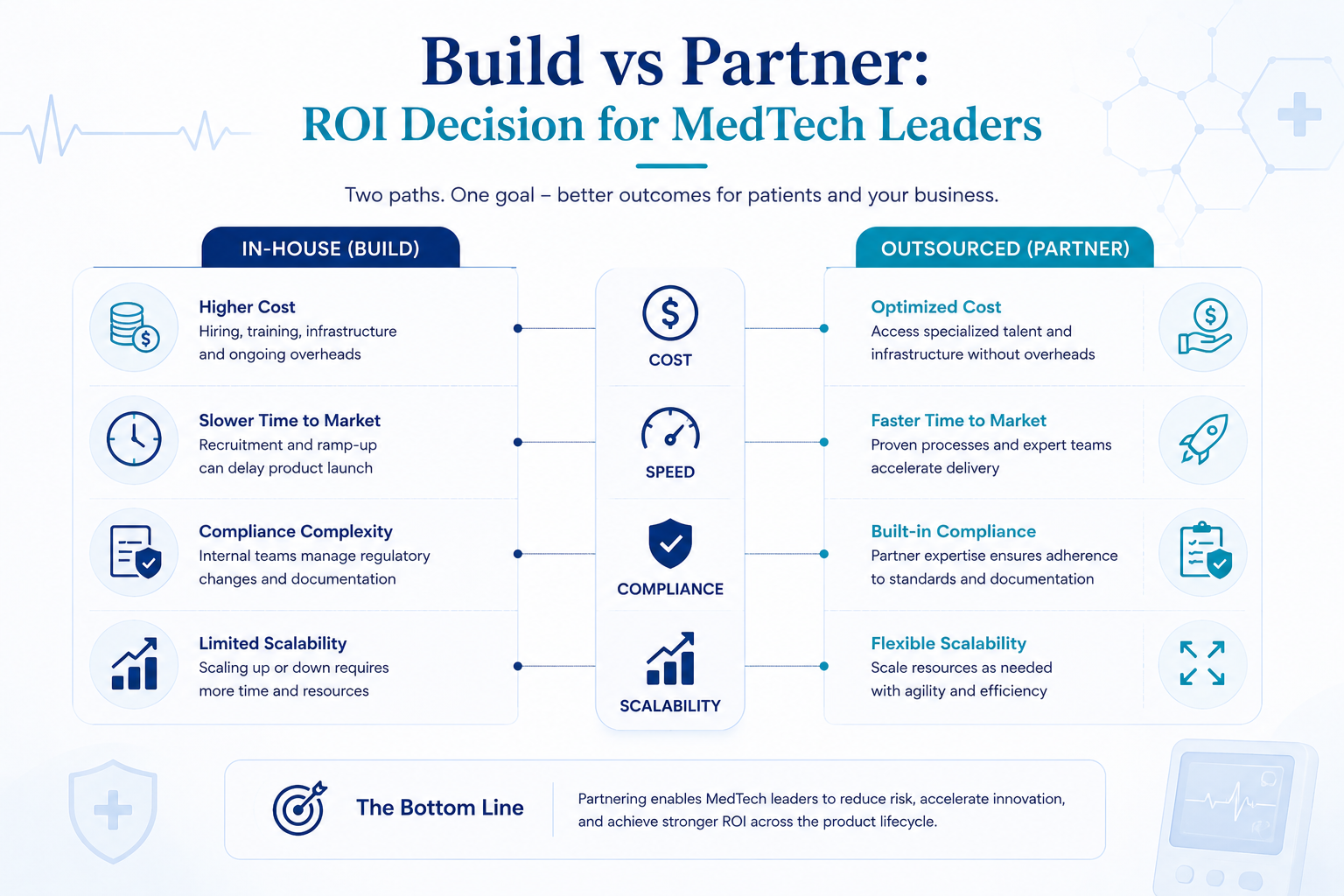
Internal engineering capabilities: Building in-house delivers better ROI when your roadmap includes multiple device generations and long-term product ownership.
Time-to-market goals: Partnering accelerates medical device software development, especially when fast regulatory submissions are a business priority.
Compliance expertise: Experienced medical device software engineering partners with IEC 62304 knowledge can reduce regulatory delays and improve approval readiness.
Long-term maintenance: In-house teams may provide greater value for ongoing updates, post-market support, and continuous product improvements.
Product roadmap complexity: Organizations with complex or expanding product portfolios often benefit from combining internal expertise with external specialists.
ROI consideration: Many MedTech companies achieve the strongest medical device software development ROI by partnering for the first product and building internal capabilities as the product roadmap matures.
FDA 21 CFR 820, IEC 62304 Compliance and Regulatory Risk
Regulatory risk in medical device software development and Software as a Medical Device (SaMD) comes from weak documentation more often than weak code, and inspectors know exactly where to look for gaps.
Quality management systems under 21 CFR 820 set the operational backbone that every medical device software engineering decision relies on for a paper trail. Design history files consolidate every requirement, test, and change into a single reviewable record that regulators expect to see intact.
Software lifecycle compliance with IEC 62304 should be maintained throughout the entire development process, with complete and accurate documentation at every stage.
Audit preparation should be an ongoing activity throughout Software as a Medical Device (SaMD) development rather than something done just before regulatory submission.
By building compliance into the development process from day one, companies can reduce regulatory risks, simplify audits, and improve their chances of faster approvals.
Medical Device Software Security and Risk Management
Cybersecurity is now a critical factor in medical device purchasing decisions, making security an essential part of medical device software development.
Threat modeling helps identify potential attack risks early in the design phase, allowing teams to address security gaps before they become costly to fix. Strong medical device software engineering practices also include secure coding, which prevents vulnerabilities during development.
Secure healthcare data integration ensures patient information remains protected through encryption and access controls across connected medical systems. Vulnerability management helps teams monitor risks, apply timely patches, and maintain device security over time.
For connected medical devices, strong security practices and healthcare interoperability are equally important because a single vulnerable endpoint can impact an entire healthcare network.
Vendor Selection Checklist Before You Sign
Choosing a partner for medical device software development without checking these seven areas is how companies end up with a vendor that cannot support them past the first submission.
- IEC 62304 experience across comparable device classes.
- Regulatory knowledge spanning FDA and international markets.
- Testing capabilities covering unit through system level validation.
- Documentation standards that match design history file expectations.
- Security practices covering threat modeling and vulnerability management.
- Healthcare references from comparable device categories.
- Post-launch support for updates and audit readiness.
A vendor missing more than one of these areas usually shows up as a gap during the first regulatory review, not before. Vetting hard on these seven points protects the entire medical device software development and Software as a Medical Device (SaMD) timeline from a late-stage surprise.
Why Choose Patoliya Infotech for Medical Device Software Development
Patoliya Infotech delivers custom software development for MedTech companies, building secure and compliant medical device software solutions focused on lifecycle management, testing, and regulatory readiness.
IEC 62304-focused development: We follow structured software lifecycle practices to support safer and more reliable medical solutions.
Medical device engineering expertise: Our team helps design, develop, test, and maintain scalable healthcare software.
Testing and validation support: We focus on verification, validation, and documentation processes required for regulatory confidence.
Security-first approach: We integrate secure coding, risk management, and cybersecurity practices for connected medical systems.
Long-term support: From initial development to post-launch updates, we help companies maintain product reliability and compliance.
Patoliya Infotech helps MedTech companies build reliable medical software with compliant development processes, robust testing, secure architecture, and ongoing engineering support.
Conclusion
Successful medical device software development requires more than technical expertise. Companies need structured lifecycle processes, rigorous testing, complete documentation, and compliance built into every stage. The right development approach for Software as a Medical Device (SaMD) helps reduce regulatory risks, accelerate approvals, and create reliable medical solutions.
By combining engineering excellence with compliance-focused practices, organizations can build software that supports patient safety, business growth, and future product innovation. A strong foundation ensures every release remains secure, scalable, and ready for evolving healthcare needs.
FAQs:
Medical device software development covers building embedded, cloud, or mobile software that controls, monitors, or supports a regulated medical device, including standalone SaMD products, under structured lifecycle and testing requirements.
IEC 62304 requires six lifecycle stages for medical device software development, covering planning, design, implementation, verification, release, and maintenance, each tied to safety classification and documented traceability.
Verification confirms the software was built correctly against its specification. Validation confirms the software solves the right clinical need. Both are required for regulatory clearance in medical device software development.
It depends on regulatory maturity and timeline. In-house suits companies with deep internal expertise and long roadmaps. Outsourced medical device software engineering suits teams needing speed and existing IEC 62304 experience.
Validation requires a URS, SRS, risk management file, traceability matrix, verification protocols, and validation reports, all central to defensible medical device software development documentation.
Medical device software development cost scales with safety classification, regulatory scope, and testing depth, not a flat per-feature rate, so budgets should account for documentation as core work.