Digital Transformation in Healthcare: From Strategy to Adoption
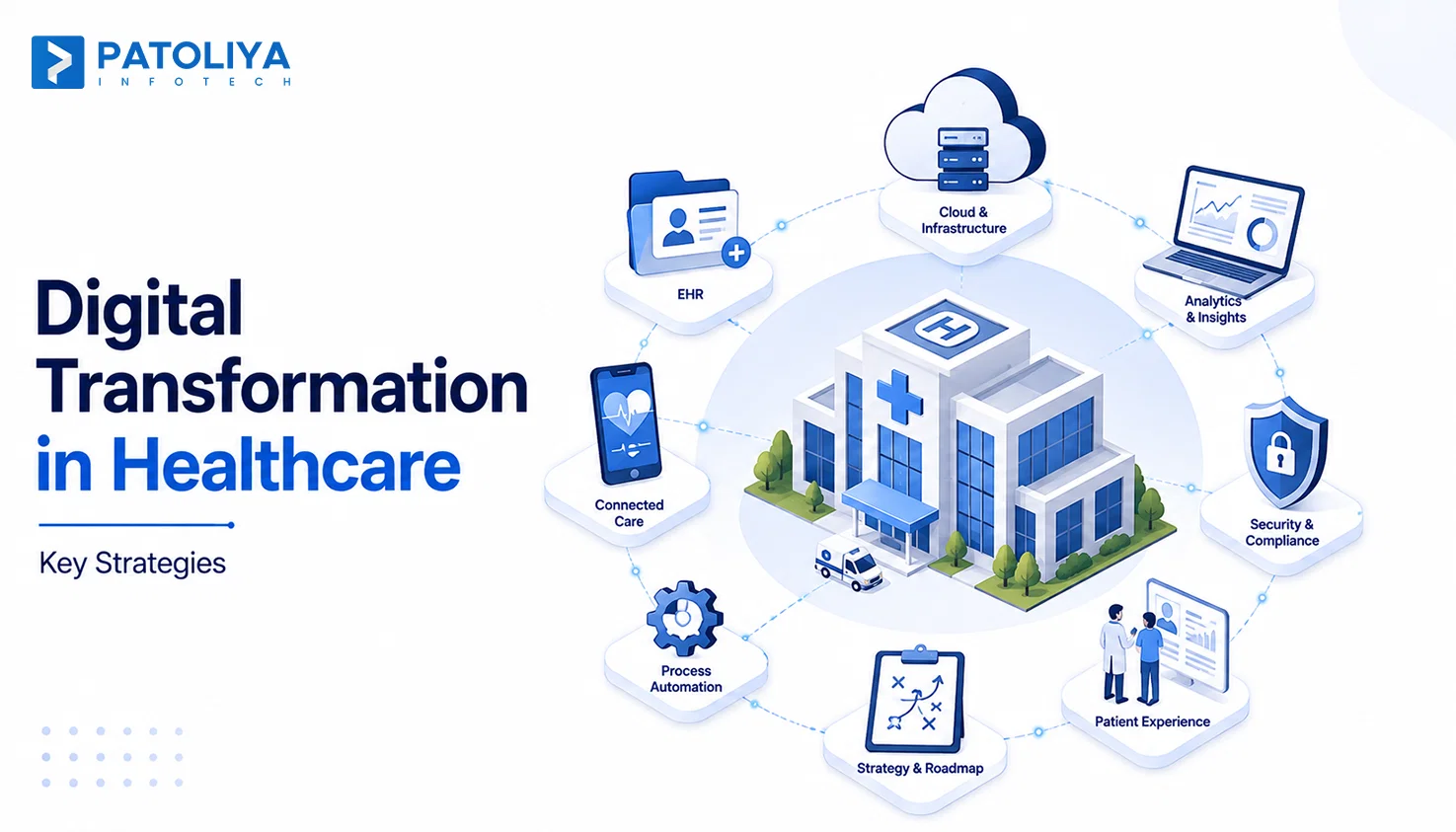
TLDR: A new EHR does not equal digital transformation in healthcare. Adoption does. Most hospitals launch systems successfully and still fail transformation because no one built a healthcare digital transformation strategy around workflow change, staged funding, and measured adoption.
A hospital can spend $40 million on new systems and still run the same broken workflow underneath. That is the real failure pattern behind digital transformation in healthcare, not bad software, bad sequencing.
Leaders who treat transformation as a purchase get a system that works and a staff that avoids it, which is why healthcare software consulting should connect technology decisions with actual clinical workflows. Leaders who treat it as a staged operational shift, foundation first, then workflow redesign, then scale, get adoption numbers that actually move.
This roadmap shows exactly how to assess where your organization stands, sequence the work correctly, and prove the results to a board that wants numbers, not slideware.
What Is Digital Transformation in Healthcare?
Digital transformation in healthcare means redesigning clinical and operational workflows around data and connected systems, not simply digitizing paper processes. A scanned form is not transformation. A workflow that eliminates the form is.
Most organizations sit somewhere between digitized records and connected systems. Data exists digitally, but it rarely moves between departments without manual effort, which is exactly where digital health maturity stalls for years at a time.
Why Healthcare Digital Transformation Projects Fail
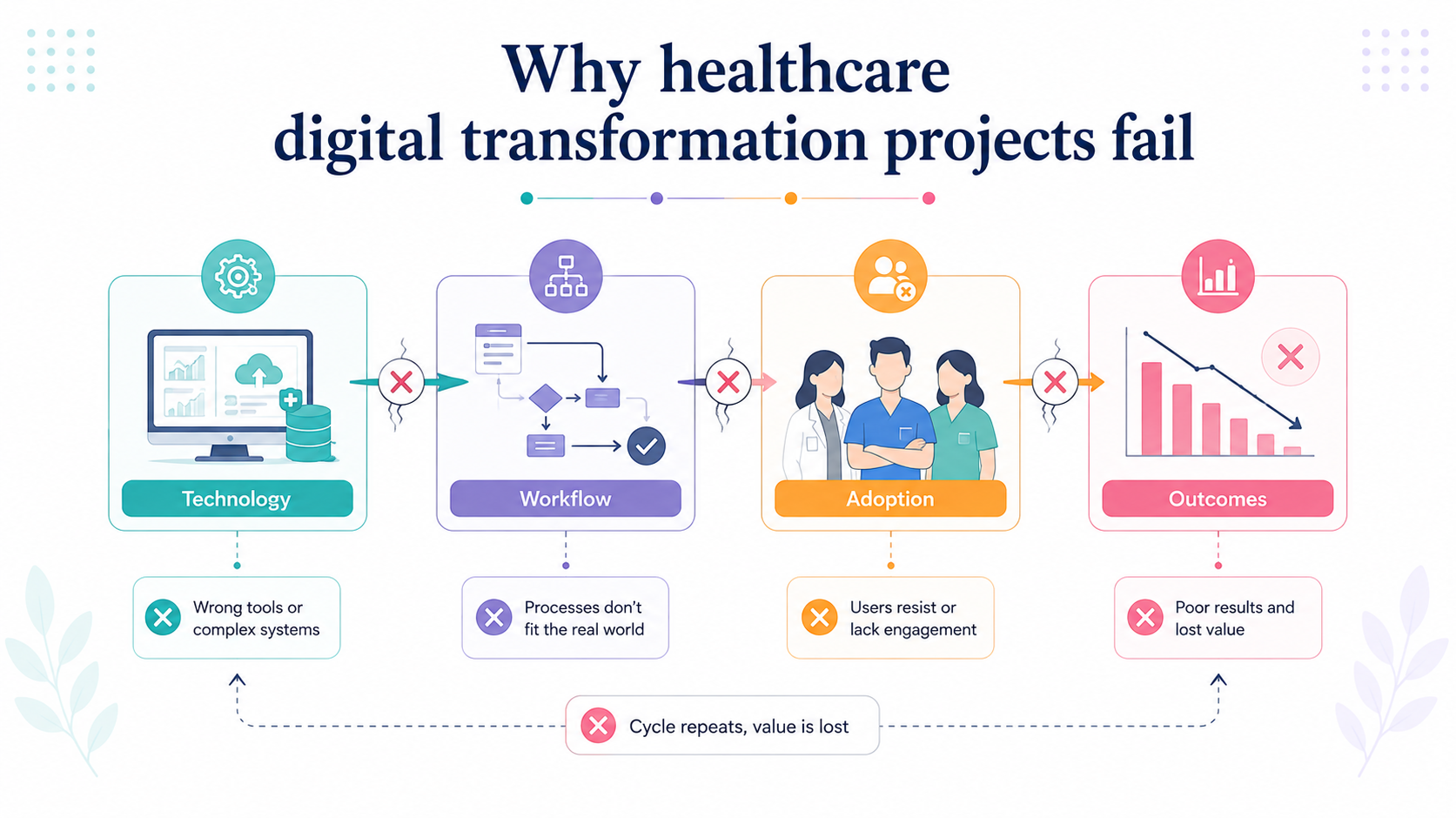
Common reasons transformation projects stall
Projects stall when leadership treats Digital transformation in healthcare as an IT purchase instead of an operational change. Budget gets approved for software, nothing gets approved for training, workflow redesign, or the staff time needed to actually shift daily habits.
Why going live does not mean successful adoption
A system going live only proves the technology works. Adoption proves the organization changed. A community hospital that rolls out a new discharge planning tool but keeps the old paper checklist running in parallel has not transformed anything; it has doubled the work.
Many healthcare digital transformation strategy efforts get reported as complete the day a system launches, months before anyone measures whether staff actually use it correctly.
How to Assess Your Digital Maturity
The five stages of healthcare digital maturity
Most organizations move through recognizable stages that can be assessed using digital health maturity models on the way to full digital transformation in healthcare maturity.
|
Stage |
Description |
Example Signal |
|
Paper based |
Records and workflows remain largely manual. |
Nurses chart on paper, scan later. |
|
Digitized |
Data exists digitally but stays siloed by department. |
Lab and pharmacy systems do not talk. |
|
Connected |
Systems share data through basic integration. |
Orders flow between EHR and lab automatically. |
|
Data driven |
Analytics actively inform clinical and operational decisions. |
Staffing adjusts based on live census data. |
|
Adaptive |
Systems and workflows adjust continuously in real time. |
Alerts trigger automatic care pathway changes. |
How to identify your organization's current stage
Map your actual systems against this table honestly. A hospital where billing still exports data manually into a spreadsheet every month sits at digitized in digital transformation in healthcare, no matter how modern its EHR looks on the surface.
Technology maturity vs transformation maturity
|
Technology Maturity |
Transformation Maturity |
|
Measures the adoption of advanced healthcare technology. |
Measures how effectively staff changes workflows and behavior. |
|
Example: Predictive analytics for readmission risk is installed. |
Example: Discharge teams actively use risk insights to improve decisions. |
|
Focuses on tools, systems, and capabilities. |
Focuses on adoption, workflows, and measurable outcomes. |
How to Build a Healthcare Digital Transformation Roadmap
Start with business and clinical goals
A roadmap built around technology trends instead of organizational goals collapses the first time budget gets tight, which is why the Global Strategy on Digital Health emphasizes aligning digital health initiatives with organizational, financial, human, and technological resources.
Start with the actual problems like denial rates, discharge delays, and staff turnover tied to administrative burden, then use digital transformation in healthcare to work backward to the technology that solves them.
For instance, if late discharges are costing bed capacity, the roadmap should open with discharge workflow tools, not a general analytics platform.
This is the difference between a genuine healthcare digital transformation strategy and a shopping list of vendor names.
Prioritize projects by value, readiness, and risk
Score every initiative against three factors: the financial or clinical value it creates, how ready the organization actually is to execute it, and the operational risk if it goes wrong.
A remote monitoring program might score high on value but low on readiness if nursing staff have no bandwidth to review incoming alerts; in digital transformation in healthcare, it should wait behind a lower-value project the organization can actually execute well.
Fix data, integration, and security foundations first
New applications built on top of fragmented data and weak healthcare data integration inherit those problems immediately.
One health system added a patient engagement app before addressing legacy system modernization and duplicate patient records across two legacy systems; the app sent conflicting appointment reminders to the same patient for months.
Fixing interoperability and healthcare software security before adding new tools creates a stronger foundation for a healthcare data fabric and every digital transformation in healthcare project that comes after it.
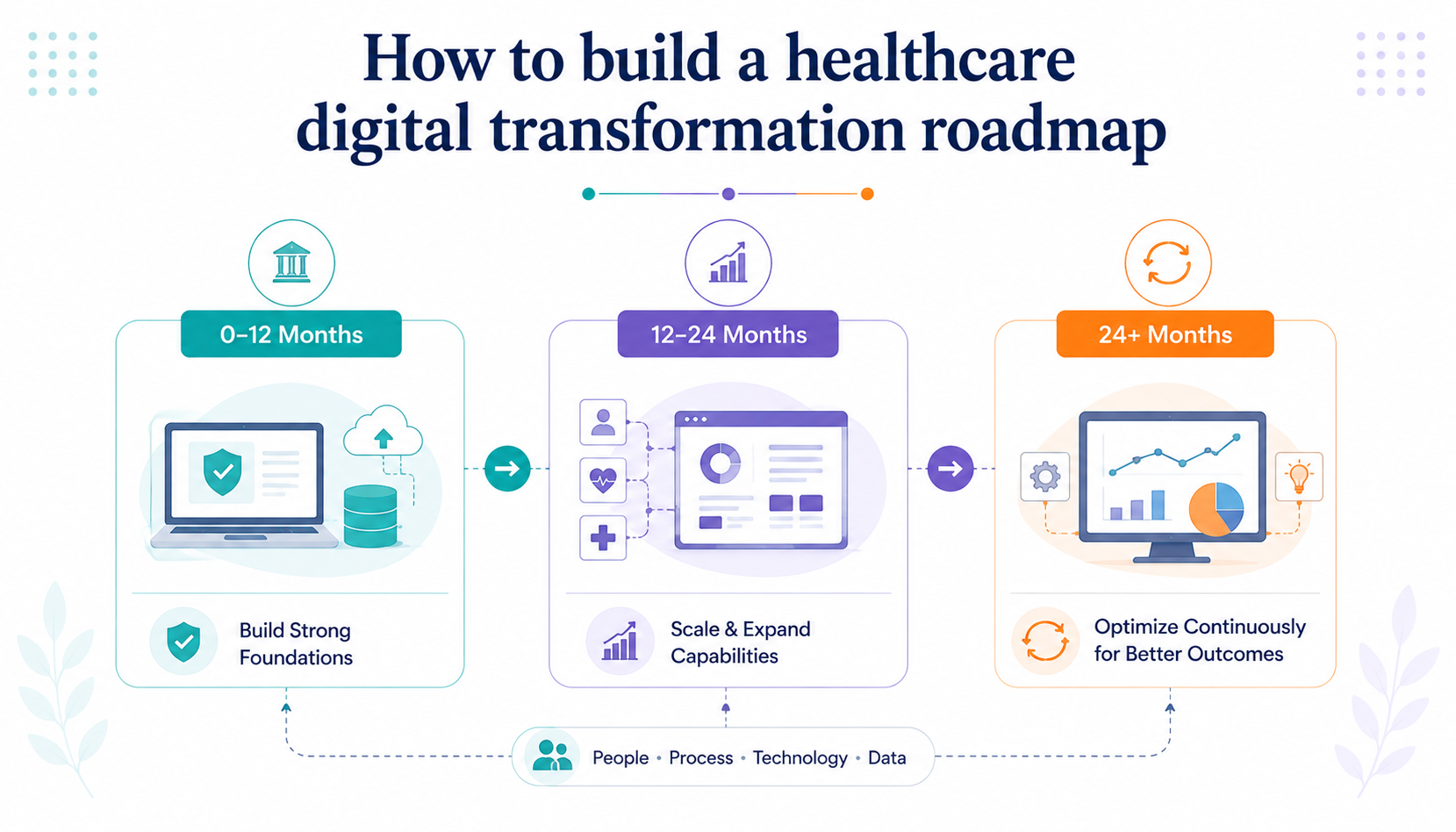
Plan transformation in 0 to 12, 12 to 24, and 24 plus month stages
For healthcare digital transformation strategy, break the roadmap into three horizons and determine where cloud technology in healthcare fits within the organization's modernization priorities. The first 12 months should fix foundational gaps and deliver one visible win, for example, closing the interface gap between the EHR and the lab system.
Months 12 to 24 should scale proven initiatives across additional units or facilities. Beyond 24 months, the organization should shift toward continuous healthcare technology adoption roadmap planning instead of one large fixed program.
How Should Healthcare Leaders Govern and Fund Transformation?
Decide who owns digital transformation: Digital transformation in healthcare without a single accountable owner splinters across departments, each optimizing its own priority instead of the organization's.
Name one executive, often a CDO or CIO, with authority across clinical and operational stakeholders.
Create one enterprise transformation plan: Separate department level digital projects running without coordination create duplicate systems and conflicting data standards.
Radiology buying its own scheduling tool while the enterprise rolls out a new patient portal is exactly the fragmentation that digital transformation in healthcare planning prevents.
Fund transformation in stages: Funding an entire multi-year program upfront invites scope creep and makes it harder to redirect budget when priorities shift.
Staged funding tied to milestone results, releasing year two budget only after year one adoption targets hit, keeps leadership accountable and gives the organization room to adjust.
How to Get Clinicians and Staff to Adopt New Technology
Involve clinicians before implementation
- Clinicians who get consulted after a system is already selected have no reason to champion it.
- Bring frontline staff into vendor evaluation and workflow design from the beginning, not as a final training session before go-live.
Redesign workflows instead of simply adding technology
- Layering new software on top of an unchanged workflow adds a step instead of removing one.
- A nurse asked to log the same vitals in both a new tablet system and the old paper flowsheet during transition will default back to paper the moment supervision eases. Digital transformation in healthcare eliminates redundant work.
Make change management part of the project
- Change management funded as an afterthought produces exactly the adoption gap leadership complains about a year later.
- Build training, communication, and feedback loops into the project budget from day one, not as a line item added after launch.
Track adoption as an executive metric
- Usage rate, error rate, and workflow completion time deserve the same executive visibility as project timeline and budget.
- A dashboard that tracks go-live dates but not actual adoption is only telling half the story.
How to Measure Digital Transformation Success
Measure adoption and workflow improvements
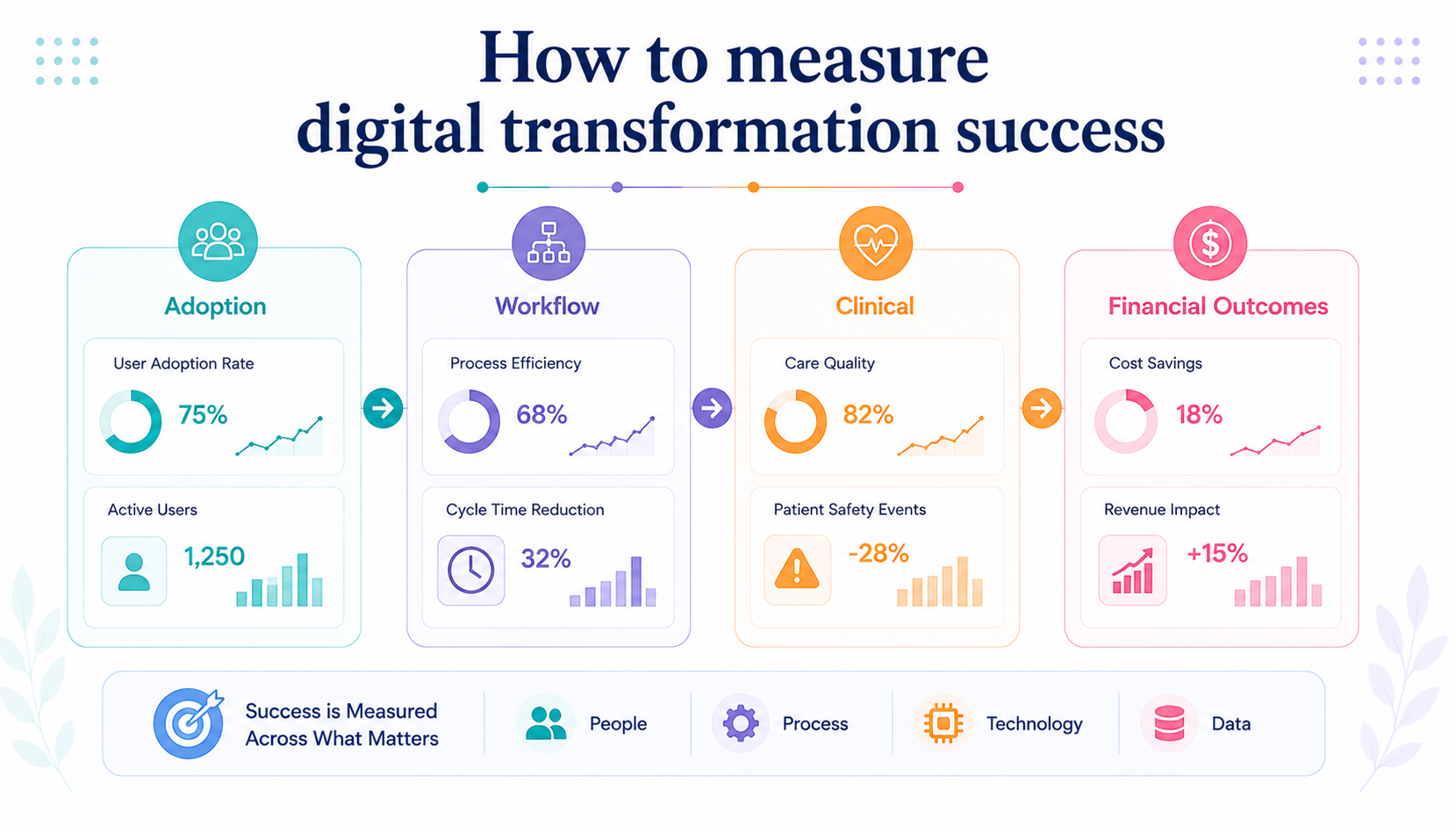
Usage rate alone does not prove success in healthcare digital transformation strategy. Track whether the new workflow in digital transformation in healthcare actually completes faster, with fewer errors, and with less duplicate data entry than the process it replaced.
For instance, if a new e-prescribing tool cuts prescription turnaround from twenty minutes to four but pharmacy call backs stay flat, the workflow gain is real even before broader clinical outcomes shift. A system with high login counts but unchanged completion times has not actually transformed anything.
Measure business, clinical, and patient outcomes
Tie every major initiative back to a specific outcome using healthcare data analytics, such as reduced readmission rates, faster time to treatment, lower administrative cost per encounter, or improved patient satisfaction scores.
Vague statements about improved efficiency do not survive a board-level budget review. Specific, measurable outcomes are essential to digital transformation in healthcare.
Know when to scale, change, or stop a project
Set decision checkpoints before a project starts, not after it underperforms. If a telehealth pilot hits its adoption and outcome targets in the first unit, scale it to the next department immediately.
If metrics stall, diagnose whether the problem is the technology or the workflow around it before spending more budget. If neither improves after a defined window, stopping the project is a legitimate outcome, not a failure to report quietly.
How to Choose a Healthcare Digital Transformation Partner
Look for healthcare and transformation expertise
A partner needs both healthcare domain knowledge and genuine transformation experience, backed by custom software development capabilities when existing systems cannot meet the organization's requirements. Ask for examples where they changed clinical workflows, not just installed software.
Evaluate the people who will lead the transformation
The proposal team and the delivery team often differ. In digital transformation in healthcare, confirm exactly who will run governance meetings and workflow redesign sessions six months into the engagement.
Make sure the partner can connect technology to business outcomes
A strong partner ties every recommendation to a measurable business or clinical result, not a generic efficiency claim. In healthcare digital transformation strategy, ask them to show the math behind a past engagement.
Ask questions that reveal how they handle adoption and change
Ask specifically how they measured adoption on a past project, and what they did when adoption lagged behind the timeline. The answer reveals whether they treat change management as core work or an afterthought.
How Patoliya Infotech Delivers Healthcare Transformation
Patoliya takes a structured approach to digital transformation in healthcare, connecting technology decisions with measurable clinical, operational, and financial outcomes.
Staged transformation roadmap: Patoliya fixes foundational data and integration issues before scaling pilots across the organization.
Workflow-led design: Clinicians and frontline teams participate early in workflow design to improve adoption and reduce post-launch friction.
Outcome-based execution: Each project starts with defined clinical or financial outcomes, giving leadership measurable results beyond project completion.
Single accountable governance: Technology, clinical, and operational teams work through one coordinated structure to reduce fragmentation.
Continuous optimization: We monitor post-go-live performance and provide ongoing software support and maintenance while continuously improving workflows, integrations, and technology as needs evolve.
This approach helps enterprises scale healthcare transformation without building new programs on fragmented data or disconnected systems. It creates a clearer path from technology investment to measurable clinical and business outcomes.
Conclusion
The real value of digital transformation in healthcare is not achieved when a new system goes live. It comes from continuously improving how technology, people, and workflows work together to deliver better outcomes.
Organizations that build this mindset into their operations can sustain progress through staged investment, ongoing measurement, and active clinician involvement.
If your last initiative delivered a new system but did not meaningfully change how work gets done, that gap is worth addressing before the next project begins.
Assess where your organization stands today, identify what is limiting progress, and focus the next transformation effort on measurable improvements that can continue to grow over time.
FAQs:
It means redesigning clinical and operational workflows around connected data and technology, not just digitizing existing paper processes into a new digital format.
Most fail from weak change management and unclear ownership, not bad technology. Going live gets treated as completion, before adoption is actually measured or achieved.
Most roadmaps span 24 months or longer, broken into foundational fixes, scaled rollout, and ongoing optimization phases rather than one fixed timeline.
Track adoption rates, workflow completion times, and measurable clinical or financial outcomes tied to each initiative, not just system usage or go-live dates.
One accountable executive, typically a CDO or CIO, should own the enterprise plan across departments to prevent fragmented, conflicting digital transformation in healthcare initiatives.
Involve clinicians in workflow design before implementation, redesign the workflow itself, and fund change management as a core project component from the start.