Denial Management in Healthcare: Revenue & Prevention
 By Hitesh SUpdated on: 08/31/2611 min read
TLDR: Denial management in healthcare shouldn't stop at getting claims paid after rejection. The real revenue impact comes from claim denial root-cause analysis that stops the same errors from repeating every billing cycle.
Claim denials drain revenue long before a check clears. Most billing teams focus entirely on recovery, resubmitting and appealing denied claims one at a time, while the same root causes keep generating new denials every month. Recovery alone treats a symptom that keeps returning.
Effective denial management in healthcare does two things at once: it recovers what's owed, and it fixes the process that caused the denial in the first place. This guide covers where revenue actually gets lost, what a real denial workflow should include, and how to evaluate denial management software built for prevention, not just recovery.
Where Revenue Gets Lost Before a Claim Is Denied
Most revenue leakage starts long before a payer rejects a claim, which is exactly where denial management in healthcare has to begin paying attention. The failure happens at registration, authorization, coding, or somewhere in payer-specific requirements nobody double-checked.
Registration and Eligibility Errors
A mistyped policy number or an expired insurance card at check-in guarantees a denial weeks later.
These errors are entirely preventable, yet they remain one of the most common causes of rejected claims across outpatient practices.
Authorization and Referral Gaps
Procedures performed without prior authorization get denied automatically, regardless of medical necessity.
Referral requirements missed at scheduling create the same outcome, and staff only discover the gap once the claim bounces back.
Documentation and Coding Issues
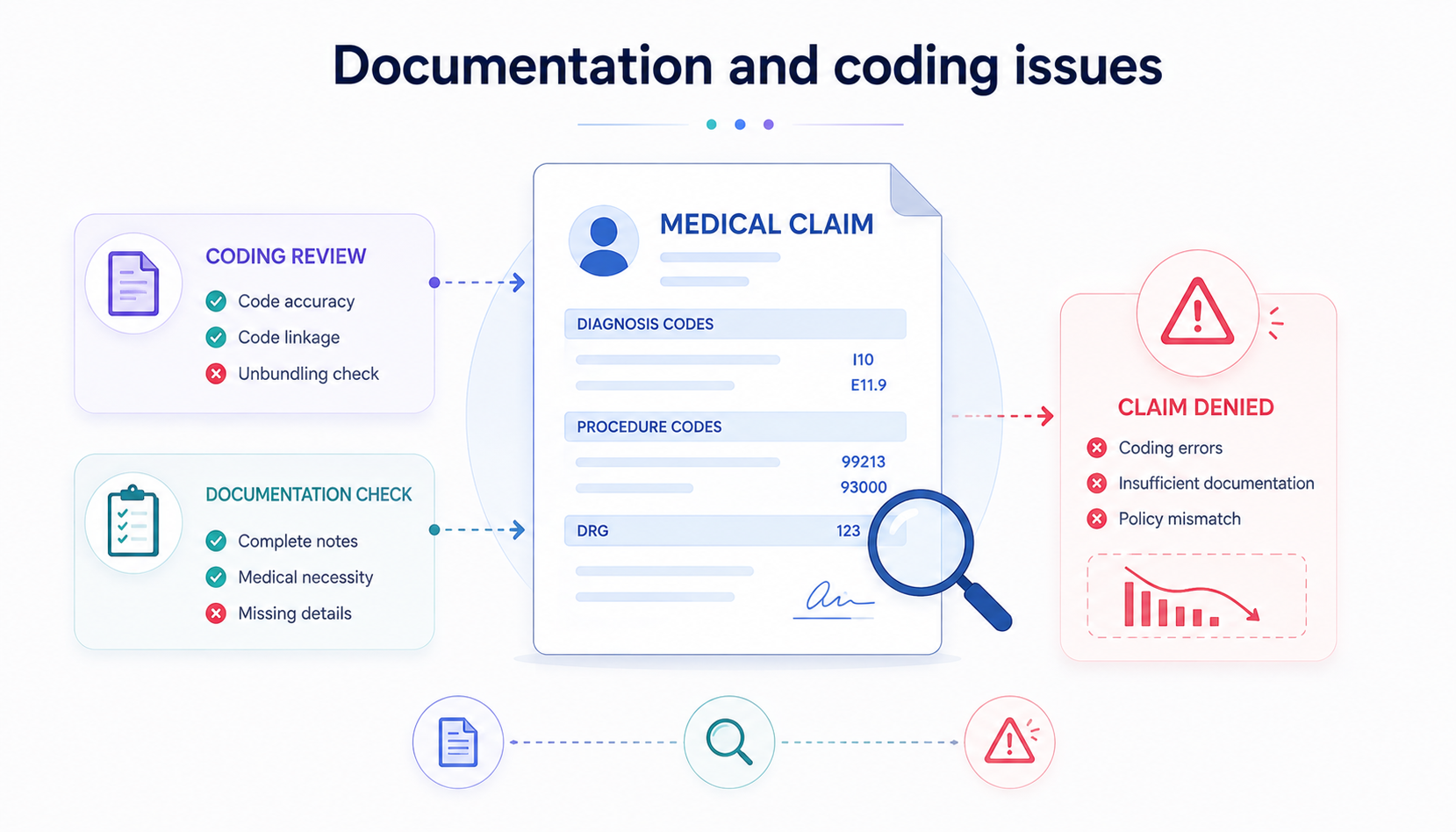
Incomplete clinical documentation or mismatched codes trigger denials that have nothing to do with whether the care was appropriate. The paperwork failed, not the treatment.
Payer-Specific Requirements
Every payer maintains its own submission rules, timely filing windows, and required modifiers. A claim built for one payer's standard often fails against another's specific requirements.
What Happens Inside an Effective Denial Management Workflow
A working revenue-cycle denial workflow moves through five stages, and each one carries weight in denial management in healthcare because skipping any single step slows recovery or lets the same denial repeat next month.
Capture and Categorize Denials: Every denial gets logged immediately with a reason code, payer, and dollar amount, with healthcare data integration helping connect claims and denial information across the revenue cycle.
Interpret Payer Rejection Codes: Staff translates raw payer rejection codes into actionable next steps, including Medicare denial reason codes where applicable, since a generic code alone doesn't tell anyone what to fix.
Prioritize Claims by Financial Impact: High-dollar claims and claims near their filing deadline move to the front of the queue, not whichever denial arrived first.
Correct, Appeal, and Resubmit: Corrections get made against the actual cause of denial, then resubmitted or appealed through the applicable Medicare claims appeals process with supporting documentation attached.
Track Resolution and Recovery: Every claim gets tracked through to final payment or write-off, so nothing quietly disappears from the books.
A workflow missing any of these five steps recovers less money and takes longer doing it. Prioritization by financial impact alone often separates teams that stay ahead of their queue from teams drowning in one.
Why Recovering Denied Claims Is Not Enough
Recovery-focused teams eventually hit a ceiling, and this is where denial management in healthcare has to grow beyond chasing individual payments.
The same denials keep coming back, recovery data rarely reaches the departments that caused the error, and high-volume noise buries the few denials worth real money.
Repeated Denials Create Recurring Revenue Leakage
If eligibility errors caused a denial in January, they will cause the same denial in February unless someone fixes the front desk process, not just the individual claim.
Recovery Data Often Fails to Reach Upstream Teams
Billing teams see the denial. Registration and clinical staff who created the error rarely hear about it, so nothing changes at the source.
High Volume Can Hide High Value Problems
A hundred small denials can consume more staff attention than five large ones, even when those five represent significantly more revenue at risk.
How Claim Denial Root Cause Analysis Prevents Repeat Denials
Claim denial root-cause analysis traces every denial back to its actual origin point, whether that's registration, coding, or authorization, and it is the piece of denial management in healthcare that separates a reactive team from one that improves steadily.
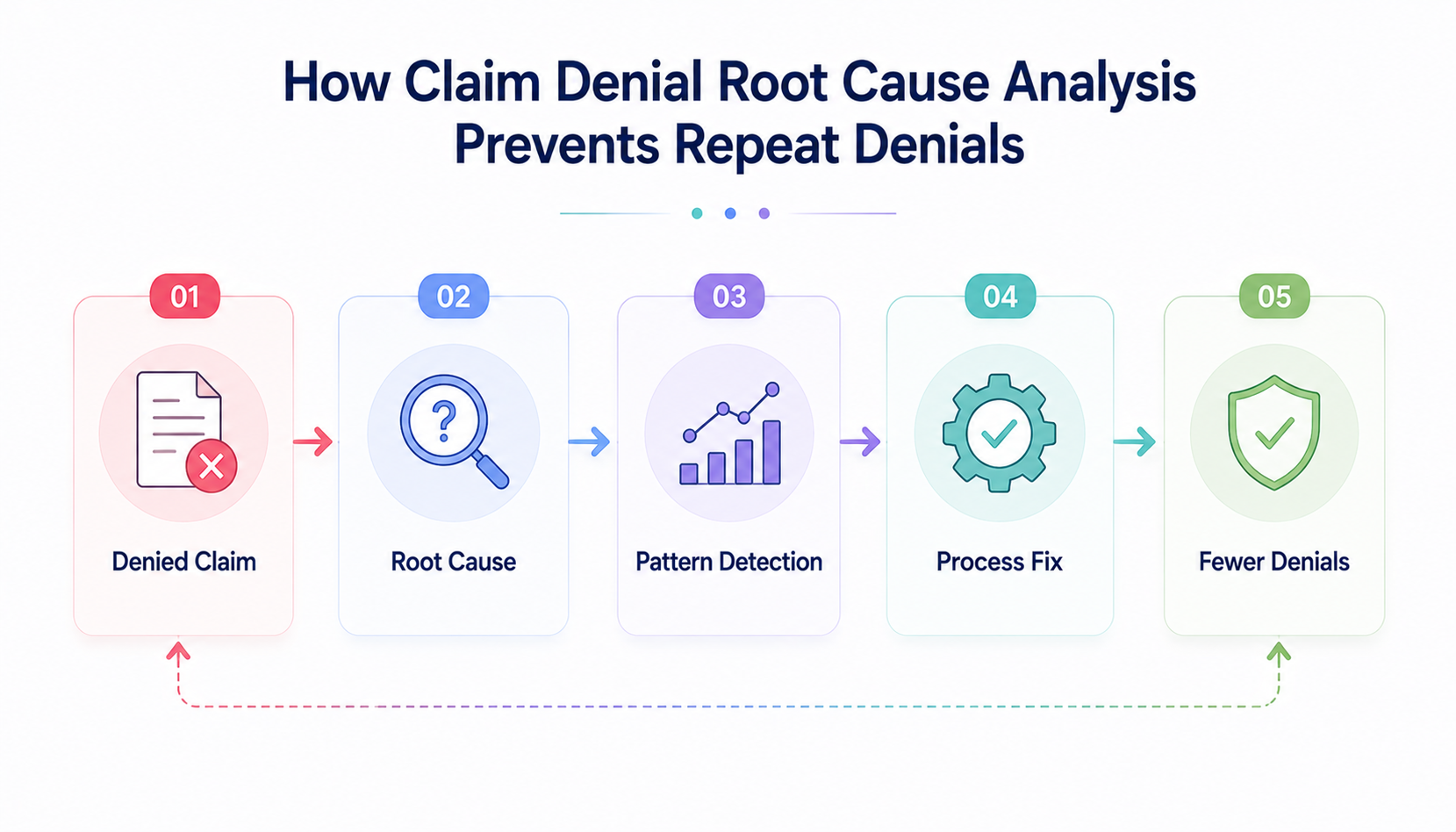
Identify the Actual Source of Failure
A denied claim coded as a "documentation issue" might actually trace back to a scheduling error that skipped the required referral step entirely.
For instance, a clinic reviewing a spike in denied imaging claims traced the real cause to a scheduler skipping authorization checks, not to coding at all.
Separate Preventable and Non-Preventable Denials
Not every denial is fixable internally. Separating preventable errors from payer policy changes focuses staff effort where it actually moves the needle.
Find Patterns Across Payers and Departments
Look beyond individual denials to identify recurring issues across payers, procedures, and departments. For denial management in healthcare, These patterns can reveal systemic problems that are better addressed at the source.
For instance, if three different payers deny the same procedure code for missing modifiers, that pattern points to one coding training gap, not three separate problems.
Turn Denial Trends Into Process Changes
Root cause data only has value once it changes a workflow, like adding an eligibility check step before intake completes. This is where denial management in healthcare moves past the billing office and starts shaping how the front desk actually operates.
Where Denial Prevention Creates the Biggest Financial Impact
Prevention delivers more value than recovery because it stops revenue loss before a claim ever gets submitted, cutting rework across the entire billing cycle, and it marks the direction most mature denial management in healthcare programs eventually take.
Eligibility and Authorization Prevention: Verifying eligibility and authorization before the appointment is a core claims denial management step that eliminates the single largest category of preventable denials industry-wide.
Coding and Documentation Validation: Catching coding errors before submission, not after denial, saves the appeal cycle entirely and gets claims paid on the first pass.
Payer Specific Rules: Building payer-specific rules into the submission process before claims go out stops denials tied to formatting or filing requirements.
High Risk Claim Identification: Flagging claims likely to get denied based on historical patterns lets staff correct them proactively, before a payer ever sees them.
What Denial Management Software Should Automate
Denial management software should automate the repetitive work of classification, analysis, and follow-up, so staff spend time correcting errors instead of hunting for them manually.
This automation layer is what allows denial management in healthcare to scale beyond what a manual team can keep up with.
Denial Classification and Work Queues
The system should auto-categorize incoming denials by reason and route them to the right team, replacing manual sorting that eats up hours weekly.
Root Cause Analysis
Built-in claim denial root-cause analysis should surface patterns automatically across payers, procedures, and departments without a manual spreadsheet pull.
Appeal and Follow Up Workflows
Automated reminders and templated appeal letters keep claims moving through the queue, while AI workflow automation for hospitals can further automate repetitive revenue-cycle tasks.
Denial Prevention Analytics
Denial prevention analytics should flag upstream risk before submission, connecting recovery data back to registration and coding teams directly.
Revenue at Risk Reporting
Real-time reporting on total revenue tied up in open denials gives leadership visibility that a monthly spreadsheet never provides fast enough.
When Should a Healthcare Organization Invest in Denial Management Software?
An organization should invest in denial management software once denial volume outpaces staff capacity, high-value claims need manual prioritization, and root causes keep resurfacing month after month, a clear sign that manual denial management in healthcare has reached its limit.
Denial Volume Is Outpacing Staff Capacity
If the denial queue keeps growing faster than staff can work through it, manual processes have already reached their limit.
High Value Claims Require Manual Prioritization
Staff manually sorting through claims to find which ones matter most wastes time software can automate instantly and consistently.
Recurring Root Causes Remain Unresolved
If the same denial reason keeps appearing month after month, the organization needs systematic claim denial root-cause analysis, not more manual review.
Denial Reporting Is Too Slow
When leadership waits weeks for a claims denial management report, decisions get made on outdated numbers instead of current risk.
What Should You Calculate Before Investing?
Before evaluating any platform, organizations need four numbers: current denial rate, revenue tied up in denials, cost of manual resolution, and recovery potential. These figures shape the entire business case for denial management in healthcare.
Current and Preventable Denial Rate: Calculate the total denial rate first, then estimate what percentage traces back to preventable causes like eligibility or authorization gaps.
Revenue Tied Up in Denied Claims: Total dollar value sitting in unresolved denials shows exactly how much cash flow is stuck in the appeals process right now.
Cost of Manual Denial Resolution: Staff hours multiplied by average hourly cost reveals what manual resolution actually costs, a number most organizations underestimate significantly.
Potential Recovery and Prevention Opportunity: Comparing current recovery rates against industry benchmarks shows the realistic upside available from better denial management software.
How to Evaluate Denial Management Software
Evaluating a denial management in healthcare comes down to five capabilities that separate a real claims denial management system from a basic tracking tool.
Root Cause Analysis Capabilities: Confirm the platform traces denials back to origin points automatically, not just categorizes them by reason code.
RCM and Payer System Integration: The software must connect directly to existing billing and payer systems, or organizations may need custom software development services to eliminate manual data re-entry.
Financial Impact Prioritization: Look for automatic prioritization by dollar value and filing deadline, not a flat first-in, first-out queue.
Payer Specific Workflow Support: Confirm the platform handles different payer rules and formatting requirements without manual configuration for each one.
Prevention and Recovery Analytics: The system should report on both recovered revenue and prevented denials, not recovery numbers alone.
KPIs That Tell You Whether Denial Management in Healthcare Is Working
Four KPIs show whether a denial management in healthcare program is actually improving: initial denial rate, recovery rate, resolution time, and net revenue recovered.
|
KPI |
What It Measures |
|
Initial and Preventable Denial Rate |
Percentage of claims denied and how many were avoidable. |
|
Denial Recovery Rate |
Percentage of denied claims eventually paid. |
|
Days to Resolution |
Average time from denial to final resolution. |
|
Net Revenue Recovered |
Total dollar value recovered after resolution costs. |
How Patoliya Infotech Helps Modernize Denial Management in Healthcare
As a healthcare software development company, Patoliya Infotech builds systems that connect denial management in healthcare directly into existing billing infrastructure, turning scattered denial data into a workflow teams can actually act on.
- Custom revenue-cycle denial workflow built around each organization's specific payer mix.
- Direct RCM and payer system integration, eliminating manual data re-entry.
- Denial management software and analytics covering both root cause analysis and prevention reporting.
Teams get one connected system instead of a spreadsheet patched together from three different sources, built around how their claims denial management process actually runs day to day.
Conclusion
Denial management in healthcare works best when recovery and prevention work together. Recovering a denied claim restores revenue once, while identifying its root cause helps prevent the same issue from recurring. A stronger claims denial management strategy uses denial data to improve upstream workflows, reduce repeat errors, and protect revenue over time.
Organizations that prioritize prevention can steadily reduce avoidable denials instead of repeatedly managing the same problems. Let's talk about where your denial process is losing revenue.
FAQs:
Yes. A denial management solution can integrate with electronic health records applications, billing, clearinghouse, claims, and other revenue cycle systems to exchange claim and denial data without replacing the existing infrastructure.
Implementation time depends on the number of systems, payer workflows, data complexity, and customization required. A focused implementation can begin with one denial management in healthcare workflow before expanding across the revenue cycle.
Yes. A properly configured platform can support payer-specific rules, workflows, rejection patterns, appeal requirements, and reporting across multiple insurance plans.
ROI can be estimated by comparing recovered revenue, prevented denials, reduced manual labor, faster resolution times, and lower administrative costs against implementation and operating expenses.
Yes. Claims denial management solutions can prioritize work based on factors such as claim value, denial type, payer, filing deadlines, recovery probability, and financial risk.
Yes. By combining denial trends, claim values, payer patterns, and unresolved work, a denial management in healthcare approach can give revenue cycle leaders a clearer view of potential revenue loss and recovery opportunities.