AI Agent Development Cost: Budgeting for Production
 By Hitesh SUpdated on: 10/01/2616 min read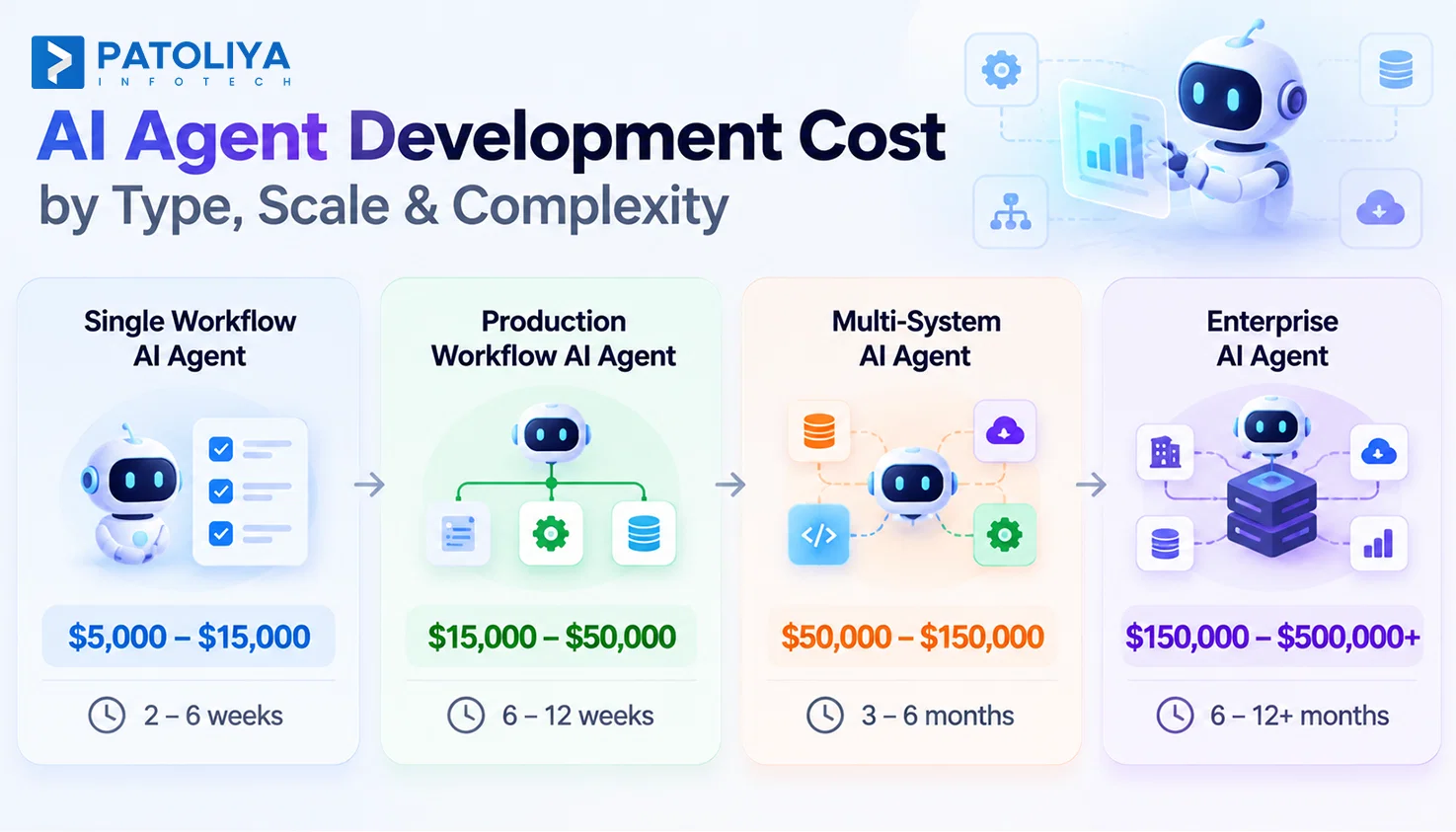
TL;DR: A production AI agent usually costs $40,000 to $250,000 to build in 2026. Then the monthly bills start. Inference, monitoring, maintenance, and human review often rival the build cost in year one. Plan for the total cost of building and operating an AI agent.
The development quote accounts for less than half of your AI agent’s total first-year cost. Gartner expects over 40% of agentic AI projects to face cancellation by the end of 2027, and rising costs sit at the top of its reasons.
Your real AI agent development cost is the price of every completed task, month after month. Buyers who track cost per task approve better projects and stop weak ones early. This guide explains how to calculate, compare, and manage your AI agent development cost, including the actual cost of building an AI agent that delivers lasting value.
How Much Does It Cost to Build an AI Agent in 2026?
In 2026, a typical AI agent development cost ranges from $15,000 for a single workflow agent to $250,000+ for an enterprise system. Integrations and autonomy decide where you land.
|
Agent type |
Example |
Build cost |
Timeline |
|
Single workflow agent |
Lead enrichment or ticket triage. |
$15,000 to $40,000 |
4 to 8 weeks |
|
Production workflow agent |
Invoice matching with ERP writeback. |
$40,000 to $100,000 |
8 to 14 weeks |
|
Multi system agent |
Support agent across CRM, billing and ticketing. |
$100,000 to $250,000 |
3 to 6 months |
|
Enterprise agent system |
Coordinated agents with governance and audit. |
$250,000+ |
6 to 12 months |
Team location explains most gaps between two quotes for the same scope. An AI engineer hourly rate runs about $40 to $70 offshore and $150 to $250 in the US. If your use case is limited to answering questions, start by comparing AI chatbot development costs first.
What the Development Quote Usually Includes
- Discovery: process mapping, edge cases and success metrics
- Agent engineering: prompts, tools, memory and control logic
- Integrations: connections to your CRM, ERP or helpdesk
- Testing: evaluation sets and failure scenarios
- Deployment: environments, access control and launch
Most quotes stop on launch day. LLM usage, infrastructure, monitoring, maintenance and human review usually sit outside the number.
Ask every vendor to price these lines, because a quote without them shows only part of the cost to build an AI agent. Compare each AI agent development cost estimate only after you add them back. Several factors push that number up or down.
What Actually Drives AI Agent Development Cost?
Five factors drive the quote: workflow complexity, integrations, data needs, guardrails and production scale. Autonomy moves price fastest, and it compounds every other factor.

Workflow complexity: An agent that drafts replies needs a few hundred test cases. An agent that issues refunds needs thousands, plus approval logic and audit trails. Before making a commitment, compare AI agents vs. workflow automation to determine whether your use case needs autonomous decision-making or a predictable, rule-based workflow.
Integrations and Business Systems: Each system the agent touches adds roughly $5,000 to $25,000 of build effort. Legacy ERPs without clean APIs sit at the top of that range.
Standard connectors built on MCP for AI agent integrations can reduce repeated integration work when several agents share the same stack. Count systems first, because each one also adds a failure point you must monitor.
Data, RAG and Knowledge Requirements: Messy documents cost more than smart models. Cleaning, chunking and permissioning a knowledge base often takes 20% to 30% of the build. A vector database adds its own monthly bill. Review RAG pipeline architecture and costs before promising that an agent can retrieve accurate answers from your entire knowledge base.
Guardrails and Human in the Loop: Guardrails protect you and add real engineering hours. Input validation, output checks, permission scopes and approval screens add 15% to 25% to the build.
Each approval step also creates recurring labor, so place human in the loop checkpoints only where an error costs real money.
Scale, Reliability and Performance: A pilot processing 50 tasks daily can run on nearly any setup. At 5,000 tasks a day, you need queues, rate limit handling, fallbacks and uptime targets.
That hardening can double the cost to build an AI agent compared with its pilot, and it lifts your AI agent development cost estimate accordingly. The build gets you started. Running the agent is where budgets drift.
The Real Cost of Running an AI Agent
Operating costs vary based on model-call frequency, the volume of context processed, and the efficiency of the agent’s workflow design.
LLM Inference Cost
Every task your agent completes has a price. LLM inference cost depends on token pricing, model choice, calls per task and context size. Architecture shapes the monthly bill more than any vendor price list, so treat design reviews as budget reviews.
Token pricing: output tokens often cost five times more than input tokens.
Model selection: route simple steps to a small model and keep the large model for reasoning.
Number of calls: A single request may initiate 4–10 model calls.
Context size: long chat histories and retrieved documents inflate every call.
Cost Per Task vs. Cost Per Token
Token prices mean little until you multiply them by agent behavior. Use this formula:
Cost per completed task = inference + tool and API fees + retrieval + infrastructure share + human review) ÷ successfully completed tasks
Consider an invoice agent that performs 6 model calls per invoice, with each call processing 8,000 input tokens and generating 800 output tokens. At $2 input and $10 output per million tokens, inference alone costs $0.144 per invoice. Factor in usage volume before relying on any AI agent development cost estimate.
Agent Orchestration and Tool Calls
Agent orchestration converts a single request into a sequence of tasks. A simple "update this order" request can mean classify, retrieve, plan, call two APIs, verify and summarize. That adds up to six model calls and two tool calls. Every extra loop in the plan raises your AI agent development cost forecast for year one.
Prompt Caching and Context Optimization
Prompt caching is the cheapest saving you can buy. Anthropic's prompt caching documentation lists cache reads at 0.1× the standard input rate. Cache 6,000 of those 8,000 input tokens and the invoice drops from $0.144 to about $0.079.
At 20,000 invoices a month, you save roughly $1,300. That single design choice cuts your AI agent development cost for operations by thousands each year.
Infrastructure, Vector Database and Observability
For a midsize agent, hosting, queues, logging, tracing, and retrieval storage generally cost $500 to $3,000 per month. Teams that omit tracing often spend more later on debugging. Apply cloud cost optimization practices to monitor infrastructure usage and identify opportunities to reduce recurring expenses.

The Run Costs Nobody Quotes
Maintenance and Model Changes: Maintenance, evaluation, human review and failed tasks form the run costs nobody quotes. Together they often exceed the monthly LLM bill and decide whether the agent pays back.
API changes: a renamed CRM field can break a tool call overnight.
Model updates: providers retire models, and new versions change output formats.
Business rule changes: new pricing, policies and approval limits need updates.
Prompt and agent updates: every fix needs a full retest.
Plan an annual maintenance cost of 15% to 25% of the original build.
Evaluation and Regression Testing: Production agents can drift quietly, and a prompt fix for one case can break ten others. Implementing LLMOps for production AI systems helps teams manage model changes, evaluations, monitoring, and deployment across the AI lifecycle. Budget $300 to $1,500 a month for evaluation runs, tooling and review time. Explore AI in software testing to understand how AI can support testing and quality checks.
Human Review and Escalation: Human review is the most underestimated line in any AI agent development cost model. Run the numbers for the same invoice agent:
|
Input |
Value |
|
Tasks per month |
20,000 |
|
Escalation rate |
12% |
|
Minutes per review |
4 |
|
Reviewer cost per hour |
$30 |
|
Monthly human review cost |
$4,800 |
That review bill runs three times higher than the cached inference bill.
Failed Tasks, Retries and Rework
Each failed task can consume tokens twice and often requires human intervention anyway. A 5% failure rate with two retries adds roughly 10% to inference spend. A wrong action that slips through costs refunds, credits, and customer trust.
A cheaper model with a 20% escalation rate can cost more per task than a premium model at 8%. Lower token prices rarely mean lower AI agent development cost over twelve months, and they never cut the true cost to build an AI agent on their own.
Sorting these costs into the right budget makes approval conversations far easier.
Build Cost vs. Run Cost vs. 12 Month TCO
Your build budget pays for everything the agent needs before launch. Your operating budget pays for everything it consumes after launch, every month. Keep them separate, because finance approves one as capital spend and tracks the other as operating spend.
Build budget lines: engineering, integrations, RAG and data work, guardrails, testing and deployment. Integrations and testing usually take the largest share.
Operating budget items: Include inference, cloud infrastructure, monitoring, evaluation, maintenance, and human review. Since finance teams classify these as recurring expenses, report each cost monthly. Tie each line to task volume so the AI agent development cost forecast moves with real usage.
A Simple 12 Month TCO Formula
12-month TCO = Initial development + LLM usage + infrastructure + maintenance + evaluation + human intervention.
Here is the invoice agent across its first year:
|
Line item |
12 month cost |
|
Initial build |
$70,000 |
|
LLM usage ($1,600 a month) |
$19,200 |
|
Infrastructure ($1,500 a month) |
$18,000 |
|
Maintenance (18% of build) |
$12,600 |
|
Evaluation ($500 a month) |
$6,000 |
|
Human review ($4,800 a month) |
$57,600 |
|
Total 12 month TCO |
$183,400 |
The build accounts for only 38% of year one. Human review alone costs 82% as much as the build. Any AI agent development cost review that stops at $70,000 misses $113,400. Use the table to show the actual cost of building and operating an AI agent, and present all AI agent development cost estimates using this breakdown.
How to Estimate AI Agent Costs Before Requesting a Quote
Estimate your AI agent development cost by defining the workflow, calculating cost per completed task, and fixing the autonomy level. These three inputs let every vendor quote the same scope. Without them, you only compare vendor guesses.
Answer five questions in writing:
Task: what exact job will the agent complete?
Frequency: Estimate the monthly task volume and identify peak usage periods.
Systems: which tools will it read from or write to?
Actions: what can it change without asking?
Approvals: who signs off, and at which step?
Fill in this worksheet before any sales call. Multiply calls by tokens, add tool fees, then add escalations priced at reviewer time:
|
Variable |
Example value |
|
Tasks per month |
20,000 |
|
Model calls per task |
6 |
|
Tokens per call |
8,800 |
|
Tool calls per task |
2 |
|
Retrieval queries per task |
1 |
|
Human escalation rate |
12% |
For simple, trigger based flows, compare n8n AI agent development costs with a fully custom build. The gap often shapes AI agent build costs more than model choice does.
Define the Required Autonomy
Choose the required autonomy level: Recommend, Draft, Execute with approval, or Execute automatically.

Each step up adds guardrails, testing, and audit work. Begin with a lower autonomy level than initially planned, then advance based on measured performance data. An invoice agent can draft for three months, prove 95% accuracy, then move to execute with approval.
This approach ensures your AI agent development cost remains aligned with demonstrated results. A clear scope makes vendor quotes easy to compare.
How to Evaluate an AI Agent Development Quote
Judge an AI agent quote by splitting build from run costs, spotting missing line items, and comparing scope. A single total hides the costs that surface after launch.
Ask for separate numbers on development, integrations, LLM and API usage, infrastructure, monitoring, evaluation, and maintenance. Use this API integration planning guide to better understand the systems and connections that may affect your project scope. A vendor who prices all seven has run agents in production. A quote covering development alone leaves you to uncover the actual AI agent development cost after deployment.
Look for these gaps in every proposal:
Retry handling: what happens when a tool call fails?
Model changes: Who covers the cost when a provider discontinues a model?
Security: how does the agent store and scope credentials?
Human escalation: where do uncertain cases go?
Post-launch support: what response times apply after go-live?
Our rule of thumb: if a vendor cannot explain its retry logic in two minutes, it has never run an agent at scale. Use an AI vendor evaluation checklist to compare vendors on technical capability, security, support, pricing transparency, and long-term operating costs. Planning an in house n8n build? Weigh n8n developer hiring costs against a vendor retainer.
|
Criterion |
Vendor A: $60,000 |
Vendor B: $85,000 |
|
Workflows |
1 |
1 with exception paths |
|
Integrations |
2 |
3 with retries |
|
Autonomy |
Draft |
Execute with approval |
|
Governance |
Basic logs |
Audit trail and permissions |
|
Testing |
Manual |
300 case regression set |
|
Support |
30 days |
6 months |
Vendor B often delivers the lower AI agent development cost per completed task. The cheaper quote usually moves the cost to build an AI agent into your first year of operations. Once quotes line up, the business case decides the rest.
When an AI Agent Is Economically Justified
An AI agent earns its budget when its fully loaded cost per completed task beats your manual cost by a wide margin, after human review and maintenance.
Manual invoice processing at 6 minutes and $30 an hour costs $3.00 per invoice. The agent's $183,400 first year TCO across 240,000 invoices works out to $0.76 per invoice. That gap justifies the AI agent development cost in under four months of avoided manual spend.
Track six numbers monthly: cost per task, processing time, throughput, escalation rate, rework, and annual operating cost. Share these metrics with the finance team from month one, assigning a dedicated owner to each metric. A falling escalation rate is the clearest sign your AI agent development cost keeps paying back.
Watch three warning signs: escalation above 20%, retries above 10% of calls and weekly maintenance tickets. Any one of them can erase your savings. Agentic AI implementation costs trends reveal how quickly back-office savings can diminish. Keep the cost to build an AI agent honest by tracking all three from launch.
From Proof of Concept to Production: Where Budgets Change
A proof of concept demonstrates that the agent can function as intended. Production shows it works safely at scale. Expect production to cost two to four times the POC budget. A $25,000 pilot usually leads to a $60,000 to $100,000 production build.
Production adds security, scale, reliability, monitoring, governance, and failure handling. Anushree Verma, Senior Director Analyst at Gartner, warned that "most agentic AI projects right now are early-stage experiments or proof of concepts" in Gartner's agentic AI forecast.
|
Gate |
Example threshold |
|
Task success |
90% or higher |
|
Cost per task |
Under $0.80 |
|
Latency |
Under 30 seconds |
|
Escalation |
Under 15% |
|
Reliability |
99.5% uptime |
Miss any gate, and you rework the design before scaling spend. Gates turns your AI agent development cost into a controlled investment.
Approve the POC and production budgets in the same meeting. Teams that include AI product development planning in their budgeting process are better prepared to move from a successful pilot to a production-ready product. Your AI agent development cost plan and the cost to build an AI agent at scale need one sign off. A short checklist keeps that decision disciplined.
AI Agent Cost Checklist for Decision Makers
Approve an AI agent project only when you can fill in every line. Ask your team or vendor for each number in writing:
- Initial development cost, split by discovery, engineering, and integrations.
- Monthly run cost, covering inference, infrastructure, and monitoring.
- Cost per completed task, compared with your current manual cost.
- 12 month TCO, including maintenance and evaluation.
- Human intervention cost, based on a realistic escalation rate.
- Expected business value, tied to time saved, throughput, or revenue.
Any blank line means your AI agent development cost estimate still carries risk. Six completed entries provide your board with a full view of AI agent development costs before the first invoice arrives.
How Patoliya Infotech Keeps AI Agent Costs Predictable
Patoliya Infotech scopes every agent around cost per completed task. We price build and run costs separately and prove return on one workflow before we scale to the next one. Your AI agent development cost stays visible from discovery through year one.
- Agent builds on n8n, LangGraph, CrewAI, and MCP, matched to your workload.
- Phased, outcome linked pilots with production gates agreed upfront.
- Post-launch support and optimization included in every engagement.
Explore our AI agent development services, then bring one workflow to a 30 minute call. We will map its cost per task with you.
Conclusion
Budget for the agent you will operate, beyond the agent you can build. The development quote buys a working system. Inference, infrastructure, governance, maintenance, and human intervention decide whether it pays back.
Track cost per completed task from the first pilot and treat the 12 month TCO as your real AI agent development cost. Teams that plan this way scale agents with confidence and avoid the budget shock after launch. Start with one workflow, one budget, and one set of production gates. Let's sit down and price your first workflow together.
FAQs:
Most production agents cost $40,000 to $100,000 to build. Single workflow agents start near $15,000. Enterprise systems pass $250,000. Integrations, autonomy and guardrails decide your exact AI agent development cost.
A midsize agent handling 20,000 tasks typically costs $2,000 to $8,000 monthly. Inference, infrastructure, evaluation and human review make up that range, with human review often the largest line.
Every escalated task needs paid human time. At 12% escalation and four minutes per review, a 20,000 task agent needs 160 review hours monthly, often exceeding the entire inference bill.
Caching repeated instructions and context cuts the running AI agent development cost sharply. Anthropic bills cache reads at 0.1 times base input price. In our invoice example, caching lowered inference cost per task by about 45%.
Plan 15% to 25% of the original build every year. Maintenance covers API changes, model updates, business rule changes and regression testing, which keeps your AI agent development cost predictable.
Rarely. Production adds security, monitoring, governance, failure handling and scale. Expect two to four times the POC budget, and agree production gates before the pilot starts.