Agile vs Kanban: Key Differences for Software Teams
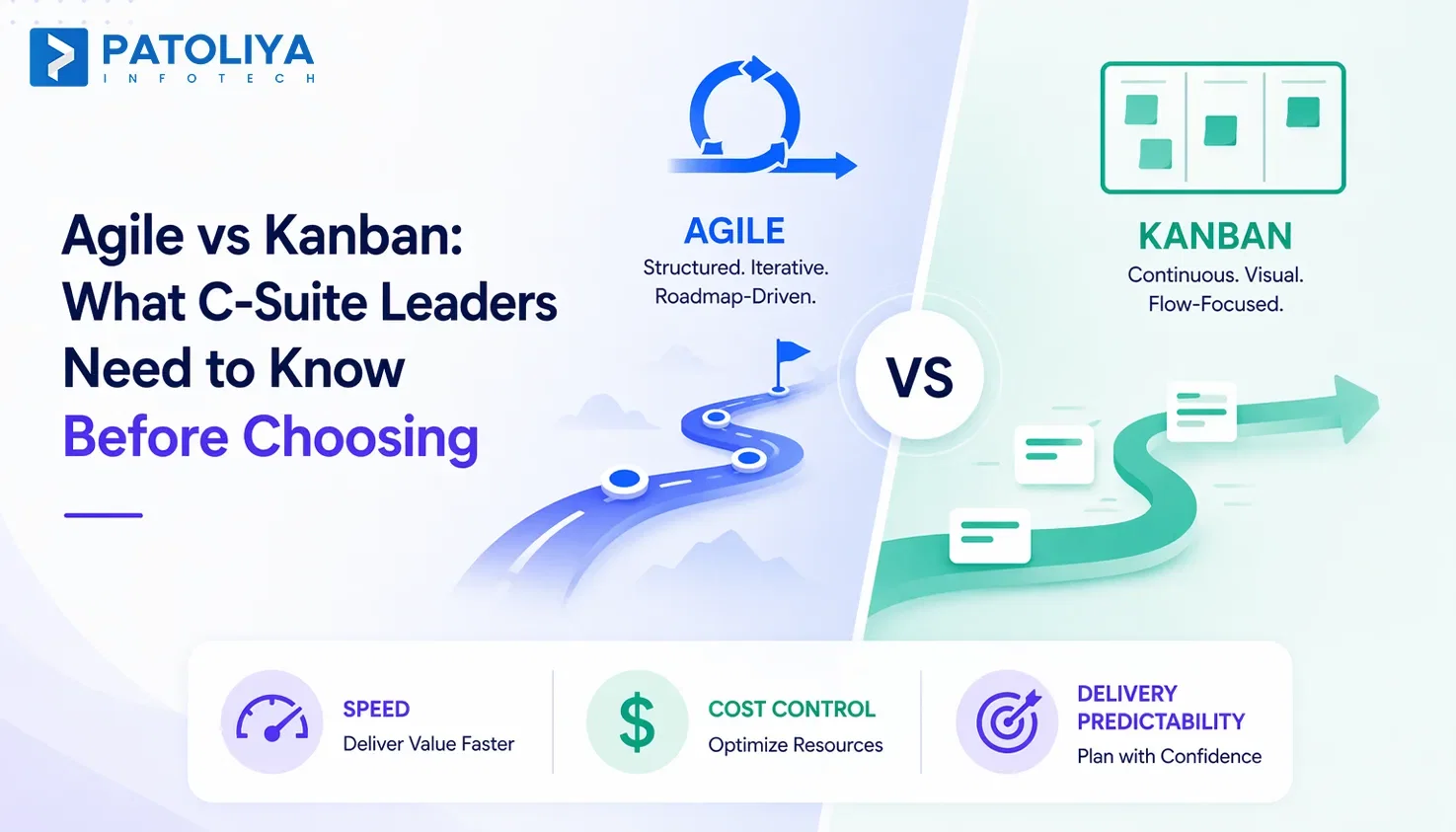
71% of software teams report using Agile. Most are running the wrong framework for their actual work pattern. The agile vs Kanban decision gets made in a tooling meeting instead of a strategy session, and that costs teams six to twelve weeks of misaligned delivery per year.
Agile vs Kanban for software development is not one-size-fits-all. A product squad building net-new features has a completely different delivery shape than a DevOps team managing support queues and release pipelines. The 17th Annual State of Agile Report confirms 71% adoption, based on industry-wide Agile adoption data. Yet delivery satisfaction keeps declining, proof that adoption does not equal fit.
Agile vs Kanban comparison done right starts with auditing your team’s actual work, not your industry’s default. This guide breaks down structure, cost, ROI, and failure modes so engineering leads, CTOs, and product heads can make a grounded call.
What Agile and Kanban Actually Mean
Agile as a Mindset, Not a Tool
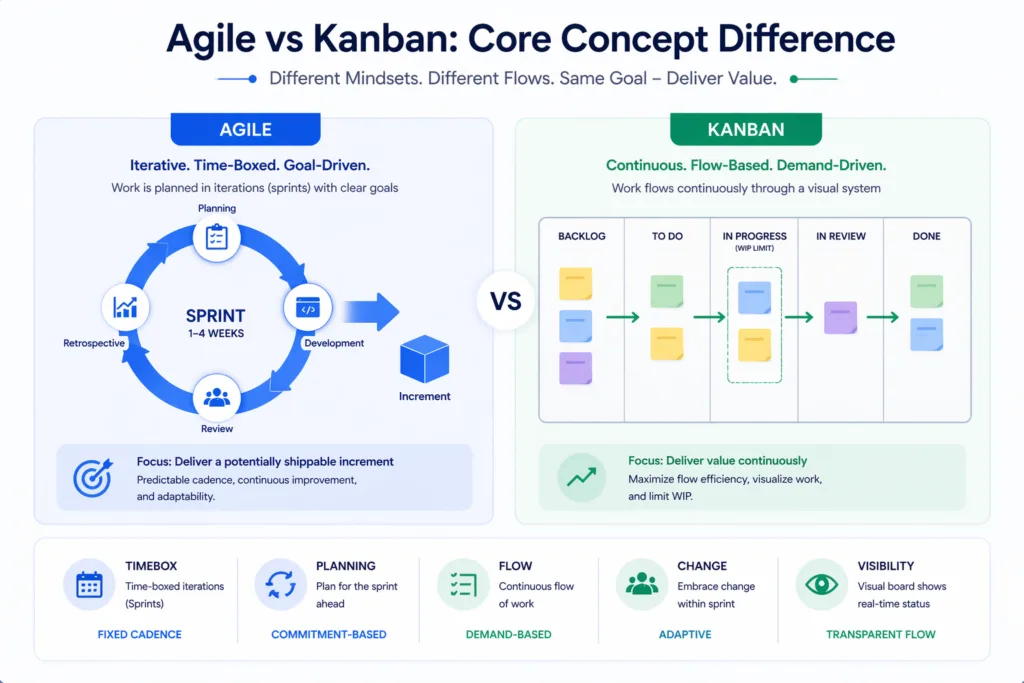
Agile vs Kanban starts with a foundational distinction. Agile is a delivery philosophy rooted in the 2001 Agile Manifesto. It drives iterative development, short cycles, and continuous stakeholder feedback. Scrum, XP, and SAFe all implement it. Agile methodology vs Kanban is not a fair fight; one is a mindset, the other is a flow system.
Kanban as a Flow System
Kanban vs agile, which is better, depends entirely on work type. Kanban originated in Toyota’s lean manufacturing and uses a kanban board to visualise work, pull-based task movement, and WIP limits to prevent overload. No sprints. No fixed roles. No time-boxed commitments. Agile vs kanban for software development teams running continuous ops lean toward Kanban precisely because of this flexibility.
Core Structural Differences: Agile vs Kanban
Cadence and Iteration
Agile vs kanban diverges first on rhythm. Agile runs on sprint planning cycles of two to four weeks with defined start and end dates. Kanban board vs agile sprint is the clearest structural contrast: a sprint is a time-locked commitment; a kanban board is a live flow system with no artificial boundaries.
Agile vs kanban for software development teams with versioned releases benefit from sprint gates. Kanban vs agile which is better, depends on continuous delivery teams aligning better with flow-based delivery.
Roles and Accountability
Agile methodology vs kanban splits hard on team structure. Agile requires a Product Owner, Scrum Master, and development team with explicit accountability. Kanban assigns no mandatory roles. Shared board ownership works for small, self-directed teams. It creates accountability gaps at scale. Agile vs kanban comparison on roles is not about which is simpler. It is about which matches your organisational accountability model.
Change Management
Kanban vs agile which is better for absorbing change mid-delivery? Kanban wins. Agile locks scope mid-sprint. Kanban board vs agile sprint flexibility means any new request enters the queue immediately. On metrics: Agile tracks velocity and sprint burndown. Agile vs kanban metric selection maps to the delivery model. Kanban teams track cycle time, lead time, and throughput for flow visibility.
Performance Metrics
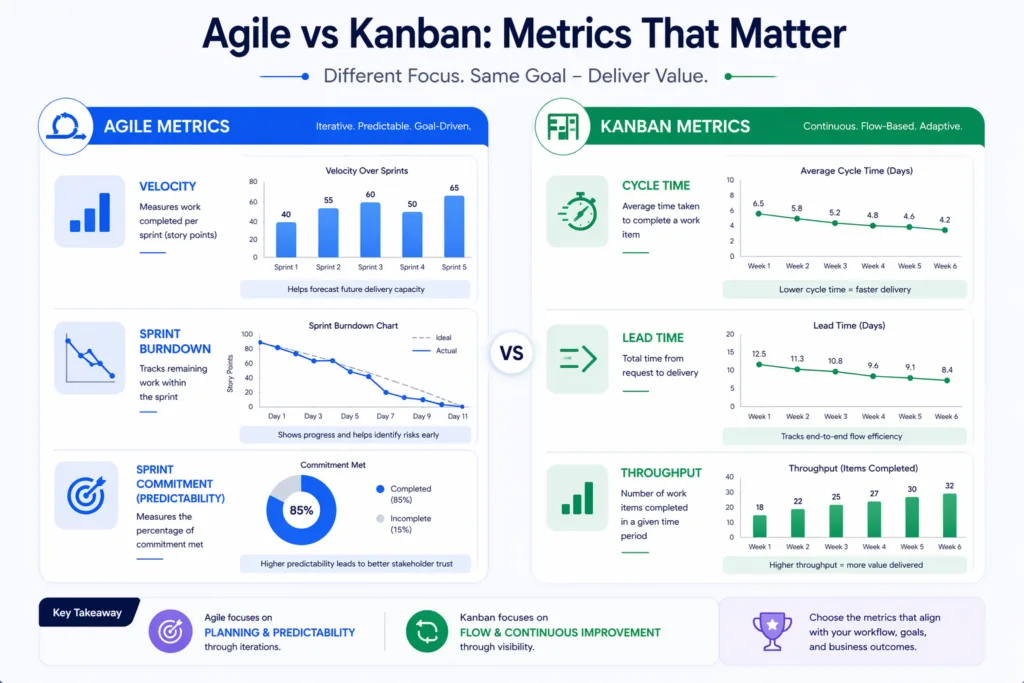
Agile vs kanban metric selection is all about how leadership reads delivery health. Agile teams track velocity and sprint burndown. Kanban teams track lead time, cycle time, and throughput. Agile vs kanban comparison on metrics reflects the core structural difference: one measures time-boxed output, the other measures flow rate. Pick the metric set that matches how your team actually commits to delivery.
When Each Framework Delivers Business Value
Use Agile When…
Agile vs kanban for software development favours Agile when requirements are uncertain, stakeholder approval cycles are frequent, and cross-functional teams need structured accountability.
Agile methodology vs kanban delivers the strongest ROI on new product builds, where iterative development surfaces misalignment before it compounds. If your backlog is roadmap-driven and releases are versioned, agile vs kanban comparison points clearly to Agile.
Use Kanban When…
Kanban vs agile which is better for ops-heavy teams? Kanban every time. Support queues, bug fixes, platform maintenance, and content pipelines do not fit a sprint shape. Kanban board vs agile sprint structure gives ops teams real-time visibility without the overhead of sprint planning ceremonies. WIP limits prevent engineers from drowning in context-switching across too many open items simultaneously.
Industry-Specific Fit
| Team Type | Best Fit |
| SaaS product squads | Agile (Scrum) |
| DevOps / platform engineering | Kanban or Scrumban |
| Marketing Operations /content pipelines | Kanban |
| Enterprise software at scale | SAFe |
| Mixed workstream teams | Scrumban |
Agile vs Kanban Comparison Table
Agile vs Kanban comparison across delivery dimensions that affect real decisions:
| Factor | Agile (Scrum) | Kanban |
| Structure | Sprint-based, time-boxed | Continuous flow |
| Roles | PO, Scrum Master, Team | Shared team ownership |
| Change tolerance | Mid-sprint locked | Anytime |
| Output metric | Velocity | Cycle time/throughput |
| Best for | Product development | Operations, support, maintenance |
| Onboarding ease | Moderate | High (low overhead) |
| Scalability | SAFe or LeSS | Scales lean |
| Tools | Jira (Scrum boards), Azure DevOps | Trello, Linear, Jira (Kanban mode) |
Agile methodology vs Kanban differences are structural and impact execution directly. Use this table to identify clear mismatches before committing to tooling or training decisions. Kanban vs agile, which is better, remains a context-driven decision with no single answer. Agile vs Kanban for software development teams should be used as an initial filter, as the final choice depends on team needs and delivery goals.
Cost and Tooling Breakdown
Tooling Costs in 2025
Agile vs Kanban tooling costs are closer than most procurement teams expect. The real gap is implementation overhead in the Kanban board vs agile sprint.
| Tool | Price/User/Month | Best For |
| Jira | $8.15 (Standard) | Both frameworks |
| Linear | $8.00 | Kanban-native teams |
| Azure DevOps | $6.00 | Enterprise Agile |
| Trello | Free to $17.50 | Kanban-only |
| Monday.com | From $9.00 | Hybrid workflows |
Hidden Cost of Framework Mismatch
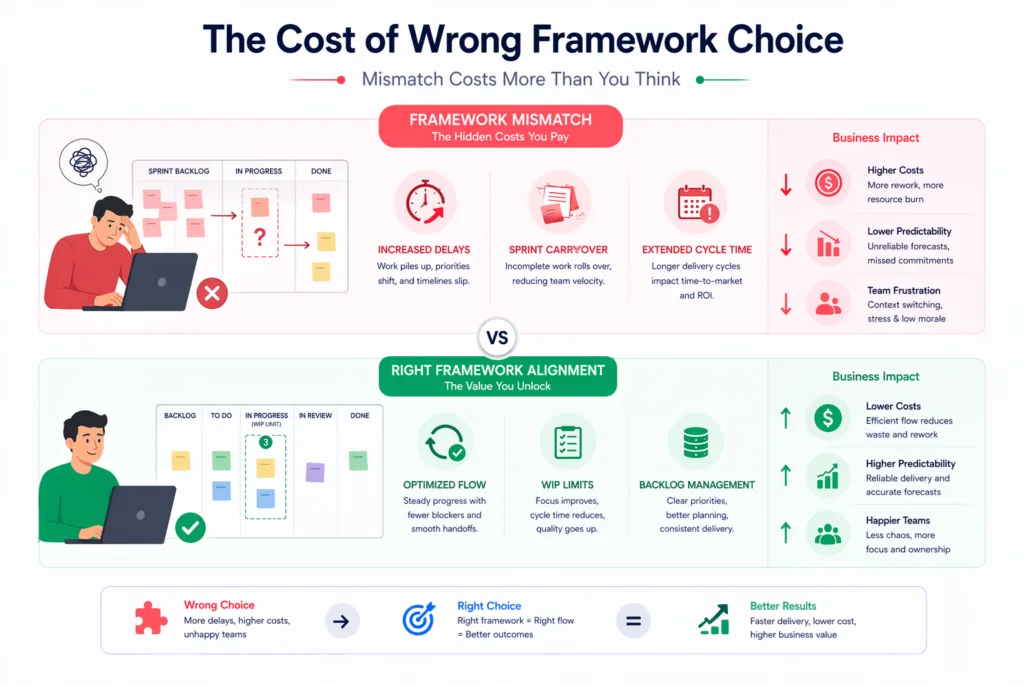
Kanban board vs agile sprint misalignment costs more than licensing. Teams running agile vs kanban for software development without backlog management discipline carry an average 23% sprint carryover rate highlighting planning inefficiencies in Scrum teams. That is a planning failure rooted in framework mismatch, not team capacity.
Agile methodology vs Kanban selection errors compound quickly. Kanban teams skipping WIP limits see delivery cycles extend 40% or longer. Switching frameworks mid-project costs two to four weeks of net delivery output minimum. Agile vs Kanban comparison on hidden costs always favours getting the decision right the first time.
ROI and Business Impact
Agile ROI Drivers
Agile vs Kanban for software development delivers a stronger ROI on new product builds. Faster time-to-feedback per sprint cycle reduces rework cost. Incremental delivery keeps stakeholders aligned before late-stage pivots become expensive.
Agile methodology vs Kanban on ROI favours Agile when requirements are still forming, and course corrections happen in two-week windows, not six-month releases.
Kanban ROI Drivers
Kanban vs Agile: Which is better for operational teams? Kanban wins on three measurable points:
Kanban board vs agile sprint, Kanban reduces cycle time, meaning faster value delivery per task
WIP limits prevent resource overload, and the burnout cost that compounds quietly over quarters
Workflow visualization makes bottlenecks visible before they become delivery failures
What the Data Says
Agile vs Kanban comparison backed by research:
- Organisations using Agile report 64% faster time-to-market versus waterfall according to global project delivery benchmarks.
- Kanban teams applying WIP limits report 37% improvement in throughput predictability within six months based on flow efficiency research.
Kanban board vs agile sprint ROI difference comes down to work type. Match the framework to the delivery model first.
Risks and Common Failure Modes
Agile Theatre
Agile vs Kanban failure in Agile teams looks like a ritual without an outcome. Stand-ups become status reports. Velocity replaces value as the primary metric. Backlog management breaks down into backlog accumulation. Sprint planning produces committed lists that carry over 23% of items from sprint to sprint. Agile methodology vs Kanban fails when teams adopt the ceremony and skip the discipline.
Kanban Without Governance
Kanban vs Agile: which is better when governance is absent? Neither works. Kanban without WIP limits is a visual to-do list. No flow policy means bottlenecks accumulate silently. Lead time reporting becomes meaningless without consistent entry and exit criteria per column. Workflow visualization without explicit policies creates interpretation gaps of Agile vs Kanban across team members.
Hybrid Pitfalls
ScrumBan without clear mode triggers creates role confusion. Agile vs Kanban for software development hybrid models fail when Kanban board vs agile sprint rules are not defined upfront. Agile vs kanban comparison of hybrid risks: the flat ownership of Kanban conflicts with Agile’s defined accountability when neither mode is declared primary.
Vendor and Tool Selection Checklist
Before committing to a framework-tool combination in your agile vs kanban decision:
| Question | Why It Matters |
| Does the tool support both Agile and Kanban natively? | Prevents forced migration if you run a hybrid |
| Can it generate cycle time and lead time reports? | Essential for Kanban flow visibility |
| Is there role-based access for Product Owners? | Agile accountability requires a permission structure |
| Does it integrate with your CI/CD pipeline? | Delivery metrics must connect to deployment data |
| Can it scale across multiple teams? | Critical for enterprise agile vs Kanban adoption |
| Is reporting executive-friendly? | C-suite needs outcome data, not task lists |
| What is the migration effort if you switch? | Lock-in cost matters for growing teams |
Agile vs Kanban for software development tool selection must follow framework selection, never precede it. Agile methodology vs Kanban tool needs differ structurally. Pick the framework first. Then evaluate the checklist. Kanban vs agile, which is better for your tooling budget, depends entirely on which workflow model you are actually running. Patoliya Infotech helps teams run this audit before a single sprint is planned.
Top Tools for Agile and Kanban Teams in 2026
Jira
Most flexible for agile vs Kanban for software development teams. Kanban vs agile, which is better, depends on delivery needs. Agile supports native sprints, while Kanban uses boards with built-in backlog management. Best for mid-to-large engineering teams managing both delivery models simultaneously.
- Key Features: Sprint boards, Kanban mode, WIP controls, advanced reporting
- Rating: 4.3/5
Linear
The top pick when Kanban vs agile which is the better answer is Kanban. Built-in cycle time tracking with a lean UI purpose-built for continuous delivery teams.
- Key Features: Kanban boards, cycle time analytics, Git integration
- Rating: 4.6/5
Azure DevOps
Best for enterprise agile methodology vs Kanban teams on the Microsoft stack. Deep CI/CD pipeline integration makes sprint metrics meaningful beyond the board.
- Key Features: Sprint planning, Kanban boards, pipeline and test management
- Rating: 4.2/5
Trello
Kanban-only. Strongest kanban board vs agile sprint alternative for small teams wanting visual flow management with zero ceremony overhead.
- Key Features: Kanban board, card-based workflows, simple WIP management
- Rating: 4.4/5
Monday.com
Hybrid-friendly. Best for agile vs kanban comparison decisions where leadership needs outcome dashboards, not just developer task lists.
- Key Features: Custom workflows, executive dashboards, sprint and Kanban modes
- Rating: 4.3/5
ClickUp
Consolidates agile vs kanban with heavy customisation across multiple concurrent workstreams in one platform.
- Key Features: Sprint boards, Kanban views, goal tracking, time reporting
- Rating: 4.2/5
Why Patoliya Infotech Is a Strong Choice for Agile and Kanban Implementation
For teams deciding between agile vs kanban, framework selection must happen before the first commit. Agile vs Kanban for software development decisions made during delivery cost two to four times more to reverse than decisions made in scoping.
We stand apart through three delivery-focused differentiators:
- Framework audit and workflow mapping are part of pre-engagement scoping, not afterthought billing.
- Both agile vs kanban comparison models are in active delivery across SaaS, fintech, and enterprise product teams.
- Kanban board vs agile sprint structures are built into product architecture from day one.
Talk to the Patoliya Infotech team about which framework fits your next build.
Conclusion
Agile vs Kanban is not a rivalry. Agile structures output around time. Kanban structures it around flow. The real risk is picking one without auditing your team’s actual delivery pattern first.
Building net-new software? Agile methodology vs Kanban points to Agile. Running continuous ops or mixed workstreams? Kanban vs Agile which is the better answer is Kanban. Managing both? ScrumBan is worth a serious evaluation.
Agile vs Kanban for software development decisions made in strategy sessions outperform those made in tool demos every time. Let’s run a framework audit before your next product sprint begins.
FAQs:
Agile vs Kanban share values but differ in structure. Kanban implements Agile principles without requiring sprints. In Kanban board vs agile sprint, it uses a Kanban board and WIP limits to manage continuous flow. Agile methodology vs Kanban is not a parent-child relationship. Both are valid delivery approaches that happen to share foundational principles from the Agile Manifesto.
Agile vs Kanban for software development depends on the work shape. Agile vs Kanban comparison favours Agile for new product builds with evolving requirements and versioned releases. Kanban fits maintenance, support, and continuous delivery environments. Most mature software teams run both, separating product workstreams from operational ones based on delivery cadence.
Yes. ScrumBan is a hybrid. Teams use a sprint structure for planning commitments and a Kanban board for daily task flow. Kanban board vs agile sprint rules must be defined before the hybrid runs. Without clear mode triggers, the combination creates accountability gaps faster than either framework running alone, of Agile vs Kanban.
Agile vs Kanban metric selection maps to the delivery model. Agile teams track velocity and sprint burndown. Agile methodology vs Kanban comparison on metrics: Kanban teams track lead time, cycle time, and throughput. Neither is universally superior. The right metric matches how your team commits to delivery, by time-box or by flow.
Basic Kanban adoption takes two to four weeks: set up the board, define columns, and apply initial WIP limits. Full flow optimisation, including explicit policies and lead time baselines, takes two to three months. Kanban vs agile which is better for transition speed? Kanban has a lower ceremony overhead and faster team onboarding time.