Clinical Decision Support Systems: How AI-Assisted Diagnosis Actually Works
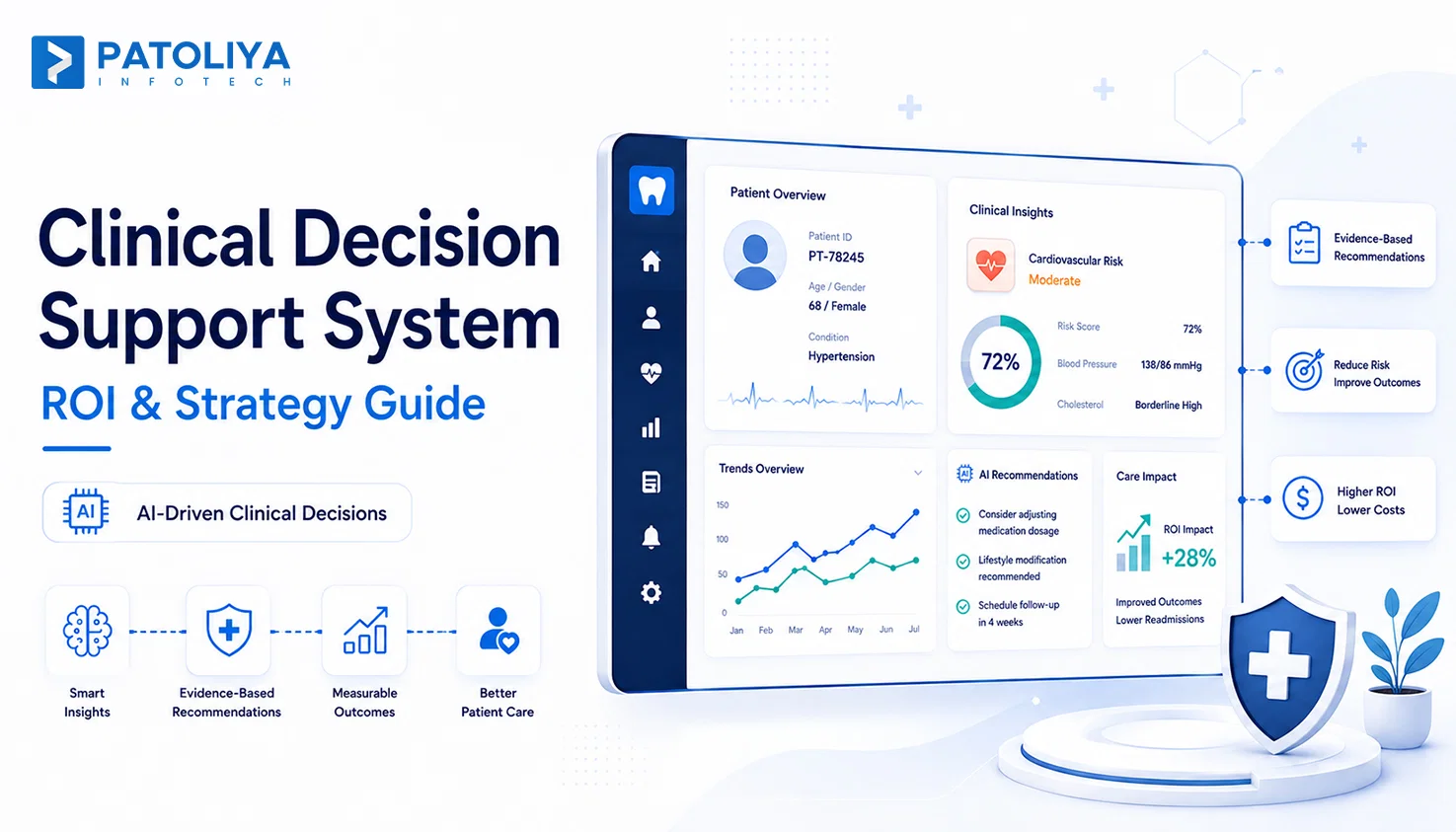
TL;DR: A Clinical Decision Support System (CDSS) helps clinicians turn complex patient data into actionable insights in seconds. Modern platforms combine clinical rules with AI to analyze clinical notes, lab results, medical images, and patient history, enabling faster and more informed decisions.
A physician can review hundreds of data points during a single patient encounter: lab trends, medications, imaging reports, previous diagnoses, and clinical notes. The challenge is not access to information anymore. The challenge is turning that information into the right decision at the right time.
A CDSS filters this information, identifies relevant patterns through AI-powered predictive analytics in healthcare, and delivers timely recommendations within the clinical workflow.
While traditional systems relied on predefined rules, today's AI-powered solutions can interpret unstructured data and prioritize likely diagnoses. This guide explains how CDSS works, where it delivers value, and the key factors to consider before choosing a solution, including the FDA Clinical Decision Support Software guidance that clarifies how certain CDS functions may be treated under medical device regulations.
What Is a Clinical Decision Support System (CDSS)?
A Clinical Decision Support System (CDSS) is software that analyzes patient data and provides evidence-based recommendations at the point of care, helping clinicians make faster, more accurate decisions.
Physicians, nurses, pharmacists, and multidisciplinary care teams use CDSS to support diagnosis, treatment planning, medication management, and patient care.
It delivers clinical alerts, medication reminders, risk predictions, diagnostic suggestions, standardized order sets, and treatment recommendations.
Traditional vs AI Powered CDSS: Understanding the Two Architectures
Knowledge-Based CDSS
A Knowledge-Based Clinical Decision Support System (CDSS) operates on predefined if-then rules created from published clinical guidelines, medical research, and expert knowledge.
For instance, if a patient has condition X and shows symptom Y, the system recommends test Z based on the programmed clinical rule. The recommendation remains consistent every time unless healthcare experts update the underlying logic.
Advantages:
- Highly transparent and explainable decision-making.
- Easier for regulators and healthcare organizations to validate.
Limitations:
- Difficult to scale across complex healthcare scenarios.
- Requires continuous manual updates for new drugs, treatments, and medical conditions.
AI-Based CDSS
An AI-Based Clinical Decision Support System uses machine learning in healthcare to identify patterns across large volumes of patient history, laboratory results, medical imaging, and clinical notes.
Unlike traditional rule-based systems, AI-assisted diagnosis software can use AI in medical imaging and other clinical data to uncover hidden correlations and risk factors that human experts may not identify while manually creating clinical rules.
These capabilities power modern hybrid diagnostic decision support systems used by many large hospital networks to improve clinical decisions and patient outcomes.
Advantages:
- Provides predictive insights instead of relying only on fixed logic.
- Identifies complex patterns that may be missed by human analysis.
Most hospitals blend both models rather than picking one over the other. A hybrid Clinical Decision Support System keeps the audit trail of fixed rules while gaining the pattern detection strength of machine learning, which is exactly why hybrid deployment now leads new hospital contracts.
How AI-Assisted Diagnosis Works Inside a Clinical Decision Support System Pipeline
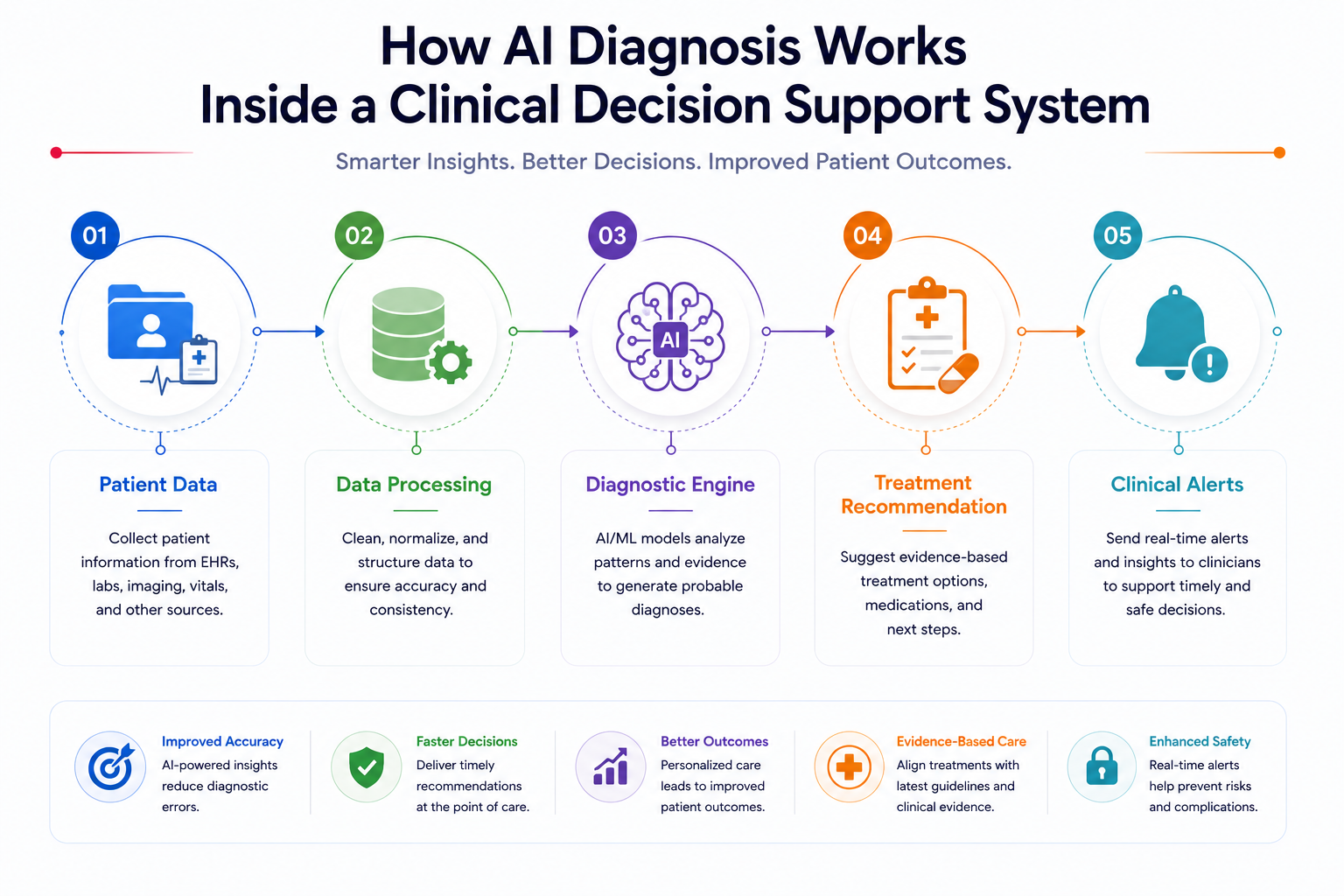
1. Healthcare Data Collection Layer
The process begins with healthcare data integration across multiple sources, including EHR and EMR systems, laboratory information systems, medical imaging platforms, patient monitoring devices, and clinical notes.
Using natural language processing (NLP), the system extracts symptoms, medical history, and clinical findings from unstructured notes that traditional rule-based systems cannot interpret. This creates a comprehensive patient profile before the diagnostic decision support systems generates recommendations.
2. Data Processing and Intelligence Layer
Once collected, the data is standardized through data normalization, followed by feature extraction, machine learning model scoring, and clinical knowledge integration.
The Clinical Decision Support System compares patient information with clinical guidelines, historical cases, and disease patterns to generate accurate, evidence-based insights.
3. Diagnostic Support Engine
At the core of every modern diagnostic decision support system, the diagnostic engine analyzes patient data to generate differential diagnoses, predict disease risks, detect abnormalities, and identify early warning signs.
Common applications include sepsis prediction, cardiac risk assessment, and cancer screening assistance, enabling clinicians to focus on confirming the most likely diagnosis rather than starting from scratch.
4. Treatment Recommendation Engine
After identifying likely conditions, the AI-assisted diagnosis software recommends the next best clinical actions.
These include medication suggestions, clinical pathways, recommended diagnostic tests, and evidence-based care protocols. By linking recommendations directly to the patient's record, the system helps clinicians move quickly from diagnosis to treatment.
5. Clinical Output Layer
The final layer delivers actionable insights through clinical alerts, interactive dashboards, physician recommendations, and EHR-integrated notifications.
To build trust and encourage adoption, modern Clinical Decision Support Systems also provide explainable recommendations, allowing clinicians to understand the evidence behind every alert and decision.
Where CDSS Creates Value and Where It Fails
Benefits
- Reduces clinical variation: supports consistent decisions using one shared evidence base.
- Speeds up diagnosis: helps physicians narrow possible conditions faster.
- Enables early intervention: sepsis detection, patient deterioration prediction, readmission risk forecasting.
- Improves operational efficiency: cuts repetitive checks and helps teams prioritize critical cases.
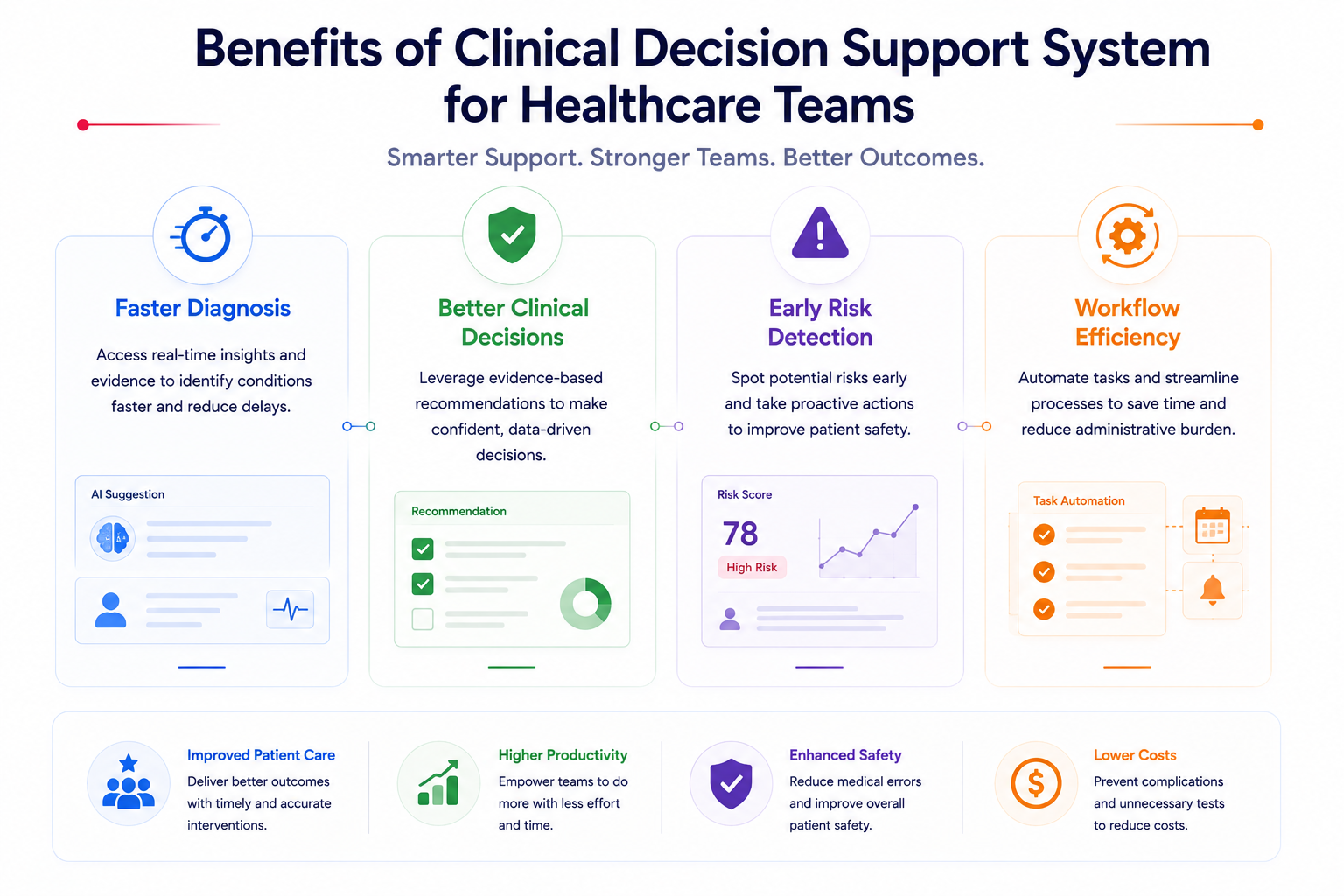
A hospital running a mature diagnostic decision support system typically sees these four benefits compound together rather than showing up one at a time.
Challenges
- Alert fatigue: too many low-value notifications and clinicians start ignoring every alert, including the ones that matter.
- Poor data quality: incomplete or inconsistent healthcare data produces poor recommendations.
- Workflow disruption: standalone tools that sit outside daily workflow get abandoned within weeks.
- Over-reliance risk: a Clinical Decision Support System should support reasoning, not replace clinical expertise.
A successful rollout depends less on the algorithm and more on integration, governance, and clinical solutions for hospital improvement that respect clinical judgment on the floor.
Hospitals that treat governance as an afterthought almost always end up rebuilding alert rules within the first year of running a Clinical Decision Support System, which costs more time than getting it right at launch.
Why Healthcare Data Infrastructure Determines CDSS Success
An advanced AI model is only as reliable as the healthcare data behind it. A Clinical Decision Support System requires accurate, complete, and connected data to generate trustworthy recommendations.
Common Data Challenges:
- Fragmented patient records across different systems.
- Disconnected healthcare applications.
- Duplicate or inconsistent patient information.
- Missing historical health data.
What Enables Better Data Quality:
- Healthcare data warehouses provide centralized information management that helps CDSS platforms work with more complete and consistent patient data.
- Strong data governance practices.
- Interoperability standards such as the HL7 FHIR standard help healthcare systems exchange structured patient information and support connected clinical applications.
A successful diagnostic decision support systems deployment starts with a strong data foundation. Without clean and connected data, even advanced diagnostic decision support systems may generate incomplete recommendations, reducing clinician trust and adoption.
CDSS Integration: The Hidden Deployment Challenge
A Clinical Decision Support System must connect with existing healthcare systems, including EHR platforms, laboratory information systems, PACS imaging systems, pharmacy systems, and patient monitoring devices.
Challenges of Poor Integration:
- Interrupts existing clinical workflows.
- Creates additional manual data entry.
- Reduces clinician adoption.
- Delays access to critical insights.
Benefits of Integrated CDSS:
- Provides real-time insights within the clinician's existing workflow.
- Improves physician acceptance and usage.
- Enables faster, data-driven decision-making.
- Reduces unnecessary workflow disruptions.
With technologies like SMART on FHIR and API-first architecture, healthcare organizations can integrate AI-assisted diagnosis software without replacing existing infrastructure.
A Clinical Decision Support System that fits naturally into daily workflows is far more likely to succeed beyond the initial implementation phase.
FDA Regulations: What Healthcare Buyers Need to Know About AI CDSS
Regulatory Classification
Non-device CDS: excluded from medical device regulation when the clinician can independently review the reasoning.
Software as a Medical Device (SaMD): regulated when the tool drives the recommendation with no visible reasoning trail.
FDA Evaluation Considerations
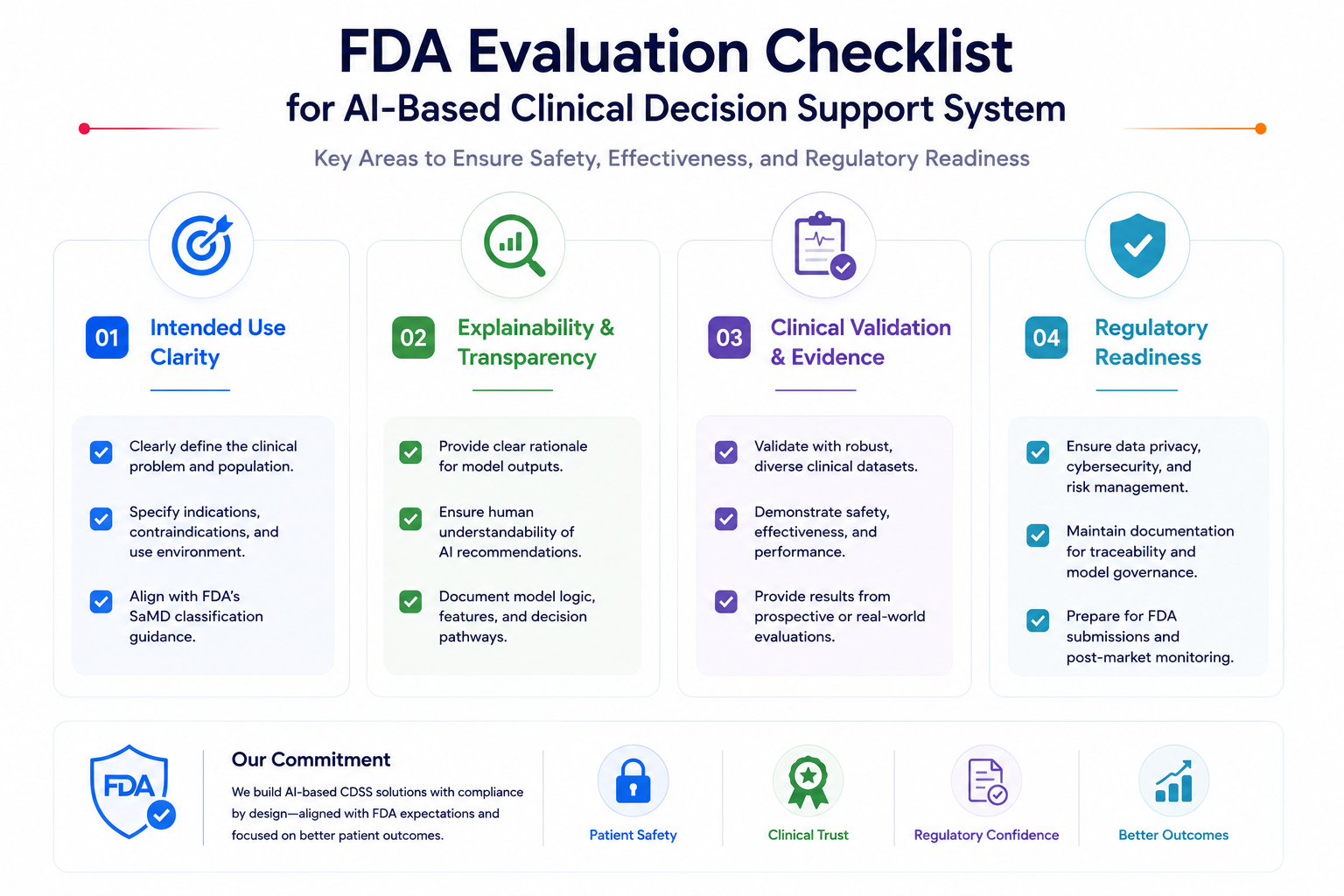
When evaluating a Clinical Decision Support System (CDSS), the FDA considers several factors to determine the appropriate regulatory approach, including:
- Intended use of the software and the clinical decisions it supports.
- Whether the system provides direct clinical recommendations or only assists healthcare professionals.
- Transparency of the reasoning behind the recommendations generated by the system.
- Whether clinicians can independently review and understand the information used to generate those recommendations.
Why Buyers Should Care
Incorrect classification of a Clinical Decision Support System can create significant challenges, including:
- Compliance risks during implementation and operation.
- Deployment delays caused by regulatory reviews.
- Legal and operational exposure that compliance teams cannot address after deployment decisions are already made.
Choosing the right CDSS approach with regulatory considerations in mind, supported by AI consulting services, helps healthcare organizations build safer, scalable, and more trusted clinical technology solutions.
Build vs Buy vs Hybrid: Choosing the Right CDSS Strategy
|
CDSS Strategy |
Advantages |
Challenges |
Key Considerations |
|
Build Custom CDSS |
Full customization based on clinical workflows. Better alignment with hospital processes. Complete ownership of the AI-assisted diagnosis software technology. |
Higher development investment. Full regulatory responsibility. Long-term maintenance and upgrade requirements. |
Best for healthcare organizations that need custom healthcare software development for a highly tailored Clinical Decision Support System with complete control over features, integrations, and future scalability. Building provides ownership, but hospitals must plan for ongoing maintenance and technology management. |
|
Buy Existing CDSS Solution |
Faster deployment timeline. Proven and validated clinical workflows. Reduced initial development effort. |
Limited customization options. Vendor dependency for updates, roadmap, and support. |
Best for hospitals looking for quick implementation of a proven diagnostic decision support systems. Buying can accelerate adoption, especially when clinicians need immediate decision support capabilities. |
|
Hybrid CDSS Approach |
Combines existing platforms with custom enhancements. Enables AI-assisted diagnosis software integration. Balances speed, customization, and scalability. |
Requires careful integration planning. May involve managing multiple technology components. |
Best for midsize hospital networks that need a faster path to implementation while maintaining flexibility. A hybrid Clinical Decision Support System allows organizations to add custom AI capabilities without replacing existing healthcare infrastructure. |
Key Decision Factors for Choosing a CDSS Strategy:
- Budget and development investment.
- Existing healthcare infrastructure.
- Clinical workflow requirements.
- Scalability and future technology goals.
- Integration needs with EHR and healthcare systems.
Healthcare Leader's CDSS Vendor Evaluation Checklist
A rushed AI-assisted diagnosis software purchase almost always shows up as a support ticket six months later.
|
Evaluation Area |
Question To Ask The Vendor |
|
Explainability |
Can clinicians understand recommendations? |
|
Integration |
Does it work with existing EHR systems? |
|
Security |
How is patient data protected? |
|
Regulatory |
Is compliance documentation available? |
|
Data Quality |
How are bias and accuracy monitored? |
|
Workflow Fit |
Does it reduce friction or add complexity? |
|
Scalability |
Can it support future healthcare needs? |
Every question above should get a direct, documented answer before a contract moves forward, particularly around healthcare software security, patient data protection, and regulatory requirements. A vendor who hedges on explainability or regulatory status is telling you something important about their Clinical Decision Support System, whether they mean to or not.
Is Your Healthcare Organization Ready for CDSS Adoption?
Signs You Are Ready
- Connected healthcare systems.
- Reliable patient data.
- Strong IT infrastructure.
- Physician involvement.
- Clear clinical goals.
Signs You Need More Preparation
- Poor data quality.
- No governance framework.
- Undefined workflows.
- No adoption strategy.
Start with a focused pilot tied to one clinical use case with measurable outcomes before scaling any diagnostic decision support systems across a full network. A three-month pilot with a defined success metric tells leadership far more than any vendor demo ever could.
Why Healthcare Organizations Choose Patoliya Infotech for Clinical Decision Support System Solutions
Patoliya Infotech develops Clinical Decision Support System solutions that help healthcare organizations improve clinical decision-making through seamless integration and AI-driven insights.
Key capabilities include:
- EHR, lab, and imaging integration to fit existing clinical workflows.
- HL7 and FHIR connectivity for secure healthcare data exchange.
- Explainable AI-assisted diagnosis modules with transparent evidence trails.
- Compliance-ready documentation support for regulatory requirements.
- Data infrastructure assessment and workflow testing before deployment.
With a focus on reliability, scalability, and clinical usability, Patoliya Infotech builds CDSS solutions designed to support healthcare teams and deliver trusted insights at the point of care.
Conclusion
A Clinical Decision Support System has become a critical tool for helping healthcare organizations detect risks earlier, reduce diagnostic delays, and support faster clinical decisions. However, successful adoption depends on more than advanced AI; it requires reliable data infrastructure, seamless integration, regulatory readiness, and clinician trust.
By building the right foundation first, hospitals can maximize the value of AI-assisted diagnosis software and create sustainable improvements in patient care. The right CDSS strategy can transform clinical workflows, improve efficiency, and deliver measurable long-term value.
FAQs:
A Clinical Decision Support System integrates with EHR platforms using HL7 and FHIR APIs, enabling real-time patient data access and delivering clinical recommendations within existing healthcare workflows.
A Clinical Decision Support System supports diagnosis assistance, risk prediction, medication safety, treatment recommendations, and patient monitoring by analyzing healthcare data to improve clinical decisions.
AI-powered Clinical Decision Support Systems rely on quality data, clinical validation, and continuous monitoring. Hospitals should evaluate accuracy, transparency, and performance before implementation.
Traditional Clinical Decision Support Systems use rule-based logic, while AI diagnostic decision support systems analyze complex clinical data to deliver predictive and adaptive insights.
The cost of a Clinical Decision Support System depends on customization, AI capabilities, EHR integration, security requirements, deployment approach, and long-term maintenance needs.
Hospitals should assess encryption, access controls, audit trails, compliance standards, and privacy measures to ensure a secure Clinical Decision Support System protects patient data.