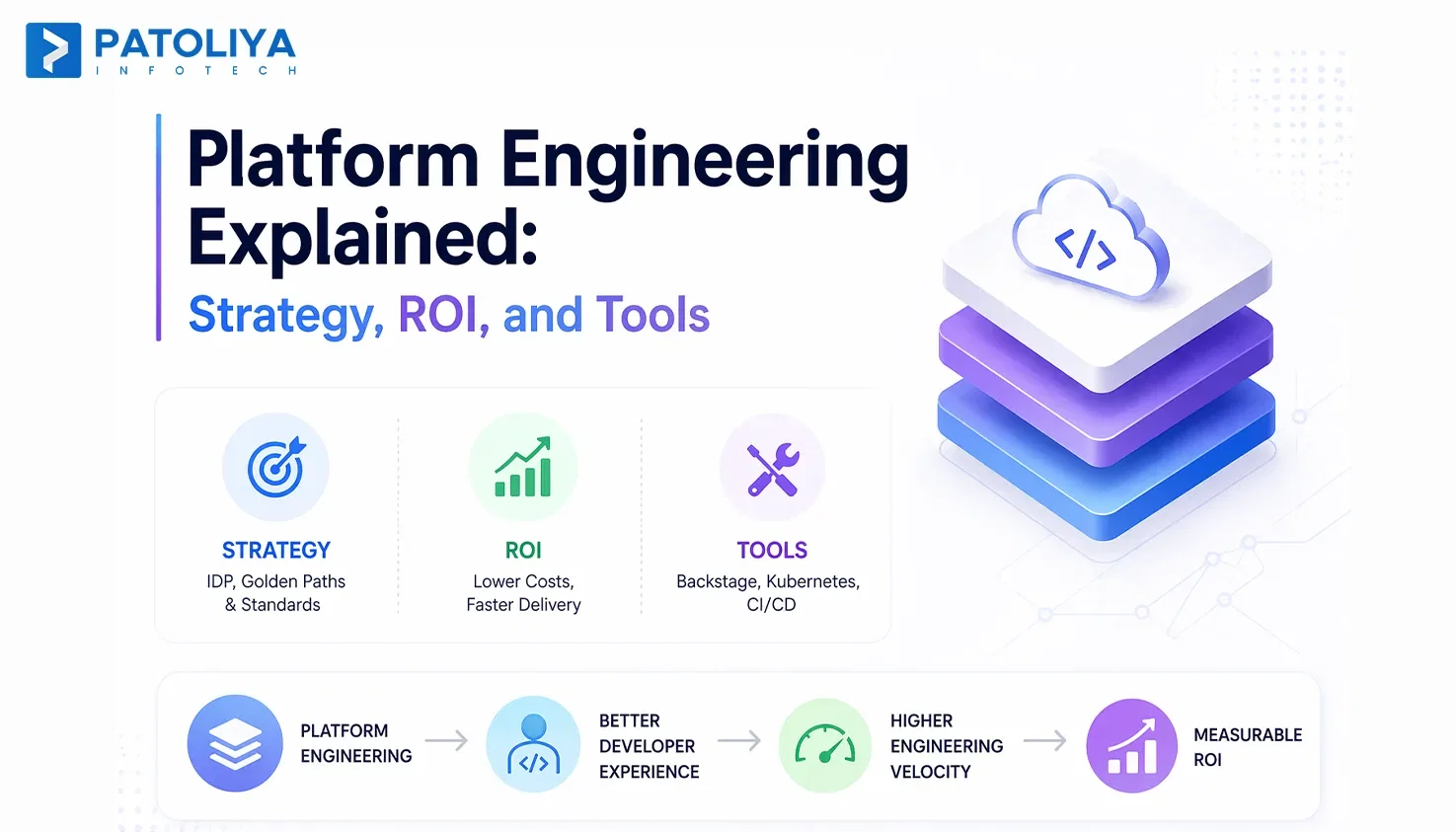
Platform Engineering Explained: Strategy, ROI, and Tools
80% of software development organizations are projected to use internal developer platforms by 2026, yet most engineering leaders still treat platform engineering as a DevOps rename. That mistake costs them budget, talent, and delivery velocity every quarter; it goes uncorrected, according to Gartner, 2024.
It is a distinct discipline. It treats infrastructure as a product and developers as internal customers. The developer experience your team has every day, the friction, the waiting, the context-switching, is a direct output of whether platform engineering ROI exists in your organization.
47% of engineers cite DevOps overhead as a primary burnout cause as per the DORA Report, 2024. That burnout compounds into attrition. Attrition compounds into rebuild cost. Replacing one senior engineer costs $150,000 to $250,000.
This blog explains what platform engineering actually is, where platform engineering vs DevOps diverges, and how to evaluate whether building or buying an internal developer platform makes financial sense for your organization.
What Platform Engineering Actually Means and What It Does Not
Platform engineering is the discipline of designing, building, and maintaining an internal developer platform that developers use as a product. The platform team owns the infrastructure layer. Developers own their applications. That separation is what makes self-service infrastructure scalable.
The Core Definition
It treats developers as internal customers. The platform team builds and maintains the internal developer platform as a product, with roadmaps, feedback loops, and SLAs. Platform engineering tools abstract infrastructure complexity so developers deploy, test, and monitor without opening a Kubernetes console or writing Terraform from scratch.
What It Is Not
It is not a tooling initiative you hand to one engineer on a Friday. It is also not exclusive to large enterprises. The threshold where self-service infrastructure starts delivering value is 30 to 50 developers.
How Platform Engineering Works: The IDP Architecture
An internal developer platform has three layers. Each one solves a different category of developer friction.
The Three Layers of an Internal Developer Platform
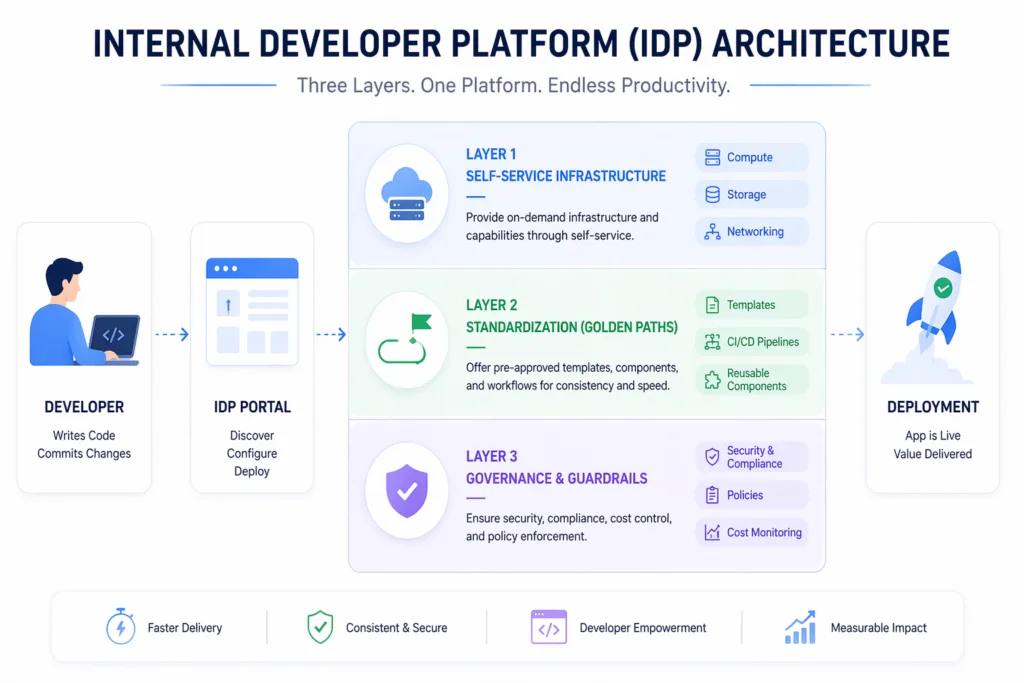
The self-service infrastructure layer is what developers see: a developer portal, CLI access, and API endpoints they use without raising ops tickets. The standardization layer delivers golden paths, reusable templates, and CI/CD pipelines that define how work gets done across squads. The governance layer bakes security policies, compliance controls, and audit logs directly into the platform, making enforcement invisible rather than manual.
self-service infrastructure that skips the governance layer ships fast and fails compliance audits. All three layers matter.
What Are Golden Paths?
Golden paths are pre-approved workflows that reduce cognitive load for development teams. A developer follows a golden path to spin up an environment, deploy code, or access infrastructure without an ops dependency at each step. Self-service infrastructure delivered through golden paths is the difference between a developer waiting two days for access and getting it in two minutes.
Platform Team Responsibilities
The engineering team owns four ongoing functions:
- Internal developer platform maintenance and uptime.
- Developer feedback loops inform the platform roadmap.
- Platform engineering tools integration across the delivery chain.
- Onboarding automation that cuts new developer ramp time from four weeks to one.
Platform Engineering vs DevOps: What the Data Says
Platform engineering vs DevOps is not a competition. DevOps is a cultural practice. It is the product that makes DevOps practices scalable golden paths beyond 50 developers.
| Dimension | DevOps | Platform Engineering |
| Primary Focus | Cultural and process change | Developer experience and IDP product |
| Ownership | Shared across teams | Dedicated engineering team |
| Infrastructure Access | Direct (Kubernetes, Terraform) | Abstracted via internal developer platform |
| Security Enforcement | Shift-left, inconsistent | Built into golden paths |
| Scales Beyond 50 Developers | No, becomes a bottleneck | Yes, reduces cognitive load |
| Deployment frequency | Monthly in 68% of organizations | 10 to 20 times daily |
Organizations with mature platform engineering report 30 to 40% improvement in deployment frequency according to the DORA Report, 2024.
When to Choose DevOps Alone
Platform engineering vs DevOps favors DevOps alone for teams under 30 developers with no recurring infrastructure repetition. If cultural issues are the primary bottleneck, a dedicated platform investment or developer experience will not fix them.
When Platform Engineering Becomes Necessary
It becomes necessary to have 50 or more developers across multiple squads of golden paths. 56% of developers report waiting one to two days for operations help on routine tasks. In platform engineering vs DevOps, engineering tools eliminate that wait entirely. Infrastructure sprawl and increasing compliance risk are the final signals that developer experience has degraded past what DevOps alone can repair from Platform engineering vs DevOps.
Business Use Cases: Where Platform Engineering Creates Measurable Value
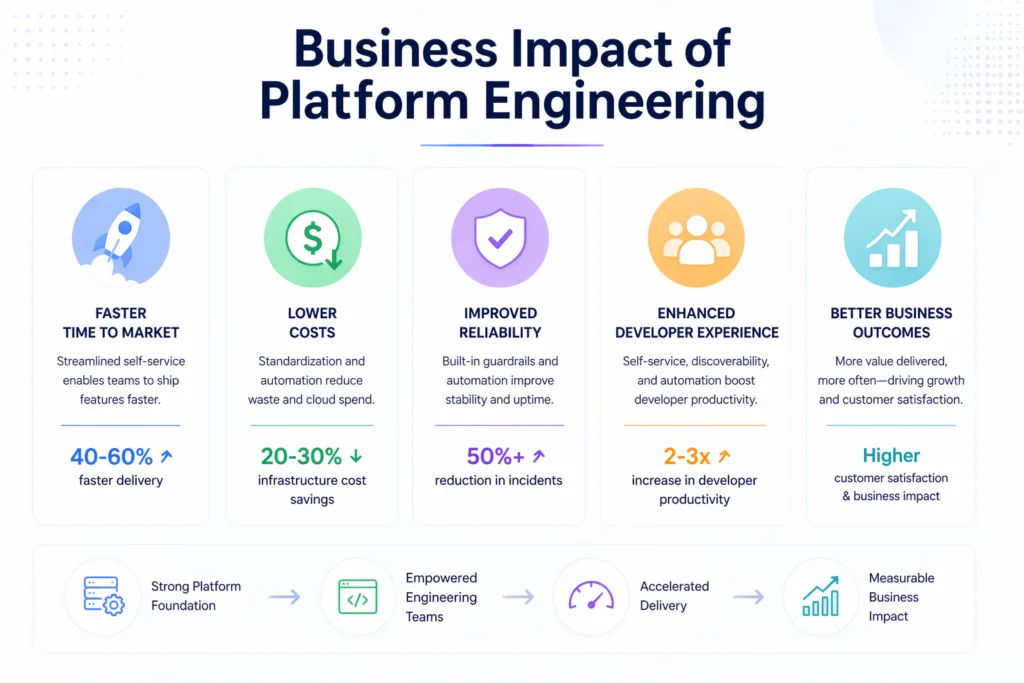
Platform engineering ROI creates measurable value in four business areas. Each one maps to a budget line your CFO already tracks.
Accelerating Product Delivery
It removes the DevOps ticket queue from the critical path of feature delivery through golden paths. Platform-enabled teams deploy without waiting. Onboarding time for new developers drops from four weeks to one week when the internal developer platform handles environment setup automatically. Engineering velocity compounds from that reduction across every sprint.
Reducing Developer Burnout and Attrition
47% of engineers cite DevOps overhead as a burnout cause. Platform engineering ROI restores developer focus to product work rather than infrastructure management. Developer experience improvements correlate with 40% higher developer satisfaction scores in IDP-mature teams. Replacing one senior engineer costs $150,000 to $250,000. Platform engineering ROI from retention alone justifies the investment in most organizations.
Enforcing Security and Compliance at Scale
Self-service infrastructure delivered through platform engineering tools bakes security policies directly into every deployment path. Cloud native architecture governance, tagging, and access control enforcement become automatic. Compliance risk drops without adding headcount.
FinOps and Cost Governance
self-service infrastructure ties cloud costs directly to products through platform-enforced tagging and budgeting. Right-sizing recommendations surface automatically rather than requiring a quarterly audit. Internal developer platform governance is one of the most underrated cost-control mechanisms available to a CTO in 2026.
Platform Engineering ROI: Numbers That Justify the Investment
The Hidden Cost of Not Building a Platform
The platform engineering vs DevOps cost is calculable before a single platform engineer is hired. 100 developers losing three hours per day to infrastructure friction equals 75,000 hours lost per year. At a $150 fully loaded hourly cost, that is $11.25 million in annual productivity loss. Add burnout-driven churn at 47% and senior engineer replacement costs of $150,000 to $250,000 each. The total hidden annual cost in organizations without it exceeds $14 million.
The ROI Case for Platform Engineering
Platform engineering ROI investment runs $500,000 to $1 million. Savings generated reach $6 million to $8 million over 18 months, a 600 to 800% return with break-even at 12 to 18 months. Gartner reports organizations prioritizing developer experience see 20% engineering velocity increase in year one, as per Gartner, 2024.
ROI Framework for C-Suite Conversations Bullet list:
- Measure current DevOps bottleneck hours per developer per week.
- Estimate the fully loaded cost per developer hour.
- Project deployment frequency improvement from baseline to the internal developer platform enabled state golden paths.
- Quantify churn risk at current developer experience satisfaction levels.
- Stack against platform tools build versus buy cost.
In platform engineering vs DevOps, the ROI framed this way stops being an engineering request. It becomes a financial case with a payback timeline.
Want a cost-benefit breakdown for your organization? Patoliya Infotech builds custom internal developer platform roadmaps for mid-market and enterprise teams.
Platform Engineering Pricing: Build vs Buy
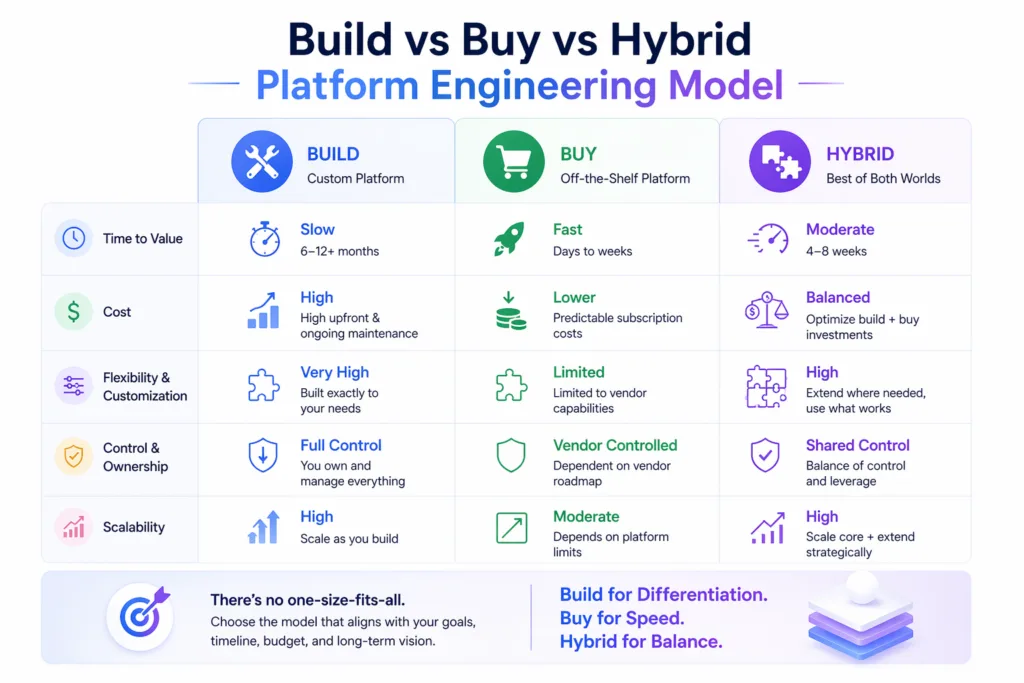
The investment decisions are split across three models. Each carries a different risk and time-to-value profile.
Build In-House
Building an engineering function in-house costs $500,000 to $2 million, depending on team size and toolchain complexity. The time to a production-ready internal developer platform runs from 6 to 18 months. Full customization and zero vendor lock-in are the upside. Opportunity cost, team distraction, and long ramp time are the downsides.
Buy a Managed Platform (Vendor-Provided IDP)
Vendor-provided platform engineering tools run $50,000 to $500,000 per year, depending on developer seat count. Options include Humanitec, Port, Cortex, and Backstage as open-source. Faster time to value is the advantage. Configuration limits and vendor dependency at scale are the risks.
Hybrid (Preferred for Most Enterprises)
| Criteria | Build | Buy | Hybrid |
| Time to Value | 12 to 18 months | 1 to 3 months | 3 to 6 months |
| Upfront Cost | High | Medium | Medium |
| Customization | Full | Limited | High |
| Vendor Risk | None | High | Low |
| Ideal Team Size | 200+ developers | 20 to 100 | 50 to 200 |
The hybrid model uses an open-source foundation like Backstage with custom plugins and vendor tools. It optimizes cost without sacrificing the self-service infrastructure flexibility that teams with evolving compliance requirements need. An engineering services partner supports build and integration, shortening the ramp from eighteen months to six.
Risks and Challenges of Platform Engineering
It fails for predictable reasons. Every one of them is avoidable with the right governance model from day one.
Adoption Risk
Self-service infrastructure built without developer input sees low adoption rates. The product mindset is non-negotiable. Telling developers to use a platform they had no voice in designing is how developer platform investments stall at 20% adoption.
Governance Creep
Over-standardization kills developer experience faster than no platform at all. The balance between golden paths, guardrails, and team-level flexibility must be actively managed, not set once at launch.
Cost Overruns in DIY Builds
Developer experience teams are consistently undersized at inception. Maintenance overhead of a homegrown internal developer platform is routinely underestimated by 40 to 60%.
Toolchain Integration Complexity
Existing Kubernetes clusters, infrastructure as code configurations, and software delivery lifecycle processes must be migrated carefully. CI/CD pipelines connected to legacy infrastructure create the most integration failures in engineering rollouts. Plan for migration time before you plan for go-live with golden paths.
Vendor Selection Checklist for Platform Engineering Services
- Does the vendor have domain expertise in your industry vertical?
- Do they support both open-source and proprietary platform engineering tools?
- What is their typical time-to-first-deployment for an internal developer platform?
- How do they handle multi-cloud or hybrid cloud environments for self-service infrastructure?
- Is security and compliance built into the internal developer platform or added after?
- Do they provide developer experience feedback loop mechanisms post-launch?
- What is their support model post-handoff for platform maintenance?
- Can they demonstrate measurable platform engineering ROI from past client engagements?
- Are golden paths configurable per team or organization-wide only?
- What is the licensing model for platform engineering tools if you scale past 100 developers?
Ready to shortlist your platform engineering partner? Use this checklist on your next vendor call. Or talk to Patoliya Infotech’s engineering team directly.
Top Platform Engineering Tools in 2026
The right platform engineering tools stack depends on your IDP layer. Each category solves a different delivery problem of the platform and related golden paths.
Developer Portal Layer
Backstage (open-source, Spotify-built), Port, and Cortex are the three dominant platform engineering tools for the internal developer platform front end. Backstage leads on community size and plugin ecosystem.
Platform Orchestration
Humanitec, Crossplane, and Pulumi handle engineering orchestration. Crossplane is preferred for teams already invested in SRE practices and Kubernetes-native workflows.
CI/CD and GitOps
ArgoCD, GitHub Actions, and GitLab CI are the standard platform engineering tools for deployment automation in 2026.
Security and Governance
Snyk covers dependency and container security. OPA handles policy-as-code enforcement across the engineering governance layer.
Workflow Orchestration
Temporal manages complex multi-step workflows at scale, particularly for developer experience teams running event-driven architectures.
Database DevSecOps
Bytebase handles SQL workflow governance, audit logs, and access control for engineering teams managing data infrastructure.
Why Patoliya Infotech is a Strong Choice for Platform Engineering
For engineering leaders evaluating a platform engineering partner, we address the two failure modes that define most IDP investments: adoption gaps and post-handoff silence.
We are built as a product engagement. Here is what that means in practice:
- Full expertise across Backstage, ArgoCD, Kubernetes, and cloud-native toolchains for internal developer platform builds
- Works with mid-market teams of 50 to 500 developers, where the build vs buy decision is most complex and most consequential
- Delivers golden paths configured to client-specific compliance requirements, not generic templates
- Developer experience feedback loop built into every engagement to ensure adoption reaches 80%+ post-launch
- Hybrid engagement model: IDP architecture, implementation, and developer onboarding support under one contract
Platform engineering ROI requires execution quality, not just architecture quality. Explore how Patoliya Infotech structures a platform engineering engagement for your team size and stack.
Conclusion
Platform engineering vs DevOps is a revenue-protection decision, not a developer productivity initiative. The ROI window is 12 to 18 months. The cost of inaction compounds every quarter you delay.
C-suite buy-in requires framing it as infrastructure cost control, talent retention, and developer experience improvement. Those three levers together justify the investment faster than any single one alone.
Platform engineering ROI at 600 to 800% within 18 months is achievable. The organizations that will hit it are the ones that start the architecture conversation now.
If you are evaluating platform engineering for your organization, connect with Patoliya Infotech’s team for a no-cost architecture assessment.
FAQs:
Platform engineering is the practice of building an internal developer platform that gives developers self-service infrastructure access, CI/CD pipelines, and deployment tools without requiring DevOps support for each task. It treats infrastructure as a product with developers as its internal customers.
Platform engineering vs DevOps: DevOps is a cultural practice focused on collaboration and automation. It builds the actual developer platform that makes those practices scalable across large teams. One is a mindset. The other is a product with a roadmap and an SLA.
It delivers measurable value once a team crosses 30 to 50 developers. Below that threshold, the overhead outweighs the gains. At 50 or more developers across multiple squads, developer experience degradation and platform engineering tools gaps become direct delivery bottlenecks.
An internal developer platform is a centralized toolset that lets developers deploy code, provision self-service infrastructure, and manage environments through a portal without manually configuring Kubernetes or writing Terraform from scratch. developer experience teams build and maintain it as a product.
Platform engineering ROI ranges from 600 to 800% within 18 months when developer time, burnout-driven churn, and infrastructure overhead are accounted for. Organizations investing $500,000 to $1 million in platform engineering typically recover $6 million to $8 million in productivity and cost savings.
Backstage and Port for developer portal needs, ArgoCD for GitOps, Crossplane or Humanitec for engineering orchestration, Snyk for security governance, and Temporal for workflow automation are the most widely adopted platform engineering tools in 2026. Stack selection depends on team size and cloud environment.