Diagnostic Lab Revenue Cycle Management: Billing Software Built for Labs, Not Hospitals
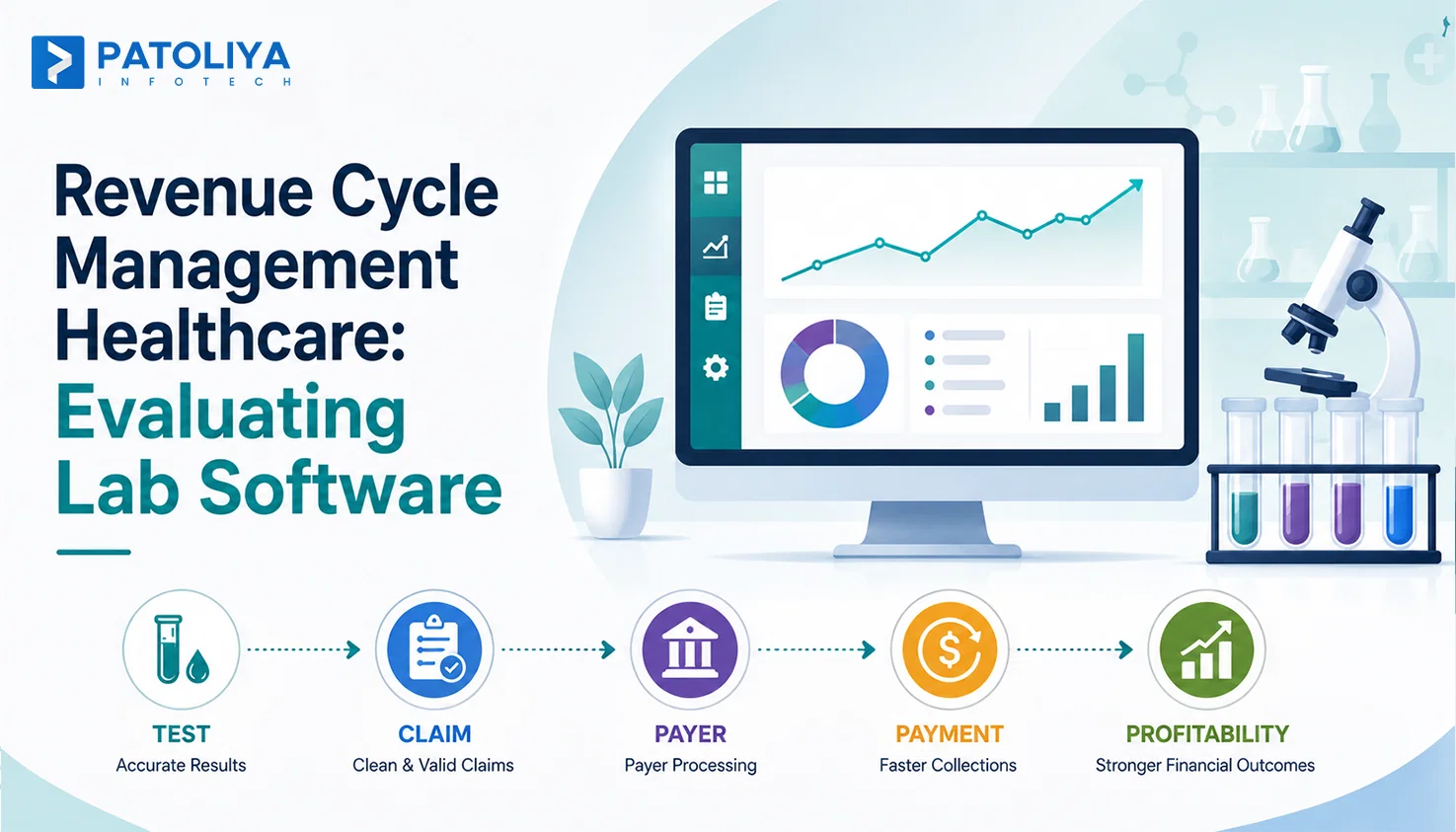
TL;DR: Revenue cycle management healthcare for labs starts with the test, not the hospital encounter. Each test carries its own code, diagnosis link, payer rule, and billing requirements.
A hospital stay generates one claim built from multiple services. A laboratory operates differently: one test can mean one claim, repeated thousands of times each day, with its own code, diagnosis link, and payer-specific rule.
That difference fundamentally changes how revenue cycle management healthcare and billing software must work. At laboratory scale, even a small billing-rule error can multiply across thousands of claims, turning one configuration issue into a significant revenue leakage problem.
This guide explains why lab billing needs specialized software, where labs lose revenue, and what CFOs should demand from a platform built for diagnostics. The core principle is simple: Laboratory Revenue Cycle Management should be built around the test, not adapted from hospital claim logic.
Why Laboratory RCM Is Different From Hospital RCM
Encounter Economics vs Test Economics
|
Area |
Hospital Billing (Encounter Economics) |
Laboratory Billing (Test Economics) |
|
Billing Unit |
Patient encounter or episode of care. |
Individual test or test panel. |
|
Claim Structure |
Multiple services bundled into one claim. |
Separate claims for individual tests. |
|
Claim Volume |
Lower volume, higher-value claims. |
High volume, lower-value claims. |
|
Revenue Driver |
Reimbursement per encounter. |
Reimbursement per test. |
|
Denial Impact |
Affects a single encounter. |
Can affect thousands of similar test claims. |
|
RCM Focus |
Encounter-level reimbursement. |
Test-level billing accuracy and throughput. |
Why Volume Changes the Impact of Every Error
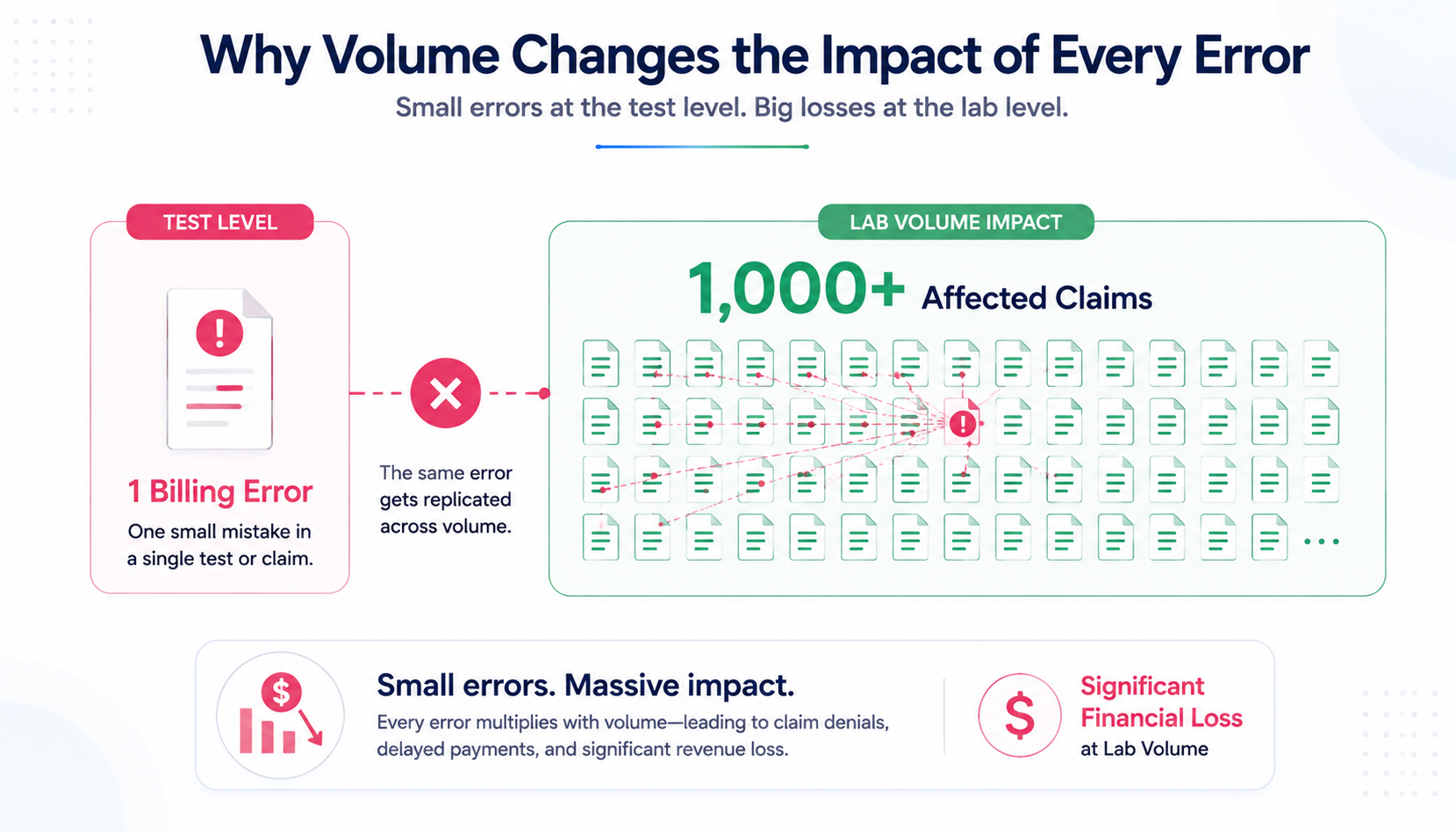
Volume magnifies every billing error financially. A hospital may process hundreds of claims, while a lab can process that volume in hours.
One error can affect thousands of claims. A coding mistake on a high-volume test can repeat across every claim using the same rule until someone catches it.
That makes healthcare revenue cycle management a systems discipline for labs, where teams need to identify recurring billing patterns rather than simply fix individual claims.
Generic diagnostic lab billing software can miss systemic patterns. Encounter-based platforms may show claim activity without revealing test-level problems.
True revenue cycle management healthcare catches patterns earlier. A lab can identify recurring errors within days instead of discovering them during a quarterly review.
The Test Is the Financial Unit
Single Tests, Panels and Components
Lab billing is fundamentally driven by individual tests and test components. The patient visit is almost incidental to the claim itself. One order can generate a single test, a full panel, or several components, and each carries its own CPT or HCPCS code.
This is the single fact that any real revenue cycle management healthcare platform has to be designed around, and it is also why general medical billing software built around patient visits can miss the needs of diagnostic laboratories.
Everything downstream in Laboratory Revenue Cycle Management traces back to this one structural fact about how labs generate a claim.
|
Billable Unit |
Example |
Billing Risk |
|
Single test |
Glucose |
Low |
|
Panel |
Basic metabolic panel |
Medium |
|
Component |
Analyte inside a panel |
High |
|
High volume test |
Screening test |
Highest |
High Volume Testing Multiplies Small Mistakes
A coding mistake on a high volume test can affect a large share of that test's claims before anyone notices.
That is why any working revenue cycle management healthcare platform needs test-level accuracy checks built in from day one, and why treating clinical lab billing the same way you would treat a physician office claim tends to create blind spots that compound over time.
A lab revenue cycle built around this principle catches the pattern early, before it compounds quarter after quarter.
Follow the Revenue From Order to Payment
The Chain From Order to Claim
The revenue cycle starts before billing: A payable claim depends on a chain of information that begins with the order and continues through payment and reconciliation.
Every data point matters: The chain includes the order, patient, payer, specimen, test, code, diagnosis, claim, adjudication, remittance, payment, and reconciliation, making healthcare data integration essential for keeping these systems connected.
A missing detail can stop the claim: Missing ordering provider information, an incorrect payer identifier, or an unsupported diagnosis can prevent a claim from reaching adjudication.
Problems often start upstream: Lab revenue cycle teams can lose visibility because errors frequently originate during ordering or specimen intake, before the billing team sees the claim.
Diagnostic lab billing software needs upstream visibility: A platform that only monitors the billing office cannot identify problems that begin earlier in the revenue cycle.
Laboratory Revenue Cycle Management connects the entire chain: The goal is to follow each test from order through final payment and identify where revenue is being lost.
The billing office misses this entire upstream half of the chain, and so does most clinical lab billing training that focuses purely on coding.
|
Stage |
Common Failure |
|
Order intake |
Missing or incorrect payer information. |
|
Coding |
Wrong test to code mapping. |
|
Diagnosis link |
Diagnosis does not support medical necessity. |
|
Adjudication |
Payer applies an unexpected rate. |
|
Remittance |
Underpayment goes unflagged. |
|
Reconciliation |
Balance never matched to expected amount. |
Any diagnostic lab billing software worth buying should catch every row in that table automatically, which is the practical test of real revenue cycle management healthcare.
Where Labs Stop Closing the Loop
Strong Laboratory Revenue Cycle Management closes every link in that chain. In practice, many labs only close the first two or three, and the rest gets absorbed as normal write-off activity when it deserves investigation.
A mature system uses healthcare workflow automation to trace unexplained write-offs back to their source and identify revenue losses before small problems become recurring losses.
Where Diagnostic Labs Lose Revenue
A Valid Code Is Not the Same as a Payable Claim
Code validation alone is not enough to establish payment eligibility. A CPT or HCPCS code being valid only confirms the code exists.
Depending on payer and service, Medicare laboratory services billing requirements can include payment rules, coverage considerations, and other requirements that determine whether a laboratory service is payable.
|
Requirement |
What It Confirms |
|
Valid CPT/HCPCS code |
The test code exists. |
|
Diagnosis support |
The test matches an accepted reason. |
|
Medical necessity policy |
The payer accepts this test for this diagnosis. |
|
Authorization |
The payer approved the test in advance. |
A billing engine that stops at code validation checks one box. Real revenue cycle management healthcare software needs payer-aware, diagnosis-aware logic in every claim.
A valid code with a weak diagnosis link can still be denied. Closing this gap is a reliable win in clinical lab billing operations.
Payer Variance on the Same Test
Reimbursement also varies by payer even when the test and the workflow stay identical.
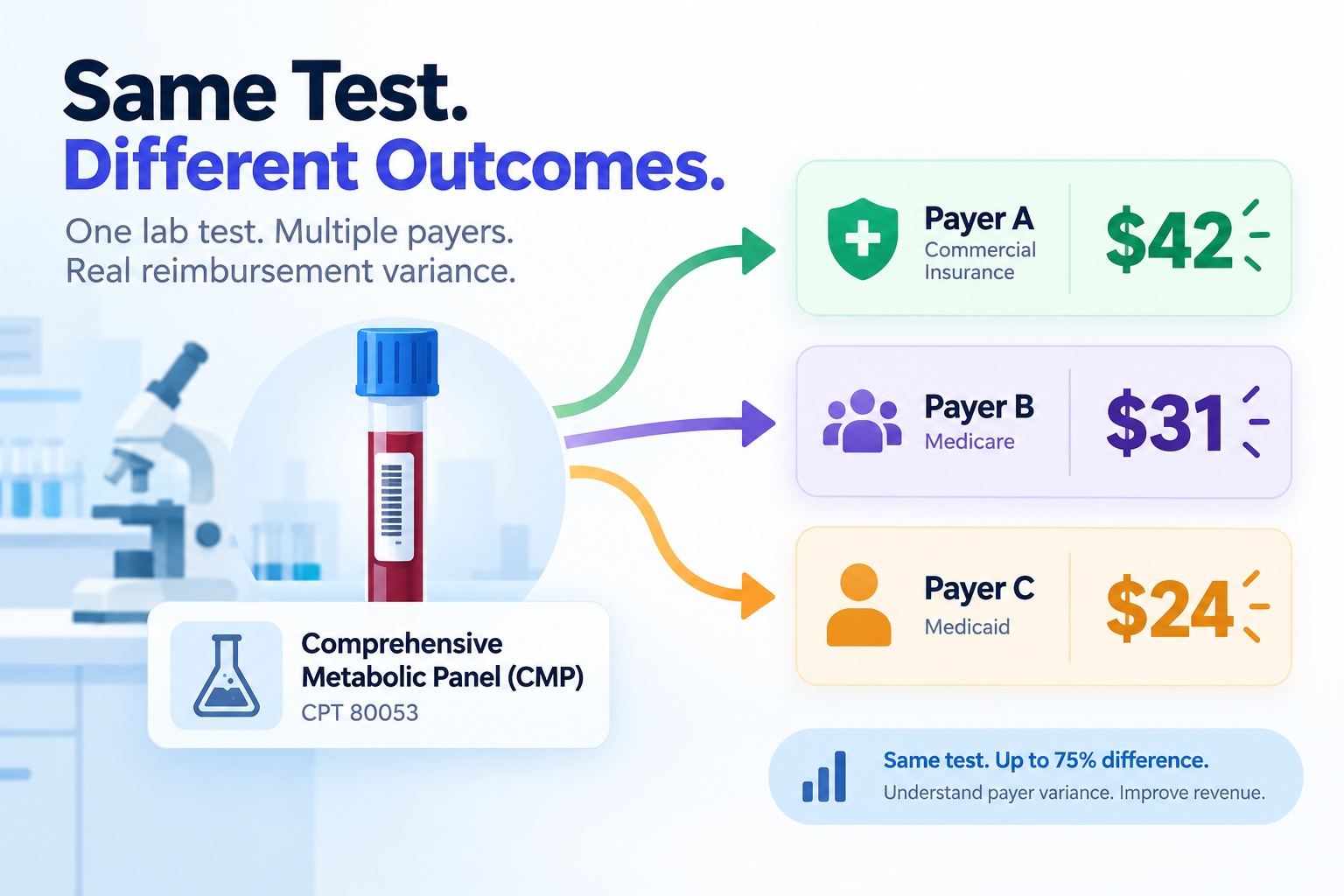
Allowed amounts, contract terms, coverage rules, and denial patterns shift from one payer to the next, while the Clinical Laboratory Fee Schedule provides an important reference point for understanding Medicare payment rates for clinical diagnostic laboratory tests.
A well-designed billing platform surfaces this insight automatically, so finance never has to reconstruct it from spreadsheets afterward.
Reference, Send Out and Outreach Billing
Reference testing, send outs, outreach programs, and client billing add another layer, and each needs a place inside a working diagnostic lab billing software platform.
Ordering and performing entities are often different organizations, and payment responsibility can sit with the payer, the client, or the patient depending on the arrangement.
- Sending out tests requires tracking which lab performed the work and who bills for it.
- Client billing requires a separate invoicing structure outside the standard payer claim.
- Outreach programs often run on contract-specific rates that differ from standard fee schedules.
Labs that ignore these paths inside their lab revenue cycle frequently cannot explain the gap between billed and collected revenue. A complete revenue cycle management healthcare view treats reference and outreach billing as core clinical lab billing workflows, handled with the same rigor as standard insurance claims.
Why Denial Rate Isn't Enough
Segment by Test, Payer, and Diagnosis
A denial rate on its own is a weak signal.
- A 7% denial rate does not show where the team should focus.
- It combines all tests, payers, and denial reasons into one number.
A segmented view is more useful.
- For instance, A specific test with a 14% denial rate from one payer, caused by a diagnosis mismatch.
- This identifies the dollar amount at risk and points to a specific fix.
revenue cycle management healthcare should segment denials by:
- Test
- Payer
- Diagnosis
- Client
- Ordering provider
- Location
Segmentation is a core feature of Laboratory Revenue Cycle Management.
- It should be included in the base platform.
- It should never be sold as an advanced add-on.
The Metrics That Matter to Lab CFOs
Why Collections Can Hide a Losing Test
Strong total collections can still hide weak performance underneath. A lab can bill ten million and collect eight and a half million and still be losing money on specific tests without knowing which ones.
Contribution margin, reimbursement minus attributable cost, is the number that answers whether a test is worth running at current volume and payer mix. Collections tell you whether money came in.
Test-level economics tell you whether the lab made money on what it billed, and healthcare data analytics can help a mature revenue cycle management report answer both questions separately.
This is the layer most clinical lab billing teams never build, because standard diagnostic lab billing software stops at collections and never gets to margin.
|
Category |
Metrics That Matter |
|
Reimbursement |
Expected vs actual payment, underpayment rate, payer variance |
|
Financial |
Revenue per test, contribution margin, payer profitability, client profitability |
|
Operational |
Denial rework volume, payment posting turnaround |
The Dashboard a CFO Actually Needs
A dashboard limited to clean claim rate and days in A/R reports on process. It does not answer whether the lab is actually profitable, and that gap is where most revenue cycle management healthcare dashboards stop short today.
A CFO evaluating a lab revenue cycle platform should ask to see the financial layer before ever looking at the process layer, because that layer is the entire point of investing in Revenue Cycle Management in the first place.
What to Look for in Lab Billing Software
Test Level Traceability
A platform built for diagnostics should be evaluated on whether it can trace one test through its full path while maintaining healthcare software security across code, diagnosis, payer, claim, denial, payment, and adjustment data.
Passing that test is the minimum bar for real Laboratory Revenue Cycle Management, especially at the level a growing lab actually needs.
Vendors who cannot demonstrate this live are not selling revenue cycle management healthcare; they are selling a claims dashboard with a lab-branded interface.
Payer Aware Rules, Not Generic Scrubbing
Payer-aware logic matters more than a vendor's marketing language around automation because the focus should be on what the system actually enforces.
Ask which specific payer rules the system enforces for your top payers and how often those rules are updated.
A platform that cannot answer that question in detail is offering a generic claims filter with a diagnostic lab billing software label attached to it.
Calling that clinical lab billing intelligence stretches the term past its meaning.
LIS Integration and Clearinghouse Connectivity
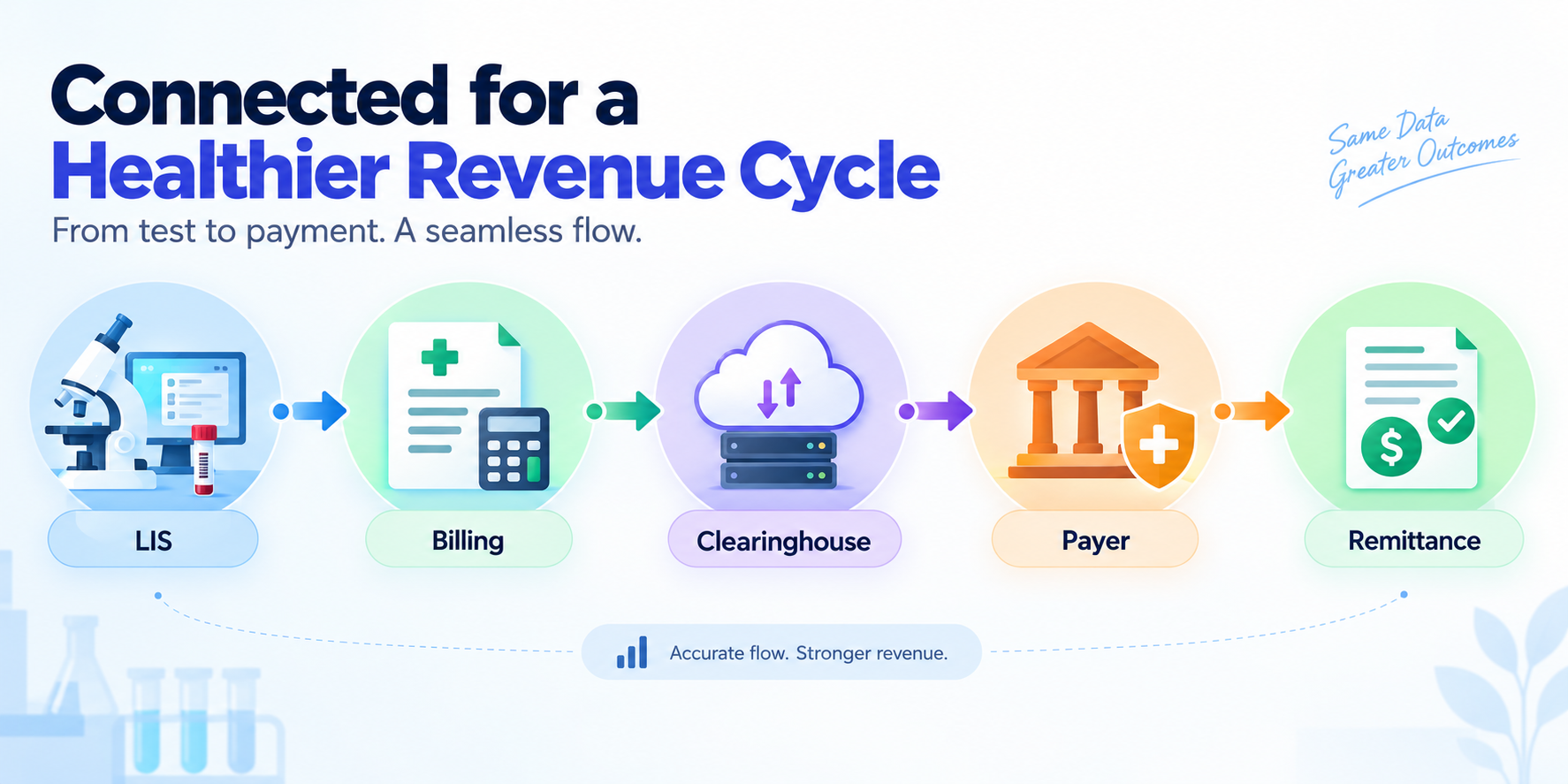
Integration depth is worth confirming directly, particularly when evaluating API-first healthcare integration between the LIS, billing platform, clearinghouse, and financial systems. A demo screen can look connected without the underlying data actually flowing in real time, which is exactly the gap real revenue cycle management healthcare is supposed to close.
|
Checkpoint |
What To Confirm |
|
LIS integration |
Real-time data feeds. |
|
Clearinghouse |
Automatic claim status feedback. |
|
Remittance |
Underpayments flagged without manual review. |
|
Reconciliation |
Every payment matched to an expected amount. |
Any billing platform should pass every row in that table before a contract gets signed. If following one test from order through final payment requires three separate logins, the lab revenue cycle is not actually connected; it just looks connected on a sales call.
This is the philosophy LabSpend builds around, connecting test-level billing data to the financial reporting a lab's finance team actually needs, so clinical lab billing activity and lab profitability live inside one view together.
Calculate the Cost of Revenue Leakage
What the Current System Is Already Costing You
Calculate Current Revenue Leakage: Identify what the current lab revenue cycle already costs in preventable losses, including preventable denials, underpayments, missed billing, avoidable write-offs, manual labor, and the carrying cost of aging receivables.
Assess Existing Billing Software Costs: Understand the revenue leakage occurring within current diagnostic lab billing software setups and determine how much is being lost due to inefficient processes.
Compare Total Costs: Compare these preventable losses against implementation cost, integration effort, subscription fees, and training time for a new solution.
Evaluate revenue cycle management healthcare: Frame a Laboratory Revenue Cycle Management upgrade as a financial decision based on measurable costs and potential savings.
Measure Return on Investment: Use the total cost of current leakage versus upgrade expenses to establish a measurable return, creating a stronger business case than a simple features comparison between vendors.
When Your Lab Has Outgrown Generic RCM
The Signals Worth Watching For
A few signals tend to show up together when a lab has outgrown a generic system and needs dedicated revenue cycle management healthcare built around test economics.
- Billing staff relies heavily on manual spreadsheets outside the core system.
- Denial causes cannot be segmented by test and payer without hours of manual work.
- Finance cannot reconcile expected reimbursement against actual reimbursement.
- The lab information system and billing platform operate as disconnected tools.
- Test-level profitability stays invisible to leadership every quarter.
These signals point to a gap in revenue intelligence. Claim processing speed is usually fine on its own, which is exactly why the problem hides so well behind normal revenue cycle management healthcare reports.
Closing the intelligence gap is what separates labs that grow profitably from labs that just grow busy, which is where custom software development services can help build workflows around test-level economics.
How Patoliya Helps Labs Turn Revenue Cycle Management Into Financial Insight
As a healthcare software development company, Patoliya helps diagnostic labs strengthen Laboratory Revenue Cycle Management by connecting test-level economics, coding, payer rules, claims, reimbursements, and profitability.
It helps billing teams identify revenue leakage, understand denials, track reimbursement performance, and gain actionable financial visibility from order to payment without forcing laboratory workflows into generic hospital billing logic or sacrificing test-level detail.
Conclusion
Diagnostic lab billing is its own discipline, built on test-level economics and payer rules that generic systems were never designed to track. Real revenue cycle management healthcare respects that discipline, never flattening it into hospital claim logic.
A platform built specifically for Laboratory Revenue Cycle Management connects every test to its code, payer, claim, and outcome in one place, turning a billing team into a source of financial insight, freed from perpetually chasing denials. A lab revenue cycle built this way stops being a cost center and starts being a source of answers finance can actually use.
That is the philosophy behind LabSpend, built as revenue cycle management healthcare software for labs, not hospitals. See where revenue is being lost at the test level. Book a walkthrough and trace your billing, reimbursement, and profitability from order to payment.
FAQs:
Labs should evaluate test-level reporting, payer-specific workflows, denial tracking, reimbursement visibility, integration capabilities, automation, scalability, and how easily the system fits existing laboratory billing processes.
Yes. The right solution should integrate with existing laboratory information systems, billing platforms, and financial workflows, allowing labs to improve revenue cycle management without completely replacing their current technology infrastructure.
Test-level analytics can help laboratories compare billed amounts, expected reimbursement, actual payments, denials, adjustments, and write-offs to identify tests or payers creating recurring financial issues.
Laboratory leaders should monitor denial rates, reimbursement by test, payment variance, days in accounts receivable, write-offs, collection rates, payer performance, and revenue leakage to understand financial performance.
Labs can compare current revenue leakage from denials, underpayments, missed billing, write-offs, and manual work against implementation, integration, subscription, and training costs to estimate potential return.
Laboratory billing depends heavily on individual tests, codes, payer rules, reimbursement rates, and test-specific economics. These variables require workflows and analytics designed around laboratory transactions rather than broader hospital claim processes.