Electronic Data Interchange: How Claims Actually Move
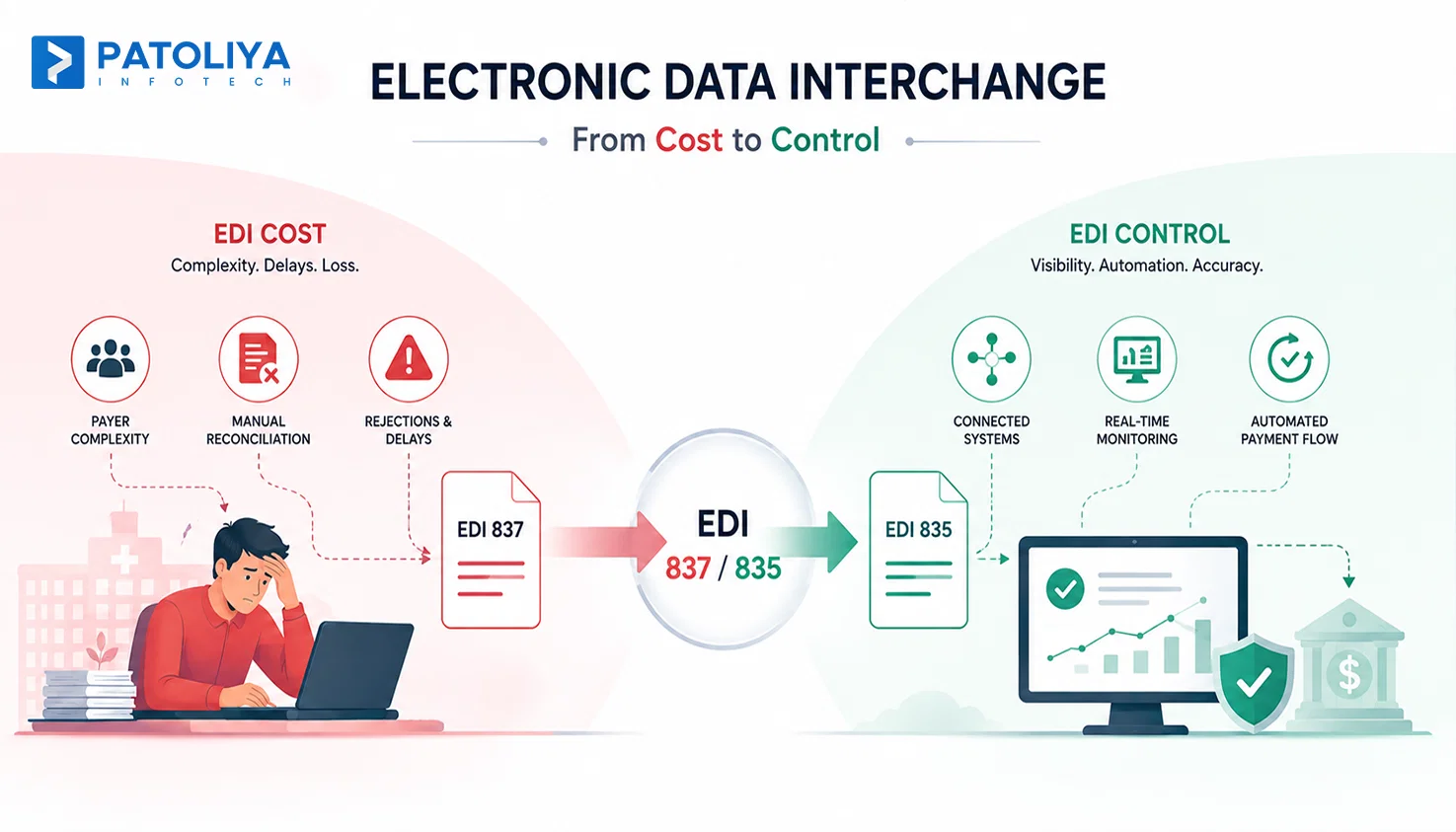
TL;DR: Electronic Data Interchange still carries almost every claim, eligibility check, and payment inside healthcare. Software teams handling EDI 837 835 healthcare claims deal with payer-specific rules, silent parsing errors, and reconciliation gaps every single day. This guide shows how the data actually moves and where engineering teams lose the most time.
Every healthcare claim that gets paid crosses at least four separate systems before the money lands. Electronic Data Interchange is the layer that connects all of them, yet most software teams only notice it when a payment breaks. Building around EDI 837 835 healthcare claims looks simple on a diagram and turns messy the moment a real payer sends back a rejection nobody expected.
Teams treat Electronic Data Interchange as a solved problem because the transaction formats have existed since the 1990s. The formats stayed still. Payer rules, volume, and connected systems did not. This guide breaks down how claims, eligibility, and payment data move in practice and where that movement quietly fails.
Electronic Data Interchange in Healthcare: The Basics
What EDI Means in Modern Healthcare
Electronic Data Interchange replaces manual paperwork with structured files that computer systems read directly. In healthcare, this means claims, eligibility checks, and payments travel as coded transaction sets instead of faxes or PDFs.
A provider system generates a file, a payer system reads it, and both sides skip the phone call. Every team that touches billing works with Electronic Data Interchange whether they realize it or not.
How X12 Transactions Standardize Data Exchange
X12 EDI transactions give every file the same skeleton no matter which state or payer receives it.
Segments, loops, and codes follow rules set by ASC X12, while HIPAA-adopted EDI standards establish the required transaction formats used across covered healthcare entities. Electronic Data Interchange only works at scale because of this shared grammar and reliable healthcare data integration across the systems exchanging that information.
The Role of Clearinghouses in the Ecosystem
Clearinghouses sit between provider systems and payer systems. They check a file for format errors, translate it into the shape a specific payer expects, and route it forward.
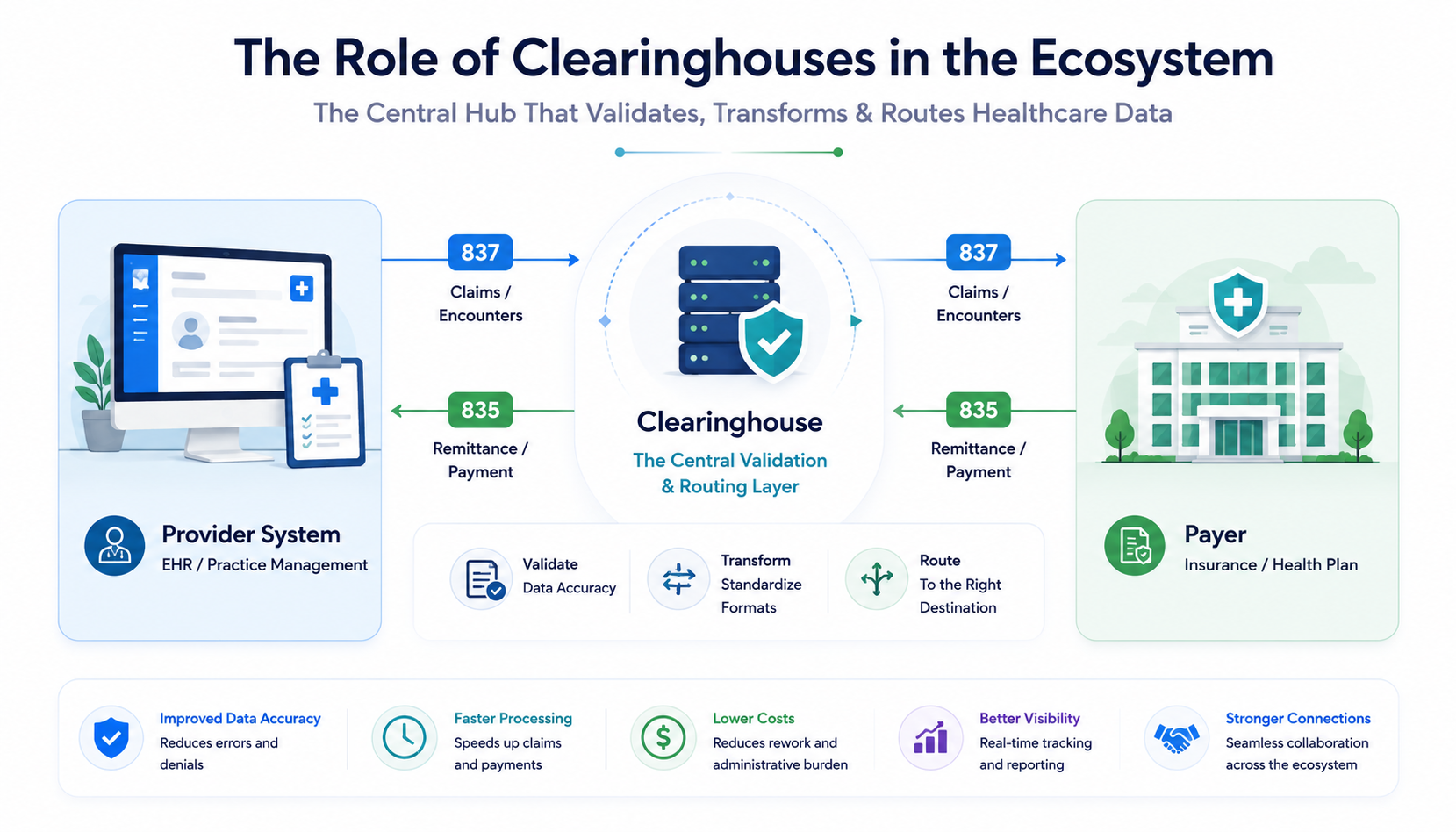
Without this layer, every provider would need a direct connection to every payer, and Electronic Data Interchange for EDI 837 835 healthcare claims would collapse under connection overhead alone.
Provider teams that skip a clearinghouse often end up building payer-specific logic by hand, which slows every future integration down.
The EDI Transactions That Matter Most
837 Claims Submission
The 837 carries diagnosis codes, procedure codes, provider details, and charges from a provider system to a payer. This is the transaction that starts the entire EDI 837 835 healthcare claims cycle. A clean 837 moves faster through adjudication than one built from incomplete patient data.
835 Payment and Remittance
The X12 transaction sets define standardized structures for healthcare exchanges, including the 835 for payment and remittance information and the 837 for healthcare claim submission. Billing teams using medical billing software can post this file automatically when the mapping is accurate, while poorly integrated systems still force teams to reconcile it by hand. Electronic Data Interchange at this stage decides how fast a practice actually gets paid.
270/271 Eligibility Verification
A 270 asks a payer if a patient has active coverage. A 271 answers with plan status, copay, and benefit details. Electronic Data Interchange makes this real-time check possible without a phone call to the payer. Teams that skip this step submit claims for patients who lost coverage weeks earlier.
276/277 Claim Status
A 276 asks a payer where a claim stands. A 277 responds with the current stage, whether that is pending, paid, or denied. This step keeps Electronic Data Interchange visible for billing teams who would otherwise guess at a claim's status.
278 Prior Authorization
The 278 requests approval before a service happens, mostly for procedures, imaging, or specialty drugs. A missing 278 breaks the entire Electronic Data Interchange chain for that claim. A delayed 278 is one of the most common reasons a clean 837 still gets denied later.
Why These Transactions Matter Across The Revenue Cycle
|
Transaction |
Direction |
Purpose |
|
270/271 |
Provider to Payer, Payer to Provider |
Eligibility check |
|
278 |
Provider to Payer |
Prior authorization |
|
837 |
Provider to Payer |
Claim submission |
|
276/277 |
Provider to Payer, Payer to Provider |
Claim status |
|
835 |
Payer to Provider |
Payment and remittance |
Electronic Data Interchange works only when a team treats these five transactions as one connected system, not five separate integrations within the broader healthcare revenue cycle management process. Skip that mindset and every fix becomes a patch instead of a solution.
How Claims Data Actually Moves Across Healthcare Systems
From Patient Encounter to Claim Generation
- A visit ends, and electronic health records applications and practice management systems provide the clinical and encounter information that is converted into codes for the 837 file.
- This is the first point where Electronic Data Interchange actually starts, and errors here travel forward into every later step.
How Clearinghouses Validate and Route Claims
- The clearinghouse receives the 837, checks it against basic format rules and payer-specific companion guides, then forwards it.
- The clearinghouse kicks back a file that fails validation as a 999 rejection before a payer ever sees it.
- This is Electronic Data Interchange working correctly, catching an error before it costs real money. Teams that treat this step as a formality miss real revenue.
How Payers Review, Adjudicate, and Respond
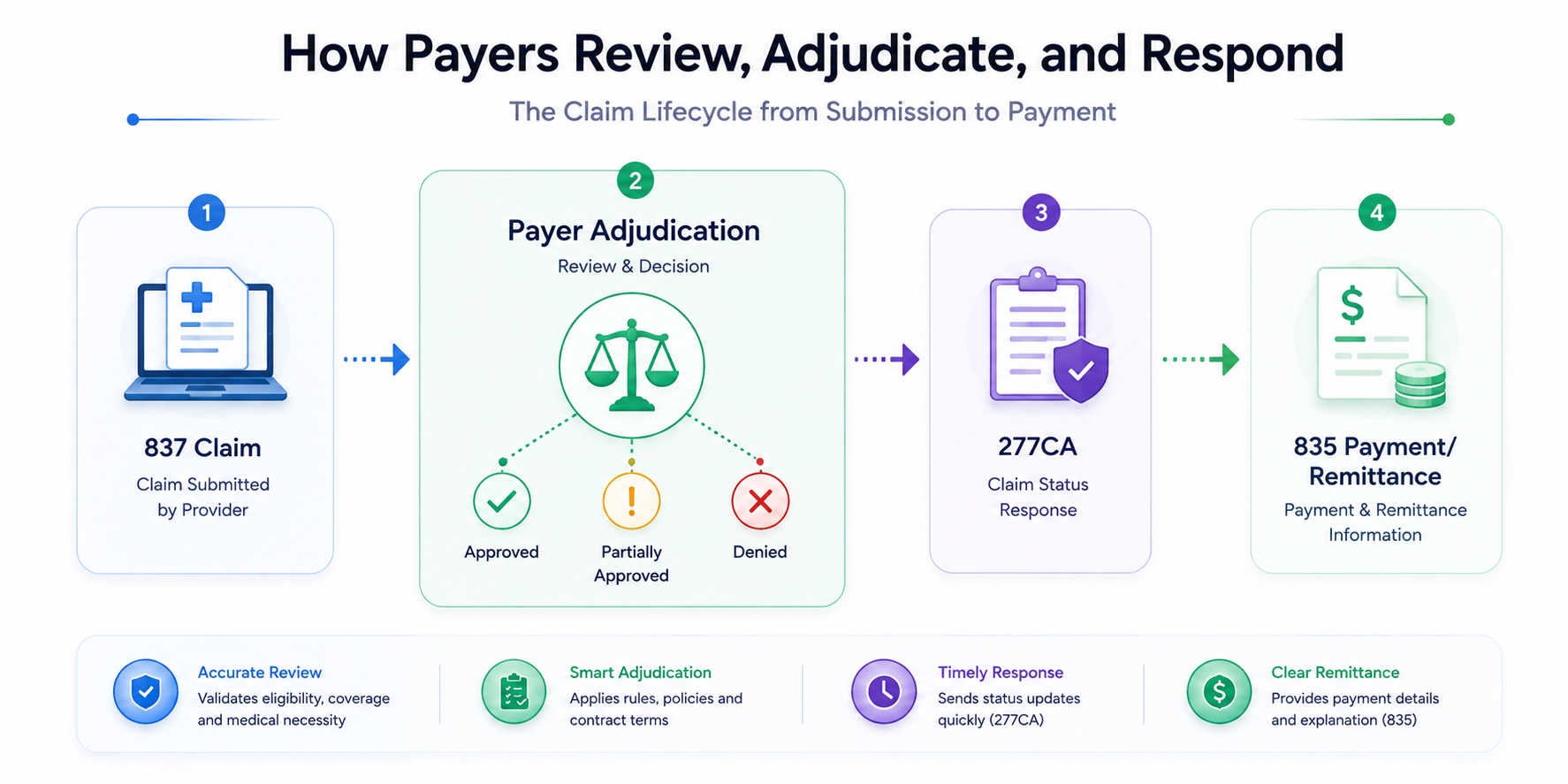
- The payer system runs the claim through coverage rules, medical policy, and pricing logic, while denial management in healthcare helps teams identify and prevent recurring claim-processing failures.
- It sends a 277CA to confirm receipt and, later, an 835 with the payment decision.
- Electronic Data Interchange for EDI 837 835 healthcare claims depends entirely on this adjudication engine acting the way the companion guide says it will.
How 835 Data Returns to Billing and Revenue Cycle Systems
- The 835 arrives with payment amounts, adjustment codes, and denial reasons at the line level.
- A well-built system auto-posts this data straight into the ledger. Electronic Data Interchange only creates value here when the mapping actually works.
- A poorly mapped system dumps the same data into a queue for a human to read line by line.
The Operational Handoffs That Introduce Delays
|
Handoff |
Common Delay |
|
Practice system to clearinghouse. |
File batching schedules. |
|
Clearinghouse to payer. |
Companion guide mismatches. |
|
Payer to clearinghouse. |
Manual adjudication holds. |
|
Clearinghouse to billing system. |
Mapping errors on the 835. |
Each handoff looks instant on paper. In practice, Electronic Data Interchange moves in batches, queues, and manual review steps that add hours or days between a service and a paid claim.
Where Healthcare EDI Integrations Break in Production
Companion Guide Variations Across Payers
Every payer publishes its own companion guide on top of the base X12 standard. One payer wants a specific qualifier in loop 2010BA, another leaves it optional.
Generic Electronic Data Interchange parsers that ignore this variation pass internal validation and still get rejected by the payer.
Eligibility Responses That Create False Confidence
A 271 can come back marked active while the actual benefit details are wrong or outdated.
Front desk staff read active coverage and move forward, then the claim denies weeks later for a plan that changed. EDI 837 835 healthcare claims built on a stale eligibility check inherit that risk immediately.
Acknowledgment Handling Failures (999 and 277CA)
Teams build 999 and 277CA handling once during launch and rarely touch it again. A rejected file sits unread because nobody built a real alert on top of it, showing why healthcare workflow automation is important for routing EDI exceptions before they become revenue problems.
This single gap causes more silent revenue loss than any other part of Electronic Data Interchange we have reviewed.
Signals a team is flying blind:
- 999 rejections sitting unread for days.
- 277CA responses never mapped to a dashboard.
- Rejections handled the same way as accepted files.
Remittance Mapping and Reconciliation Challenges
An 835 can post successfully while still mapping the wrong adjustment reason code to the wrong claim line.
The claim looks paid in the system while the actual cash never lands correctly. Electronic Data Interchange breaks quietly here, long after the claim looked complete.
Transaction Visibility Gaps Between Submission and Payment
Most teams can see a claim went out and a payment came in, but few can see what happened in between.
That blind spot, often requiring a clearinghouse support ticket, is where EDI problems hide the longest.
Why Passing Validation Does Not Guarantee Successful Processing
Passing a syntax check confirms a file is well formed. It says nothing about whether the payer will actually pay the claim.
Electronic Data Interchange success should be measured by paid claims, not passed files. Teams that track validation pass rate instead of paid claim rate are watching the wrong number entirely.
Why EDI Remains an Engineering Challenge
Supporting Hundreds of Payer-Specific Requirements
A platform connecting to fifty payers effectively maintains fifty small rule sets on top of one standard. Electronic Data Interchange engineering work grows with every new payer connection added, not with claim volume.
Managing Ongoing Mapping and Rule Changes
Payers update companion guides, code sets, and edit rules throughout the year. Electronic Data Interchange rules change more often than most teams plan for. A mapping that worked in January can silently break in June if nobody tracks the change log.
Maintaining Reliability at Scale
A system processing thousands of EDI 837 835 healthcare claims daily needs monitoring that catches a spike in rejections within hours, not a monthly report that surfaces the problem after the damage is done.
Supporting Legacy X12 and Modern APIs Simultaneously
Most healthcare platforms now run X12 files next to FHIR-based APIs for the same workflows, making an API-first healthcare software architecture increasingly important for connecting modern and legacy systems.. Running both paths keeps Electronic Data Interchange consistent across old and new systems, while avoiding duplicate logic across two very different data formats.
The Rise of EDI Observability and Monitoring
Teams now build dashboards that track rejection rate, acknowledgment turnaround, and 835 posting accuracy in one place. This shift treats Electronic Data Interchange as infrastructure that needs monitoring, the same way teams monitor uptime or API latency.
EDI and FHIR: Building Hybrid Healthcare Interoperability
Why EDI Still Dominates Financial Workflows
Claims, eligibility, and payment still run through X12 because payers built their adjudication systems around it for decades.
Replacing that core is a multi-year project few payers want to fund right now. Electronic Data Interchange stays the default for anything tied to money.
Where FHIR Is Driving Modernization
FHIR-based APIs handle real-time data sharing well, especially for clinical records and prior authorization workflows, while SMART on FHIR adds a secure framework for connecting applications to healthcare data.
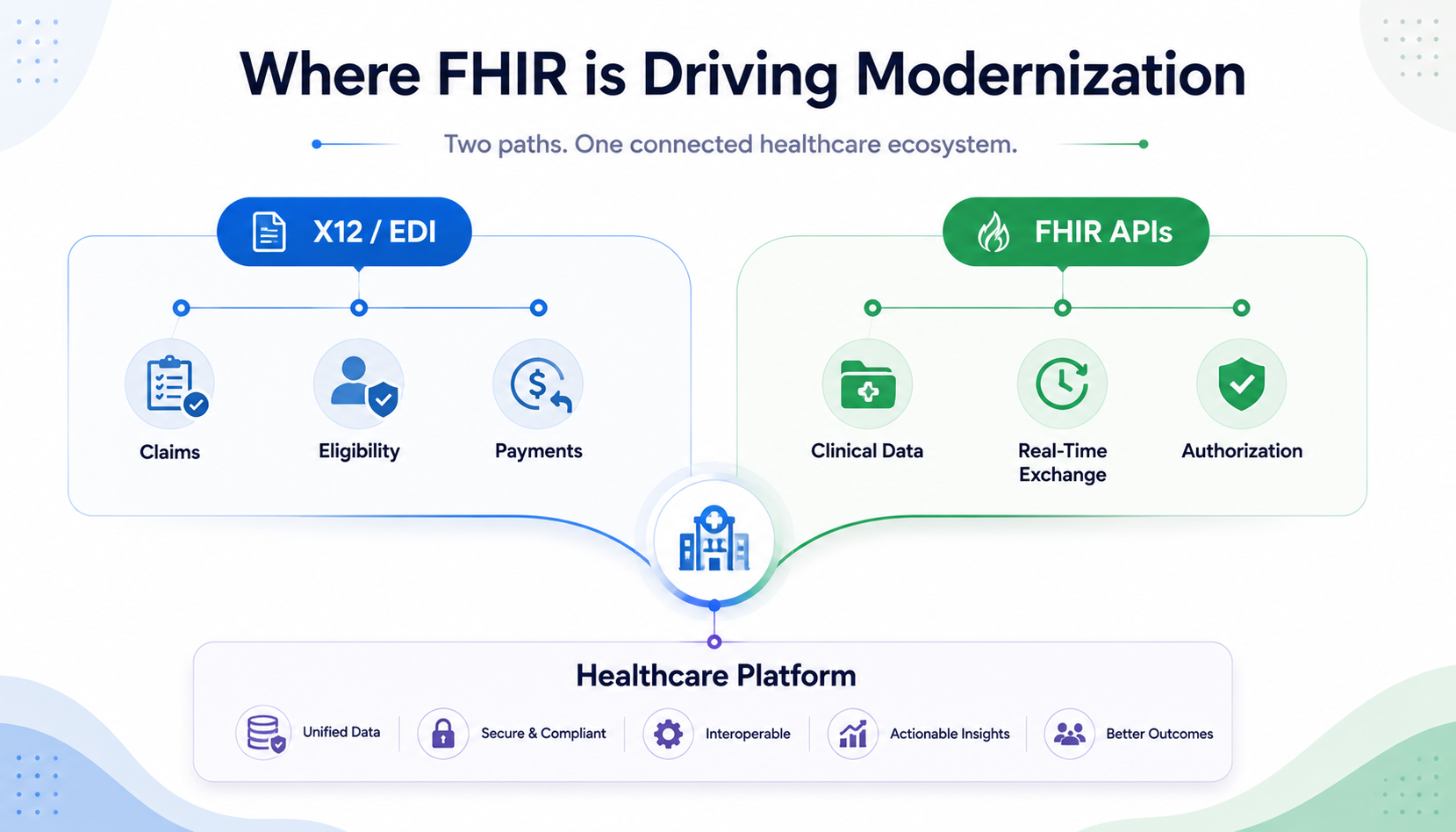
This is where new interoperability rules push the fastest change.
Financial vs Clinical Interoperability Requirements
|
Requirement |
Financial Interoperability |
Clinical Interoperability |
|
Priority |
Compliance & accuracy |
Speed & flexibility |
|
Data |
Standardized transactions |
Real-time clinical data |
|
Key Need |
Strict, auditable formats |
Fast, adaptable exchange |
|
Main Goal |
Accurate payments |
Better care decisions |
Why Most Organizations Need Both EDI and FHIR
A claims clearinghouse connection still moves the 837 and 835. A FHIR layer handles real-time eligibility checks or authorization status.
Organizations that try to force one format to do both jobs end up rebuilding the same logic twice.
Running Electronic Data Interchange alongside FHIR is not a transition phase; it is the actual architecture most platforms need for the next several years.
The Hidden Cost of DIY EDI Infrastructure
Engineering Resources Consumed by Maintenance: Senior engineers end up fixing companion guide edge cases instead of building product features.
That time never shows up on a budget line, but it shows up in every delayed release.
Payer Onboarding Delays and Custom Rules: Adding one new payer to an internal Electronic Data Interchange setup can take weeks of testing, mapping and back and forth with payer support teams.
Each new connection adds ongoing maintenance, not a one time cost.
Revenue Impact of Transaction Failures: A silent rejection in EDI 837 835 healthcare claims processing means real cash sitting unpaid until someone notices.
Teams without proper monitoring often find these gaps during a monthly close, weeks after the actual denial happened.
Product Roadmap Delays Caused by Integration Work: Electronic Data Interchange work rarely shows up on a roadmap, yet it consumes real engineering time.
Every sprint spent on a payer specific fix is a sprint not spent on the core product.
The Long-Term Cost of Technical Debt: A parser built quickly for one payer becomes fragile the moment a second payer joins with different rules.
Electronic Data Interchange systems built without a clear architecture cost far more to fix later than they would have cost to build correctly from the start.
Signs Your Organization Has Outgrown Its EDI Environment
New Payer Integrations Require Significant Engineering Effort
If adding a payer takes a full engineering sprint every time, the current Electronic Data Interchange setup was not built to scale and may be a sign that the organization needs to modernize legacy systems in healthcare. This is one of the clearest signals a platform has outgrown its original architecture.
Transaction Monitoring Is Mostly Manual
Someone on the team checks rejection files by hand or gets surprised by a denial spike during monthly reconciliation.
Electronic Data Interchange needs the same monitoring discipline as any other production system. Manual monitoring works at low volume and breaks down fast once claim volume grows.
EDI and API Workflows Operate Independently
X12 files and FHIR APIs run through separate systems that never talk to each other. Data gets duplicated, and nobody has one clean view of a claim across both paths.
Teams Spend More Time Maintaining Than Innovating
When more sprint time goes to fixing EDI 837 835 healthcare claims issues than building new features, the platform slows the team down instead of moving them forward.
What To Evaluate Before Modernizing Your Architecture
- Current rejection rate by payer.
- Time to onboard a new payer.
- Manual hours spent on reconciliation each month.
- Whether X12 and FHIR data live in one system or two.
An honest answer to these four points tells a leadership team more about their Electronic Data Interchange health than any vendor pitch will, including whether the current architecture provides adequate healthcare software security.
How Patoliya Infotech Helps Build Scalable Healthcare EDI Systems
Patoliya Infotech builds and maintains Electronic Data Interchange systems for healthcare platforms handling EDI 837 835 healthcare claims at scale.
- Custom parsers built around real payer companion guides, not generic templates.
- Monitoring dashboards that catch rejections within hours instead of weeks.
- Hybrid architecture work that connects X12 files and FHIR APIs inside one system.
Teams come to us when internal engineering time goes into payer specific fixes and product growth stalls. Book a short call and walk through your current claim rejection rate with our engineering team.
Conclusion
Electronic Data Interchange is not a legacy problem healthcare teams will simply grow out of. It is core infrastructure that needs the same monitoring, ownership, and investment as any other production system. When EDI workflows fail silently, the impact can show up later as rejected claims, delayed payments, reconciliation issues, and hours of manual work.
Electronic Data Interchange deserves the same attention as any revenue-critical system. Teams that treat EDI 837 835 healthcare claims as background plumbing keep losing revenue to problems they cannot see or measure. If your EDI process is creating avoidable delays or rework, let’s talk about what your current setup may be costing you.
FAQs:
Look beyond transaction support. Evaluate payer connectivity, companion-guide handling, rejection visibility, 837/835 automation, reconciliation, monitoring, scalability, and how quickly new payers can be added.
Use payer-specific validation before submission, maintain current companion-guide rules, monitor rejection patterns, and automatically flag recurring errors before they become costly payment delays.
Payment posting becomes slower and less accurate. Teams may manually reconcile remittances, miss adjustments, and struggle to connect payer payments with the original 837 claim.
Each payer can interpret implementation rules differently. A generic validation layer may miss payer-specific requirements, allowing technically valid claims to reach payers with preventable processing issues.
Track first-pass acceptance, rejection rates by payer, 837-to-835 turnaround, denial trends, manual rework, payment posting time, and recurring errors that indicate deeper workflow problems.
Modernization becomes necessary when payer onboarding is slow, monitoring remains manual, rejection patterns are difficult to trace, or legacy integrations require increasing engineering effort to maintain.