Microservices vs Monolith which architecture fits your growth
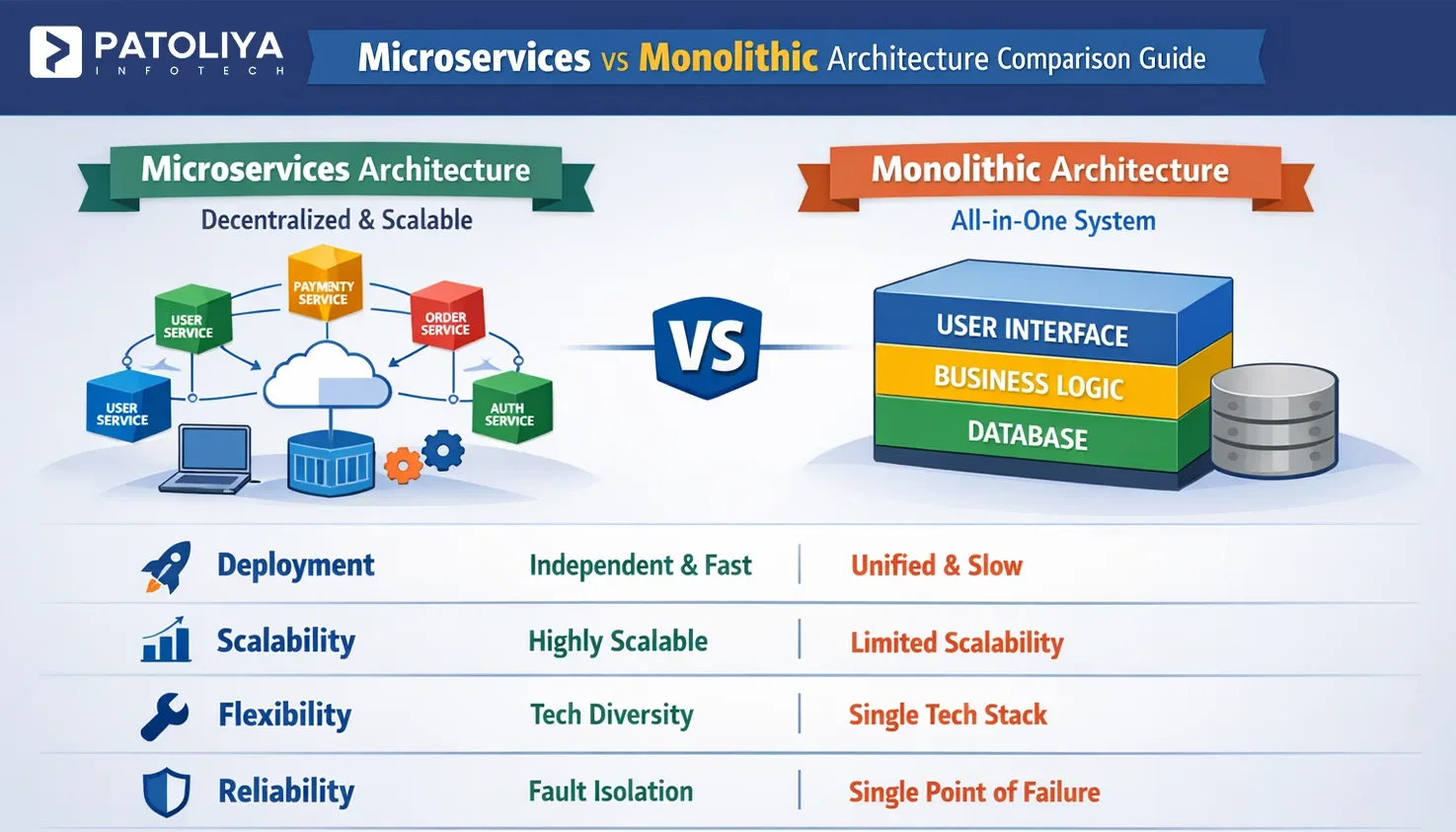
The demand for scalable software architecture has never been higher. SaaS platforms, fintech companies, ecommerce giants, and AI-driven products are all racing to build systems that grow without breaking. At the heart of every architecture conversation sits one fundamental question: microservices vs monolith, which model actually supports long-term scale?
This debate has intensified with the mainstream adoption of cloud native application development supported by modern web application development services, Kubernetes orchestration, and DevOps CI CD pipeline practices. Teams are no longer choosing architecture based on preference alone. They are choosing based on deployment speed, fault tolerance, and infrastructure economics.
This blog on microservices vs monolith cuts through the theory. Instead of abstract comparisons, you will find real business scenarios, decision frameworks, and honest monolithic architecture vs microservices trade-offs that help engineering leaders, product owners, and CTOs make the right call for their specific growth stage and product ambition.
Microservices vs Monoliths Explained in Simple Terms
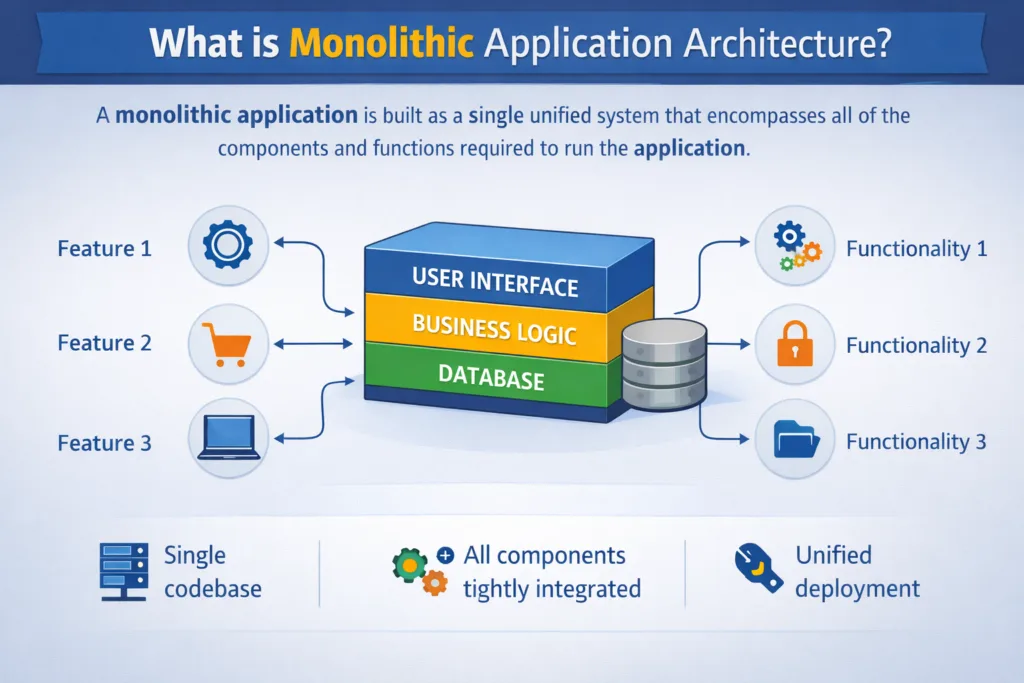
What is Monolithic Application Architecture
A monolithic application architecture is a single, unified codebase where all application components, like the user interface, business logic, and data access layer, are packaged and deployed together as one unit. Every feature lives in the same process. When you update one function, you redeploy the entire application.
Early-stage products are frequently built this way because it is fast to set up and straightforward to understand. However, as teams scale in microservices vs monolithic architecture comparison, a monolithic application architecture becomes harder to modify without risking unintended breakage across unrelated features.
What is Microservices Architecture, and How Does it works
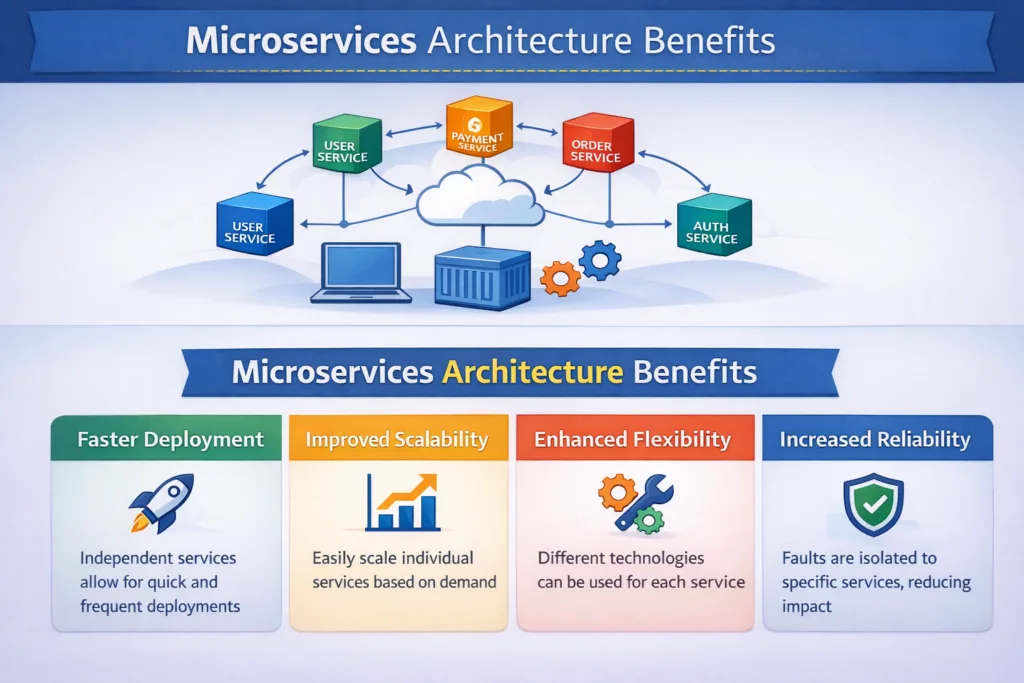
Microservices architecture benefits by breaking an application into small, independently deployable services. Each service owns a specific business capability, like payments, notifications, and user management, and communicates with others through APIs. Services can be built in different programming languages, deployed on separate servers, and scaled individually.
The microservices vs monolithic architecture comparison becomes clear here: one is a single deployable unit, the other is a network of collaborating, autonomous services managed through modern orchestration tooling.
Why the Microservices vs Monolithic Architecture Comparison Matters Today
Product teams today are shipping faster, onboarding more users, and operating across global infrastructure. The monolithic architecture vs microservices decision directly affects how quickly you can release features, how reliably your system handles failure, and how efficiently your infrastructure scales with growth. Getting this choice right early saves years of technical debt.
Microservices vs Monolith Key Differences in Architecture Design
Codebase Structure and Deployment Model
In a monolithic architecture vs microservices, the entire codebase is one deployable component. A single bug or failed test can block the release of every feature. In microservices vs monolith design, each service has its own repository, build pipeline, and deployment schedule. Teams ship independently without waiting for a full application release cycle.
Database Management Database Per Service Pattern vs Shared Database
One of the sharpest distinctions in the microservices vs monolithic architecture comparison debate is data ownership. Monoliths typically use a shared database; all modules read and write to the same schema.
In monolithic architecture vs microservices, a major difference is the database per service pattern, where each service manages its own data store. This microservices architecture benefits improve autonomy but requires thoughtful API design to maintain data consistency across service boundaries.
Scalability Model Vertical Scaling vs Horizontal Scaling
Monolithic application architecture scales vertically; you add more CPU or RAM to the single server running your application. Microservices architecture benefits enable horizontal scaling; you spin up additional instances of only the services under load.
During a traffic spike on your checkout service, you scale just that service, not your entire product, as a microservices architecture benefit. In microservices vs monolith, this is a defining factor for high-growth products.
Fault Isolation and System Resilience
In the microservices vs monolith comparison, a memory leak or unhandled exception in a monolith can bring down the entire application. Fault isolation in microservices means that a failing notification service does not bring down your payment service.
System resilience improves significantly because failure is contained at the service boundary rather than propagating through a single shared process.
Microservices Architecture Benefits for Modern Digital Products
Faster Release Cycles with DevOps CI CD Pipeline
Independent services mean independent deployments. Engineering teams can build, test, and ship individual services through DevOps CI CD pipeline practices implemented through structured IT outsourcing services without coordinating a full application release.
In microservices vs monolith, this compresses release cycles from weeks to hours and directly supports continuous delivery practices that modern product teams depend on.
Independent Scaling for High Traffic Modules
One of the strongest microservices architecture benefits is granular scalability. An ecommerce platform can scale its product search service during a sale event while keeping inventory and CRM services at baseline capacity. Resources are allocated exactly where needed, minimizing infrastructure waste and clearly highlighting the benefits of microservices vs monoliths.
Better Fault Isolation in Microservices
Fault isolation in microservices is not just about preventing crashes; it is about designing systems where partial degradation is acceptable. A recommendation engine going offline should never block a user from completing a purchase. Microservices vs monolith reliability comparisons consistently favor distributed services for large-scale products.
Improved Cloud Native Application Development Readiness
In monolithic architecture vs microservices, microservices align naturally with cloud native application development principles. The microservices architecture benefits include containerized services, Kubernetes-based orchestration, and deployment across distributed infrastructure, enabling scalability and resilience.
In comparison of microservices and monoliths, microservices architecture makes it easier to leverage managed cloud services, adopt serverless patterns, and build globally resilient systems from day one.
Monolithic Architecture Benefits and When it Still Wins
Faster Initial Development for Early Stage Startups
In the microservices vs monolithic architecture comparison, when speed to market matters more than architectural elegance, monolithic application architecture wins. A single codebase means no inter-service communication to design, no distributed system design complexity to manage, and no infrastructure overhead to configure. Early-stage teams validate product ideas faster with a monolith.
Simplified Testing and Debugging
Considering the microservices vs monolithic architecture comparison, in a monolithic architecture, testing is performed on the entire application as a single unit. A monolithic application architecture has no network boundaries, no service version mismatches, and no distributed tracing complexity. Debugging is straightforward because all logs, errors, and stack traces exist in a single runtime context.
Lower Infrastructure Complexity
Microservices vs monolith infrastructure costs differ significantly at a small scale. A monolith runs on a single server or a small cluster. Microservices architecture benefits require container orchestration, service registries, API gateways, and distributed monitoring. For a 10 person startup, that operational overhead can slow development rather than enable it.
Cost Efficiency for Small Teams
Small engineering teams lack the bandwidth to maintain dozens of independent services, deployment pipelines, and monitoring dashboards. In a monolithic architecture vs microservices, a monolithic application architecture keeps cognitive load low and enables small teams to move fast and iterate quickly. In the comparison of microservices and monoliths, it also allows teams to focus more on product value rather than infrastructure management.
Microservices vs Monolith in Real Business Scenarios
Ecommerce Platforms Handling Seasonal Traffic Spikes
Ecommerce platforms face dramatic traffic variation. Black Friday volumes can be ten times baseline. In a monolithic architecture vs microservices, a monolithic application architecture forces you to scale the entire application to handle checkout traffic spikes.
With a microservices architecture benefits, teams independently scale the cart, payment, and search services. In comparison of microservices and monoliths, this directly reduces infrastructure cost while maintaining performance under load, a clear microservices architecture benefit for retail products.
Fintech systems requiring strong compliance and reliability
Fintech products operate under strict regulatory requirements. In the microservices vs monolithic architecture comparison context, fintech teams often prefer bounded services because compliance rules can be enforced at the service level.
Payment processing, KYC verification, and transaction reporting can each operate within their own compliance boundary. Fault isolation in microservices also means a failed reporting job never impacts live transactions.
SaaS products evolving with new feature releases
SaaS products continuously release new capabilities. Microservices vs monolith becomes a velocity question here. As a SaaS platform matures, independent services let product squads ship features without stepping on each other’s code. The monolithic architecture vs microservices trade-off shifts decisively toward microservices architecture benefits as team size and feature surface grow.
Legacy system modernization journey
In the microservices vs monolith comparison, many enterprises still run on monolithic application architectures built decades ago. Legacy system modernization, often executed through software services, does not require a full rewrite.
Teams typically apply the Strangler Fig pattern, extracting discrete business capabilities into new microservices architecture benefits while the monolith continues running. In comparison of microservices and monoliths, this phased migration reduces risk and allows gradual adoption of cloud native application development practices.
| Scenario | Recommended Architecture |
| Early-stage MVP, small team | Monolith |
| Ecommerce with seasonal peaks | Microservices |
| Fintech with compliance boundaries | Microservices |
| Legacy modernization | Phased migration |
| SaaS scaling beyond 50 engineers | Microservices |
Technical Challenges in Microservices vs Monolithic Architecture Comparison
Managing Distributed System Design Complexity
- In a monolithic architecture vs microservices, Microservices architecture introduces distributed system design challenges that monoliths avoid entirely.
- Network partitions, eventual consistency, and distributed transactions require engineering discipline that junior teams may not yet possess.
- The microservices vs monolithic architecture comparison decision must account for your team’s readiness to handle this complexity in production.
Service Discovery Mechanism and API Gateway Pattern Overhead
- Every service in a microservices architecture needs to locate other services dynamically.
- In a monolithic architecture vs microservices, this complexity is minimal since components communicate within a single application. A service discovery mechanism like Consul or Kubernetes-native DNS handles this at runtime.
- At microservices vs monolith, an API gateway pattern adds another layer, managing routing, authentication, and rate limiting centrally.
- Both add operational overhead that does not exist in a monolithic application architecture, as seen in the comparison of microservices and monoliths.
Monitoring and Observability Challenges
- In a monolithic application architecture, one logging system covers everything. In microservices vs monolith environments, distributed traces must be correlated across dozens of services, each emitting separate logs and metrics.
- Building effective observability requires investment in tooling like tools widely used in modern observability frameworks costs that compound as service count grows.
Performance Bottlenecks in Monolith vs Network Latency in Microservices
- Performance bottlenecks in monolith systems typically appear at the database or CPU level.
- In microservices architecture, the bottleneck shifts to network latency, as every service to service API call adds milliseconds.
- Synchronous call chains across ten services can accumulate latency that a monolith would resolve with a single in-process function call.
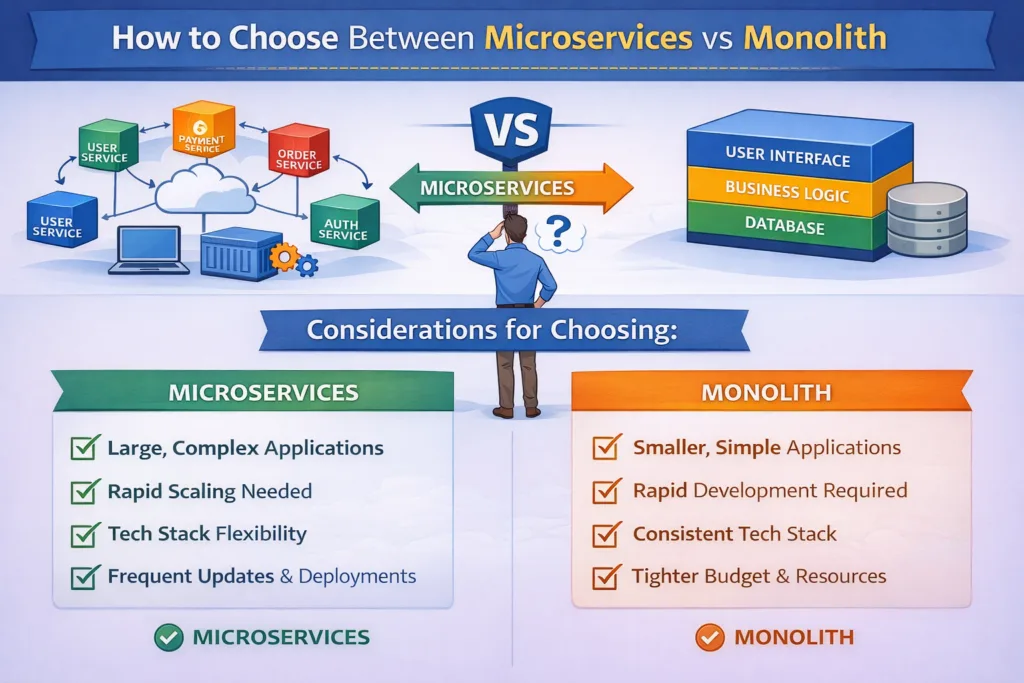
How to Choose Between Microservices vs Monolith for Your Project
Team expertise and DevOps Maturity Level
The microservices vs monolithic architecture comparison is partly a people question. Does your team have experience with container orchestration, DevOps CI CD pipeline automation, and distributed debugging? If your DevOps maturity is low, adopting microservices architecture from a monolithic architecture vs microservices will create operational bottlenecks that slow delivery rather than accelerate it.
Expected Growth and Scalability Roadmap
If your product roadmap includes rapid user growth, international expansion, or high-volume transaction processing, microservices architecture benefits provide the scalable software architecture foundation to support that trajectory.
If you are in the product discovery phase, start with a well-structured monolith and migrate when scale demands it, before comparing microservices vs monoliths.
Budget Constraints and Infrastructure Readiness
Microservices vs monolith infrastructure costs differ at every scale. Early products can save significantly by running a monolithic application architecture on minimal infrastructure in a monolithic architecture vs microservices setup.
As scale grows, the operational cost of a monolith, including over-provisioning to handle uneven load, often exceeds the investment in microservices architecture.
Long Term Product Vision
The monolithic architecture vs microservices decision must align with your five-year product vision. Are you building a platform that third parties will integrate with? Will separate product squads own distinct feature areas? Long-term platform thinking in the microservices vs monolith comparison often favors microservices architecture benefits as the right architectural investment.
Why Patoliya Infotech is Important for Microservices vs Monolith Strategy
Architecture Consulting Backed by Scalable Software Architecture Experience
Choosing between microservices vs monolith without deep architectural experience leads to costly rebuilds. We bring hands-on consulting expertise across fintech, ecommerce, and SaaS products. The team evaluates your current system, growth roadmap, and team maturity to recommend the right scalable software architecture path.
Expertise in Kubernetes Orchestration and Containerization with Docker
Our engineering team has deep operational experience with Kubernetes orchestration and containerization with Docker. Whether you are deploying your first containerized service or managing a multi-cluster production environment, Patoliya Infotech brings the execution capability to make microservices architecture work reliably at scale.
Seamless Transition from Monolithic Application Architecture to Microservices
In the microservices vs monolith comparison, migration from a monolithic application architecture to microservices is a high-risk undertaking without structured guidance. We use proven patterns, including the Strangler Fig and domain-driven decomposition, to execute phased migrations that keep your existing product running while progressively modernizing the architecture.
Performance Optimization and Cloud Migration Support
Beyond architecture design, we support cloud-native application development adoption, performance tuning, and infrastructure cost optimization. The team helps businesses eliminate performance bottlenecks in monolith systems and transition to resilient, cloud-optimized platforms that support sustainable digital growth.
Conclusion
The microservices vs monolithic architecture comparison debate has no universal winner. Architecture choice depends on your current scale, team maturity, product complexity, and long-term growth ambition. Startups benefit from the simplicity of monolithic application architecture. Scaling platforms benefit from the resilience and deployment independence that microservices architecture provides.
The worst architecture decision is the one made based on industry trends rather than business reality in microservices vs monoliths. Evaluate your actual constraints like team size, deployment frequency, traffic patterns, and compliance requirements before committing to either model.
The future of digital products is built on deliberate, growth-aligned architecture. Whether you are optimizing a monolith, planning a migration, or designing microservices from the ground up. In the microservices vs monolithic architecture comparison, the path forward requires strategic clarity, engineering discipline, and the right implementation partner with proven architecture expertise. In microservices vs monolith, start with the architecture your current reality demands, and build toward the scale your ambition requires.
FAQs:
The core difference in microservices vs monoliths is deployment and scalability. A monolith is a single deployable unit where all components are tightly coupled. Microservices architecture deploys each business capability independently, allowing individual services to be scaled, updated, and maintained without affecting the rest of the system.
No. In comparison of microservices and monoliths architecture, microservices architecture benefits from operational complexity that can slow small teams down. Monolithic application architecture remains the practical choice for early-stage products, small engineering teams, and applications with limited scalability requirements. Architecture should match your current stage, not your aspirational one.
Yes. Legacy system modernization through phased migration is a well-established practice. At microservices vs monolith, the Strangler Fig pattern allows teams to extract individual services from a monolithic application architecture incrementally, reducing migration risk. Full rewrites are rarely necessary and often counterproductive.
The risks in adopting microservices are distributed system design complexity, inter-service communication failures, and significant operational overhead during a microservices vs monolithic architecture comparison. Teams without strong DevOps maturity often underestimate the investment required to monitor, deploy, and maintain dozens of independent services effectively.
In a microservices vs monolithic architecture comparison, a monolithic application architecture is more cost-effective at the startup stage. Lower infrastructure complexity and faster initial development reduce burn rate. As scale grows, the investment in microservices architecture benefits becomes justified by the reduction in deployment bottlenecks and over-provisioning costs.
Cloud native application development practices, particularly containerization with Docker and Kubernetes orchestration, are purpose-built for microservices architecture. If your infrastructure roadmap includes cloud-native deployment, adopting microservices aligns naturally with the tooling, enabling granular scaling, automated failover, and continuous delivery at production scale.