Healthcare Business Intelligence Tools: Dashboards vs. Custom-Built Reporting
TL;DR: Most hospitals fail at reporting not because the dashboard looks weak, but because the data model underneath cannot answer the real question. Choose your healthcare business intelligence tools based on data maturity, not price alone.
Executives ask the wrong question constantly. They ask which dashboard looks polished when they should ask whether the system can explain why a number moved. That shift changes how leaders should evaluate healthcare business intelligence tools entirely.
Most comparisons treat this like a features contest between vendors. It never was one. The real constraint sits inside the data model, the integration logic, and the governance rules nobody explains during a sales demo.
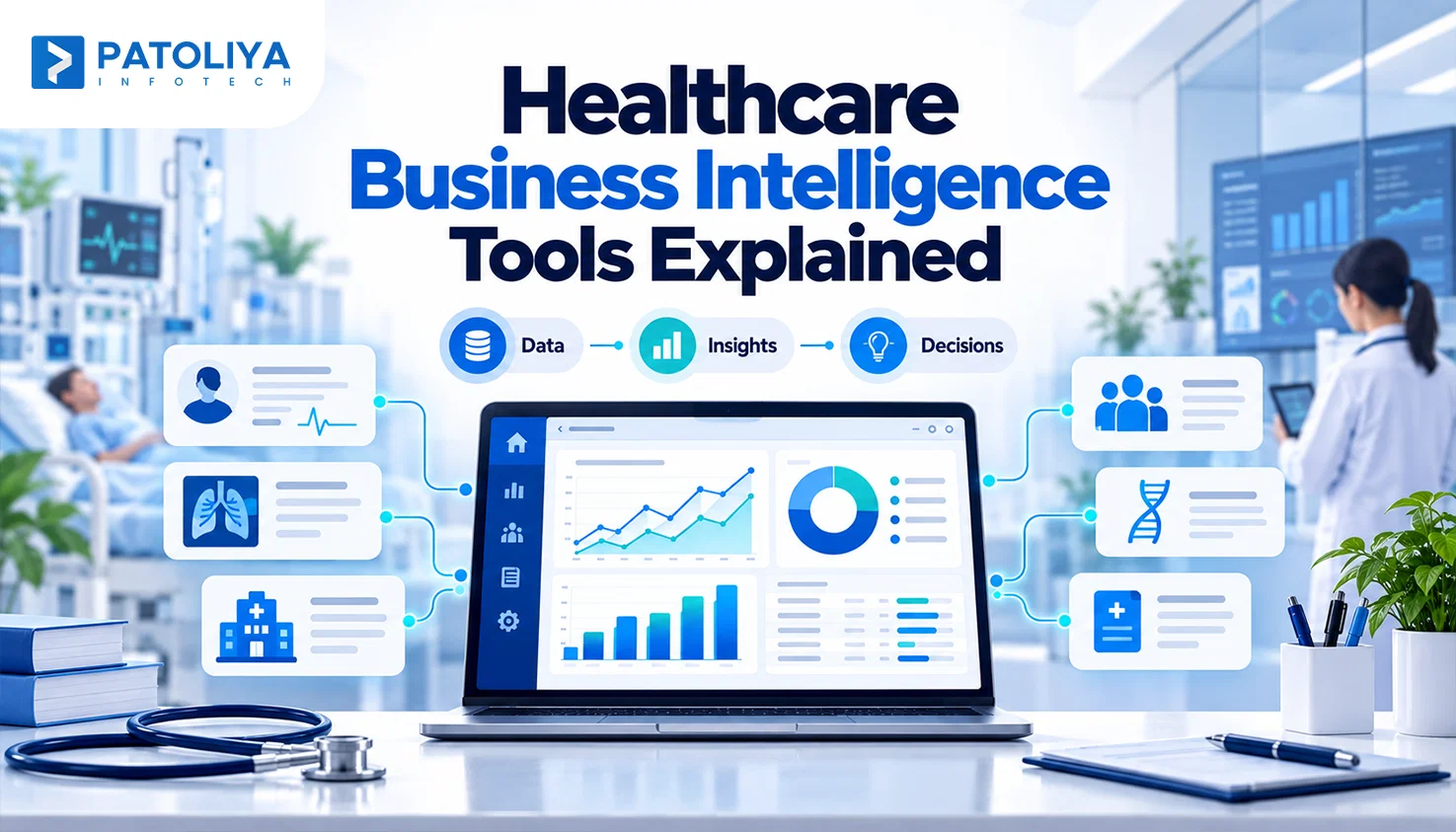
Some teams call this healthcare BI software, others call it clinical analytics or healthcare data analytics, but the underlying question stays identical: can the numbers be trusted? This guide breaks down how to choose between standard dashboards, custom healthcare business intelligence tools, and the hybrid path most organizations land on eventually.
Dashboards vs. Custom BI: What Actually Separates Them
Off-the-shelf platforms ship with prebuilt connectors, standard KPI templates, and vendor managed updates. Teams go live within weeks because the model behind these healthcare business intelligence tools stays generic by design, built for an average hospital and not one specific organization.
Generic healthcare BI software handles standardized metrics like bed occupancy or basic financial summaries well. It starts breaking the moment a KPI needs to reflect a specific payer mix or a readmission definition unique to one system. This gap explains why buyers underestimate how quickly rigid healthcare business intelligence tools limit growth once volume and complexity climb.
Custom Reporting That Fits Your Business
Custom reporting means building a purpose-built data model around an organization's actual definitions, often supported by custom software development services when standard BI platforms cannot meet those requirements. Every KPI, every integration, and every workflow view gets designed around how clinical and financial teams truly operate.
This approach buys control and shifts technical responsibility onto the internal team. Many of the strongest healthcare business intelligence tools running in production today exist as custom builds because generic logic could never carry the weight of real clinical decisions. Compare that to typical healthcare BI software, which locks logic inside vendor code the buyer cannot touch.
The table below settles the surface-level debate fast, showing where healthcare business intelligence tools diverge on cost, control, and speed.
|
Factor |
Standard Dashboards |
Custom BI |
|
Implementation time |
Weeks |
Months |
|
Initial investment |
Lower |
Higher |
|
Flexibility |
Limited |
High |
|
Data model control |
Vendor owned |
Organization owned |
|
Custom KPI logic |
Difficult |
Native |
|
Maintenance responsibility |
Vendor |
Internal or partner |
|
Scalability |
Capped by license tier |
Built for growth |
|
Vendor dependency |
High |
Low |
Neither column wins by default. The table only earns value once matched against actual reporting complexity, covered next.
What Most Healthcare BI Comparisons Miss
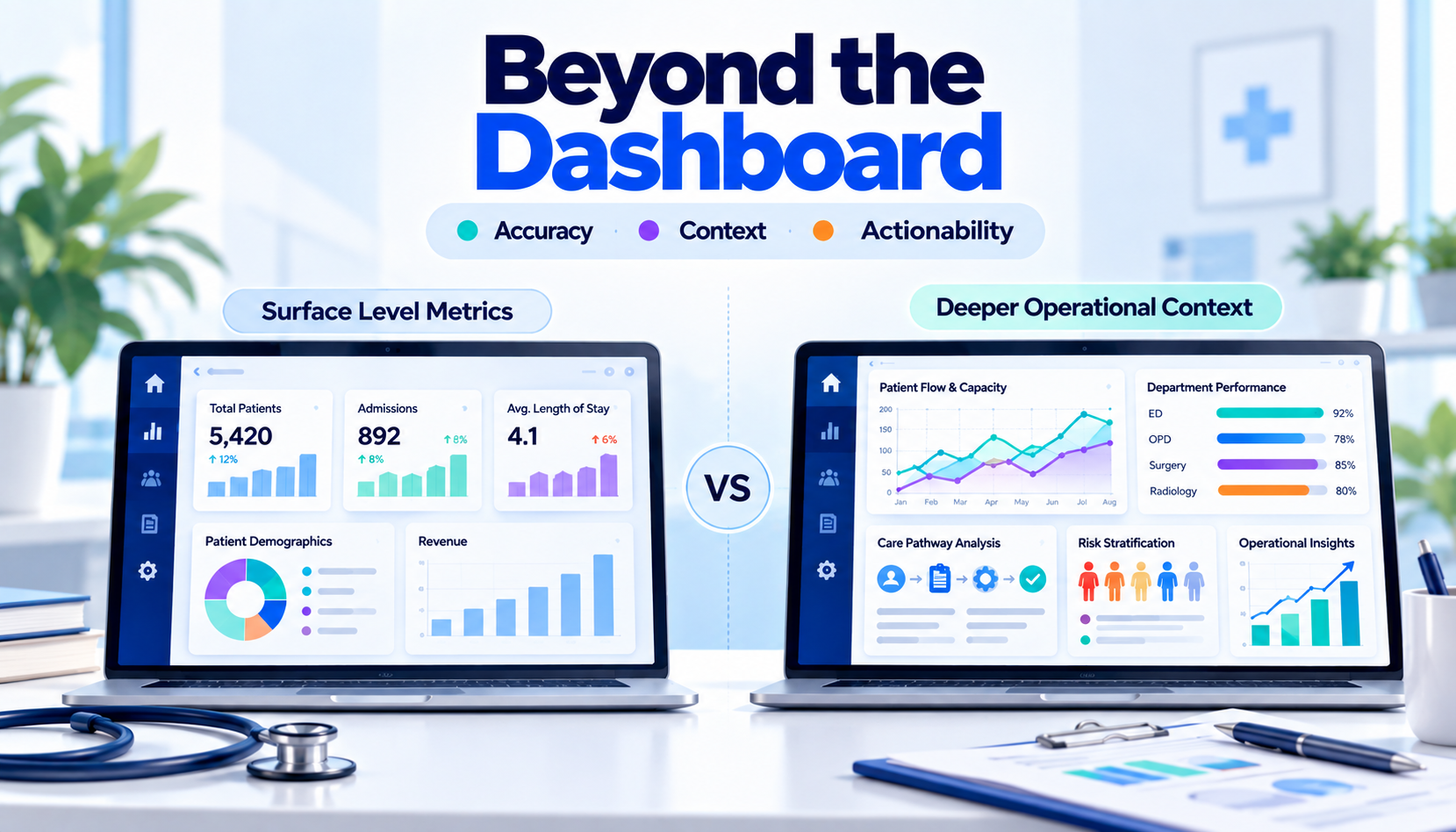
The Real Cost Driver Isn't the Dashboard, It's the Data Model
Every strong reporting environment depends on healthcare data integration to reconcile EHR and EMR records, HL7 and FHIR feeds, claims data, scheduling systems, and revenue cycle data into one coherent model.
A dashboard stays only as trustworthy as the model feeding it, which is why a well-designed healthcare data warehouse can provide an important foundation for reliable business intelligence.
Longitudinal patient records span years and multiple facilities. Multi-source reconciliation across those systems is where most healthcare BI software quietly fails, long before anyone notices the chart itself is wrong.
For instance, A regional network pulling patient encounters from three EMR instances after a merger risks counting one patient three times across healthcare reporting dashboards, inflating volume metrics for months before finance catches it.
When a Simple KPI Becomes a Data Engineering Problem
Take the 30-day readmission rate. It sounds like one number, but it depends on patient identity matching, encounter definitions, inclusion and exclusion rules, multiple data sources, data freshness, and calculation logic.
Change any single input and the number shifts, even though nothing clinically changed.
This is exactly why generic healthcare BI software produces numbers finance teams quietly stop trusting within a year, regardless of how good the healthcare business intelligence tools look on screen.
The Customization Trap Inside Off the Shelf Platforms
Configuration feels harmless early on. A custom field here, a workaround there, some external data preparation, a manual reconciliation step every month-end. None of it looks like a project on its own.
Six months later, the team runs a semi-custom operation on top of licensed healthcare business intelligence tools, paying custom development effort while getting none of the ownership benefit.
Customization itself isn't the issue. The issue is doing it without ever acknowledging the real cost, and teams rarely audit this creep until total spend rivals dedicated healthcare business intelligence tools built from scratch.
Compliance Depth Goes Beyond the HIPAA Checkbox
A signed BAA reveals almost nothing about how a system protects patient data day to day; organizations also need to consider the HIPAA Security Rule safeguards covering administrative, physical, and technical protections for electronic protected health information. Real healthcare software security requires more than a compliance checkbox, including role-based access, field and row-level access controls, audit logging, data lineage tracking, PHI exposure limits, and ongoing monitoring.
A vendor being compliant does not automatically make an implementation compliant. That gap sits at the center of governance failures across both custom and off-the-shelf healthcare business intelligence tools used across hospital systems today.
This is precisely where buyers should slow down and ask harder questions when evaluating healthcare business intelligence tools for enterprise deployment.
Reporting Latency Should Match the Decision
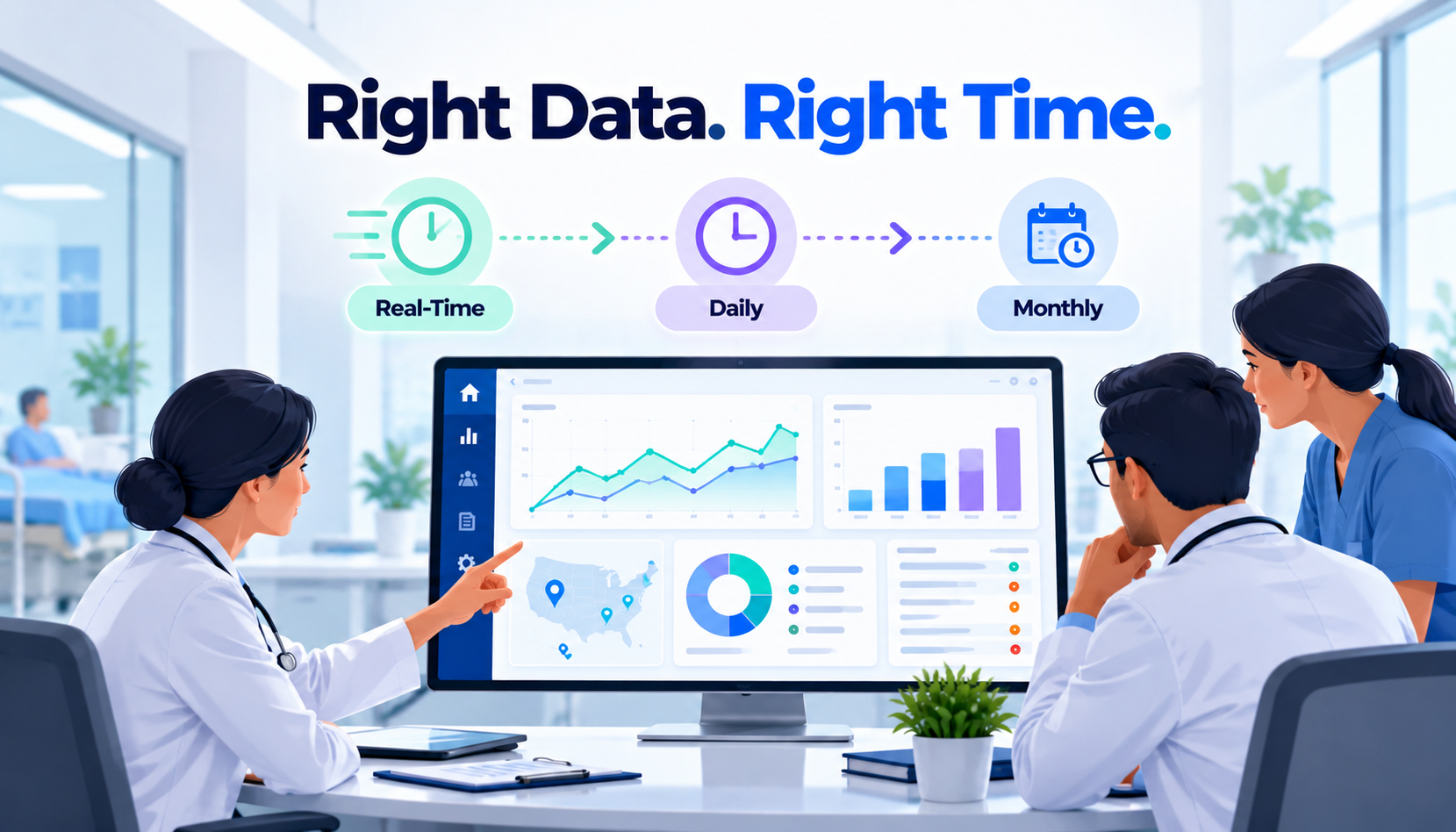
Monthly reporting works for board-level financial reviews. Daily reporting supports staffing and capacity planning, while near-real-time or event-driven reporting can support healthcare workflow automation when minutes can affect operational or clinical decisions.
Before choosing reporting latency, ask one question: How quickly does this specific information lose its value for decision-making?
Match reporting speed to that answer. Leaders comparing healthcare business intelligence tools on speed alone often overlook this distinction.
The Hybrid Architecture Most Comparisons Ignore
A hybrid model keeps the existing visualization platform in place while adding a custom integration and governed KPI layer underneath. Organizations get customization where it matters without replacing the entire environment.
This approach is increasingly practical for mid-size and large health systems that have outgrown generic healthcare BI software but cannot justify a full custom rebuild.
The real problem rarely sits in the clinical BI tools users see on the surface. It usually sits underneath in data integration, governance, and KPI logic.
The Executive Decision Framework
|
Factor |
What It Means |
|
Data maturity |
How well your data is structured, integrated, and ready for analysis. |
|
Reporting complexity |
How specialized, detailed, and frequently changing your reporting needs are. |
|
Technical capacity |
Your organization’s ability to build, integrate, and maintain BI systems internally. |
|
Compliance and governance requirements |
The level of security, privacy, auditability, and governance your data requires. |
|
Growth and scale trajectory |
How your data volume, users, locations, and analytics needs are expected to grow. |
For instance, A 200-bed hospital with low data maturity but high compliance requirements will often benefit more from a hybrid approach than a fully custom build, allowing it to strengthen governance while gradually developing more advanced reporting capabilities.
What 3 Year TCO Actually Includes
License cost vs. development cost is the wrong comparison.
- Total cost of ownership includes licensing, implementation, integration, customization, training, maintenance, infrastructure, internal resources, and vendor dependency.
- It should also account for switching costs, manual reporting labor, and spreadsheet reconciliation time that organizations rarely track formally.
- The cheapest platform to purchase is rarely the cheapest system to operate.
- Boards should evaluate long-term operating costs, not just vendor quotes, before committing to a healthcare BI software contract.
Who Owns the Intelligence Layer
- Ownership goes beyond legal rights.
- Evaluate who controls KPI definitions, data models, business logic, integrations, reporting metadata, and historical data.
- Data and logic portability should be considered before selecting a BI platform.
- Vendor switching can become difficult when years of KPI logic and reporting rules are embedded in proprietary healthcare business intelligence tools.
- Choose a platform that allows your organization to retain control and move its data and logic when needed.
What a Healthcare Organization Should Demand From Its BI Architecture
Can It Explain Why Performance Changed?
Revenue decreased four percent tells a board nothing useful on its own; predictive analytics in healthcare can add another layer by helping teams identify patterns, drivers, and potential future changes.
A strong reporting environment identifies which payer, which service line, which facility, or which utilization pattern caused the shift, applying the same standard to clinical and operational metrics beyond finance alone within any serious healthcare business intelligence tools deployment.
Can It Connect Financial, Clinical, and Operational Performance?
Evaluate whether reporting connects clinical outcomes, patient activity, resource utilization, revenue, cost, and capacity into one coherent view, with HL7 FHIR interoperability providing one standards-based option for exchanging clinical and administrative health data.
Supported by interoperability approaches such as SMART FHIR where appropriate. Fragmented reporting environments fail exactly at this connection point, showing three separate truths that never add up to one story, a common weakness across basic healthcare BI software packages.
Can Architecture Evolve Without Rebuilding Everything?
New facilities, new data sources, new KPIs, and new regulatory requirements arrive constantly across healthcare organizations. Check the API-first healthcare approach, data model extensibility, security controls, and integration strategy before signing anything tied to long-term healthcare business intelligence tools contracts.
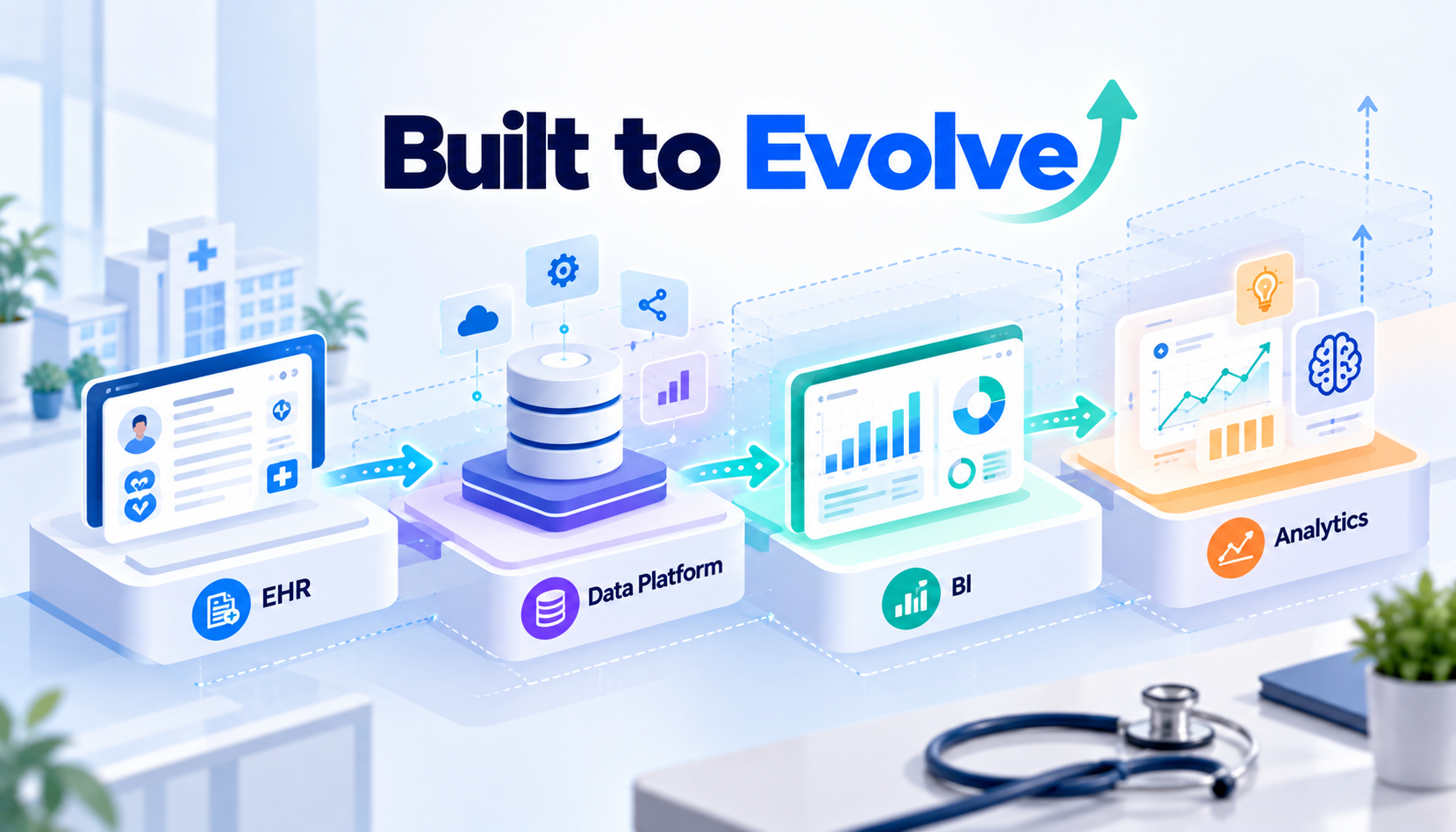
The real question isn't whether the system works today. It's whether these healthcare business intelligence tools survive three years of change without a full rebuild.
Questions to Ask Before You Sign
If You're Evaluating an Off the Shelf Vendor
Ask about data portability, who owns the KPI definitions, audit logging depth, pricing at scale, customization limits, integration costs, and exit terms before signing any healthcare BI software agreement. This single list separates serious vendors of healthcare business intelligence tools from ones selling a screenshot.
If You're Evaluating a Custom BI Development Partner
Ask about healthcare data integration experience, HL7 and FHIR expertise, claims and clinical data handling history, data model ownership terms, source code ownership, post launch maintenance model, security architecture, and scalability plan for healthcare business intelligence tools built specifically for the organization.
Ask for the Architecture Before the Demo
Request the full picture: sources, integration, data model, KPI and semantic layer, visualization, governance. A polished screenshot reveals nothing about where the numbers inside these healthcare business intelligence tools actually originate.
How Patoliya Infotech Engineers Healthcare BI
At Patoliya Infotech, we approach healthcare BI as an operational architecture problem, combining data integration, governed KPI models, interoperability, and cloud infrastructure services rather than treating it as a dashboard implementation exercise. Our teams work across data integration, governed KPI models, interoperability, analytics, and scalable cloud infrastructure to build reporting environments that remain reliable as complexity grows.
We design around the organization’s existing systems rather than forcing every workflow into a rigid platform. Whether the requirement calls for healthcare business intelligence tools, custom reporting, or a hybrid architecture, the focus remains the same: trusted data, consistent business logic, secure access, and reporting that supports decisions rather than creating another layer of operational work.
Conclusion
Selection between standard and custom healthcare business intelligence tools is ultimately a question of fit, not features. Standard platforms can accelerate reporting when requirements are predictable, while custom architectures make sense when data complexity, governance, and differentiation demand greater control.
For many health systems, the strongest answer sits between the two. A hybrid model can preserve proven visualization capabilities while adding the integration, governance, and KPI logic the organization actually needs.
The right decision starts by understanding where complexity truly exists and investing accordingly rather than paying for customization without gaining ownership.
FAQs:
Implementation timelines vary by data complexity, integrations, governance requirements, and reporting scope. A focused deployment may take months, while enterprise environments require phased implementation and validation.
Yes. Integration can connect multiple EHRs through standards-based interfaces, APIs, and data pipelines, provided the architecture handles identity matching, normalization, security, and consistent healthcare data definitions.
Not necessarily. Organizations can retain existing visualization tools while adding custom integration, governed data models, and KPI layers when replacing the platform offers limited additional business value.
Business and clinical stakeholders should define KPI meaning, while technical teams operationalize those definitions. Clear ownership prevents conflicting calculations and ensures metrics remain consistent across departments and reporting systems.
Historical data should be profiled, mapped, validated, and reconciled before migration. Organizations should also preserve lineage and business definitions so historical metrics remain comparable after the new system goes live.
Evaluate integration depth, data ownership, governance, scalability, implementation effort, portability, support requirements, security controls, total cost of ownership, and the organization’s ability to maintain the environment long-term.