Digital Twins in Healthcare: Predictive Planning Guide
 By Hitesh SUpdated on: 08/26/2611 min read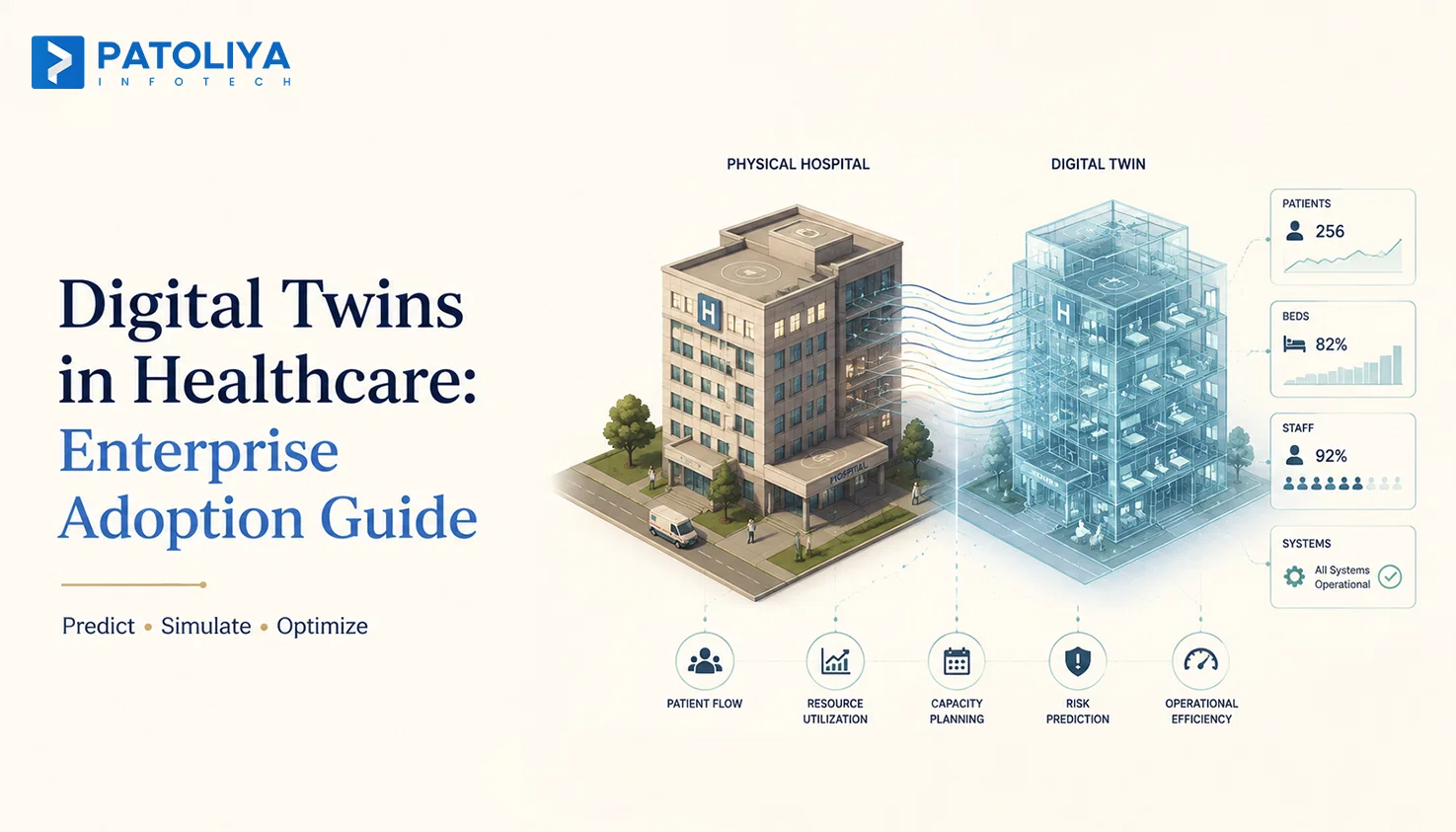
TL;DR: Digital Twins in Healthcare let hospital leaders test changes on a virtual model before touching a real ward, a real OR schedule, or a real patient plan. Health systems using hospital simulation software report fewer bed shortages and faster discharge cycles because decisions get tested first, not fixed later.
Hospitals rarely fail because staff work poorly. They fail because decisions get made on incomplete data and then get corrected in real time, with real patients waiting. Digital Twins in Healthcare flip that order.
A virtual replica of a ward, a device, or a patient absorbs the risk of a bad guess before the guess reaches anyone lying in a bed. Healthcare digital twin technology now models everything from ICU bed flow to individual drug response curves. This guide explains what these systems simulate, how they get built, what they cost, and when a hospital should build one.
What Digital Twins in Healthcare Actually Simulate
Digital Twins in Healthcare simulate two connected systems at once: a patient's biological state and a hospital's operational state, both refreshed continuously from live data feeds rather than static weekly reports.
Patient Digital Twins: A patient digital twin mirrors one person's vitals, labs, and history inside a living model, letting clinicians test dosage or surgery timing before touching the real patient.
Digital Twins for Hospital Operations: Digital Twins in Healthcare operations models track beds, staff, and equipment as one connected system. A change in ER intake gets tested against the whole floor before the real schedule changes.
Virtual Hospital Simulation vs. Traditional Healthcare Analytics
Virtual hospital simulation predicts forward, while healthcare data analytics can help organizations understand historical and current performance.
|
Factor |
Virtual Hospital Simulation |
Traditional Healthcare Analytics |
|
Direction |
Forward-looking, predictive |
Backward-looking, historical |
|
Data Use |
Live, continuously updated |
Batch, periodic reports |
|
Decision Timing |
Before the change happens |
After the outcome occurs |
|
Best For |
Testing "what if" scenarios |
Reviewing past performance |
How Healthcare Digital Twins Turn Real World Data Into Simulations
Live EHR feeds, connected devices, and floor sensors feed a healthcare digital twin, which runs thousands of scenarios in minutes to predict outcomes a spreadsheet cannot catch in time.
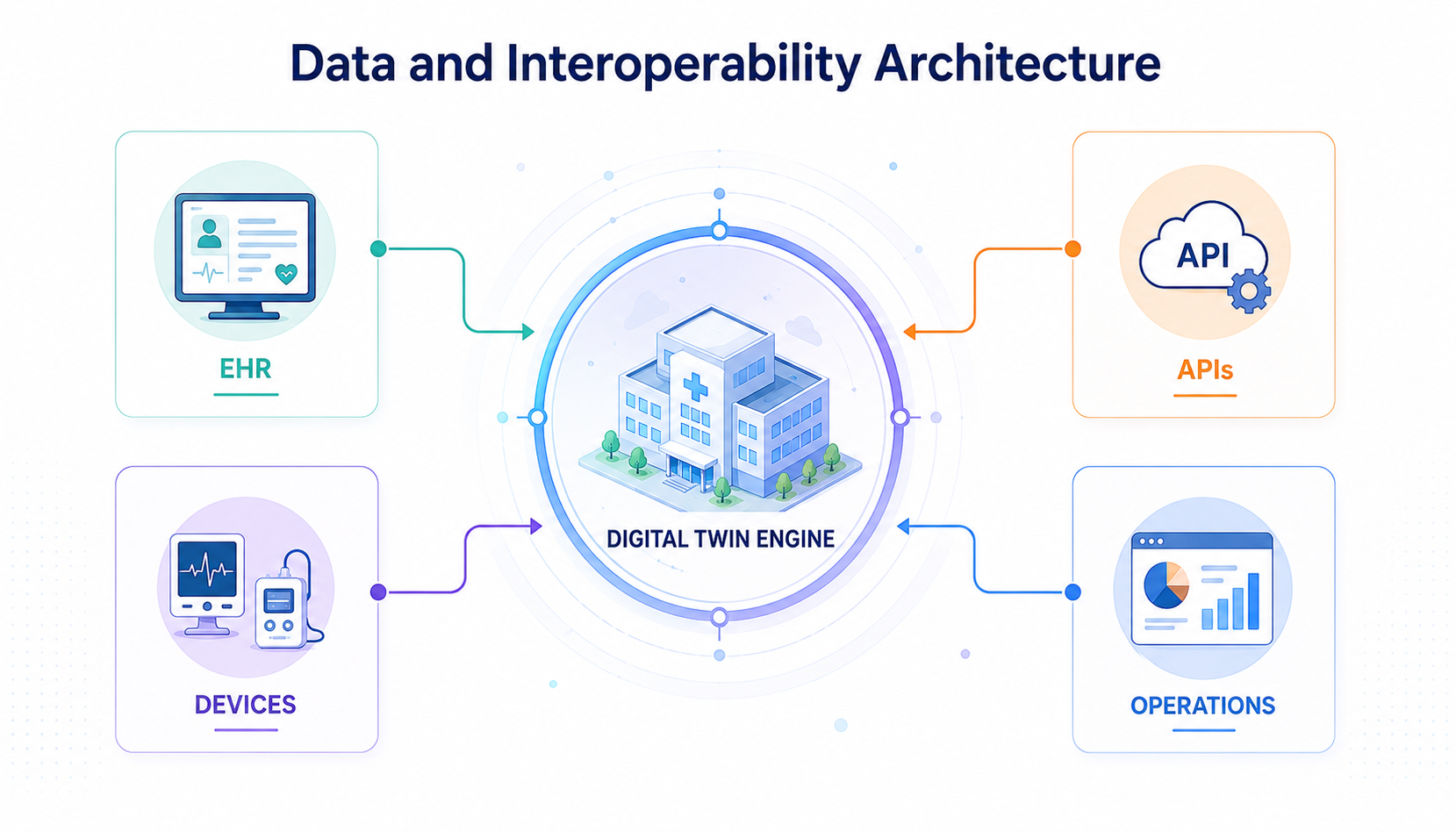
Connecting EHR, IoT, Medical Devices, and Operational Data
Every Digital Twins in Healthcare operations build starts with pipelines pulling from electronic health records applications, bedside monitors, infusion pumps, and staffing software. Weak healthcare data integration means the model runs on stale numbers and produces confident, wrong answers.
Building and Updating the Digital Twin
Engineers build a baseline model, validate it against known outcomes, then refresh it continuously. A twin that stops updating stops being useful within days, not months.
Real-Time Data, Historical Data, and Predictive Models
Historical data trains the model. Real-time data keeps it accurate. Predictive layers turn both into forecasts a charge nurse can act on before a shift starts, not after it ends.
Where Digital Twins Can Change Healthcare Decisions
Digital Twins in Healthcare change outcomes by letting teams test a choice virtually first, then act on whichever version performed best across simulated conditions.
Simulating Patient Care Pathways: Compare three treatment sequences on a patient digital twin and review recovery timelines before choosing one for the actual patient.
Optimizing Hospital Capacity and Patient Flow: Run admission surges through a virtual hospital simulation to find bottlenecks before flu season arrives.
Testing Staffing and Resource Allocation: Shift a nurse ratio inside the model and watch wait times move, with zero disruption to a real shift.
Predictive Capacity Planning: Feed seasonal trends into the twin to forecast bed demand three months out, giving procurement real lead time.
Reducing Readmission Risk: Simulate discharge timing against a patient's recovery curve to catch early warning signs a standard checklist misses.
Every one of these applications shares one pattern. The mistake happens inside the model, not on the hospital floor. That single shift is the entire value case for Digital Twins in Healthcare.
Digital Twin Hospital Operations: What Can You Test Before Changing the Real System?
Digital twin hospital operations let administrators trial staffing changes, room conversions, and scheduling rules against a virtual floor, catching failures in software instead of a packed emergency department.
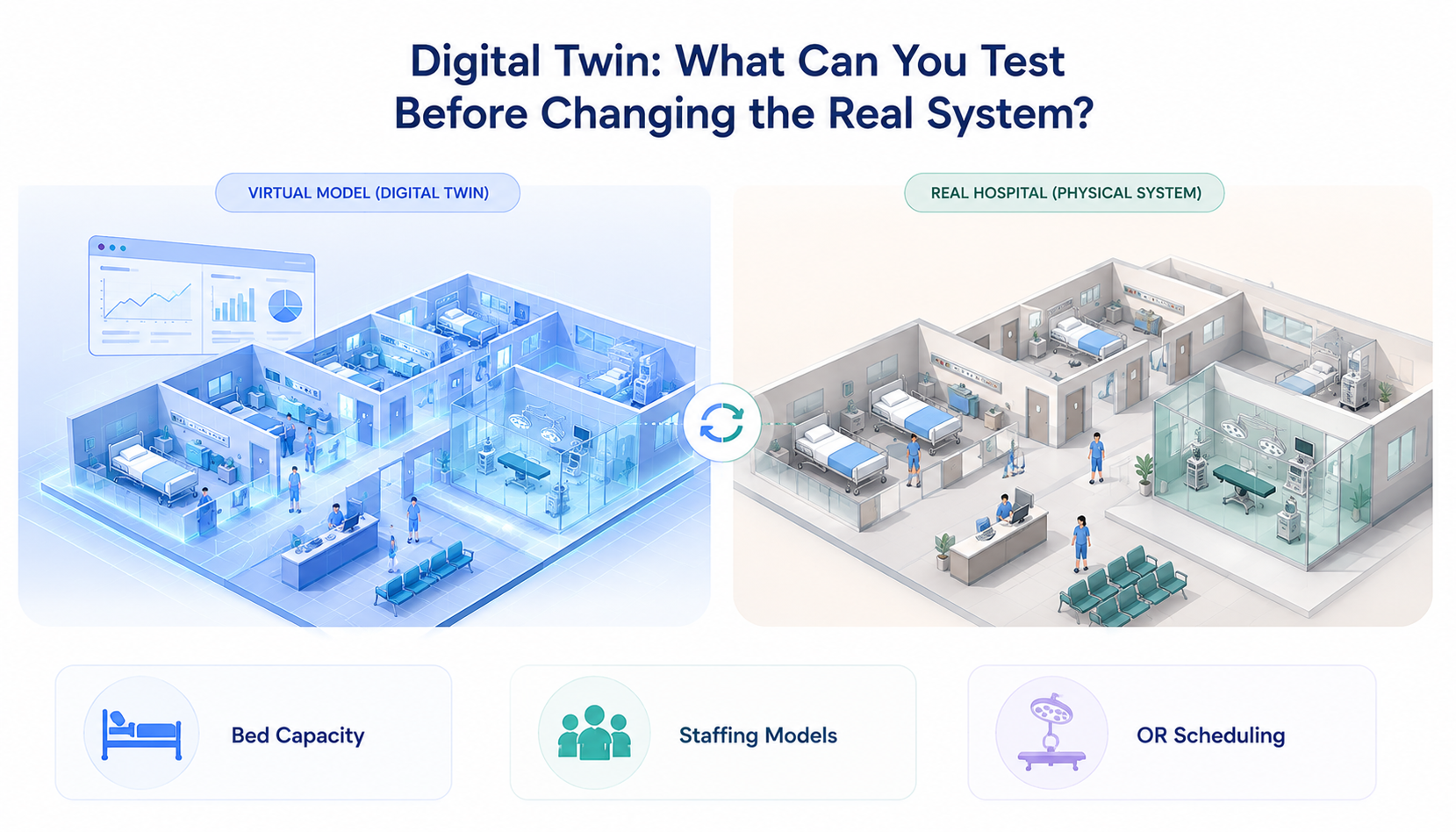
Emergency Department and Bed Capacity: A hospital can simulate converting five general beds into overflow ICU capacity and see the effect on ED boarding times within hours, not after a live conversion fails midway.
Operating Rooms and Procedure Scheduling: Run a revised OR block schedule through the twin and check surgeon utilization and turnover time. Teams testing block reallocation often find scheduling gaps a spreadsheet review missed for months.
Workforce and Resource Utilization: Model a nurse to patient ratio change across three shifts simultaneously. The twin flags where fatigue risk climbs before it shows up in overtime spend or staff turnover numbers.
"What-If" Scenarios for Operational Planning
Ask the model what happens if a supply vendor delays shipment by a week, or patient volume spikes twenty percent overnight.
For instance, one simulated flu surge scenario can reveal exactly which unit runs out of beds first. Digital Twins in Healthcare answer these questions in minutes, giving leadership a rehearsed response instead of a scramble.
Patient Digital Twins: From Monitoring to Personalized Care
A patient digital twin goes beyond monitoring by modeling how one specific person's body will respond to a treatment path, giving clinicians a preview instead of a retrospective chart review.
Modeling Patient Health Trajectories: The twin projects how a chronic condition will progress over months based on current labs and lifestyle data, flagging deterioration risk earlier than a standard follow-up catches it.
Predicting Treatment Response and Risk: Clinicians compare simulated outcomes across drug options for one patient's twin before prescribing anything.
For Digital Twins in Healthcare, this matters most in oncology and cardiology, where the wrong first choice costs real time.
Supporting Clinical Decision-Making: The twin surfaces risk scores and probable outcomes at the point of care, giving physicians a second data source alongside clinical judgment.
Where Patient Digital Twins Need Human Oversight: A model is a probability engine, not a diagnosis tool. Every patient digital twin output needs a clinician's review because rare presentations still break statistical models.
Digital Twins in Clinical Trials and Healthcare Research
Digital twin clinical trials let researchers simulate a treatment arm virtually, cutting the number of real participants needed for early-phase testing while keeping statistical power intact.
- Researchers build synthetic control arms from historical patient data, reducing placebo group size in select trial designs.
- Trial teams model cohort response before recruitment starts, tightening inclusion criteria and cutting screen failure rates.
- Digital twin clinical trials shorten early phase timelines by testing dosing scenarios before first human exposure.
- Regulatory acceptance of synthetic arms still varies by phase and therapeutic area, and models require ongoing validation against real trial outcomes.
What Does It Take to Build a Healthcare Digital Twin?
Building a Digital Twins in Healthcare requires four layers working together: clean data architecture, simulation models, real-time pipelines, and governance strong enough to satisfy regulators and clinicians.
Data and Interoperability Architecture
- Everything starts with HL7 FHIR-compliant data exchange between EHR, device, and operational systems.
- This layer determines whether every downstream model runs on good inputs or bad ones, making a healthcare data warehouse valuable for organizing historical and operational healthcare data.
Simulation and AI/ML Models
- Discrete event simulation handles operational flow. Machine learning handles patient trajectory prediction.
- Serious Digital Twins in Healthcare platforms combine both methods rather than leaning on one alone.
Real-Time Data Pipelines and APIs
- Streaming pipelines keep the twin synced with live conditions. A twin running on batch updates from last night is already behind before a shift even starts.
Security, Governance, and Model Validation
- Healthcare software security, including HIPAA-compliant storage, access controls, and audit trails, remains non-negotiable.
- Every model needs ongoing validation against real outcomes, with FDA AI/ML guidance becoming relevant where a digital-twin application falls within medical-device software regulation.
What Does Healthcare Digital Twin Development Cost?
Healthcare digital twin technology costs vary by scope, with single-department pilots starting at much lower levels than enterprise platforms covering an entire hospital network's operations and patient population.
Factors That Drive Development Cost
Data integration complexity drives most of the cost. A hospital with fragmented legacy systems pays significantly more than one already running interoperable infrastructure.
Cost by Digital Twin Scope and Complexity
|
Scope |
What It Covers |
Typical Timeline |
|
Department Pilot |
Single unit, one use case |
3 to 5 months |
|
Multi Department |
Bed flow plus staffing across units |
6 to 9 months |
|
Enterprise Platform |
Full digital twin hospital operations system |
12+ months |
Build vs. Integrate Existing Simulation Technologies
Building from scratch gives full control but takes longer to launch. Integrating existing hospital simulation software with a custom data layer gets a working pilot live faster, which is why most systems start there.
How to Measure the ROI of a Healthcare Digital Twin
ROI on Digital Twins in Healthcare shows up in two places: measurable operational savings and improved patient outcomes, both needing a baseline captured before the model goes live.

Hospital Operations KPIs
Track ED boarding time, average length of stay, OR utilization rate, and readmission rate through a healthcare dashboard portal before and after deployment. These numbers move fastest once digital twin hospital operations models start shaping schedules.
Clinical and Patient KPIs
Track treatment response accuracy, adverse event rate, and care pathway adherence. A patient digital twin that improves these numbers justifies its cost on clinical grounds alone.
Simulation Accuracy and Business Impact
Compare simulated predictions against actual outcomes monthly. A model with high accuracy but low adoption delivers zero business impact, so usage rate matters as much as precision.
When Should a Healthcare Organization Invest in Digital Twin Technology?
A hospital should invest in Digital Twins in Healthcare once manual planning consistently misses capacity events, or existing analytics tools stop explaining why bottlenecks keep repeating.
When Simulation Can Reduce Operational Risk
If a hospital has faced repeated ED overflow, delayed discharges, or OR scheduling conflicts, simulation removes the guesswork behind every fix attempted so far.
When Existing Analytics and Simulation Tools Are Not Enough
Static dashboards and legacy hospital simulation software rarely model cross-department effects. In Digital Twins in Healthcare, that gap is exactly where a connected digital twin earns its cost.
When to Build a Custom Healthcare Digital Twin
Organizations with complex, multi-site operations or unique patient populations benefit most from custom software development built around their specific data and workflows.
Why Enterprises Trust Patoliya Infotech
As a healthcare software development company, Patoliya Infotech helps health systems address complex healthcare technology challenges by building Digital Twins in Healthcare around existing EHR, device, and operational infrastructure rather than forcing a complete rebuild.
- Custom hospital simulation software designed around real clinical and operational workflows.
- Integration with fragmented legacy systems, EHRs, medical devices, and data platforms.
- HIPAA-aligned architecture with security considered from the beginning.
- Scalable solutions that can evolve as hospitals add facilities, data sources, and use cases.
Hospitals that need to simulate, predict, and optimize real-world operations can use Patoliya Infotech to turn disconnected healthcare data into a working digital model.
Conclusion
Digital Twins in Healthcare move the cost of a bad decision from the hospital floor to a screen. Teams can simulate capacity constraints, staffing risks, patient flow changes, and treatment scenarios before they affect real operations or patients.
Instead of relying on assumptions, leaders can test different scenarios, compare outcomes, and make decisions with greater confidence. That shift can make hospital planning more predictable, measurable, and resilient over time.
FAQs:
It depends on the use case of Digital Twins in Healthcare. Data can include EHR records, patient flow, staffing, equipment, scheduling, operational, and IoT data. A pilot usually starts with the data needed for one defined workflow.
Yes. A Digital Twins in Healthcare can be connected to existing EHRs, hospital information systems, medical devices, IoT platforms, and operational databases rather than requiring the organization to replace them.
Common applications include capacity planning, patient flow optimization, staffing scenarios, resource utilization, treatment planning, and operational risk analysis.
Accuracy of Digital Twins in Healthcare depends on the intended use. Operational models need reliable real-world data and validated assumptions, while clinical applications require substantially stronger validation and oversight.
ROI can be evaluated through metrics such as improved capacity utilization, reduced waiting times, better staff utilization, fewer operational bottlenecks, and avoided costs from testing changes virtually before implementation.
Yes. Starting with a department, workflow, or specific operational problem can reduce implementation complexity and provide measurable results before expanding the model across the organization.
Hospital simulation software models scenarios and workflows, while a digital twin can continuously represent a real-world system using current data. Simulation can therefore be one component of a broader healthcare digital twin.