Context Engineering: A Production AI Agent Guide
 By Hitesh SUpdated on: 10/14/2612 min read
TL;DR: Context engineering is the practice of choosing what an AI agent sees at each step: instructions, memory, retrieved facts, tool definitions, and task state. The Lost in the Middle study (Liu et al., TACL 2024) found models use facts at the start or end of long inputs better than facts in the middle. Curated context usually beats a larger, unfiltered one.
Your system prompt may be fine. The failures teams debug often come from everything around it. Context engineering treats every token as a design decision with a cost. Poor input pipelines make agents forget, contradict themselves, or choose the wrong tool. Larger windows add capacity, but context position still affects model performance.
This guide explains context engineering, its differences from RAG and memory, failure points, and production governance.
Prompt Engineering vs Context Engineering: What Actually Changed?
Context engineering is the umbrella discipline. Prompt engineering, RAG, and memory each solve one part of the input problem, and context engineering decides how those parts combine inside a fixed budget.
|
Discipline |
What It Controls |
Question It Answers |
|
Prompt engineering |
Instructions, tone, output format. |
What should I tell the model? |
|
RAG |
Documents fetched for a query. |
Which documents match this question? |
|
Memory management |
Facts kept across turns and sessions. |
What should the agent remember? |
|
Context engineering |
The full assembled input per step. |
What information should the model receive, in which order, and at what token cost? |
Teams that grew out of prompt engineering often treat RAG as the full answer. RAG handles document matching. It ignores tool definitions, task state and chat history, so a strong RAG pipeline can still feed a confused agent.
The Context Stack: What an AI Agent Actually Sees
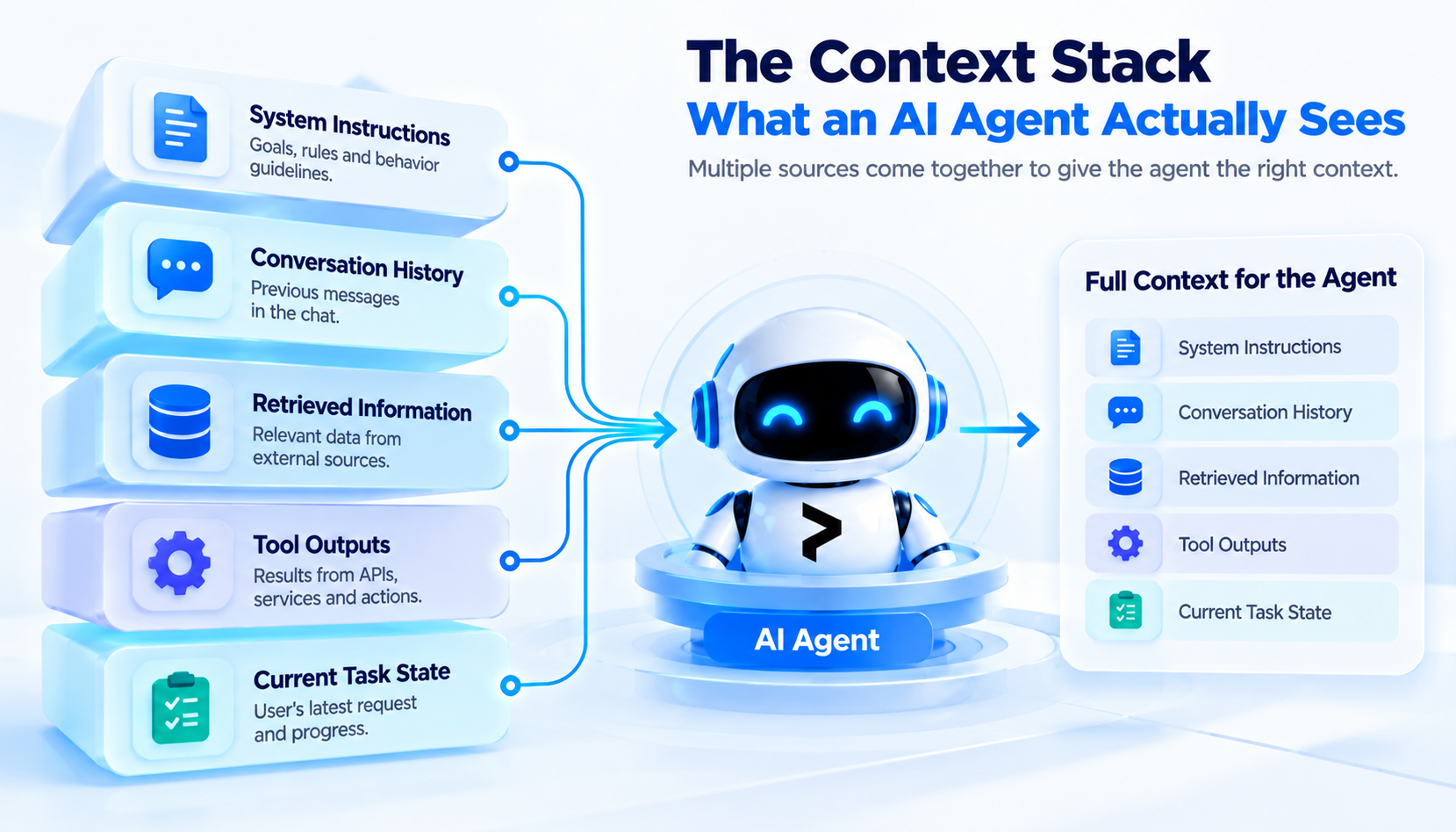
An AI agent receives six layers of input at runtime: instructions, user context, memory, retrieved information, tool definitions and task state. Each layer has its own owner, failure mode, and budget share.
- Instructions carry the system prompt, policies, and constraints. They break when rules from past releases contradict each other.
- User context holds the request and relevant preferences. It breaks when a full profile loads for a one line question.
- Memory stores durable facts and prior state. It breaks when every past chat becomes memory.
- Retrieved information brings in documents, APIs, and search results. It breaks when 20 chunks enter with no relevance threshold.
- Tool definitions describe actions and parameters. They break when every tool appears on every call.
- Task state records completed and pending steps. Without it, the agent repeats finished work.
Example: A sales assistant receives "Draft a renewal email for Acme." A well-built context holds tone rules, discount limits, Acme's last renewal terms, the current price sheet, two tools for CRM lookup and drafting, and a task state showing the contract already pulled. Acme's support history stays out.
Context engineering for AI agents starts with this inventory. If your team cannot list what each layer held for a failed call, nobody can debug it. System prompt design covers one layer out of six. Order belongs to context engineering too: hard constraints near the top, the live request near the end.
Anthropic's engineering team describes context as a finite resource with diminishing marginal returns and recommends the smallest set of high-signal tokens that completes the task.
Context Is a Scarce Resource
Every token adds cost, latency, and competition for model attention. Context engineering treats the context window as a budget, requiring each input to justify its value. Teams should prioritize relevant, current information, remove duplication, and set a deliberate token budget across instructions, memory, retrieved evidence, tools, and task state. Logging actual token use reveals waste, while overspending can also reduce answer quality.
Context Rot: Why More Context Can Make Agents Worse
A larger window lets irrelevant, stale, and conflicting material compete with the facts your agent needs.
In the Lost in the Middle study (Liu et al., TACL 2024), researchers from Stanford, UC Berkeley, and Samaya AI tested models on multi-document question answering. Accuracy followed a U-shaped curve, peaking when the answer sat at the start or end and dropping in the middle. In one setting, GPT-3.5 Turbo scored below its own closed book baseline with the answer mid-input.
Long context models reduce truncation, yet they rank nothing by relevance. The fix costs nothing: place critical facts at the top or bottom of the input and keep the middle for supporting detail. That rule turns the research into everyday context engineering.
Four Causes Behind the Decay
Context rot is the decline in agent quality when useful facts get harder to find inside the input.
Overload means too much input, such as 60 retrieved chunks for a yes or no question. Cap chunks per query.
Pollution means irrelevant data, such as marketing pages inside a billing answer. Filter by metadata and intent before ranking.
Conflict means disagreeing sources, such as old pricing in memory and new pricing in the docs. Rank sources by authority.
Decay means lingering state, such as a cancelled order that still shapes replies. Expire state when a task closes.
Strong context engineering for AI agents checks for all four before every model call. Fixing them takes a repeatable method.
Five Steps to Engineer Context for Production Agents
Step 1: Define the Minimum Context
Start every workflow by listing what the model needs to finish the task. Ask "What does this step require?" and drop "What can we give it?" A refund agent needs the order, the refund policy, and the payment status. This one question cuts more waste than any other context engineering habit.
Step 2: Retrieve Selectively
Combine semantic and keyword search so exact terms like product codes still match. Apply metadata and permission filters before ranking, then set a relevance threshold so weak matches never enter.
A legal assistant, for example, filters by jurisdiction first, so a California query never sees Texas case notes. Our guide on retrieval and context walks through the full build.
Step 3: Separate Three Kinds of Memory
Conversation history is a log. Memory is a curated asset. Strong memory design separates three stores. Short-term state holds what the current task needs.
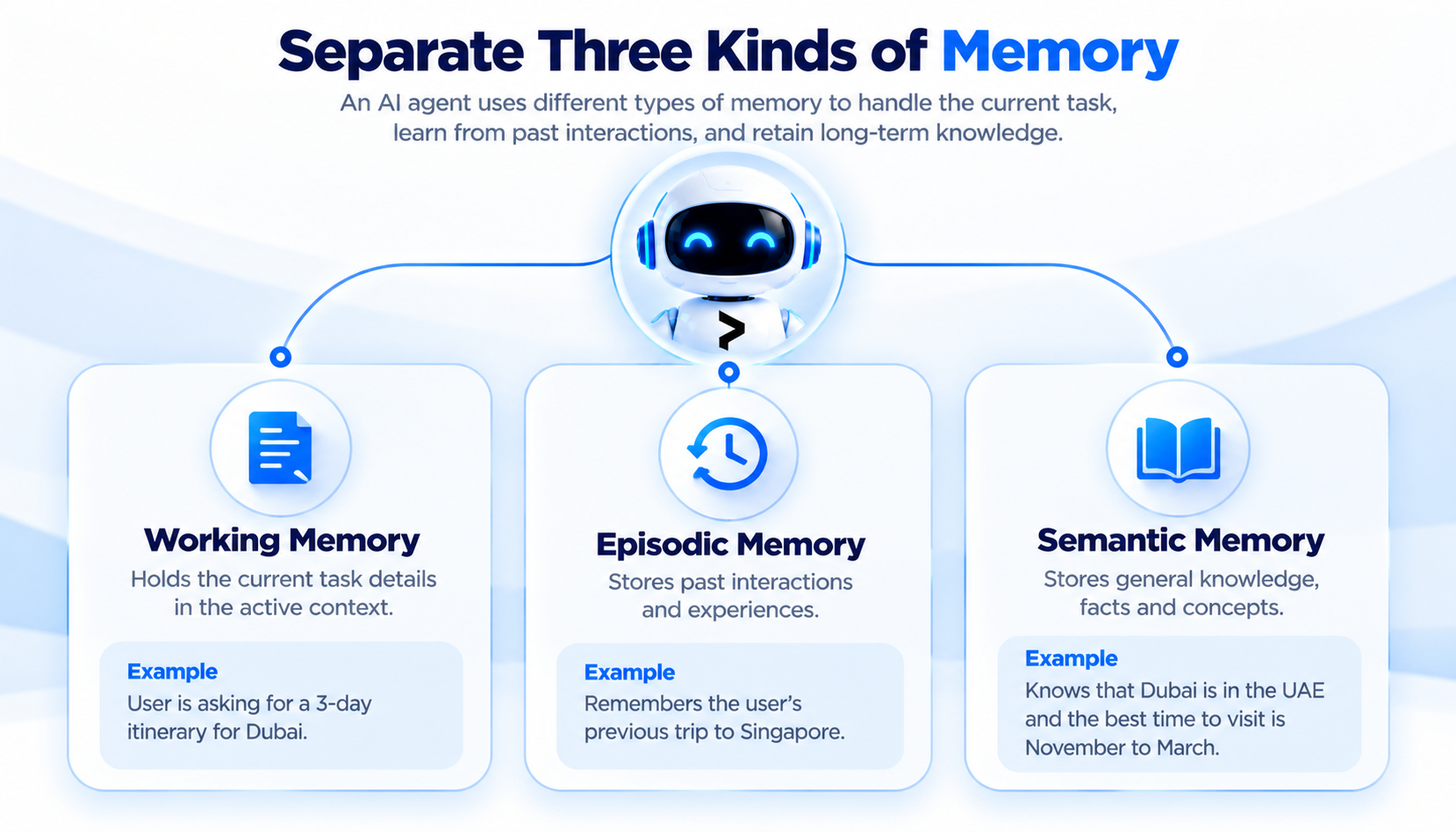
Long-term memory holds facts that stay useful across sessions. Task memory records the steps the agent already finished. Write to long-term memory only when a fact will matter next week. Read more on agent memory and context.
Step 4: Trim Tool Definitions
Tool definitions consume tokens on every call. An agent with 40 tools and full parameter docs burns thousands of tokens before it reads the user's question.
Expose only the tools the current step can use, with short descriptions and clear parameters.
A support agent at the refund step needs two tools: order lookup and refund issue. Few teams pull this lever in context engineering for AI agents, and it pays off fast.
Step 5: Assemble Context Dynamically
Context should shift with the task, the user, the current state, the evidence, and the next action. A static prompt serves one situation. A well-built context layer rebuilds the input for each one.
One shared builder, for example, loads billing policy for a refund request and shipping policy for a delay complaint. Good context engineering turns that switch into code you can test.
Context Engineering for AI Agents: The Runtime Loop
An agent rebuilds context before each model call, updating memory, retrieving evidence, and sizing inputs for the next step. Context engineering happens throughout this loop. Planning needs goals, constraints, and tools; tool calls need exact schemas and parameters; observations need relevant outputs; final responses need verified facts and user intent.
Example: A travel booking agent plans with the itinerary and budget. It calls a flight search tool with only that schema loaded. The tool returns 200 results. The agent keeps the five cheapest options that match the dates and writes its choice into task state. The next call never sees the other 195 flights. That one filter is context engineering at the tool level.
Long agent runs expose context problems as observations accumulate and crowd out the original goal. Mature context engineering for AI agents prunes observations after recording their results in task state.
Logging each assembled context with a step ID also enables exact replay, making it easier to identify failures and fix the context builder instead of debugging context engineering problems blindly.
Our walkthrough on context engineering for AI agents shows this loop inside real workflows. Our breakdown of AI agent architecture explains where the context builder fits.
Summarization Should Raise Information Density
Blind compression can reduce tokens while removing critical business details. A 20,000-token context compressed to 2,000 tokens may lose an approved refund amount, forcing the agent to repeat questions.
Effective summaries must distinguish business-critical facts from low-value content, rather than treating decisions, customer details, and routine conversation as equally important.
Structured Summaries in Practice
Structured summaries keep durable facts and drop redundant dialogue. Anthropic's engineering guidance calls this compaction, paired with structured notes the agent writes outside the window and reloads when needed. The goal is higher information density. Shorter context is a side effect.
In context engineering for AI agents, trigger summaries at task boundaries: after a decision, a tool result, or a closed subtask. Token count triggers fire mid-thought and split facts in half.
In context engineering, a summary works like a database record. Treat it with the same schema discipline. Summaries still need rules for what enters the context.
How to Design a Context Policy
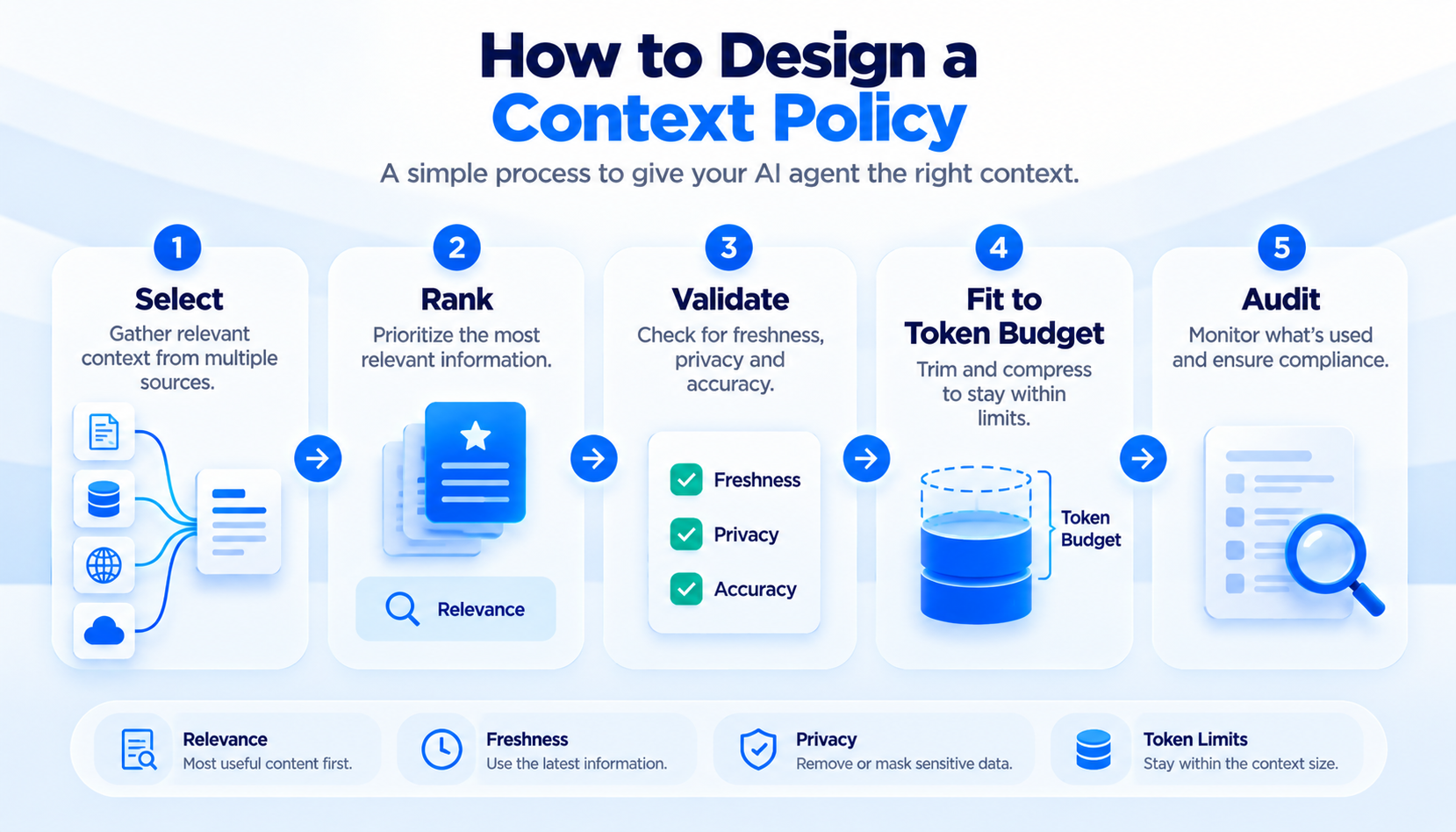
A context policy is a written rule set that decides which candidate information enters an agent's context. It covers relevance, freshness, priority, authority, privacy, and budget for every call.
|
Policy |
Question |
Example Rule |
|
Relevance |
Does this help the current task? |
Drop chunks below your similarity threshold. |
|
Freshness |
Is it still valid? |
Expire pricing memory after 30 days. |
|
Priority |
What must the model see first? |
Policies load before retrieved docs. |
|
Authority |
Which source wins a conflict? |
Contract database beats chat history. |
|
Privacy |
Is the agent allowed to see it? |
Mask card numbers before injection. |
|
Budget |
Is it worth the token cost? |
Cap retrieval at 4,000 tokens. |
Example: Memory says a customer pays $99 per month. The billing database says $129 after an upgrade. The authority rule sends $129 into the context and drops the memory entry. The agent quotes the right price, and your team avoids a refund dispute.
Write the policy down and version it like code. Assign one owner per rule and review the policy every time you add a data source. Context engineering without a written policy drifts with every new feature, and nobody can explain why the agent changed behavior.
How to Measure Context Quality
Measure the context pipeline separately from the final answer. Even a correct answer can be expensive if it relies on excessive, unused context, while fixing a wrong answer requires diagnosing the issue at each layer.
Seven metrics cover the pipeline. Retrieval precision shows whether fetched chunks were useful. Context utilization shows whether the model used them. Attribution traces which inputs shaped the answer.
Token efficiency compares supplied tokens with needed tokens. Memory relevance checks whether stored facts helped. Tool selection accuracy checks whether the agent received and used the right tools. Assembly latency measures how long the builder took.
Start with retrieval precision and token efficiency. They expose most pipeline waste within the first week of logging. Evaluate each metric at every step, since a single weak step can be masked by an otherwise strong average.
Pair these with LLM context and production operations monitoring and your AI model evaluation process. Mature context engineering teams review the numbers weekly. Without them, every fix stays a guess.
Context Is Becoming an Operating Control
Context is becoming an operating control because it determines what AI sees, remembers, and exposes, directly affecting data risk, model spend, and audit readiness. Context engineering for AI agents should have clear ownership across access, relevance, freshness, budget, and auditability.
Before deployment, assign an owner to each context source, keep memory separate from raw chat history, define token budgets, establish retrieval thresholds and permission filters, limit access to necessary tools, and set clear rules for resolving conflicts.
For agents, rebuild context from task state at every step, log each assembled context with a step ID, and test stale memory, tool overload, and conflicting sources before launch. Review context engineering metrics weekly with agent owners to maintain cost control, reliable decisions, and a defensible audit trail.
Build Context Aware Agents With Patoliya Infotech
Patoliya Infotech starts every AI agent project with a context audit before any prompt work. We trace what each agent receives at every step, set a budget per layer, and write the context policy your team owns after launch.
- Context builders that rebuild input per step within a set budget.
- Hybrid retrieval with permission-aware filtering on existing data.
- Context logs that let your team replay any failed run.
We apply the same method to context-aware AI applications and full AI agent development. Bring one workflow that keeps failing, and we will map its context stack with you.
Conclusion
Prompt engineering taught teams to write clear instructions. Context engineering decides what an AI system should know, remember, retrieve, ignore, and act on at each step. Agents raise the stakes because their context shifts with every plan, tool call, and state update.
Reliable agents come from teams that govern what enters the window and can prove it. If your agents shine in demos and stumble in production, let's sit down and map your context stack together.
FAQs:
Apply data masking, role-based access, and source-level permissions before information enters the model context. Regularly test for sensitive data exposure and unauthorized retrieval across agent workflows.
Treat retrieved documents, tool outputs, and user messages as untrusted inputs. Apply instruction separation, permission checks, and security testing to reduce context injection risks in production.
Yes. Context engineering can reduce unnecessary token usage by removing duplicate information, limiting tool descriptions, and retrieving relevant evidence selectively, lowering inference costs without sacrificing task quality.
Evaluate retrieval relevance, information freshness, source coverage, and token efficiency separately from final answer quality. These metrics help identify whether context engineering improvements address actual input problems.
The system may truncate, summarize, or reject input, depending on implementation. Context management should prioritize essential instructions, verified evidence, and task state before less relevant history.
Review context policies whenever data sources, permissions, workflows, or business rules change. Scheduled reviews also help confirm that context engineering controls remain effective as agent responsibilities expand.