Logo
Back to blogs

AI in Logistics: 12 Use Cases, Costs and Business Impact

Hitesh SBy Hitesh SUpdated on: 10/16/2613 min read
AI in Logistics: 12 Use Cases, Costs and Business Impact

TLDR: AI in logistics pays back fastest on decisions that repeat thousands of times a week, such as replenishment, routing, carrier choice, and exception handling. Start with one expensive, measurable workflow, baseline it, then let AI recommend before you let it act. The model matters less than the data and the decision you connect it to.

Most logistics teams already own the data that AI needs. They just spend it on reports nobody acts on in time. AI in logistics earns its budget when it moves from predicting problems to resolving them inside the TMS, WMS, and carrier portals your team already uses. 

Shipment volumes, shifting demand, fragmented systems, late trucks, and constant cost pressure make logistics one of the richest places to apply it. Modern systems now forecast, optimize, flag exceptions, and increasingly take action through agents. This guide explains 12 use cases, the ROI metric to baseline for each, and a 90 day path to production.

12 Use Cases of AI in Logistics

1. Demand Forecasting & Inventory Optimization

AI in logistics starts with demand, because every truck, pallet, and shift downstream depends on how much product moves where. Better forecasts cut stockouts and overstock at the same time.

Modern demand forecasting predicts volume by SKU, location, season, and customer segment, and it spots demand shifts weeks before a monthly report would. Inventory optimization then sets safety stock and replenishment points per SKU and location. Teams that sell online should pair it with demand forecasting tuned for e-commerce spikes and inventory optimization tied to real stock records.

The agent version watches demand signals daily and drafts replenishment orders for a planner to approve. A beverage distributor that sees a heatwave coming can lift stock in hot regions days early. That is AI in logistics paying off before a single truck moves.

ROI metric to baseline: stockout rate and days of inventory on hand.

2. Route Optimization

Route optimization plans multi-stop routes around delivery windows, vehicle capacity, traffic, and weather, then replans when conditions change. Static routes are built the night before, broken by 10 am on most urban days.

Good route optimization treats the plan as a living object. A driver stuck behind an accident gets a resequenced route, and the two affected customers automatically get an updated window. For fleets running last-mile logistics, AI in logistics shows up on the fuel bill first. Route quality also depends on clean addresses, so fix geocoding errors before you blame AI in logistics for a bad plan.

A parcel van running 120 stops a day saves real hours when the plan respects loading dock hours and customer time windows together.

ROI metrics to baseline: cost per stop, miles per route, and on-time delivery rate.

3. Predictive ETA & Delivery Visibility

Predictive ETA models combine traffic, historical lane times, weather, driver behavior, and shipment status to forecast arrival far better than a GPS estimate. The goal is to know a delivery will run late before the customer does.

A distributor that sees a 40 minute slip at noon can warn the receiving dock and rebook the unloading slot. That one message prevents a detention charge and an angry phone call. Feed the same prediction to your customer portal, and your service team stops answering the same tracking question fifty times a day. AI in logistics turns visibility from a tracking screen into a proactive customer update.

ROI metric to baseline: late delivery rate and inbound "where is my order" calls.

4. Exception Management

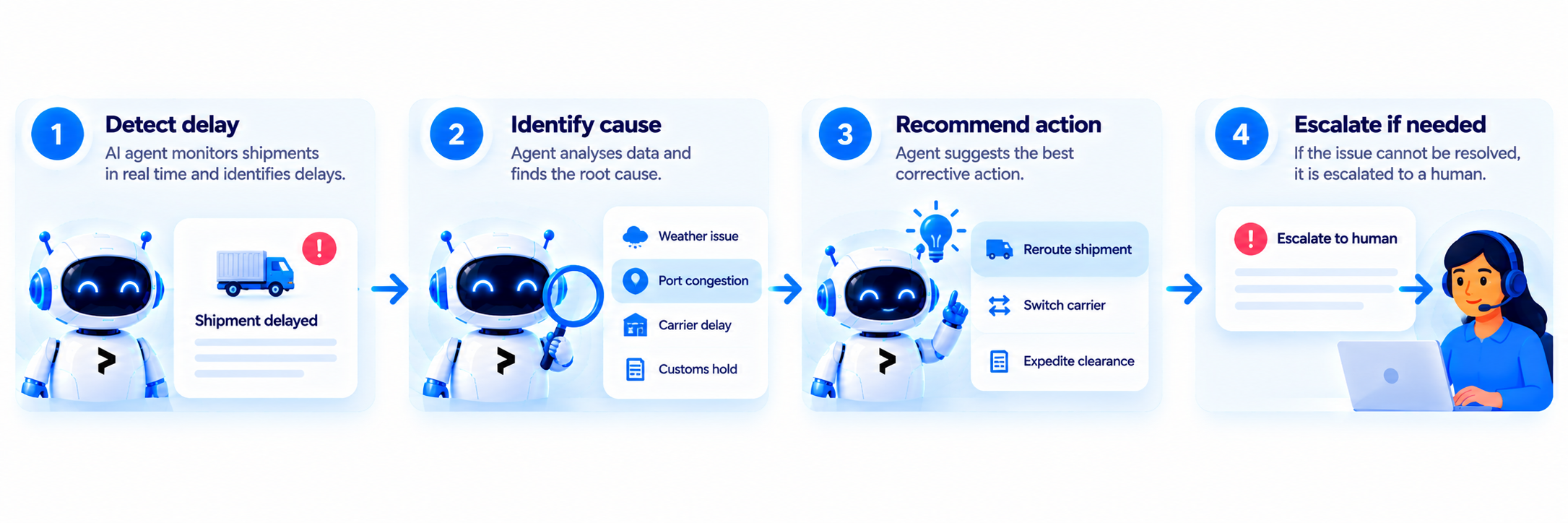
Exception management is where most logistics teams lose their day. AI detects delays, missed scans, temperature deviations, customs holds, and capacity gaps, then ranks them by business impact.
TLDR: AI in logistics pays back fastest on decisions that repeat thousands of times a week, such as replenishment, routing, carrier choice, and exception handling. Start with one expensive, measurable workflow, baseline it, then let AI recommend before you let it act. The model matters less than the data and the decision you connect it to. Most logistics teams already own the data that AI needs. They just spend it on reports nobody acts on in time. AI in logistics earns its budget when it moves from predicting problems to resolving them inside the TMS, WMS, and carrier portals your team already uses.  Shipment volumes, shifting demand, fragmented systems, late trucks, and constant cost pressure make logistics one of the richest places to apply it. Modern systems now forecast, optimize, flag exceptions, and increasingly take action through agents. This guide explains 12 use cases, the ROI metric to baseline for each, and a 90 day path to production. 12 Use Cases of AI in Logistics 1. Demand Forecasting & Inventory Optimization AI in logistics starts with demand, because every truck, pallet, and shift downstream depends on how much product moves where. Better forecasts cut stockouts and overstock at the same time. Modern demand forecasting predicts volume by SKU, location, season, and customer segment, and it spots demand shifts weeks before a monthly report would. Inventory optimization then sets safety stock and replenishment points per SKU and location. Teams that sell online should pair it with demand forecasting tuned for e-commerce spikes and inventory optimization tied to real stock records. The agent version watches demand signals daily and drafts replenishment orders for a planner to approve. A beverage distributor that sees a heatwave coming can lift stock in hot regions days early. That is AI in logistics paying off before a single truck moves. ROI metric to baseline: stockout rate and days of inventory on hand. 2. Route Optimization Route optimization plans multi-stop routes around delivery windows, vehicle capacity, traffic, and weather, then replans when conditions change. Static routes are built the night before, broken by 10 am on most urban days. Good route optimization treats the plan as a living object. A driver stuck behind an accident gets a resequenced route, and the two affected customers automatically get an updated window. For fleets running last-mile logistics, AI in logistics shows up on the fuel bill first. Route quality also depends on clean addresses, so fix geocoding errors before you blame AI in logistics for a bad plan. A parcel van running 120 stops a day saves real hours when the plan respects loading dock hours and customer time windows together. ROI metrics to baseline: cost per stop, miles per route, and on-time delivery rate. 3. Predictive ETA & Delivery Visibility Predictive ETA models combine traffic, historical lane times, weather, driver behavior, and shipment status to forecast arrival far better than a GPS estimate. The goal is to know a delivery will run late before the customer does. A distributor that sees a 40 minute slip at noon can warn the receiving dock and rebook the unloading slot. That one message prevents a detention charge and an angry phone call. Feed the same prediction to your customer portal, and your service team stops answering the same tracking question fifty times a day. AI in logistics turns visibility from a tracking screen into a proactive customer update. ROI metric to baseline: late delivery rate and inbound "where is my order" calls. 4. Exception Management Exception management is where most logistics teams lose their day. AI detects delays, missed scans, temperature deviations, customs holds, and capacity gaps, then ranks them by business impact. A missed scan on a low-value parcel can wait. A reefer trailer drifting above its temperature limit cannot. The agentic version investigates the issue, contacts the carrier, updates the record, and escalates when approval is needed. This is the clearest early win for AI agents in supply chain teams, because exceptions are frequent, costly, and well documented. Most teams trying AI in logistics for the first time should start right here. ROI metric to baseline: exceptions handled per planner and average time to resolution. 5. Intelligent Carrier Selection Carrier selection models compare cost, capacity, service levels, past performance, and lane characteristics for every shipment. Lowest rate rarely means lowest total cost once claims and late fees land. The system learns which carrier actually delivers on a given lane in December, and it tenders accordingly. A carrier that wins on price but misses one in five pickups costs you more in rebooking and customer credits than it saves. Over time, AI in logistics builds a live scorecard for every carrier that procurement can bring to the next rate negotiation. ROI metrics to baseline: cost per shipment, tender acceptance rate, and on-time performance by carrier. 6. Freight Audit & Invoice Intelligence Freight audit with AI extracts invoice data, matches it against contracts and shipment records, and flags duplicate or incorrect charges. Accessorial fees such as detention, liftgate, and residential surcharges hide the most leakage. A manual auditor samples invoices. An AI audit checks every line, every week. AI in logistics recovers money that teams never knew they were losing, and it frees finance staff for disputes that need judgment. Start with your top ten carriers by spend, since they usually hold most of the recoverable errors. ROI metric to baseline: billing errors recovered and invoices processed per auditor. 7. Warehouse Automation Warehouse automation uses AI to improve picking paths, putaway, slotting and labor allocation, and to coordinate robots and conveyors with the people working beside them. The gains come from better decisions about where items live and who picks them. AI predicts tomorrow's workload by zone, so the shift manager staffs the right aisles before the rush. Slotting is the quiet winner. Moving fast movers closer to packing saves more walking than most robots, and AI in logistics recalculates those slots weekly as demand shifts. Our warehouse automation guide covers the operational basics. Every AI decision must write back to the warehouse workflow, or AI in logistics stays a dashboard. ROI metric to baseline: lines picked per labor hour and order cycle time. 8. Computer Vision for Logistics Computer vision reads labels, detects package damage, verifies trailer loading, counts inventory, and spots safety risks on the dock floor. Cameras already installed for security often provide enough footage to start. A vision model at the outbound door can confirm that every pallet carries a readable GS1 barcode before the truck leaves. It can also photograph shipment condition as proof for damage claims. This side of AI in logistics cuts the disputes that eat customer service time. Start with one dock door, prove accuracy for a month, then roll the model out to the rest of the building. Teams that deploy AI in logistics vision tools this way avoid expensive camera upgrades. ROI metric to baseline: damage claims, mislabeled shipments, and cycle count accuracy. 9. Digital Twins for Supply Chain Planning A digital twin models your warehouses, transport network, and inventory flows so you can test decisions before spending money on them. It answers "what happens if" questions with your own operating data. Leaders use it to simulate a port closure, test a second shift, or evaluate a new distribution center location. A twin is only as good as its inputs, so build it after your forecasting and warehouse data are clean. National freight trends from the Bureau of Transportation Statistics give useful external context for those scenarios. AI in logistics at this level supports strategy more than daily execution. ROI metric to baseline: forecast versus actual cost of network changes. 10. AI Agents for Supply Chain Operations AI agents in supply chain operations close the gap between insight and action. They connect operational data, business rules, tools, and approval steps to move an issue toward resolution, which a recommendation alone cannot do. Practical agents fall into clear roles. A demand planning agent drafts replenishment, a transportation agent rebooks loads, and a shipment exception agent chases missing scans. Procurement, warehouse, and freight audit agents follow the same pattern. Each one runs the same loop: monitor, reason, recommend, act, and escalate. Start every agent in recommend mode. Grant action rights only after its suggestions match what your best planner would do. Done this way, AI agents in supply chain work feel like extra planners with perfect memory. This is the step where AI in logistics stops reporting problems and starts closing them. ROI metric to baseline: manual touches per shipment and planner hours saved. 11. Transportation Management System Intelligence AI extends your existing TMS with no rip and replace project. It adds shipment planning, carrier recommendations, ETA prediction, tender optimization, exception detection, automated communication, and cost analysis on top of the system your team already trusts. The integration layer decides success here. Pick from proven logistics management systems or keep your own, then connect AI agents in supply chain workflows through APIs. AI in logistics works best as an intelligence layer around the TMS. A planner should see the AI suggestion, its reason, and the cost difference on one screen, then accept it with a single click. That approval history becomes the training data for later automation. ROI metric to baseline: freight spend per unit shipped. 12. Warehouse Management System Intelligence The same logic applies to your WMS. AI adds inventory recommendations, slotting, picking optimization, labor planning, exception detection, vision checks and replenishment triggers around the system that already runs the building. Fleet heavy operations can extend this layer into fleet management software so warehouse and yard decisions share one view. Keep the WMS as the system of record, and let AI in logistics handle the decisions it surfaces. A common first project is replenishment triggers. The AI watches pick face levels and calls a forklift move before pickers find an empty slot, which keeps the whole wave on schedule. ROI metrics to baseline: order accuracy and dock to stock time. How AI in Logistics Use Cases Connect AI in logistics works best as a connected system, where a forecast feeds inventory, inventory feeds routing, and routing feeds customer updates. Isolated pilots rarely survive budget reviews. Logistics function AI use case Primary outcome Planning Demand forecasting. Better inventory decisions. Inventory Inventory optimization. Lower carrying costs. Transportation Route optimization. Lower delivery costs. Transportation Predictive ETA. Better delivery visibility. Carrier management Carrier selection. Better cost and service balance. Operations Exception management. Faster issue resolution. Finance Freight audit. Reduced billing leakage. Warehouse Warehouse automation. Higher throughput. Quality Computer vision. Fewer handling errors. Strategy Digital twin. Better scenario planning. TMS AI intelligence layer. Smarter transportation decisions. WMS AI intelligence layer. Smarter warehouse operations.  Read the table as a chain. A wrong forecast in planning shows up three weeks later as an expensive expedited shipment in transportation. Connecting AI agents in supply chain functions catches that error at the source. Plan your AI in logistics roadmap so each new use case reuses data the last one already cleaned. What Leaders Should Prioritize First Leaders should prioritize AI in logistics use cases by data availability, decision frequency, financial impact, and integration effort. The best first project is frequent, costly, measurable, and already well documented. Start with data. If the shipment, scan, or invoice data sits in a system you can query today, the project moves fast. Then look at decision frequency, because a choice made 5,000 times a week compounds savings far faster than a quarterly one. Financial impact comes next. Name the cost, revenue, or service metric the use case moves, and get finance to agree on the baseline. The number of exceptions reveals how much work still requires human intervention, often exposing hidden labor costs. Integration complexity decides your timeline. Check whether the AI can read from and write to your TMS, WMS, ERP, and carrier systems. Risk level decides autonomy, so separate actions an agent can take alone from actions that need a human signature. Finally, insist on measurement against a baseline, or nobody will trust the results. Score each candidate on all seven criteria, and fund the top AI in logistics project first. Our view: exception management and freight audit usually win the first slot. Both are frequent, documented, and easy to price. For AI agents in supply chain programs, they also build the trust you need before agents touch routing or procurement. From AI Use Case to Production Workflow AI in logistics moves one workflow from baseline to measured production, then adds agent actions once the numbers hold. Start with a decision, and pick the model last. Phase What happens Identify and connect Pick one workflow, connect TMS, WMS, and carrier data, set the baseline. Pilot and measure Define decision rules, run in recommend mode, compare against baseline. Act and expand Add agentic actions with approvals, then plan the next use case.  The pattern matters more than the dates. Teams that start by choosing a model spend month two looking for a problem to solve. Teams that start with an expensive, repetitive, data-rich decision finish with a result the CFO can read.  Phased rollout of AI agents in supply chain work also keeps every change easy to reverse. Review results with operations and finance at day 30, 60, and 90 so AI in logistics spending stays tied to measured outcomes. Don't start with an AI model. Start with a logistics decision that is expensive, repetitive, measurable, and rich in operational data. How Patoliya Infotech Builds AI for Logistics Operations Patoliya Infotech builds AI in logistics systems that plug into the TMS, WMS, and carrier tools you already run. Each engagement starts with one workflow, a measured baseline, and clear approval rules for agent actions. Logistics software development for custom TMS, WMS, and fleet integrations. AI consulting for logistics to rank use cases by data readiness and ROI. Agent workflows for exceptions, freight audit, and replenishment. Bring your most expensive recurring decision, and let's scope your first 90 days together. Conclusion AI in logistics pays off when it changes a decision your team makes thousands of times a week. Forecasting, routing, carrier choice, and exception handling share the same data, so connect them early.  Let agents recommend first and act once they earn trust. Done well, AI agents in supply chain operations give planners their time back and give leaders numbers they can defend. Let's sit down with your exception log and pick the first workflow worth automating. FAQs: What data is required to implement AI in logistics? AI in logistics typically requires shipment histories, carrier performance, delivery times, inventory levels, freight costs, and order data. Data quality determines forecast accuracy and operational reliability. How does AI improve supply chain visibility? AI in supply chain visibility combines shipment updates, carrier feeds, weather conditions, and inventory data to identify disruptions early, estimate downstream impacts, and prioritize corrective actions. Can AI in logistics reduce transportation costs? AI in logistics reduces transportation costs by improving load consolidation, selecting cost-effective routes, minimizing empty miles, and identifying recurring carrier inefficiencies without compromising delivery commitments. How can logistics companies measure AI performance? Logistics companies measure AI performance through on-time delivery rates, cost per shipment, forecast accuracy, detention hours, exception resolution time, and measurable improvements against pre-implementation operational baselines. What risks can arise when AI agents are deployed in logistics operations? AI agents in logistics can act on inaccurate data, overlook operational constraints, or trigger costly changes. Approval thresholds, audit trails, access controls, and escalation rules help manage these risks. How can AI improve inventory management across logistics operations? AI in logistics analyzes demand patterns, lead times, and stock levels to identify replenishment needs, reduce excess inventory, prevent stockouts, and improve warehouse resource allocation.

A missed scan on a low-value parcel can wait. A reefer trailer drifting above its temperature limit cannot. The agentic version investigates the issue, contacts the carrier, updates the record, and escalates when approval is needed. This is the clearest early win for AI agents in supply chain teams, because exceptions are frequent, costly, and well documented. Most teams trying AI in logistics for the first time should start right here.

ROI metric to baseline: exceptions handled per planner and average time to resolution.

5. Intelligent Carrier Selection

Carrier selection models compare cost, capacity, service levels, past performance, and lane characteristics for every shipment. Lowest rate rarely means lowest total cost once claims and late fees land.

The system learns which carrier actually delivers on a given lane in December, and it tenders accordingly. A carrier that wins on price but misses one in five pickups costs you more in rebooking and customer credits than it saves. Over time, AI in logistics builds a live scorecard for every carrier that procurement can bring to the next rate negotiation.

ROI metrics to baseline: cost per shipment, tender acceptance rate, and on-time performance by carrier.

6. Freight Audit & Invoice Intelligence

Freight audit with AI extracts invoice data, matches it against contracts and shipment records, and flags duplicate or incorrect charges. Accessorial fees such as detention, liftgate, and residential surcharges hide the most leakage.

A manual auditor samples invoices. An AI audit checks every line, every week. AI in logistics recovers money that teams never knew they were losing, and it frees finance staff for disputes that need judgment. Start with your top ten carriers by spend, since they usually hold most of the recoverable errors.

ROI metric to baseline: billing errors recovered and invoices processed per auditor.

7. Warehouse Automation

Warehouse automation uses AI to improve picking paths, putaway, slotting and labor allocation, and to coordinate robots and conveyors with the people working beside them. The gains come from better decisions about where items live and who picks them.

AI predicts tomorrow's workload by zone, so the shift manager staffs the right aisles before the rush. Slotting is the quiet winner. Moving fast movers closer to packing saves more walking than most robots, and AI in logistics recalculates those slots weekly as demand shifts. Our warehouse automation guide covers the operational basics. Every AI decision must write back to the warehouse workflow, or AI in logistics stays a dashboard.

ROI metric to baseline: lines picked per labor hour and order cycle time.

8. Computer Vision for Logistics

Computer vision reads labels, detects package damage, verifies trailer loading, counts inventory, and spots safety risks on the dock floor. Cameras already installed for security often provide enough footage to start.
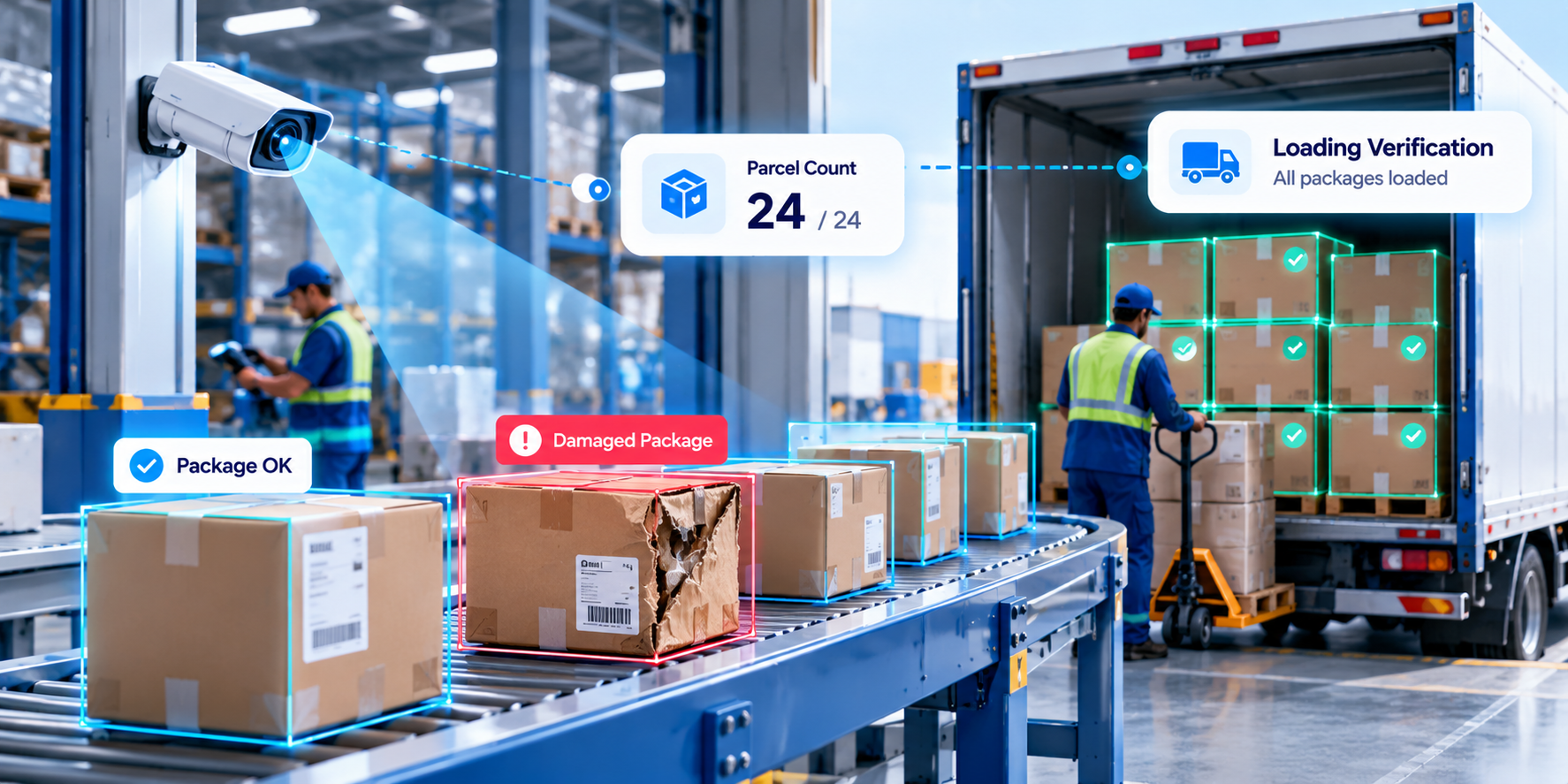
Smart Warehouse Parcel Inspection Dashboard

A vision model at the outbound door can confirm that every pallet carries a readable GS1 barcode before the truck leaves. It can also photograph shipment condition as proof for damage claims. This side of AI in logistics cuts the disputes that eat customer service time. Start with one dock door, prove accuracy for a month, then roll the model out to the rest of the building. Teams that deploy AI in logistics vision tools this way avoid expensive camera upgrades.

ROI metric to baseline: damage claims, mislabeled shipments, and cycle count accuracy.

9. Digital Twins for Supply Chain Planning

A digital twin models your warehouses, transport network, and inventory flows so you can test decisions before spending money on them. It answers "what happens if" questions with your own operating data.

Leaders use it to simulate a port closure, test a second shift, or evaluate a new distribution center location. A twin is only as good as its inputs, so build it after your forecasting and warehouse data are clean. National freight trends from the Bureau of Transportation Statistics give useful external context for those scenarios. AI in logistics at this level supports strategy more than daily execution.

ROI metric to baseline: forecast versus actual cost of network changes.

10. AI Agents for Supply Chain Operations

AI agents in supply chain operations close the gap between insight and action. They connect operational data, business rules, tools, and approval steps to move an issue toward resolution, which a recommendation alone cannot do.

Practical agents fall into clear roles. A demand planning agent drafts replenishment, a transportation agent rebooks loads, and a shipment exception agent chases missing scans. Procurement, warehouse, and freight audit agents follow the same pattern.

Each one runs the same loop: monitor, reason, recommend, act, and escalate. Start every agent in recommend mode. Grant action rights only after its suggestions match what your best planner would do. Done this way, AI agents in supply chain work feel like extra planners with perfect memory. This is the step where AI in logistics stops reporting problems and starts closing them.

ROI metric to baseline: manual touches per shipment and planner hours saved.

11. Transportation Management System Intelligence

AI extends your existing TMS with no rip and replace project. It adds shipment planning, carrier recommendations, ETA prediction, tender optimization, exception detection, automated communication, and cost analysis on top of the system your team already trusts.

The integration layer decides success here. Pick from proven logistics management systems or keep your own, then connect AI agents in supply chain workflows through APIs. AI in logistics works best as an intelligence layer around the TMS.

A planner should see the AI suggestion, its reason, and the cost difference on one screen, then accept it with a single click. That approval history becomes the training data for later automation.

ROI metric to baseline: freight spend per unit shipped.

12. Warehouse Management System Intelligence

The same logic applies to your WMS. AI adds inventory recommendations, slotting, picking optimization, labor planning, exception detection, vision checks and replenishment triggers around the system that already runs the building.

Fleet heavy operations can extend this layer into fleet management software so warehouse and yard decisions share one view. Keep the WMS as the system of record, and let AI in logistics handle the decisions it surfaces.

A common first project is replenishment triggers. The AI watches pick face levels and calls a forklift move before pickers find an empty slot, which keeps the whole wave on schedule.

ROI metrics to baseline: order accuracy and dock to stock time.

How AI in Logistics Use Cases Connect

AI in logistics works best as a connected system, where a forecast feeds inventory, inventory feeds routing, and routing feeds customer updates. Isolated pilots rarely survive budget reviews.

Logistics function

AI use case

Primary outcome

Planning

Demand forecasting.

Better inventory decisions.

Inventory

Inventory optimization.

Lower carrying costs.

Transportation

Route optimization.

Lower delivery costs.

Transportation

Predictive ETA.

Better delivery visibility.

Carrier management

Carrier selection.

Better cost and service balance.

Operations

Exception management.

Faster issue resolution.

Finance

Freight audit.

Reduced billing leakage.

Warehouse

Warehouse automation.

Higher throughput.

Quality

Computer vision.

Fewer handling errors.

Strategy

Digital twin.

Better scenario planning.

TMS

AI intelligence layer.

Smarter transportation decisions.

WMS

AI intelligence layer.

Smarter warehouse operations.

Read the table as a chain. A wrong forecast in planning shows up three weeks later as an expensive expedited shipment in transportation. Connecting AI agents in supply chain functions catches that error at the source. Plan your AI in logistics roadmap so each new use case reuses data the last one already cleaned.

What Leaders Should Prioritize First

Leaders should prioritize AI in logistics use cases by data availability, decision frequency, financial impact, and integration effort. The best first project is frequent, costly, measurable, and already well documented.

Start with data. If the shipment, scan, or invoice data sits in a system you can query today, the project moves fast. Then look at decision frequency, because a choice made 5,000 times a week compounds savings far faster than a quarterly one.

Financial impact comes next. Name the cost, revenue, or service metric the use case moves, and get finance to agree on the baseline. The number of exceptions reveals how much work still requires human intervention, often exposing hidden labor costs.

Integration complexity decides your timeline. Check whether the AI can read from and write to your TMS, WMS, ERP, and carrier systems. Risk level decides autonomy, so separate actions an agent can take alone from actions that need a human signature. Finally, insist on measurement against a baseline, or nobody will trust the results. Score each candidate on all seven criteria, and fund the top AI in logistics project first.

Our view: exception management and freight audit usually win the first slot. Both are frequent, documented, and easy to price. For AI agents in supply chain programs, they also build the trust you need before agents touch routing or procurement.

From AI Use Case to Production Workflow

AI in logistics moves one workflow from baseline to measured production, then adds agent actions once the numbers hold. Start with a decision, and pick the model last.

Phase

What happens

Identify and connect

Pick one workflow, connect TMS, WMS, and carrier data, set the baseline.

Pilot and measure

Define decision rules, run in recommend mode, compare against baseline.

Act and expand

Add agentic actions with approvals, then plan the next use case.

The pattern matters more than the dates. Teams that start by choosing a model spend month two looking for a problem to solve. Teams that start with an expensive, repetitive, data-rich decision finish with a result the CFO can read. 
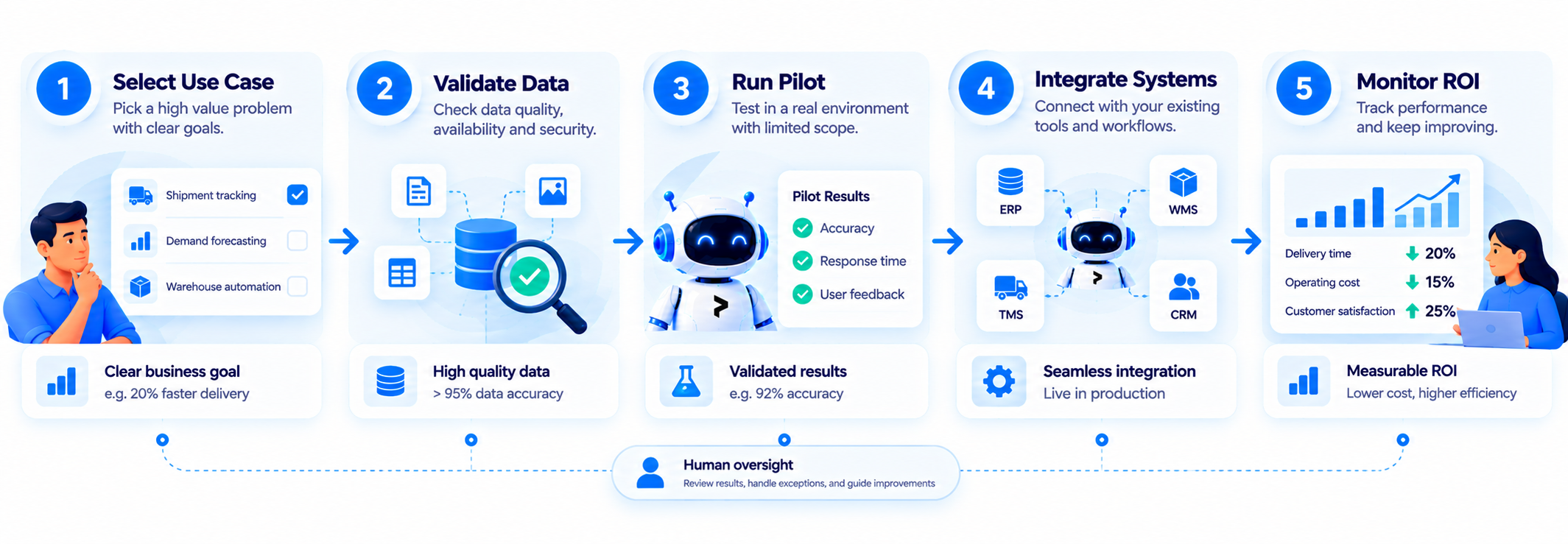
From AI use case to production workflow

Phased rollout of AI agents in supply chain work also keeps every change easy to reverse. Review results with operations and finance at day 30, 60, and 90 so AI in logistics spending stays tied to measured outcomes.

Don't start with an AI model. Start with a logistics decision that is expensive, repetitive, measurable, and rich in operational data.

How Patoliya Infotech Builds AI for Logistics Operations

Patoliya Infotech builds AI in logistics systems that plug into the TMS, WMS, and carrier tools you already run. Each engagement starts with one workflow, a measured baseline, and clear approval rules for agent actions.

Bring your most expensive recurring decision, and let's scope your first 90 days together.

Conclusion

AI in logistics pays off when it changes a decision your team makes thousands of times a week. Forecasting, routing, carrier choice, and exception handling share the same data, so connect them early. 

Let agents recommend first and act once they earn trust. Done well, AI agents in supply chain operations give planners their time back and give leaders numbers they can defend. Let's sit down with your exception log and pick the first workflow worth automating.

FAQs:

AI in logistics typically requires shipment histories, carrier performance, delivery times, inventory levels, freight costs, and order data. Data quality determines forecast accuracy and operational reliability.

AI in supply chain visibility combines shipment updates, carrier feeds, weather conditions, and inventory data to identify disruptions early, estimate downstream impacts, and prioritize corrective actions.

AI in logistics reduces transportation costs by improving load consolidation, selecting cost-effective routes, minimizing empty miles, and identifying recurring carrier inefficiencies without compromising delivery commitments.

Logistics companies measure AI performance through on-time delivery rates, cost per shipment, forecast accuracy, detention hours, exception resolution time, and measurable improvements against pre-implementation operational baselines.

AI agents in logistics can act on inaccurate data, overlook operational constraints, or trigger costly changes. Approval thresholds, audit trails, access controls, and escalation rules help manage these risks.

AI in logistics analyzes demand patterns, lead times, and stock levels to identify replenishment needs, reduce excess inventory, prevent stockouts, and improve warehouse resource allocation.
Start Your
Digital Transformation
Today

Looking for a trusted custom software development company to scale your business?

Partner with our experienced bespoke software development company and build innovative, secure, and scalable digital solutions.