Behavioral Health Electronic Medical Records Software Guide
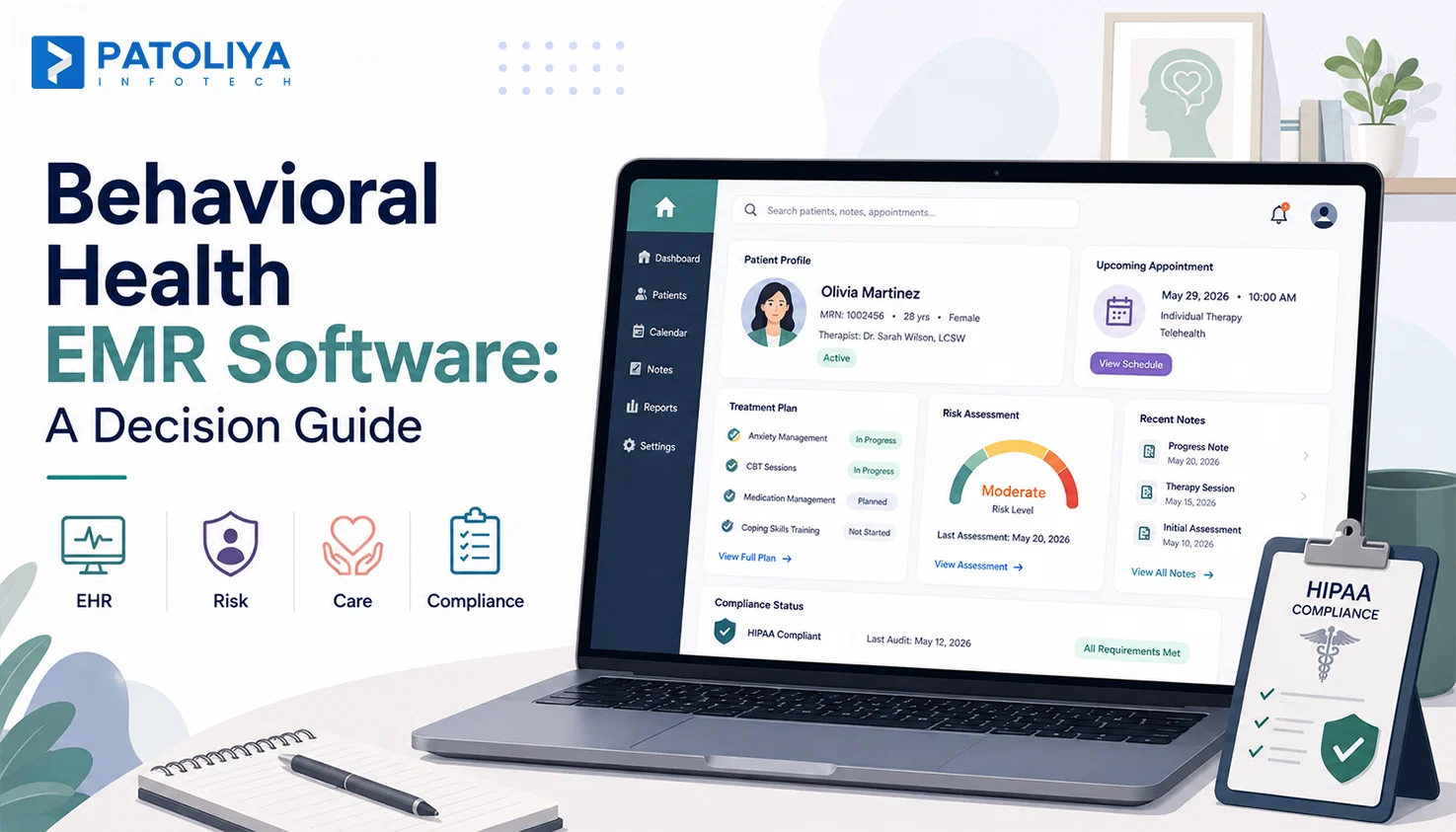
TL;DR: behavioral health electronic medical records software directly shapes clinical workflows, patient safety, and compliance. Treating it like generic IT procurement can create documentation gaps, workflow friction, and costly operational workarounds.
Feature lists rarely reveal whether a platform will work in real behavioral health settings. Unlike a general EHR, behavioral health electronic medical records software must support treatment plans, risk screening, sensitive consent requirements, and legally significant session notes.
A poorly designed system can leave critical information buried across disconnected workflows. This guide examines the capabilities, integrations, substance use treatment software, and build-vs-buy decisions that matter most to behavioral health leaders evaluating healthcare software development.
Behavioral Health Software Landscape at a Glance
The Five Core Software Categories
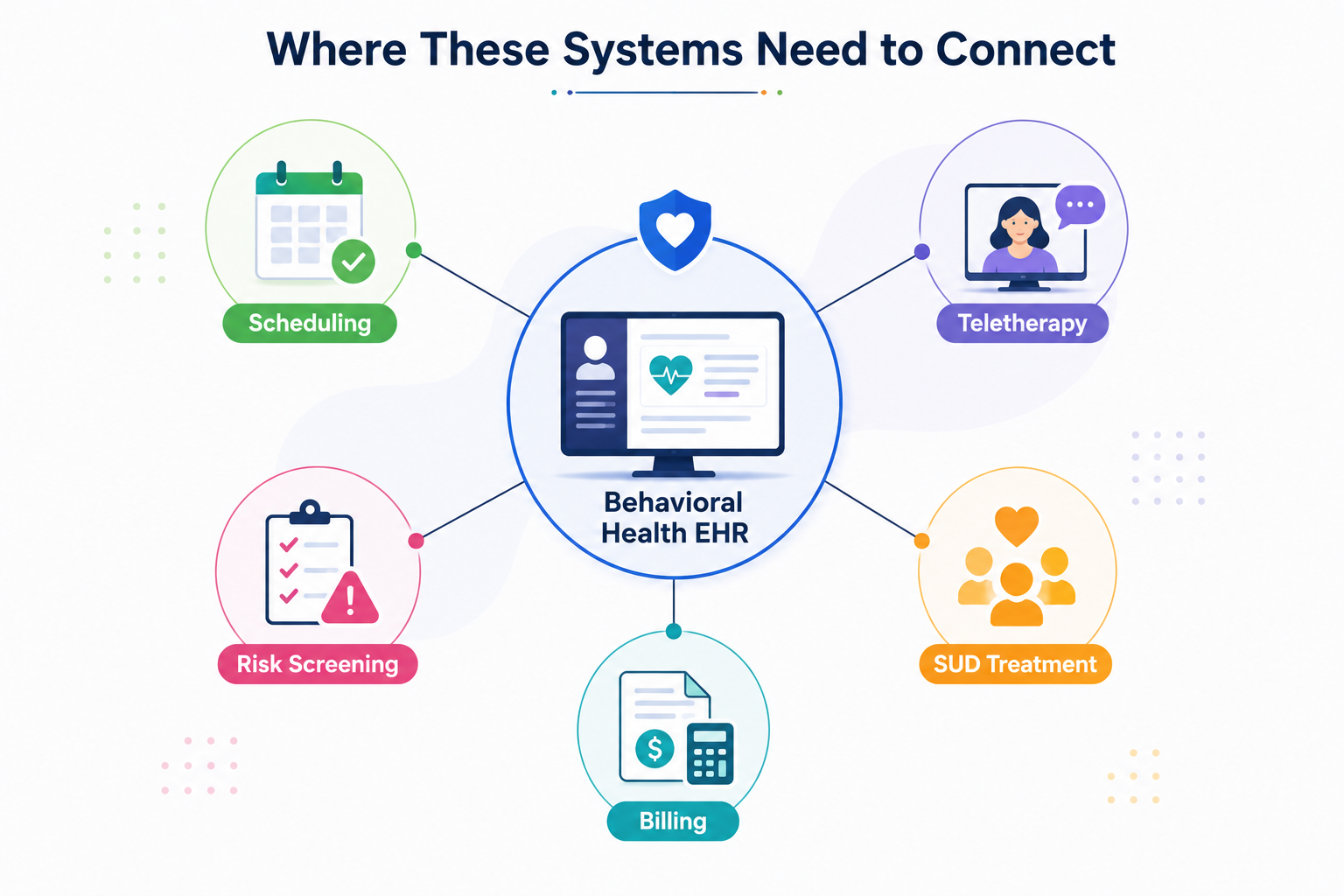
Every organization running mental health services touches several healthcare software types, whether they planned for it or not.
- Behavioral health electronic medical records software, similar to electronic health records applications, supports clinical documentation and treatment planning.
- Teletherapy scheduling for session management.
- Risk screening tools for intake and ongoing assessment.
- Substance use treatment software for consent tracking and level of care.
- Billing tools tied to authorization workflows.
Most organizations buy these separately, then discover the gaps between them cost more than the software itself. One outpatient network with five separate vendors spent more staff hours reconciling data than any single license cost them monthly.
Where These Systems Need to Connect
A behavioral health electronic medical records software that lacks healthcare data integration with your scheduling tool creates duplicate entry for every clinician, every day. Teletherapy platforms sitting outside the record force staff to copy notes manually, and disconnected risk screening tools mean a high score can get missed entirely.
Organizations that run smoothly treat these five categories as one system with five entry points, not five separate purchases.
Behavioral Health Electronic Medical Records Software: What Leadership Should Actually Evaluate
Clinical Documentation and Treatment Planning
A strong behavioral health electronic medical records software should reduce documentation effort while keeping treatment plans connected to ongoing care. Look for psychiatric note types, reusable templates, goal tracking, and progress documentation that carries forward between sessions.
For instance, a therapist treating anxiety should be able to link each progress note to the patient's treatment goals and see how those goals change across 12 sessions.
Billing, RCM, and Authorization Workflows
Behavioral health billing depends heavily on authorizations, payer rules, and visit limits, making the underlying medical billing software a critical part of the workflow. Behavioral health electronic medical records software should track authorization usage and surface issues before they become denied claims.
For instance, if a patient has one authorized session remaining, the system can alert staff during scheduling instead of discovering the issue after the claim is rejected.
42 CFR Part 2, Consent, and Sensitive Data Controls
Behavioral health platforms need more than basic access controls, particularly when HIPAA compliance software and consent-driven data workflows must work together. They should support granular consent management, separating sensitive SUD information from other clinical records when required.
For instance, A patient may authorize the release of therapy records without authorizing disclosure of their SUD treatment history.
Patient Engagement and Teletherapy: Beyond Basic Features
What Actually Drives Patient Engagement Between Sessions
Reminders alone rarely create meaningful engagement, which is why patient portal development increasingly focuses on connected patient experiences beyond appointment reminders. Look for asynchronous check-ins, mood tracking, progress prompts, and clinician visibility between appointments.
For instance, a patient completes a daily mood check-in, allowing the therapist to identify a difficult week before the next session.
Scheduling, Reminders, Waitlists, and Self-Service
Behavioral health electronic medical records software should account for cancellations, recurring appointments, no-shows, and waitlist demand. Automated reminders and self-service rebooking can help fill open slots without adding administrative work.
For instance, when a patient cancels a Tuesday appointment, the system automatically offers the slot to eligible patients on the waitlist.
Multi-State Licensure and Provider Credentialing
Telemedicine software development creates additional credentialing considerations when providers serve patients across state lines. The platform should connect provider licenses, locations, specialties, and appointment eligibility.
For instance, if a patient joins a session while temporarily in another state, the system can verify whether the assigned clinician is authorized to provide care there.
Risk Screening Software: From Assessment to Clinical Action
Validated Screening vs. Black-Box Risk Scores
|
What to Evaluate |
Validated Screening Tools |
Black-Box Risk Scores |
|
Clinical basis |
Published instrument |
Unclear methodology |
|
Score interpretation |
Defined |
Difficult to explain |
|
Clinical defensibility |
Stronger |
Limited |
|
Audit readiness |
Easier to document |
Harder to justify |
Tools based on validated instruments such as PHQ-9, GAD-7, and C-SSRS give clinicians a defined basis for assessment and follow-up.
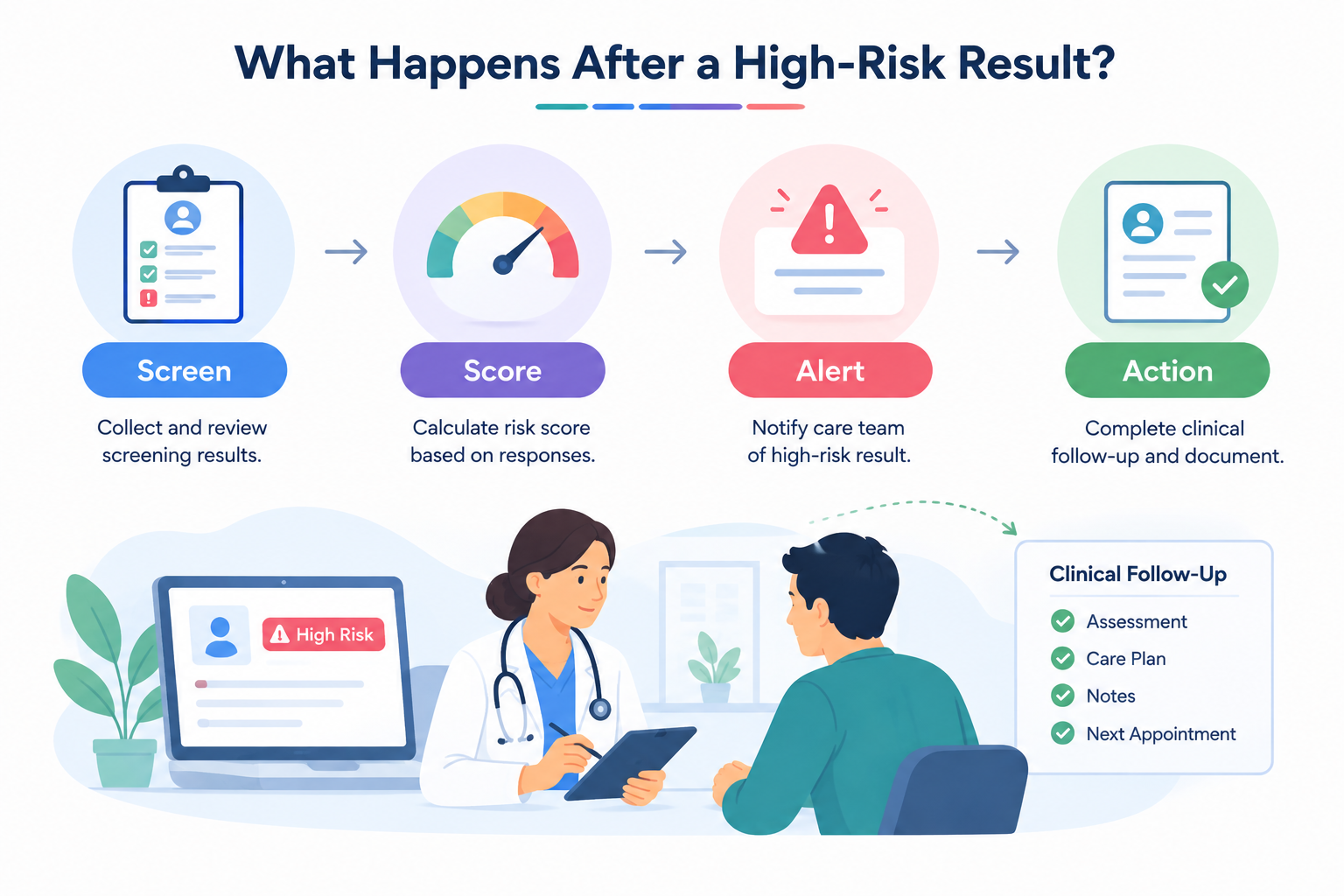
What Happens After a High-Risk Result?
A screening score has limited value if the system simply stores it instead of surfacing it through a healthcare dashboard portal that supports clinical visibility and action. Effective risk screening tools should trigger the appropriate alert, assign follow-up actions, and record when the response occurred.
Escalation, Documentation, and Auditability
Every escalation should leave a clear record of who received the alert, when it was acknowledged, what action followed, and when it was completed.
This gives leadership an auditable chain from screening result to clinical response across mental health engagement apps, rather than relying on manual notes or separate communication tools.
Substance Use Disorder Software: The Compliance and Workflow Layer
42 CFR Part 2 and Consent-Based Data Sharing
Substance use treatment software should support consent-based access to SUD records under 42 CFR Part 2 rather than treating every clinical note the same way.
For instance, A patient can authorize specific providers to access SUD treatment information while keeping that data restricted from unrelated record requests.
ASAM and Level-of-Care Documentation
SUD workflows should capture the clinical reasoning behind level-of-care decisions and track changes over time.
For instance, when a patient moves from residential treatment to intensive outpatient care, the system can document the assessment factors supporting that transition.
Coordinating SUD Workflows With the Core EHR
Separate SUD and behavioral health electronic medical records software can create gaps when patients receive treatment for co-occurring conditions. The better approach is controlled integration: keep protected information appropriately segmented while giving authorized clinicians the context they need.
What Should a Modern Behavioral Health Platform Integrate?
EHR, Scheduling, Billing, and Engagement: A connected behavioral health electronic medical records software environment should link clinical documentation, scheduling, billing, and engagement without repeated data entry.
Screening, Telehealth, and External Clinical Systems: Risk screening and telehealth should feed relevant information back into the clinical workflow instead of creating separate data silos. Referral, laboratory, and external care systems may also need integration.
APIs, Interoperability, and Data Ownership: Evaluate the platform’s API capabilities, interoperability standards, export options, and support for mental health engagement apps, especially if your organization is considering a healthcare data fabric, before signing a long-term contract.
Build, Buy, or Customize: Which Strategy Fits Your Organization?
When Off-the-Shelf Software Is Enough
Smaller practices with standard outpatient workflows are usually well served by established behavioral health electronic medical records software platforms.
Buying makes sense when your workflows already match what the vendor built, such as a five clinician group running standard individual and group sessions.
When Customization or a Hybrid Approach Makes More Sense
Mid-size organizations running multiple program types, like outpatient therapy alongside substance use treatment software, often need configuration beyond defaults.
A hybrid, core behavioral health electronic medical records software plus custom modules fits a clinic that needs one extra intake field the base platform doesn't support.
When a Custom Behavioral Health Platform Is Justified
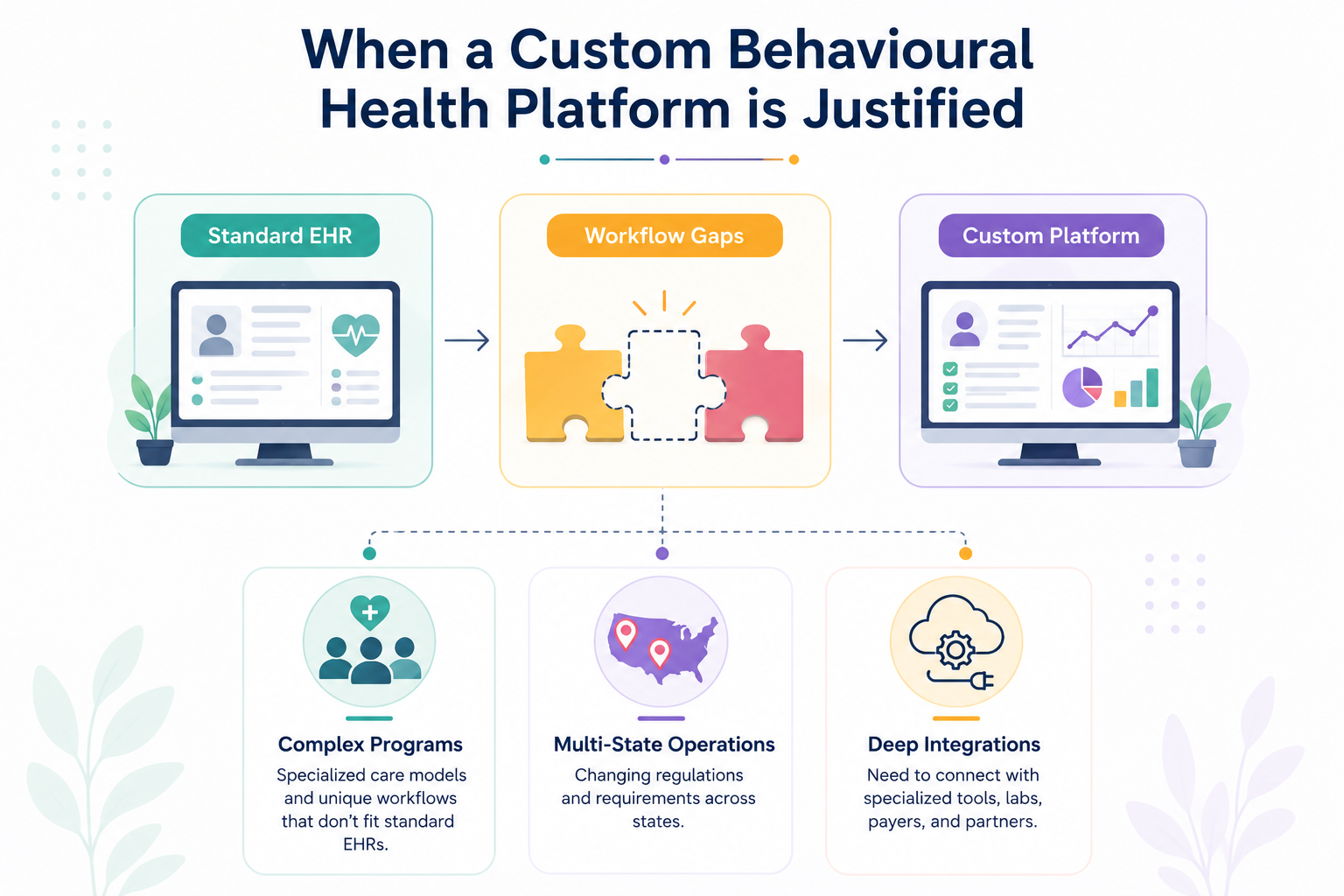
Large systems with unique risk screening tools or multi-entity billing outgrow off-the-shelf platforms entirely, making custom software development a more viable long-term approach. Mental health platform development from the ground up makes sense once configuration costs approach a custom build's cost, common for a multi-state network billing a dozen payer contracts.
Comparing 3 to 5 Year Total Cost of Ownership
|
Approach |
Year 1 Cost |
Years 2 to 5 |
Flexibility |
|
Off-the-shelf |
Lower |
Licensing fees compound |
Limited |
|
Hybrid/Customized |
Moderate |
Scales with modules |
Higher |
|
Custom build |
Highest |
Lower ongoing licensing |
Highest |
Custom platforms cost more upfront but often win on 5 year total cost once per-module fees on off-the-shelf tools exceed what a custom build would have cost by year three.
How to Evaluate a Behavioral Health Software Vendor
Compliance and Security Questions to Ask Before Signing
Ask directly how the vendor handles 42 CFR Part 2 segmentation, the HIPAA Security Rule, where servers are hosted, and who accesses raw patient data.
A vendor pointing to a general compliance page instead of answering specifically about healthcare software security is a warning sign for any behavioral health electronic medical records software purchase.
Clinical Workflow and Integration Questions
Ask a working clinician to test actual documentation flow during the demo, not a sales rep.
Confirm teletherapy scheduling and risk screening tools connect to the chart without manual export steps, such as a live intake screening completed on the spot.
Data Ownership, Portability, and Exit Strategy
Confirm in writing that you own your data and can export the full record set at contract end, in a usable format, without extra fees.
Red Flags Hidden Behind a Polished Product Demo
Watch for demos that avoid crisis workflows or skip billing entirely, such as a demo that shows scheduling beautifully but never opens a claims screen.
The Decision Framework: Buy, Customize, or Build?
|
Decision Factor |
Buy Off-the-Shelf |
Customize |
Build Custom |
|
Program complexity |
Best for single-program organizations with standard workflows |
Works when existing workflows need moderate changes |
Best for multi-program organizations with distinct clinical models |
|
Integration needs |
Suitable for basic integrations |
Better when several systems need deeper connections |
Ideal for complex interoperability and data workflows |
|
Behavioral health EHR software |
Fast deployment with established features |
Extends an existing EHR to fit specific needs |
Gives complete control over the platform and workflows |
|
Budget |
Lower upfront investment |
Moderate implementation and customization costs |
Higher initial investment and ongoing maintenance |
|
Time to market |
Fastest route to launch |
Moderate timeline |
Longest development timeline |
|
Workflow flexibility |
Limited to vendor capabilities |
Moderate flexibility |
Full control over clinical and operational workflows |
|
Mental health platform development |
Usually unnecessary |
Useful for targeted gaps |
Justified when standard platforms cannot support core requirements |
|
Long-term scalability |
Depends on vendor roadmap |
Depends partly on vendor architecture |
Organization controls the roadmap and future expansion |
|
Best fit |
Standardized operations and limited integration needs |
Existing EHR with meaningful workflow gaps |
Complex programs, proprietary workflows, and strategic data requirements |
Why Choose Patoliya Infotech for Behavioral Health Platform Development
Patoliya Infotech develops behavioral health electronic medical records software and custom mental health platforms around real clinical workflows, compliance requirements, and operational needs.
- Risk screening tools based on validated clinical instruments and connected to patient records.
- Substance use treatment software with consent-based 42 CFR Part 2 data controls.
- Teletherapy scheduling and mental health engagement apps integrated with existing systems.
- Custom workflows and integrations designed around your programs and care model.
We help organizations identify platform gaps and build scalable solutions around them. If your current system creates workflow friction, let's map the gaps and define a better-connected platform strategy.
Conclusion
The right behavioral health electronic medical records software should support how clinicians actually deliver care, not force teams to adapt around the platform. Documentation, risk screening, patient engagement, interoperability, and 42 CFR Part 2 compliance all need to work together.
Whether you buy, customize, or build depends on your program complexity, integration requirements, budget, and growth plans. Evaluate those factors before committing to another platform, and make sure your technology can support both today's workflows and tomorrow's expansion.
FAQs:
A behavioral health EHR handles treatment plans, risk screening tools, and consent segmentation under 42 CFR Part 2, none of which a standard medical EHR manages properly.
Most small practices with standard workflows are well served by established behavioral health electronic medical records software and don't need custom mental health platform development unless their workflow is unusual.
Substance use treatment software segments SUD records so they release only with specific documented consent, separate from general mental health notes.
Ask whether risk screening tools are built on validated instruments, how high scores trigger alerts, and whether escalation gets logged automatically for audit purposes.
Strong teletherapy scheduling tools track clinician licensure by state in real time, preventing bookings with providers unlicensed in the patient's state.
For mid-size organizations, a hybrid combining core behavioral health electronic medical records software with custom modules often balances cost and workflow fit better than either extreme.