AI in Real Estate: Benefits and Use Cases
 By Hitesh SUpdated on: 10/21/2611 min read
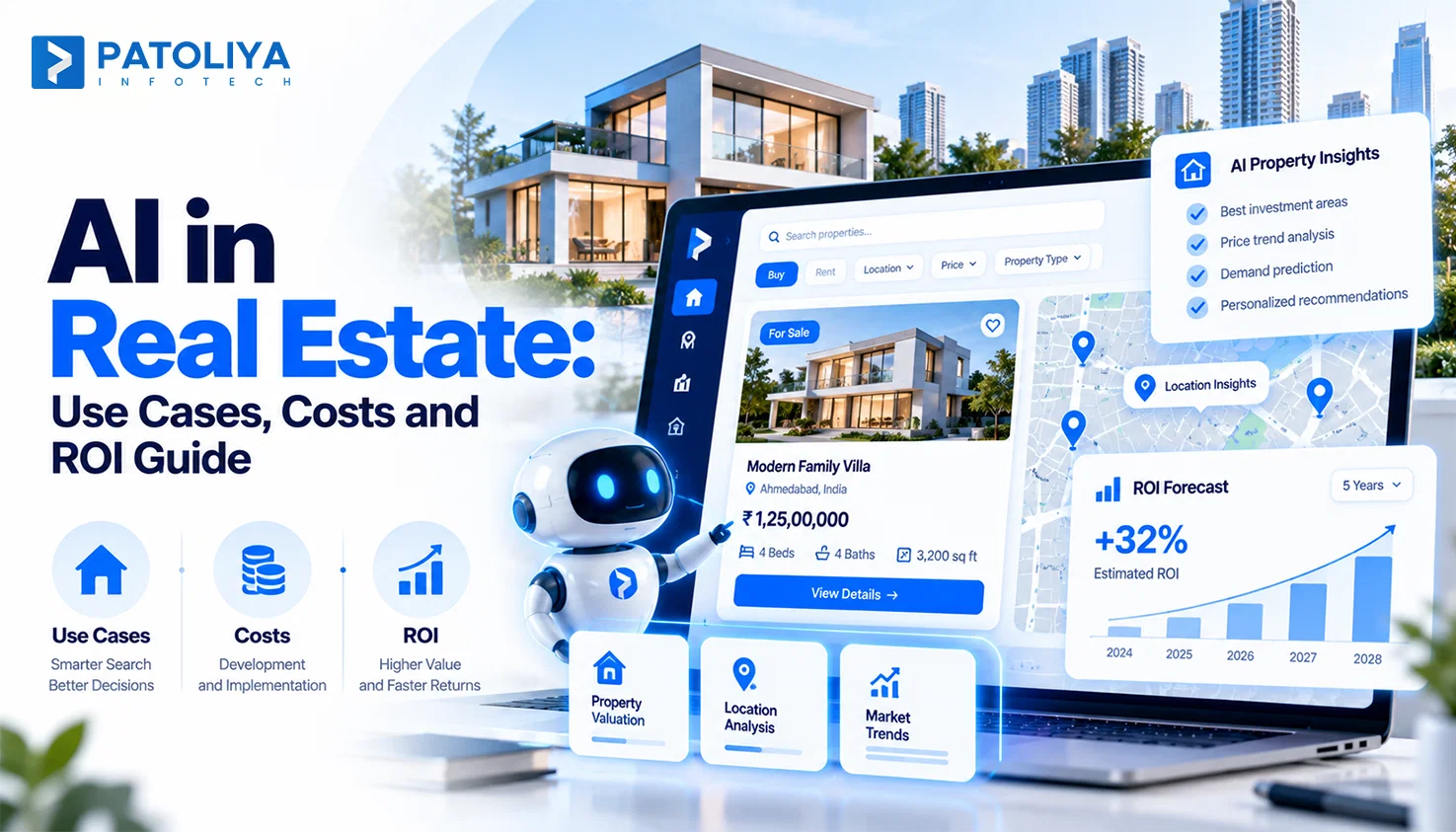
TLDR: AI in real estate pays off when it fixes one costly workflow with data you already own. Lead scoring, lease abstraction, and maintenance forecasting deliver the fastest returns. Most custom builds land between $10,000 and $75,000, and data cleanup often decides the final bill. Pick one bottleneck, test it, then scale.
Real estate firms lose valuable time when property data, lead histories, lease documents, and maintenance records sit in disconnected systems. AI in real estate can turn these fragmented records into actionable insights, helping brokerages qualify leads faster, review leases efficiently, and detect equipment failures before they disrupt operations.
Property managers read leases line by line. Maintenance teams react after tenants complain. AI for property management and brokerage work can change each of those moments. This guide breaks down 10 use cases with data needs, indicative build costs, and a practical roadmap.
Where AI Creates Value Across Real Estate Operations
Brokerages focus on lead conversion, property valuation, and listing quality, making AI-powered lead scoring, pricing recommendations, and listing cleanup valuable applications. Property managers prioritize tenant service, lease administration, maintenance, and portfolio returns, benefiting more from document intelligence and predictive forecasting.
Growing use of AI in property management shows the shift from listings to operations. AI for property management focuses on cost and retention, while brokerage AI chases speed to close.
Evaluate each use case by its potential business impact, the availability of clean and relevant historical data, and the complexity of integrating existing systems. Prioritize opportunities with measurable returns and minimal implementation barriers.
The model matters least. Strong AI in real estate projects starts with a measurable workflow and solid evidence. AI for property management and brokerage pilots fail most often on data gaps, and rarely fail on model choice.
10 AI Use Cases: Business Value, Data Needs and Build Costs
1. Predictive Property Valuation and AVMs
Agents often price listings based on intuition and a limited number of comparable properties.
Predictive valuation models estimate property values using comparable sales, location, property attributes, and market trends. Automated valuation models (AVMs) provide a starting price within seconds, along with a confidence range.
The required data includes historical transactions, property characteristics, geospatial data, and comparable sales.
Estimated build cost: 25,000 to 70,000.
Typical pilot duration: 8 to 12 weeks.
Show clients a confidence range rather than a single figure. This transparency communicates pricing uncertainty and builds trust in AI in real estate decisions.
2. AI Lead Scoring for Real Estate CRM
Agents often spend hours following up with buyers who have little intention of purchasing.
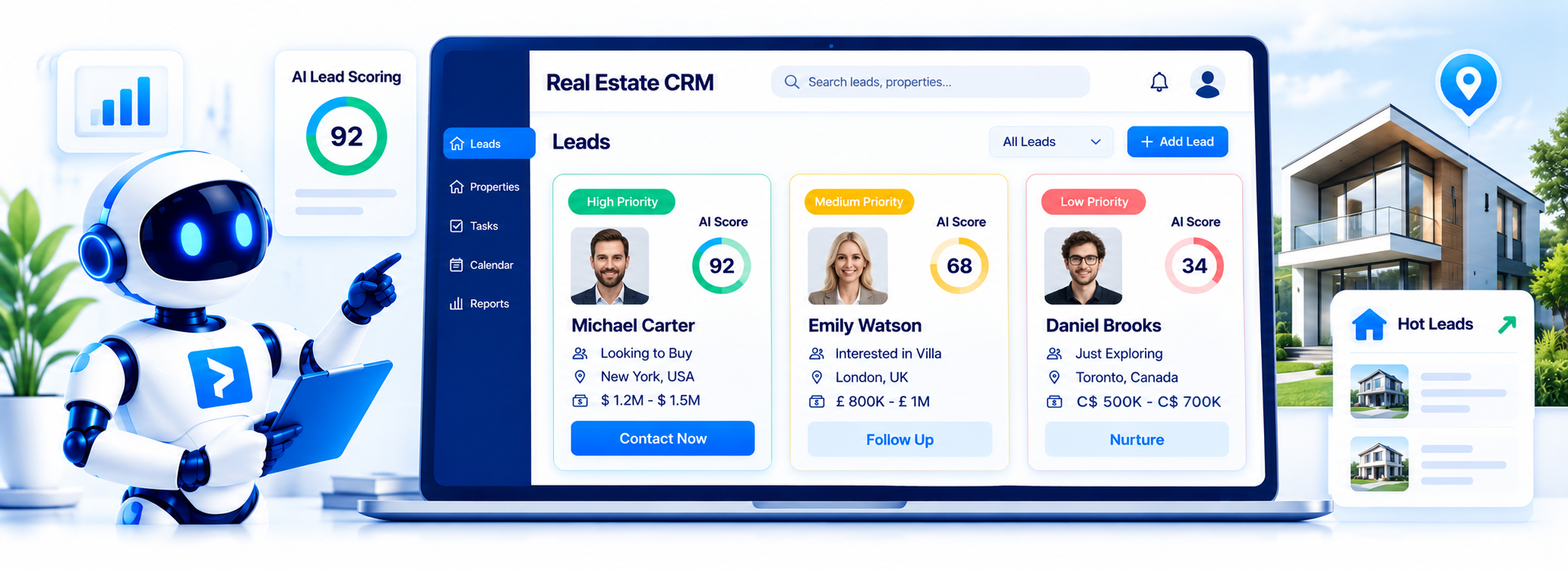
AI lead-scoring models rank prospects by engagement, budget, preferences, and past conversion outcomes within the real estate CRM. For example, a buyer who views three properties and asks about mortgages receives a higher priority.
The data required for AI in real estate lead scoring includes CRM records, inquiries, lead sources, property viewing history, and conversion outcomes.
Estimated build cost: 15,000 to 40,000.
Typical pilot duration: 6 to 8 weeks.
Lead scoring is often a practical starting point for brokerages. Retrain models monthly to account for changing buyer behavior and mortgage rates.
3. AI Chatbots for Real Estate Inquiries
Property inquiries often arrive outside business hours, allowing potential leads to lose interest before agents respond.
AI chatbots answer listing questions, recommend properties, qualify prospects, and book viewings. They can use AI eCommerce personalization techniques and connect to live availability through AI chatbot development.
The required data includes listing feeds, property FAQs, availability, CRM records, and scheduling integrations.
Estimated build cost: 10,000 to 30,000.
Typical pilot duration: 4 to 6 weeks.
Transfer conversations to a human agent when buyers begin negotiating prices. AI in real estate chatbots works best as the first point of contact.
4. AI-Assisted Tenant Screening
Leasing teams spend hours reviewing application documents manually, increasing the risk of missed inconsistencies.
AI organizes applicant documents and flags discrepancies for human review using lawful, documented screening criteria.
The data required for AI in real estate tenant screening includes applicant-authorized documents, verified application details, and legally permitted screening records.
Estimated build cost: 15,000 to 40,000.
Typical pilot duration: 8 to 10 weeks.
Keep final screening decisions with human reviewers and audit outcomes for potential discrimination under the Fair Housing Act. AI for property management should improve efficiency without introducing additional bias.
5. Predictive Maintenance for Property Portfolios
Equipment failures during peak seasons can lead to expensive emergency repairs and tenant disruption.
Predictive maintenance identifies equipment at risk of failure and prioritizes work orders by urgency and cost. For example, a model can flag an aging rooftop HVAC unit before summer.
The required data includes work orders, equipment history, inspection reports, asset age, and available sensor readings.
Estimated build cost: 25,000 to 70,000.
Typical pilot duration: 10 to 14 weeks.
Start with existing work order records before investing in sensors. Property managers can demonstrate value from historical data alone, making predictive maintenance a practical application of AI in real estate.
6. Lease Abstraction and Document Intelligence
Missed renewal dates and overlooked escalation clauses can quietly reduce rental income and increase financial risk for property owners.
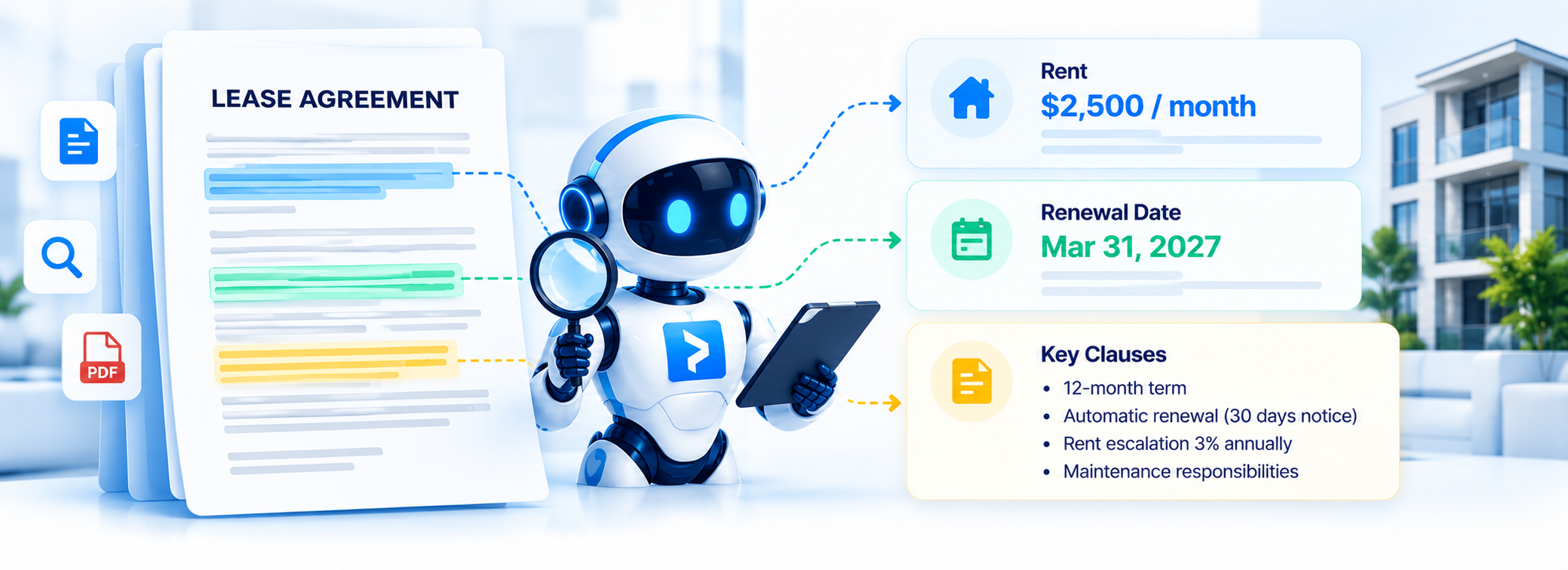
Lease abstraction uses AI to extract rent terms, renewal dates, escalation clauses, and contractual obligations into searchable, structured fields.
The required data includes lease PDFs, amendments, clause definitions, and verified extracted fields.
Estimated build cost: 10,000 to 35,000.
Typical pilot duration: 4 to 8 weeks.
Have reviewers validate the first 200 leases to establish accuracy. A well-defined clause library helps AI in real estate improve extraction consistency and reduce manual review effort over time.
7. Computer Vision for Property Inspections
Property inspectors review hundreds of photos but can still miss gradual damage or emerging maintenance issues.
Computer vision identifies visible damage, such as water stains and cracked tiles, and compares images across inspections for human verification. See synthetic data generation for related AI training techniques.
The required data includes inspection images, labeled damage examples, property records, and inspection reports.
Estimated build cost: 25,000 to 75,000.
Typical pilot duration: 12 to 16 weeks.
Collect labeled inspection photos early, as data quality directly affects detection accuracy. Human verification remains essential for reliable property condition assessments.
8. AI Virtual Staging for Property Listings
Empty rooms can be difficult to market effectively, while physical staging adds high costs per property.
Virtual staging uses AI to generate furnished room images while preserving the property's actual walls, windows, and floors.
The data required for AI in real estate virtual staging includes property photographs, room dimensions where available, and visual editing constraints.
Estimated build cost: 8,000 to 25,000.
Typical pilot duration: 3 to 6 weeks.
Clearly label digitally staged images to set accurate buyer expectations. Transparency protects buyer trust and strengthens the credibility of AI-powered real estate marketing.
9. MLS Data Enrichment and Listing Intelligence
Property listings often contain missing fields, inconsistent attributes, and duplicate records.
AI models standardize attributes, fill data gaps, and flag duplicate listings across authorized MLS data sources. Reliable MLS API integration keeps feeds current, while the RESO Data Dictionary standardizes field names.
The required data includes licensed MLS records, property identifiers, listing descriptions, and data quality rules.
Estimated build cost: 15,000 to 45,000.
Typical pilot duration: 6 to 10 weeks.
Clean listing data strengthens other AI in real estate applications. Addressing data quality early helps reduce rework and integration costs in subsequent projects.
10. AI Rental and Portfolio Performance Forecasting
Property owners often base budgets on last year’s occupancy figures rather than changing market conditions.
AI forecasting models predict occupancy, rental demand, renewal likelihood, and revenue under different market scenarios.
The required data includes lease history, rental rates, vacancies, renewals, expenses, and local market indicators.
Estimated build cost: 20,000 to 60,000.
Typical pilot duration: 8 to 12 weeks.
Model three scenarios: base, downside, and upside. Showing a range of possible outcomes helps owners understand uncertainty, build confidence in AI forecasts, and refine property management plans each quarter.
Here is how the ten compare for planning budgets:
|
Use case |
Main user |
Payback speed |
|
Valuation and AVM |
Brokerage |
Medium |
|
Lead scoring |
Brokerage |
Fast |
|
Inquiry chatbot |
Both |
Fast |
|
Tenant screening support |
Property manager |
Medium |
|
Predictive maintenance |
Property manager |
Medium |
|
Lease abstraction |
Property manager |
Fast |
|
Inspection vision |
Property manager |
Slow |
|
Virtual staging |
Brokerage |
Fast |
|
MLS enrichment |
Brokerage |
Medium |
|
Portfolio forecasting |
Owner or operator |
Slow |
Cost note: These figures are illustrative custom development estimates in USD. Treat them as planning ranges, since they do not represent verified market averages. Actual costs depend on data licensing, integrations, complexity, deployment, and ongoing operating expenses.
How to Prioritize Use Cases and Estimate Total Cost
Brokerages should start with lead scoring or inquiry automation when their CRM and listing data are reliable. Property managers should prioritize lease abstraction or maintenance prioritization when lease documents and work orders are accessible. Portfolio operators should begin with rental forecasting when their operating history is consistent.
Pick the workflow that hurts most this quarter. For instance, a 30 agent brokerage losing weekend leads gains more from a chatbot than from a valuation model. AI in real estate delivers when it removes a visible pain your team feels daily. Brokers building on mobile can extend this through real estate app development.
Assess Data Readiness and Integration Complexity
Before starting any build, assess how many records are missing key fields, confirm you have permission to use the data for AI, and verify that historical data covers at least two years. Ensure MLS access is licensed for the intended purpose and identify which CRM, property management, and accounting systems need to be integrated.
Score each answer red, amber, or green. Two red flags mean fixing data quality should come before funding any AI in real estate model.
Messy contact records usually need CRM data migration first. AI for property management projects often uncover duplicate tenant records at this stage. Expect two to four weeks of cleanup.
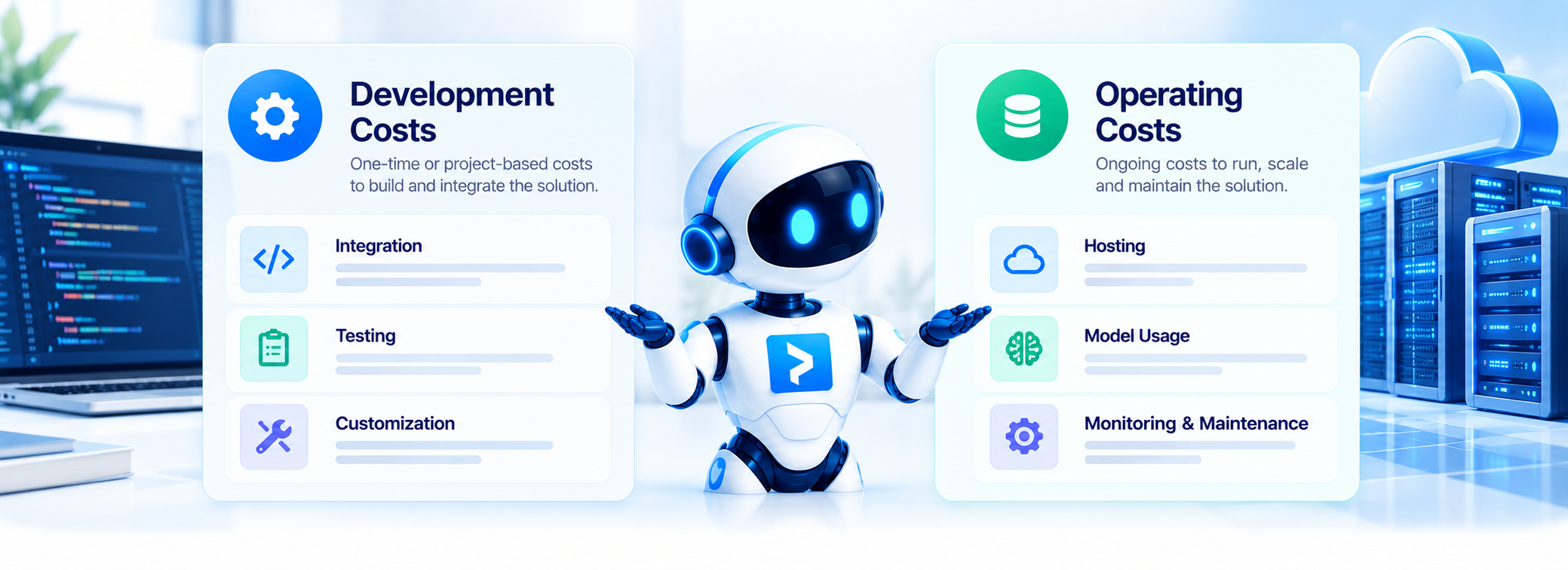
Separate Development Costs From Operating Costs
|
Cost type |
What it covers |
|
One-time build |
Data preparation, integrations, model development, testing. |
|
Monthly operating |
Cloud or API usage, monitoring, retraining, support. |
A $10,000 prototype often needs three times that budget to reach production. Prototypes skip security, edge cases, integrations, and monitoring. Budget for twelve months of AI in real estate operating costs before you approve any build.
Ask every vendor for a 12 month total that covers hosting, support, and retraining. Every AI tool also needs staff training time, which rarely appears on vendor quotes. Smart budgets include it upfront.
What Real Estate Businesses Need for Successful AI Adoption
Implementing AI in real estate requires more than selecting a model. Businesses need reliable integrations, clean data, and workflows that fit existing operations.
A partner experienced in real estate software development can connect AI solutions with property management systems, CRMs, and listing platforms.
Combining this expertise with AI personalization helps tailor property recommendations and buyer experiences to individual preferences.
The priority is to solve a measurable business problem while keeping the solution practical for teams to use and maintain.
Build AI Around Real Estate Needs
Patoliya Infotech helps real estate businesses connect AI capabilities with everyday workflows, from property data management and lead qualification to rental forecasting and maintenance planning.
Our approach focuses on identifying the operational bottleneck, integrating relevant data sources, and developing solutions around existing systems.
We also apply AI personalization to improve property discovery and buyer experiences. The goal is to make AI in real estate practical, measurable, and aligned with how property teams work.
Conclusion
The brokerages and property managers who win with AI in real estate start small, stay disciplined, and measure everything. They match one business problem with reliable data and a number they can measure. Choose one workflow, check your data honestly, and price the full build plus a year of operating costs before you commit.
AI for property management and brokerage tools pay back fastest when people trust and use them daily. If you want a grounded view of what fits your operations, let’s map your first use case, its data gaps, and its real cost together.
FAQs:
Track business outcomes such as reduced manual workload, faster response times, fewer data errors, improved occupancy, and lower maintenance costs. Compare results against pre-implementation baselines.
Common challenges include fragmented data, outdated systems, integration issues, privacy requirements, and employee resistance. Addressing these operational barriers early helps prevent delays and unreliable results.
Yes. AI solutions can connect with existing CRMs, property management platforms, accounting systems, and listing databases through APIs, provided the systems support integration and appropriate data access.
Protect AI in real estate data with role-based access controls, encryption, data minimization, audit logs, and clear retention policies. Review vendor data-handling practices and secure appropriate permissions before processing sensitive information.
AI can automate repetitive tasks such as document extraction, inquiry handling, and data analysis. Agents and property managers remain essential for negotiations, relationship building, complex decisions, and accountability.
For AI in real estate, define a clear business problem, validate outputs against verified records, establish human review procedures, and monitor performance after deployment. Scale only when results meet agreed acceptance criteria.