AI Fraud Detection: A Guide for Fintech Executives
 By Hitesh SUpdated on: 10/19/2613 min read
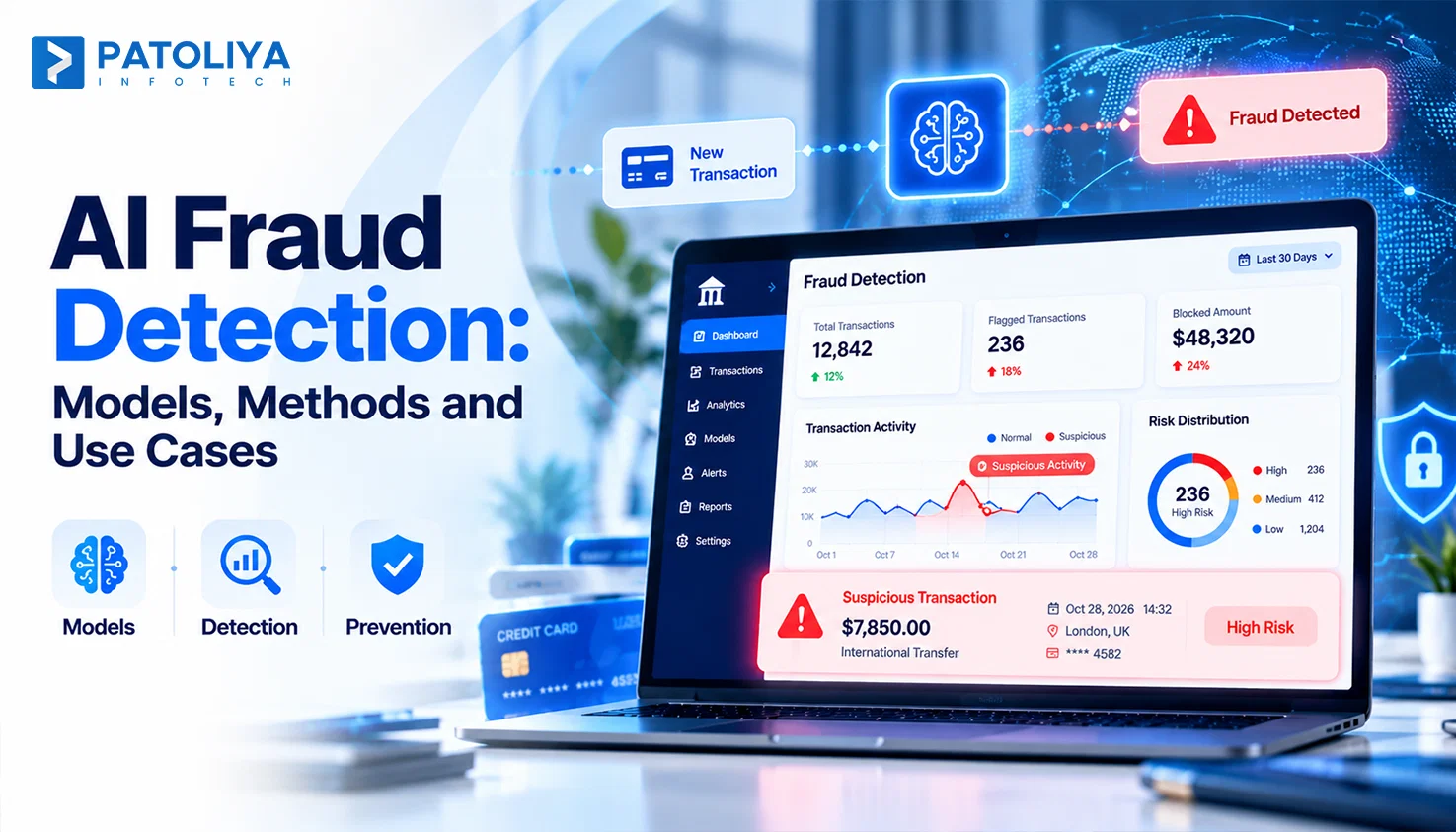
TLDR: AI fraud detection earns its budget when it lowers fraud losses and false declines together. The setup that works blends rules, machine learning, and graph signals, scores each transaction in milliseconds, and routes risk to approve, challenge, review, or decline. Start with a data readiness check and a measured pilot before any full rollout.
Every blocked payment feels like a win for your fraud team and a lost sale for your growth team. Both teams are right, and that tension decides your margins. AI fraud detection works best as a decision system that weighs fraud losses, approval rates, customer friction, and investigation cost together.
Static rules break because fraudsters probe limits daily and scatter activity across devices and channels. Leaders who treat AI in fintech as a scoring engine alone miss the bigger payoff. This guide breaks down the architecture, models, and decision logic behind detection that cuts false declines without inviting new fraud.
AI Fraud Detection in Fintech: Essential Fundamentals
Rules catch known fraud patterns, while machine learning identifies suspicious behavior across hundreds of signals. Static rules, such as blocking cards used in two countries within one hour, are easy to audit but slow to adapt. A hybrid approach combines both, using rules to enforce limits and models to assess risk as fraud patterns evolve. For a deeper look at implementation, see our guide to machine learning fraud detection, including how intelligent security systems identify suspicious activity.
Each fraud type leaves distinct signals. Payment fraud often involves high card velocity, such as ten test charges followed by one large order. Account takeover may show a new device and suspicious password-reset timing, followed by a new payee within 20 minutes.
Synthetic identity fraud can involve thin credit files and shared phone numbers, with credit maxed out by month six. Mule networks may reveal shared devices across multiple accounts funneling money into one wallet. AML red flags include structuring, where deposits are split into smaller amounts to avoid reporting thresholds. Map your top three loss types before you pick any model. Skip this, and AI in fintech tools solve the wrong problem.
AI Fraud Detection Models: Choosing the Right Approach
Selection of the right fraud detection model depends on your data, fraud patterns, transaction volume, and acceptable risk levels.
Supervised Learning for Known Fraud Patterns
Supervised models learn from transactions your analysts have already labeled as fraud or genuine. Gradient-boosted trees stay the workhorse since they train fast and explain well.

Best for: card testing, refund abuse, repeat attack patterns.
Watch out: they only spot fraud that looks like past fraud.
Anomaly Detection for Emerging Fraud
Anomaly detection flags behavior that drifts from a customer’s normal rhythm, even with zero labels. Example: a salaried user who pays bills at 9 a.m. suddenly sends five transfers at 3 a.m. to new payees.
Our view: feed anomaly scores into the main model. Standalone anomaly alerts flood review queues.
Graph Neural Networks for Connected Fraud
Graph neural networks read links between accounts, devices, cards, and addresses. One mule account looks clean. Forty accounts sharing two phones and one payout wallet look like a ring, and graph features expose it.
Hybrid Models and Behavioral Signals
Strong AI fraud detection combines all three layers. Rules enforce hard stops, behavioral models track typing speed and session flow, and the ensemble returns one real-time scoring output per event.
Some teams now add AI agent fraud detection to triage alerts. For AI in fintech buyers, hybrid design balances accuracy and audit comfort, keeping decisions defensible.
Great models still fail inside weak plumbing, so architecture comes next.
Inside a Production-Ready AI Fraud Detection Architecture
A production-ready pipeline scores transactions in milliseconds, combining real-time data, fraud models, decision rules, and continuous feedback.
From Transaction Events to Real-Time Decisions
A production pipeline turns a raw payment event into an action in under a few hundred milliseconds. Here is the five step flow we recommend for card and wallet traffic:
Event ingestion: Payments, logins, and profile changes stream through a message bus like Kafka.
Feature engineering: The system computes rolling counts, such as transfers in the last ten minutes or device age.
Model inference: Models score the event and return reason codes.
Decisioning: A policy layer maps the score to approve, challenge, review or decline.
Feedback loop: Chargebacks, analyst verdicts and disputes return as fresh labels.
This same flow powers real-time transaction monitoring across cards, wallets and bank transfers.
Feature Freshness, Throughput and Latency
Stale features hurt more than weak models. A velocity count that lags 30 seconds misses the exact burst a fraud bot relies on.
Feature lookup has a sample latency budget of 15 ms at p95 and 30 ms at p99. Model inference is allocated 20 ms at p95 and 40 ms at p99, while decision-making and logging have budgets of 10 ms and 20 ms, respectively.
Track p99, since your slowest calls hit your busiest hours. Load test AI fraud detection services at three times your highest sale day peak, and watch queue lag during that test.
Fallbacks When Models or Data Sources Fail

Every AI fraud detection system needs a written plan for bad days.
Timeouts: Switch to fallback rules after a fixed wait, such as 80 ms.
Missing features: Use safe defaults and tag the decision for later review.
Safe degradation: Approve small, known customer payments. Hold large or first-time transfers.
Escalation: Route high-risk cases to analysts with full context attached.
Teams applying AI in fintech often skip fallback testing, and outages then become fraud windows. Run a failure drill each quarter so stays dependable when a vendor API goes down.
Reliable plumbing sets up the real business win: fewer wrong declines.
How to Reduce False Positives Without Increasing Fraud Losses
A model with 99.9% accuracy can still hurt you. If fraud makes up 0.1% of volume, a model that approves everything scores the same. False positives cost you sales, support tickets, and loyal customers.
Example: Raising a decline threshold from 0.70 to 0.80 lets a few more small frauds through and saves hundreds of good customers each week. Price both sides in dollars before you choose. Count manual review cost too, since every borderline case delays a real customer. Good AI fraud detection tunes for profit, with accuracy as a supporting number.
|
Risk score |
Context |
Action |
|
Low |
Known device, usual amount |
Approve instantly |
|
Medium |
New device, normal amount |
Step up with OTP or biometrics |
|
High |
New payee, large transfer |
Hold for manual review |
|
Very high |
Linked to known mule ring |
Decline and flag |
This tiered approach lets AI fraud detection protect revenue and customers at the same time. A step-up check costs seconds. A wrong decline costs the relationship.
Find False Positives by Customer and Transaction Cohort. Slice declines by:
- Payment method, such as cards against UPI or ACH.
- Geography and cross-border activity.
- Customer tenure and past dispute history.
- Recent device or SIM changes.
- The specific rule that fired.
One overeager rule often causes most false declines in a single cohort. Travel spending and new phones regularly trigger repeat blocks on loyal customers. Fix that rule first, then retrain, and your AI fraud detection gains show up within weeks. Good AI-driven risk detection makes these cohort views a standard report.
Track six numbers weekly: fraud loss, approval rate, false decline rate, chargebacks, investigation cost, and customer friction. Leaders funding AI in fintech should see all six on one dashboard, since success shows up across them together.
Better decisions mean little if the model quietly decays, which brings reliability into focus.
Model Reliability, Explainable AI and Compliance
Fraud labels arrive late. Chargebacks can land 60 to 120 days after purchase. Use this checklist:
- Validate on time-based splits, training on older months and testing on newer ones.
- Exclude features created after the decision moment, such as dispute flags.
- Let labels mature before judging recent performance.
- Monitor score distributions and feature drift every week.
Teams that skip time-based validation ship models that look brilliant in testing and fail in week two. Strong AI fraud detection treats drift as normal and plans for it.
Make Fraud Decisions Explainable and Auditable
Regulators, analysts, and customers all ask why. Explainable AI answers it through reason codes such as “new device plus new payee plus large amount.”
- Build these controls into every deployment: maintain decision logs that record the model version and input features, require human review for high-impact declines, enforce least-privilege security for model and data access, and use controlled releases with documented sign-off.
AML rules, privacy laws, and rules on automated decisions, such as Article 22 of the GDPR, shape what you must log and explain. AI in fintech tools supports compliance work. Your legal and risk teams still own it, and it works best inside that oversight. With trust in place, the next task is proving value in production.
How to Evaluate AI Fraud Detection in Production
Measure Business Outcomes Alongside Model Performance. Review this scorecard every month:
- Business: fraud losses, legitimate approval rate, review workload.
- Engineering: p99 latency, availability, timeout rate.
- Model: precision at your threshold, recall, drift alerts.
A model that wins on recall and doubles analyst workload loses the business case. Healthy AI fraud detection improves at least two business numbers without hurting the rest.
Deploy the model in stages: backtest historical data, run shadow scoring on live traffic, roll out to 5% of transactions, test against a challenger model, and proceed to full release once performance meets the agreed criteria.
Backtest on at least six recent months. Shadow scoring runs the new model on live traffic without acting on it, so you can compare decisions side by side. Keep the current model as a challenger for two weeks after launch. Set rollback criteria upfront, such as approval rate dropping 0.5 points. The NIST AI Risk Management Framework offers a useful structure for these gates across AI in fintech programs, and it fits AI fraud detection reviews well.
How to Evaluate an AI Fraud Detection Service Provider
Ask every provider these questions before you sign:
- How many months of transaction history and fraud labels do you need?
- Can you use identity signals from KYC automation and device data?
- Have you built fraud detection in payment systems across gateways, core banking, and case management tools?
- How do you handle missing or noisy fraud labels in our history?
Vague answers here predict a slow, expensive pilot. Partners who ask for your data dictionary in week one usually deliver.
A reliable vendor shares live p99 latency data from past projects rather than discussing model accuracy alone, explains feature pipelines and backfills instead of leaving data challenges to your team, demonstrates fallback behavior and monitoring for model outages, and provides reason codes for every decision rather than delivering an unexplained, black-box score.
Ask for a failure demo. Strong partners love showing how their AI fraud detection behaves when things break.
Define Deliverables Before Implementation Starts
Put these five items in the statement of work, each with an owner and a date:
- Data readiness assessment with gap list.
- Target architecture and integration map.
- Baseline metrics from your current system.
- Pilot plan with validation gates.
- Production handover with runbooks.
Specialist fintech software development partners and teams offering AI development for financial services should commit to each item in writing. Our guide on AI in fintech covers wider build choices. Clear deliverables keep AI fraud detection projects from drifting into open ended research.
Building the Business Case for AI Fraud Detection
Use this formula to calculate fraud savings, recovered margin, and operating costs.
Net benefit = fraud losses avoided + recovered legitimate margin + review cost savings − implementation cost − operating cost − extra intervention cost
Worked example:
|
Line item |
Annual value |
|
Fraud losses avoided |
$1,200,000 |
|
Recovered margin from fewer false declines |
$450,000 |
|
Review cost savings |
$180,000 |
|
Implementation cost |
($600,000) |
|
Operating cost |
($250,000) |
|
Extra OTP and review cost |
($80,000) |
|
Net benefit |
$900,000 |
Recovered margin often surprises boards most. Most teams track fraud, avoid and forget the good customers they stopped wrongly blocking. That second number turns AI fraud detection from a cost center into a growth lever. Run the model with conservative inputs first, then update it with real pilot data.
Set Executive Success Criteria and Ownership
|
Owner |
Accountable for |
|
Risk |
Acceptable fraud loss rate. |
|
Product |
Approval rate and friction targets. |
|
Engineering |
Latency, uptime, cost limits. |
|
Compliance |
Audit trail and regulatory fit. |
Agree on pilot exit criteria before launch, such as a target approval lift with flat fraud losses over 90 days. Review these numbers monthly with all four owners in one room. Shared ownership decides whether AI in fintech projects scale or stall. Partners with deep fintech development experience help set these targets, so your AI fraud detection pilot ends with a clear go or no-go call.

Why Fintech Leaders Trust Patoliya’s AI Expertise
At Patoliya Infotech, we approach AI fraud detection as a business-critical decision system, not just a model deployment. Our engineering focus spans real-time transaction scoring, hybrid rule-based and machine learning architectures, anomaly detection, and explainable risk decisions.
We prioritize production realities: data quality, millisecond-level latency, fallback mechanisms, auditability, and false-positive reduction so fintech leaders can protect margins while maintaining customer trust.
Conclusion
The winners in fraud prevention treat it as a profit decision. Reliable data, the right mix of models, risk-based actions, and steady monitoring make AI fraud detection pay for itself. Every point of approval rate you protect is revenue your competitors lose.
Leaders who run AI in fintech with clear owners and hard exit criteria move faster and sleep better. Start small, measure honestly, and scale what works. If your roadmap needs a sharp starting point, let’s sit down for a data readiness review and shape a pilot with success criteria your board will trust.
FAQs:
AI fraud detection models should be retrained when fraud patterns, customer behavior, or transaction distributions change significantly. Monitor model drift, precision, recall, and fraud losses regularly to determine when retraining is necessary.
Yes, AI fraud detection can use graph analytics to connect accounts through shared devices, phone numbers, payment instruments, and transaction patterns. These relationships help uncover coordinated fraud that individual transaction checks may miss.
Measure AI fraud detection using fraud loss rates, false-positive rates, approval rates, precision, recall, and decision latency. Track these metrics by transaction type and customer segment to identify performance gaps without hiding losses behind overall averages.
When AI fraud detection produces an uncertain score, the system can request additional authentication, route the transaction for manual review, or apply a temporary restriction. Defined thresholds and escalation rules keep ambiguous cases from receiving inconsistent treatment.
AI fraud detection can integrate with legacy payment systems through APIs, event streams, or middleware. A phased integration lets fintech teams evaluate latency, data quality, and decision consistency before replacing existing rules or expanding automated decisions.
Explainable AI fraud detection provides reason codes and supporting signals that help investigators understand why a transaction was flagged. Clear explanations speed case reviews, support appeals, and create an audit trail for internal risk and compliance teams.