Medical Invoice Software: Features, Cost & Benefits
TL;DR: Medical invoice software turns confusing patient statements into clear, accurate, payment ready documents. Automating this layer cuts administrative workload and speeds up revenue collection without touching the claims process.
Healthcare billing problems often begin before payment is even due. When patients receive statements they cannot understand, confusion around procedure codes, insurance adjustments, and balances can quickly delay payments.
Medical invoice software helps healthcare organizations transform complex billing data into clear, patient-friendly invoices that improve transparency and payment experiences.
By fixing communication gaps between providers and patients, organizations can reduce billing friction, improve collections, and reduce staff workload. This guide explains what medical invoice software does, how it differs from patient billing software, and how to choose the right solution.
What Is Medical Invoice Software?
Medical invoice software is a system that creates, manages, and delivers patient-facing billing documents, translating clinical and insurance data into a statement a patient can read and pay without calling the front desk.
It sits downstream of claims processing, pulling finalized balances and turning them into itemized invoices delivered by email, text, or a secure patient portal. Good patient billing software also tracks payment status and reconciles what comes back against what was billed.
Medical Invoice Software vs Medical Billing Software: What Is the Difference?
Medical invoice software and medical billing software solve different problems, and confusing the two is why many organizations buy the wrong tool.
|
Function |
Medical Billing Software |
Medical Invoice Software |
|
Primary Focus |
Claims, coding, payer workflows |
Patient statements, invoices, payment collection |
|
Main User |
Billing and coding staff |
Patients and front desk teams |
|
Core Output |
Submitted claims, reimbursement |
Itemized invoice, payment link |
|
Success Metric |
Clean claim rate |
Days to patient payment |
Billing software talks to payers. Patient billing software talks to patients. Most healthcare organizations need both working together, since a clean claim means nothing if the resulting invoice confuses the person who has to pay it.
The Key Components Behind an Accurate Medical Invoice
A clear invoice from medical invoice software includes these components every time.
- Patient and provider information.
- Service dates for each line item.
- CPT or procedure codes with plain language descriptions.
- Diagnosis-related details when applicable.
- Insurance payments and adjustments shown separately.
- Patient responsibility amount stated clearly.
- Outstanding balance as a single visible number.
- Digital payment options, including payment links and QR codes.
Skipping any one of these fields is usually what breaks itemized medical invoice generation and triggers a confused call to the front desk about patient billing software accuracy.
The Patient Billing Journey From Visit to Payment
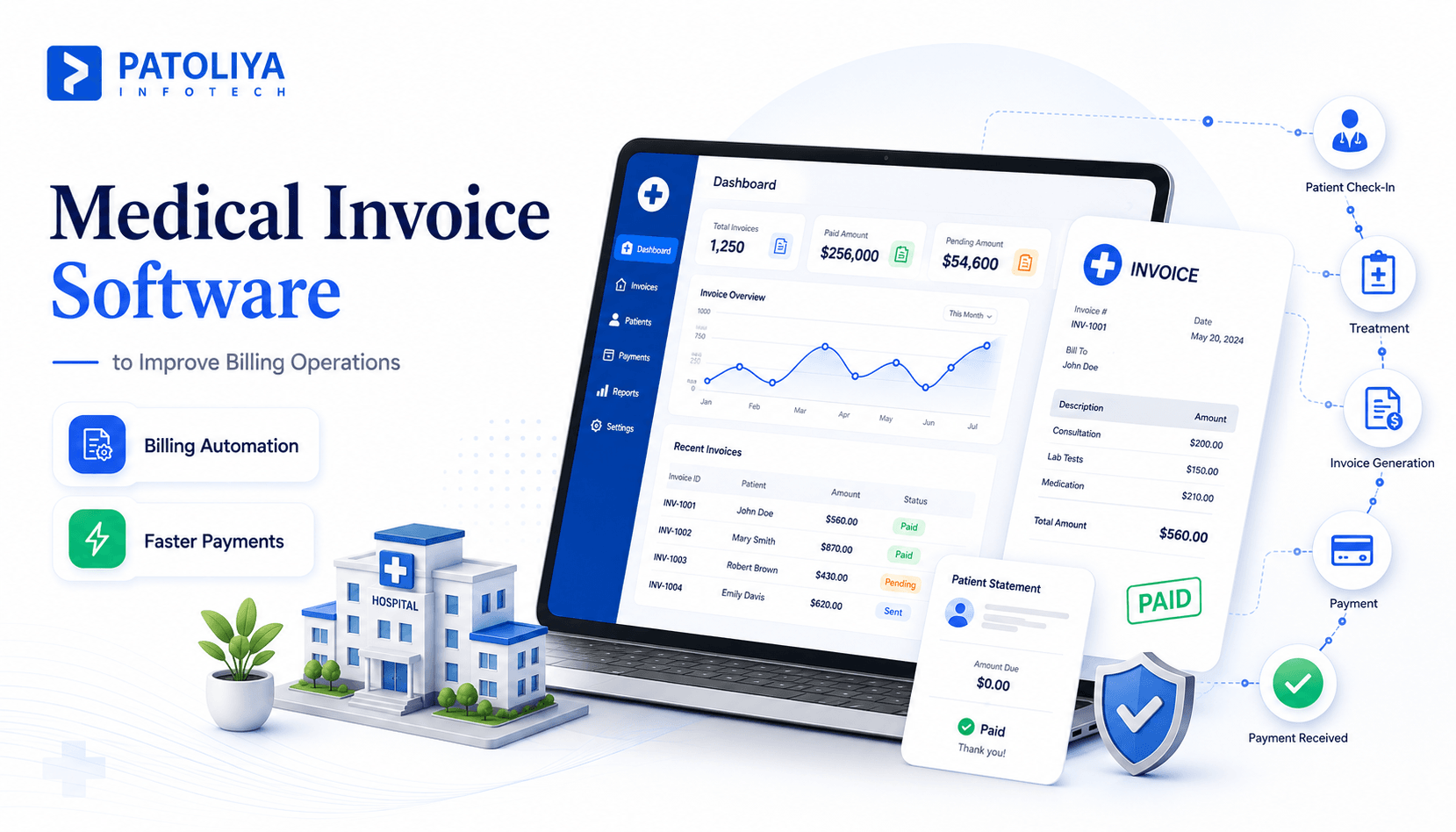
The patient billing journey is a key part of healthcare revenue cycle management, running through eight connected steps where delays at any point can slow patient payments.
The journey starts at the encounter itself, where the visit gets documented and coded by clinical staff. Coding feeds insurance processing, where the payer applies coverage rules and returns an adjusted balance. That balance flows into invoice generation, where medical invoice software builds an itemized statement automatically. Delivery happens through email, SMS, or a patient portal, depending on patient preference. The patient then completes an online payment, and the system closes the loop with payment reconciliation against the original claim.
What Real Medical Invoice Automation Should Deliver
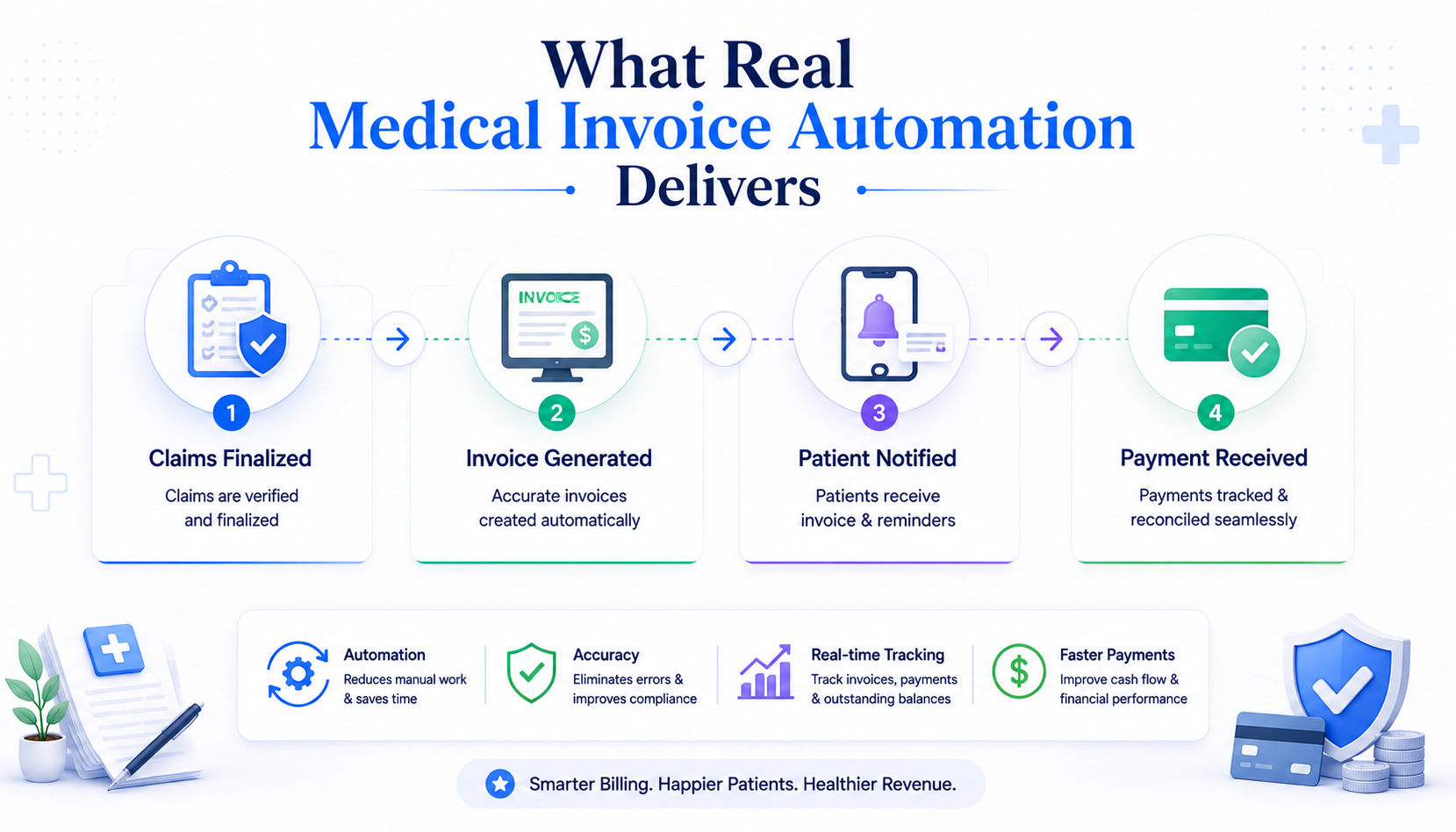
Real medical invoicing automation goes beyond creating PDF invoices. It helps healthcare organizations reduce manual work, improve accuracy, and streamline the entire billing process.
- Automated invoice generation: Creates invoices automatically after claims are finalized.
- Dynamic payment updates: Adjusts balances automatically when payments or insurance changes occur.
- Insurance adjustment handling: Reduces manual recalculations by updating patient balances accurately.
- Patient communication workflows: Sends reminders, confirmations, and payment notifications.
- Payment tracking: Provides visibility into invoice status through connected healthcare payment processing software.
- System integration: Connects with existing healthcare systems.
How Medical Invoice Software Improves Revenue Collection
Medical invoice software improves revenue collection by removing the friction that causes patients to delay or avoid payment entirely.
- Faster payments, since patients receive clear statements immediately after claims finalize.
- Reduced billing delays, because invoices generate automatically instead of waiting on manual staff review.
- Fewer payment disputes, since itemized detail answers questions before patients need to call.
- Better visibility into outstanding balances that patient billing software tracks across the entire patient population.
- Improved patient payment software experience through digital, mobile-friendly statements.
A mid-sized clinic replacing paper statements with automated medical invoice software cut its average days to payment nearly in half within two billing cycles.
Reducing Administrative Work While Improving Patient Trust
Automation through medical invoice software reduces manual work for staff while giving patients a clearer, more trustworthy billing experience.
Front desk teams field far fewer confused calls once patient billing software explains charges in plain language instead of raw codes.
Billing departments spend less time chasing manual corrections, since healthcare payment processing software handles adjustment calculations automatically.
Patients build more trust in the organization when statements arrive quickly, match what they remember from the visit, and show a clear path to pay. That trust translates directly into faster payment, since patients pay bills they believe are accurate.
Essential Integrations Every Healthcare Organization Should Expect
Medical invoice software only performs as well as the systems it connects to, and gaps here are what stall organizations at scale.
Healthcare data integration through EHR and EMR systems keeps clinical and billing information synchronized so invoices accurately reflect each patient encounter.
Practice management systems feed scheduling and provider data directly into the invoicing layer. Healthcare payment processing software handles the actual transaction, and this is where it does its heaviest lifting.
Effective payment gateway integration connects healthcare payment systems with insurance verification, reducing billing errors and surprise patient charges.
Accounting platforms pull reconciled payment data for financial reporting, and patient portals give patients one place to view and pay every invoice. Organizations that skip any of these integrations eventually hit a wall where manual work creeps back into a process meant to run without it.
Buy, Build or Customize Which Approach Fits Your Healthcare Business
Off-the-shelf Software
Off-the-shelf medical invoice software fits small practices running standard workflows without complex billing needs. Limitations show up fast for growing organizations, since customization stays limited and the roadmap depends entirely on the vendor's priorities.
Custom Medical Invoice Software Development
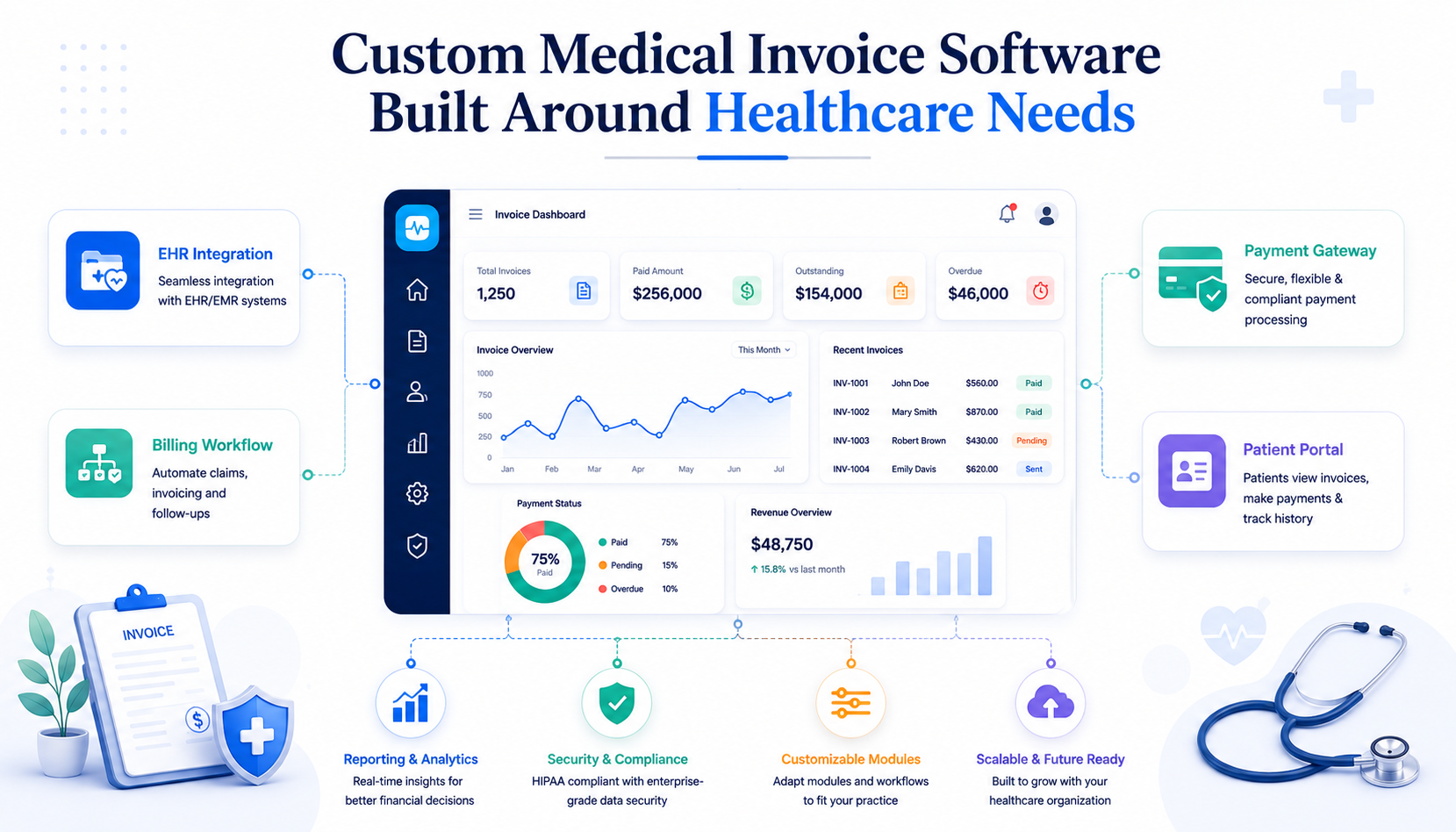
Custom software development for medical invoice platforms fits healthcare networks, SaaS providers, and organizations managing complex billing workflows across multiple locations.
Benefits include custom workflows built around actual operations, full integration control, complete ownership of the technology, and no dependency on a vendor's release schedule.
API Based Customization
API integration enables organizations to extend existing healthcare platforms with new invoicing and patient billing capabilities without rebuilding the entire system.
This route works well for organizations that already run healthcare payment processing software and only need the invoicing layer rebuilt around it.
Top 5 Medical Invoice Software Development Partners
Choosing a partner for medical invoice software development takes more than a general software team, since patient billing carries compliance and payment requirements a generic vendor often misses.
1. Patoliya Infotech
Best for: Custom healthcare invoice and SaaS platform development.
Patoliya Infotech builds custom billing and patient-facing software for healthcare organizations, focusing on scalable architecture, healthcare system integrations, and workflow automation instead of rigid templates.
Strengths:
- Custom medical billing and invoice workflows.
- Healthcare SaaS development expertise.
- EHR/EMR and third-party integration capabilities.
- Secure cloud-based healthcare solutions.
- Patient portal and payment experience development.
2. ScienceSoft
Best for: Enterprise healthcare software modernization.
ScienceSoft builds complex healthcare platforms, including systems that require compliance, interoperability, and enterprise-level scalability across large organizations.
Strengths:
- Healthcare IT consulting experience.
- Enterprise healthcare application development.
- Data security and compliance-focused development.
- Integration with existing healthcare systems.
3. Emorphis Technologies
Best for: Healthcare workflow automation solutions
Emorphis Technologies specializes in healthcare software development, including clinical applications and digital health platforms, with experience across HIPAA, HL7, and FHIR standards.
Strengths:
- Healthcare-specific development expertise.
- HL7/FHIR integration capabilities.
- Custom healthcare applications.
- Compliance-focused engineering.
4. Peerbits
Best for: Custom healthcare platforms and integrations.
Peerbits develops patient portals, healthcare applications, and interoperability-focused platforms, emphasizing scalable systems built around real operational workflows.
Strengths:
- Custom healthcare software development.
- Healthcare API integrations.
- Patient engagement platforms.
- Scalable cloud-based solutions.
5. Chetu
Best for: Healthcare SaaS and digital health products.
Chetu builds custom healthcare software across billing, patient engagement, and clinical workflow categories, with a dedicated healthcare technology practice.
Strengths:
- Healthcare-only software focus within its healthcare division.
- HIPAA-compliant development approach.
- EHR and healthcare integration experience.
- Custom healthcare product development.
Medical Invoice Software Development Cost SaaS Fees vs Custom Investment
|
Approach |
Estimated Cost Range |
Suitable For |
|
SaaS Medical Invoice Software |
$50 to $2,000+/month |
Clinics and healthcare organizations looking for ready-to-use billing workflows. |
|
Custom MVP Development |
$75,000 to $150,000+ |
Organizations needing specific invoicing features and essential integrations. |
|
Enterprise Custom Platform |
$150,000 to $500,000+ |
Healthcare networks requiring advanced integrations, security, and scalability. |
Security and Compliance Requirements: HIPAA, PCI DSS, and Patient Data Protection
Security in medical invoice software requires HIPAA compliance alongside secure platform design, since compliance depends on both technology and operational processes.
Strong healthcare software security protects patient data through encryption, secure transmission, access controls, and continuous monitoring. Access controls limit who can view or modify patient billing software records inside the organization. Audit logs create a record of every access and change for compliance review.
Secure healthcare payment processing software running through PCI DSS compliant gateways protects card data during transactions. Compliance responsibility sits with the healthcare organization as much as the software vendor, since no platform guarantees compliance without proper configuration and process on the buyer's side.
Implementation Timeline: What to Expect Before Going Live
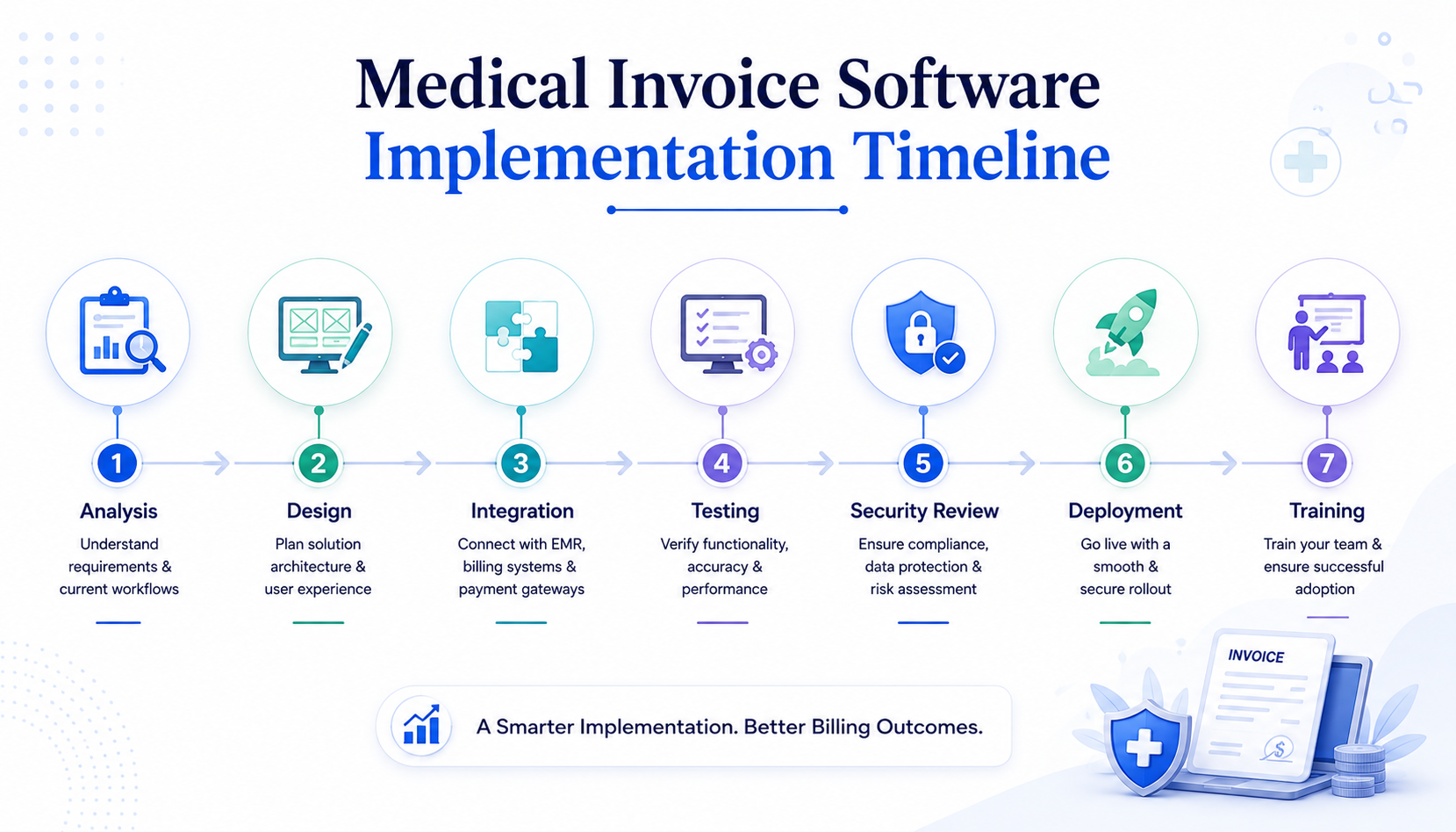
A realistic medical invoice software implementation runs through seven stages before go-live.
- Requirement analysis to map current billing gaps and integration needs.
- Design covering workflow, invoice templates, and patient communication touchpoints.
- Integration development connecting EHR, payment gateways, and practice management systems.
- Testing across billing scenarios, edge cases, and payment flows.
- Security review confirming healthcare payment processing software meets HIPAA and PCI DSS alignment.
- Deployment into the live environment with monitoring in place.
- Staff onboarding so front desk and billing teams can support the new system.
|
Stage |
Estimated Timeline |
|
Requirement analysis |
2 to 4 weeks |
|
Design and workflow planning |
3 to 6 weeks |
|
EHR, payment gateway, and system integrations |
6 to 12 weeks |
|
Testing and quality validation |
3 to 6 weeks |
|
Security review and compliance checks |
2 to 4 weeks |
|
Deployment and production setup |
1 to 2 weeks |
|
Staff onboarding and adoption support |
2 to 4 weeks |
Final Checklist Before Choosing Medical Invoice Software
|
Evaluation Criteria |
Why It Matters |
|
Healthcare integrations |
Determines whether data flows without manual entry |
|
Payment capabilities |
Directly affects how fast patient billing software, backed by solid healthcare payment processing software, turns balances into paid invoices |
|
Compliance readiness |
Protects the organization from HIPAA and PCI DSS risk |
|
Customization options |
Determines whether the tool fits real workflows |
|
Scalability |
Prevents another migration as patient volume grows |
|
Vendor support |
Affects how fast issues get resolved after launch |
|
Total ownership cost |
Reveals the real cost beyond the subscription price |
Why Choose Patoliya for Medical Invoice Software Development
Patoliya Infotech delivers healthcare software development solutions by building medical invoice software around an organization's actual billing workflows instead of forcing businesses into fixed templates.
- Healthcare-focused development: Experience with healthcare compliance and HIPAA-aligned architecture.
- Seamless integrations: Custom integration support for EHRs, payment gateways, and practice management systems.
- Complete technology ownership: Clients receive full ownership of the solution without vendor lock-in.
Patoliya helps organizations identify billing gaps and build custom medical invoice software that works with existing patient billing software and workflows. A focused discussion can help determine the right development approach.
Conclusion
Medical invoice software closes the gap between healthcare operations and the patient financial experience. The organizations collecting payments faster are the ones treating patient statements as a designed experience, not just a byproduct of the claims process.
By making billing information clearer, reducing manual work, and improving payment visibility, the right solution creates a smoother journey for both patients and providers. Select a platform built for transparency, accuracy, and integration that delivers value beyond the first billing cycle.
FAQs:
Medical invoice software improves payment collection by creating clearer invoices, reducing billing confusion, and giving patients convenient payment options. Better transparency helps healthcare organizations reduce payment delays and improve the overall patient financial experience.
Yes, most medical invoice software solutions can integrate with EHR, EMR, practice management, and healthcare payment processing systems to automatically sync patient, billing, and payment information.
The cost depends on whether an organization chooses a SaaS solution or custom medical invoice software development. Pricing varies based on features, integrations, compliance needs, security requirements, and scalability goals.
Implementation timelines vary based on complexity. A standard SaaS setup may take weeks, while a custom medical invoice software solution with multiple integrations and workflows may require several months.
Yes, advanced platforms can automate parts of the billing workflow, including invoice generation, claim data processing, payment tracking, and patient balance updates, reducing manual administrative effort.
Healthcare organizations should evaluate features such as data encryption, role-based access control, audit logs, secure payment processing, and compliance support when selecting medical invoice software.