How to Evaluate Healthcare Technology Companies Before You Sign a Contract
TL;DR: A strong choice among healthcare technology companies goes beyond compliance checks. Evaluate technical fit, security, clinical workflow expertise, team capabilities, ROI, contract terms, and financial stability before committing.
The healthcare technology market is crowded, and most healthcare technology companies promise similar outcomes. But healthcare software decisions carry higher risks because patient data, clinical workflows, integrations, and regulatory requirements directly affect operations and trust.
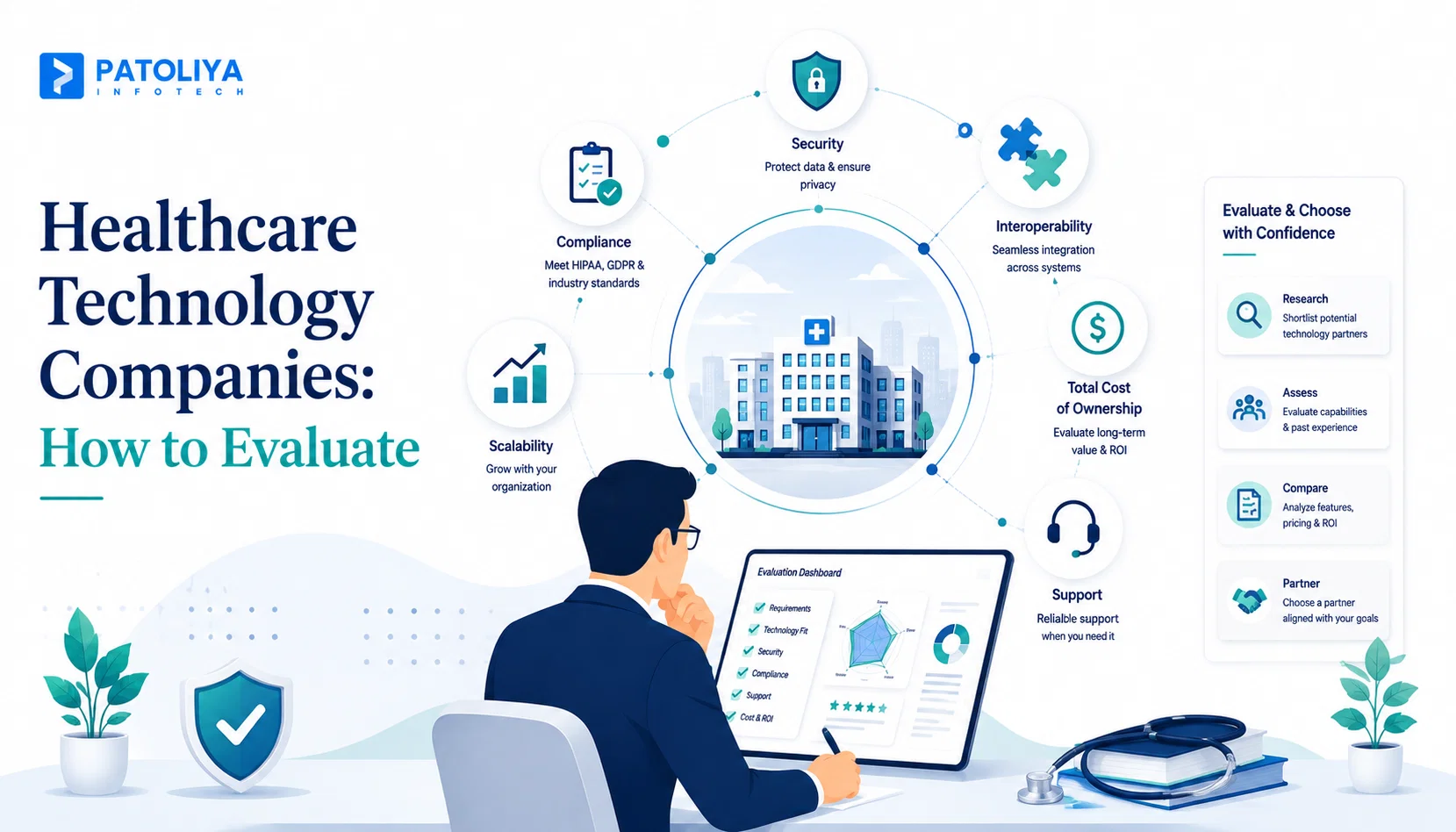
Compliance is only one part of the equation. A stronger evaluation looks at technical capabilities, security practices, healthcare expertise, implementation approach, team quality, scalability, ROI, contract protection, and financial stability. This helps you identify a technology partner that can deliver reliably today and scale with your organization tomorrow.
The Real Cost of Choosing the Wrong Healthcare Technology Partner
Why Healthcare Technology Vendor Selection Carries More Risk
Choosing among healthcare technology companies carries more risk than selecting standard business software. Patient data, clinical workflows, EHR dependencies, and regulatory requirements make reliability and security essential. A poor technology decision can also delay implementation and disrupt care delivery.
Where a Poor Vendor Decision Creates Financial Loss
A weak vendor choice can quickly increase costs through:
- Delayed implementation and go-live.
- Unexpected EHR integration work.
- Security incidents and remediation.
- Low clinician adoption.
- Unplanned customization fees.
- Operational downtime.
- Rising support costs.
- Expensive vendor replacement.
The Hidden Costs Behind the Initial Quote
The quoted price rarely reflects the full investment. When comparing healthcare technology companies, account for implementation, data migration, integrations, customization, training, support, internal IT resources, and change management.
A lower proposal is not always the lower-cost option. For example, an inexpensive vendor may later charge heavily for EHR integration or data migration. A thorough healthcare tech vendor evaluation should assess total cost, technical fit, implementation risk, and long-term value, not compliance alone.
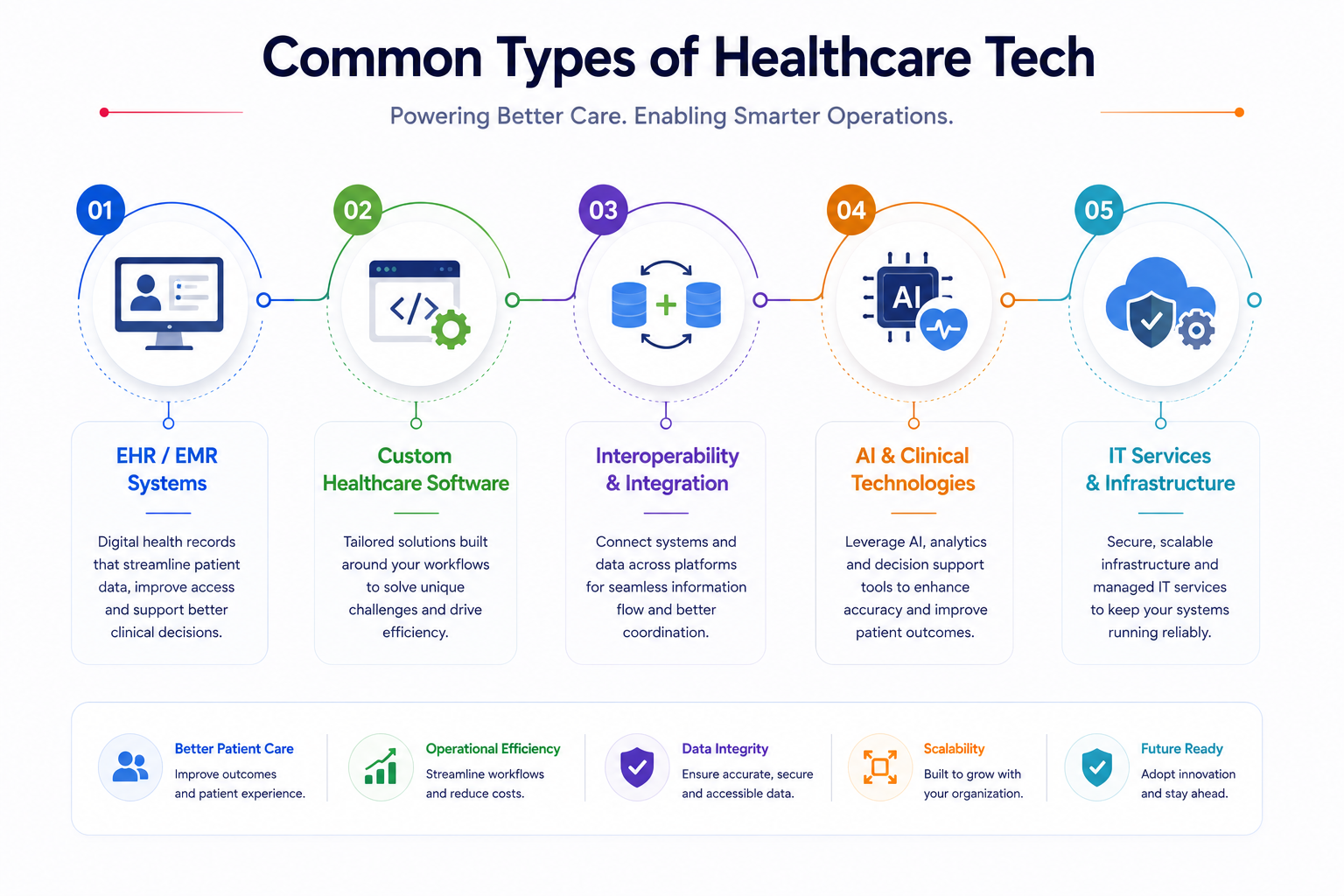
Common Types of Healthcare Technology Companies
|
Company Type |
What They Usually Provide |
Best Fit |
|
EHR and EMR vendors |
Clinical records and workflows |
Healthcare providers |
|
Healthcare software development companies |
Custom applications and platforms |
Unique requirements |
|
Interoperability vendors |
Healthcare data exchange |
Multi-system environments |
|
AI and clinical technology companies |
AI, analytics, decision support |
Data-driven workflows |
|
Healthcare IT service providers |
Technology implementation and support |
Enterprise transformation |
Identify the Type of Partner You Actually Need
Before contacting healthcare technology companies, decide whether the project needs ready-made software, a custom build from a healthcare software development company, system integration, legacy modernization, AI implementation, product engineering, or long-term technology support. This decision shapes your entire shortlist.
Core Healthcare Technology Vendor Evaluation Criteria
Verify Healthcare Compliance Before Anything Else
Compliance is the baseline every one of the healthcare technology companies on your list must clear before anything else gets discussed.
Confirm HIPAA compliance, a signed Business Associate Agreement, documented privacy controls, role-based access controls, a written incident response process, and audit trail capability.
Examine Security Certifications and Technical Controls
|
Evaluation Area |
What to Verify |
|
SOC 2 Type II |
Report, scope and validity |
|
HITRUST |
Certification or assessment status where applicable |
|
Encryption |
Data at rest and in transit |
|
Access control |
RBAC, MFA and privileged access |
|
Audit logging |
User and system activity |
|
Incident response |
Documented response process |
Test Interoperability Instead of Trusting the Sales Deck
A sales deck can claim anything, so healthcare technology companies need to prove interoperability directly, including the depth of their healthcare data integration capabilities.
Evaluate HL7 FHIR support, HL7 compatibility, open APIs, EHR integration, single sign-on, identity management, and data migration capability when assessing a healthcare technology vendor's interoperability.
Ask Vendors to Prove Their Claims
Evaluating a healthcare tech partner works best with a simple framework: claim, then evidence, then validation. A vendor claims FHIR support. You request the API documentation and verify its healthcare API integration capabilities through a real integration workflow.
You test an actual integration workflow before signing. This approach keeps a healthcare tech vendor evaluation grounded in proof rather than sales language.
Healthcare Technology Vendor Checklist for Team, References and Proof of Work
Evaluate the Team You Will Actually Receive
The people assigned to the build matter more than the company name on the contract. Ask healthcare technology companies to confirm the healthcare experience of solution architects, developers, QA staff, security specialists, project managers, and the support engineers who take over after launch.
Protect Against the Bait and Switch Team
During sales: Senior architect, healthcare specialist and experienced engineers presented on the call.
After signing: Junior developers, a different delivery team, and outsourced resources show up instead.
Protect yourself by naming key roles inside the contract, requesting the proposed team structure in writing, and confirming exactly how replacements get handled if someone leaves mid-project.
Ask for Healthcare Specific References
Skip the logo wall and ask healthcare technology companies direct questions instead:
- What healthcare workflow did you build for this client?
- Which systems did you integrate with?
- How long did implementation actually take?
- What went wrong during the project?
- How did the vendor respond to the problem?
- Would the customer choose them again today?
Validate Capabilities Through a Pilot or POC
|
Situation |
POC Recommendation |
|
Complex EHR integration |
Strongly recommended |
|
New AI workflow |
Strongly recommended |
|
Highly customized platform |
Recommended |
|
Standard SaaS deployment |
Depends on scope |
|
Proven low-risk implementation |
May not be necessary |
The Healthcare Technology Vendor Checklist
Run through this healthcare technology vendor checklist before any final decision: relevant healthcare experience, healthcare-specific references, named delivery team, security evidence, integration capability, support model, POC option, clear project responsibilities, data ownership terms, and exit strategy.
Total Cost of Ownership and ROI Before Signing
Look Beyond the License or Development Cost
The quoted price from healthcare technology companies rarely covers the full investment, especially when evaluating healthcare SaaS where implementation, integrations, customization, training, and support can add to the total cost. Implementation, integration, migration, training, customization, and support all add cost; projects involving centralized analytics or a healthcare data warehouse can introduce additional infrastructure and integration considerations.
Calculate the Full Cost of Ownership
|
Cost |
Questions to Ask |
|
Software |
What is included in the base license |
|
Implementation |
What is included in setup |
|
Integration |
Are APIs and integrations extra |
|
Migration |
Who handles the data migration |
|
Training |
Is training included or billed |
|
Support |
What does the support tier cover |
|
Customization |
What counts as billable work |
Challenge the Vendor's ROI Assumptions
Ask what baseline the vendor is using, which savings are actually measurable, when ROI should appear, and what assumptions drive the projected numbers. Vague answers on any of these four points are a warning sign.
Contract Terms That Protect You
Define the SLA and Support Obligations
Confirm uptime commitments, response time, resolution time, escalation procedures and service credits before signing with any of the healthcare technology companies on your shortlist.
Confirm Data Ownership and Portability
Ask who owns the data, whether you can export it, in what format, how quickly and what happens to it after the contract ends.
Review Exit and Liability Clauses
|
Contract Area |
What to Verify |
|
Exit clause |
Termination rights |
|
Data portability |
Export process |
|
Breach notification |
Required timeline |
|
Liability |
Liability cap |
|
SLA |
Remedies for failure |
Vendor Financial Viability and Long-Term Risk
Assess Whether the Vendor Can Support You Long Term
Financial stability rarely gets checked during a healthcare tech vendor evaluation, yet it decides whether the platform still exists in three years.
Review company history, financial stability, leadership, customer concentration, product investment, and support capacity before committing.
Consider Acquisition and Product Roadmap Risk
Ask what happens to pricing, product roadmap, support quality, and data policies if one of the healthcare technology companies on your list gets acquired mid-contract. Roadmap priorities shift fast under new ownership.
Plan for Vendor Failure
What happens if the vendor stops operating six months after go-live? Before signing, confirm data export rights, access to technical documentation, migration support, and source code escrow where appropriate.
Also clarify transition timelines, responsibilities, and costs so your organization can move to another vendor without unnecessary disruption.
Healthcare Technology Company Comparison
Patoliya Infotech
Patoliya Infotech is a healthcare-focused custom software and digital transformation partner that helps organizations build new healthcare products and modernize existing technology environments.
Best for: Healthcare organizations that need custom platforms, healthcare management systems, integrations, cloud modernization, or solutions built around specific operational workflows.
Key strengths:
- Builds custom healthcare platforms around specific clinical and operational workflows.
- Provides healthcare management solutions for patient, hospital, billing, and scheduling needs.
- Delivers EHR and third-party integrations for connected healthcare systems.
- Develops cloud-based healthcare solutions designed for scalability and flexibility.
- Builds telemedicine and digital health platforms for remote care and patient engagement.
- Provides LIS solutions for laboratory workflows, reporting, and data management.
- Supports legacy healthcare modernization to upgrade outdated systems.
ScienceSoft
ScienceSoft is an established software consulting and development company with a broad healthcare technology practice. It supports organizations across software development, analytics, integration, and digital transformation.
Best for: Large healthcare organizations looking for enterprise-grade software development, modernization, analytics, or integration expertise.
Key strengths:
- Provides healthcare IT consulting for technology strategy and transformation.
- Develops enterprise healthcare software for complex organizational needs.
- Delivers healthcare analytics solutions for reporting and data-driven decisions.
- Provides system and data integration across healthcare applications.
- Supports software modernization for legacy healthcare environments.
- Delivers digital transformation services across technology and workflows.
- Builds custom healthcare applications around specific business requirements.
Itransition
Itransition provides enterprise software engineering services through a dedicated healthcare practice. Its experience with healthcare standards makes it suitable for organizations managing complex interoperability requirements.
Best for: Healthcare organizations working on interoperability, enterprise healthcare platforms, and systems that need to connect multiple clinical or administrative data sources.
Key strengths:
- Provides healthcare IT engineering for complex technology environments.
- Supports FHIR implementation for healthcare data exchange and interoperability.
- Delivers DICOM integration for medical imaging systems.
- Applies healthcare data standards to support consistent data exchange.
- Builds interoperability solutions connecting clinical and administrative systems.
- Develops custom healthcare software for specific organizational needs.
- Provides enterprise system integration across complex healthcare ecosystems.
Chetu
Chetu provides custom software development and IT services across healthcare, with solutions covering applications, telehealth, integrations, and connected medical technologies.
Best for: Healthcare organizations requiring custom applications, telehealth capabilities, third-party integrations, or medical device connectivity.
Key strengths:
- Develops custom healthcare applications for specific organizational workflows.
- Builds telehealth software for virtual care and remote consultations.
- Provides third-party integrations connecting healthcare applications and services.
- Supports medical device integration for connected healthcare technologies.
- Develops healthcare workflow solutions for clinical and operational processes.
- Provides application modernization for aging healthcare systems.
- Offers IT and software services for ongoing healthcare technology needs.
Intellectsoft
Intellectsoft combines custom software development with digital transformation services for healthcare organizations. Its healthcare capabilities cover digital health products, enterprise applications, and connected healthcare technologies.
Best for: Organizations developing digital health platforms, enterprise healthcare applications, EHR-connected solutions, or IoMT products.
Key strengths:
- Develops EHR solutions connecting applications with healthcare record systems.
- Builds telehealth platforms for virtual care and remote services.
- Develops IoMT solutions connecting medical devices with healthcare software.
- Creates custom healthcare applications for specific business and clinical needs.
- Provides digital transformation services for healthcare modernization.
- Offers full-cycle software development from planning through deployment.
- Provides post-launch support for maintenance and application improvements.
WillowTree
WillowTree focuses on digital product development and experience design, making it particularly relevant for healthcare organizations where usability and patient engagement are central to the product.
Best for: Patient-facing healthcare applications, mobile health products, and digital experiences that require strong UX and product strategy.
Key strengths:
- Provides product strategy for digital health product development.
- Delivers UX/UI design focused on intuitive healthcare experiences.
- Develops mobile healthcare applications for patients and healthcare users.
- Builds digital products combining strategy, design, and engineering.
- Creates patient-facing experiences focused on engagement and usability.
- Provides UX optimization to improve digital healthcare interactions.
- Delivers digital health product design with a strong user-experience focus.
From Vendor Shortlist to Final Decision
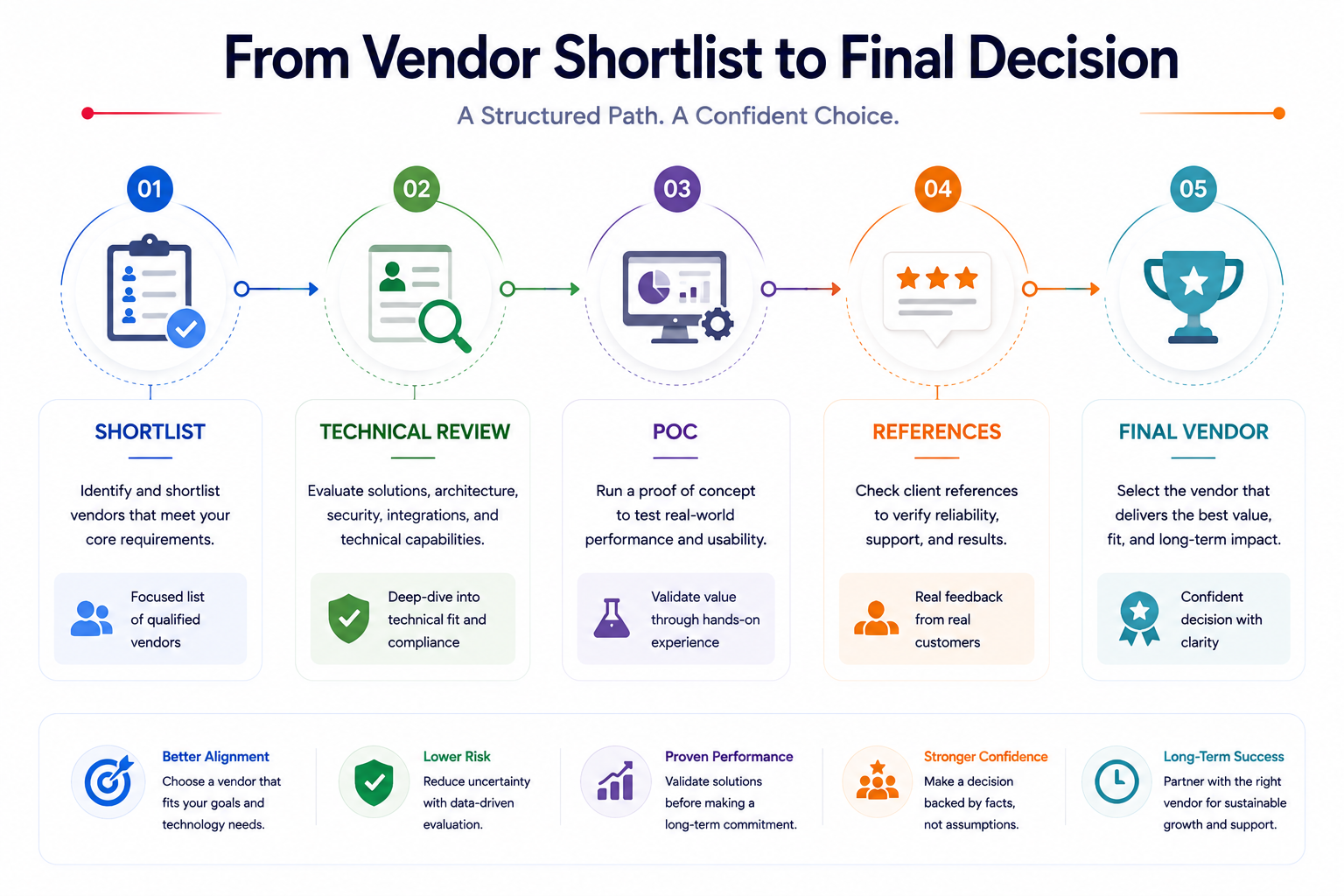
Once you have narrowed your options, move beyond comparing healthcare technology companies on features and pricing.
Request a technical discovery session, review relevant healthcare case studies, validate integration capabilities, assess security documentation, and speak with client references.
A small proof of concept can also expose workflow, scalability, and implementation issues before a long-term contract, particularly when evaluating healthcare workflow automation requirements.
The right choice should demonstrate measurable value, healthcare expertise, technical reliability, and a clear path to implementation.
Why Choose Patoliya Infotech as Your Healthcare Technology Partner
Patoliya Infotech combines healthcare expertise with custom healthcare software engineering to build secure, scalable solutions around your workflows.
Healthcare expertise: Solutions designed for real healthcare operations.
Custom development: Platforms tailored to specific business requirements.
Seamless integrations: EHR, cloud, and third-party system connectivity.
Scalable architecture: Technology built for long-term growth.
End-to-end support: From discovery and development to deployment and maintenance.
Patoliya Infotech can help you build, modernize, and integrate healthcare systems with healthcare management solutions aligned to your operational goals and long-term growth. Ready to build better healthcare technology? Talk to Patoliya Infotech today.
Conclusion
Healthcare technology procurement is never a simple feature comparison. Compliance sets the baseline, technical fit determines implementation risk, TCO determines financial value, contract terms determine future flexibility, and financial due diligence determines long-term vendor risk.
Every one of the healthcare technology companies on your shortlist should earn its spot through evidence, not promises. Patoliya Infotech works with organizations evaluating, building, integrating, and modernizing healthcare technology solutions every day. Let's talk through what your evaluation actually needs.
FAQs:
Focus on whether the company can demonstrably meet your healthcare, technical, compliance, integration, and business requirements rather than choosing based on brand recognition alone.
Complexity, number of stakeholders, integrations, compliance requirements and total project value all determine the right evaluation timeline, so simple purchases move faster than enterprise builds.
A Business Associate Agreement is the legal contract required whenever a vendor handles protected health information on behalf of a covered healthcare organization, and it should never be optional.
POCs work best for complex, high-risk, or highly customized implementations. Proven low-risk solutions with an established track record do not always require one.
Review company history, leadership stability, funding position where applicable, customer concentration, business model, product investment, and long-term support capability before signing.
Unsupported compliance claims, unclear data ownership, bait-and-switch staffing, poor references, unrealistic ROI claims, weak security evidence, and restrictive exit terms are all reasons for vetting a health tech vendor to stop there.