Dental Practice Management Software: Features, Cost, and Build Guide
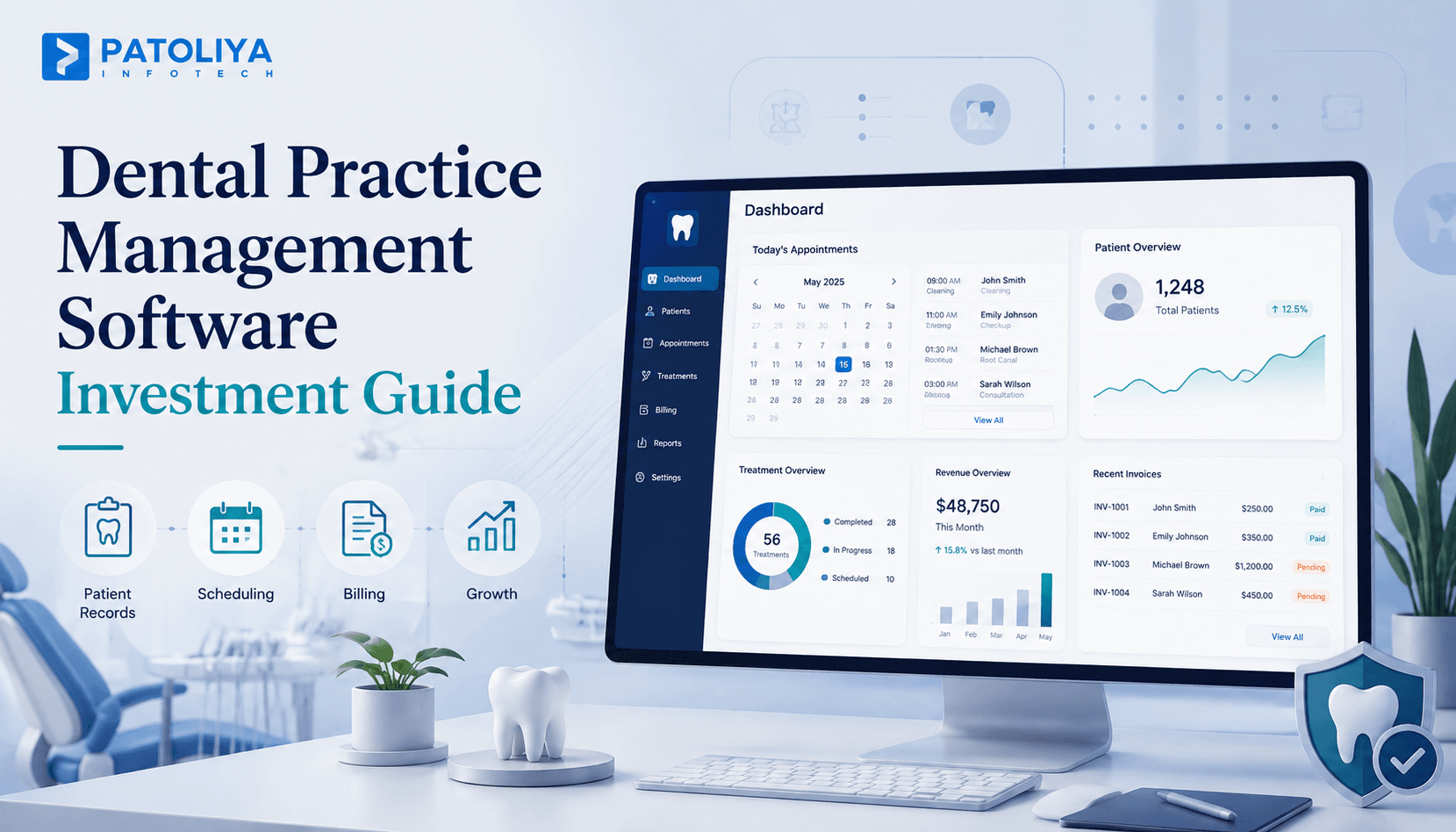
TL;DR: Dental practice management software brings scheduling, billing, patient records, and imaging into one connected platform. It helps dental practices reduce missed appointments, streamline daily operations, and improve payment collection. Custom Dental Practice Software gives growing practices more flexibility when standard solutions cannot support their unique workflows.
Growing dental practices run into the same wall. Scheduling sits in one app, billing sits in another, patient charts sit somewhere else, and imaging lives on a separate machine entirely. Dental practice management software solves this by connecting every clinical workflow to the business side that keeps a practice running through modern healthcare software development practices.
The platform a practice picks decides how fast it gets paid and how well it scales. Weak dental clinic software creates gaps in compliance, revenue, and patient experience that show up months later as denied claims or missed follow-ups. Strong Dental Practice Software removes those gaps before they cost real money.
This guide explains what dental practice management software actually includes, what it costs, and when a custom build beats a ready made dental clinic software package. Every section ahead ties back to one goal: choosing Dental Practice Software that fits how the practice actually runs, not how a sales deck describes it.
What Is Dental Practice Management Software?
Dental practice management software is the system that runs a dental office beyond the treatment chair. It manages appointments, patient communication, billing, insurance workflows, and daily reporting from a single dashboard, so front desk staff never have to switch between five separate tools to finish one task. This is what most owners mean when they search for Dental Practice Software for the first time.
The Shift to Digital Dental Practice Management
Clinics are leaving paper charts and disconnected tools behind for cloud-based dental practice management software with automated reminders and real-time visibility across every location an owner runs. This shift is what separates modern dental clinic software from the desktop tools most practices grew up on.
Dental EHR or Dental Practice Management Software: Understanding the Difference
A dental EHR stores clinical records such as chart notes, treatment plans, and X-rays. Dental practice management software runs the business layer around those records, covering scheduling, billing, and reporting.
Modern dental clinic software merges both layers into one record through healthcare data integration, allowing treatment plans to flow directly into billing without duplicate data entry.
|
Function |
Dental EHR |
Dental Practice Management Software |
|
Core Focus |
Clinical records and treatment history |
Scheduling, billing, and daily operations |
|
Primary Users |
Dentists and clinical staff |
Front desk and billing staff |
|
Data Handled |
Chart notes, X-rays, treatment plans |
Appointments, claims, payments, reports |
How Dental Appointment Scheduling and Billing Software Work
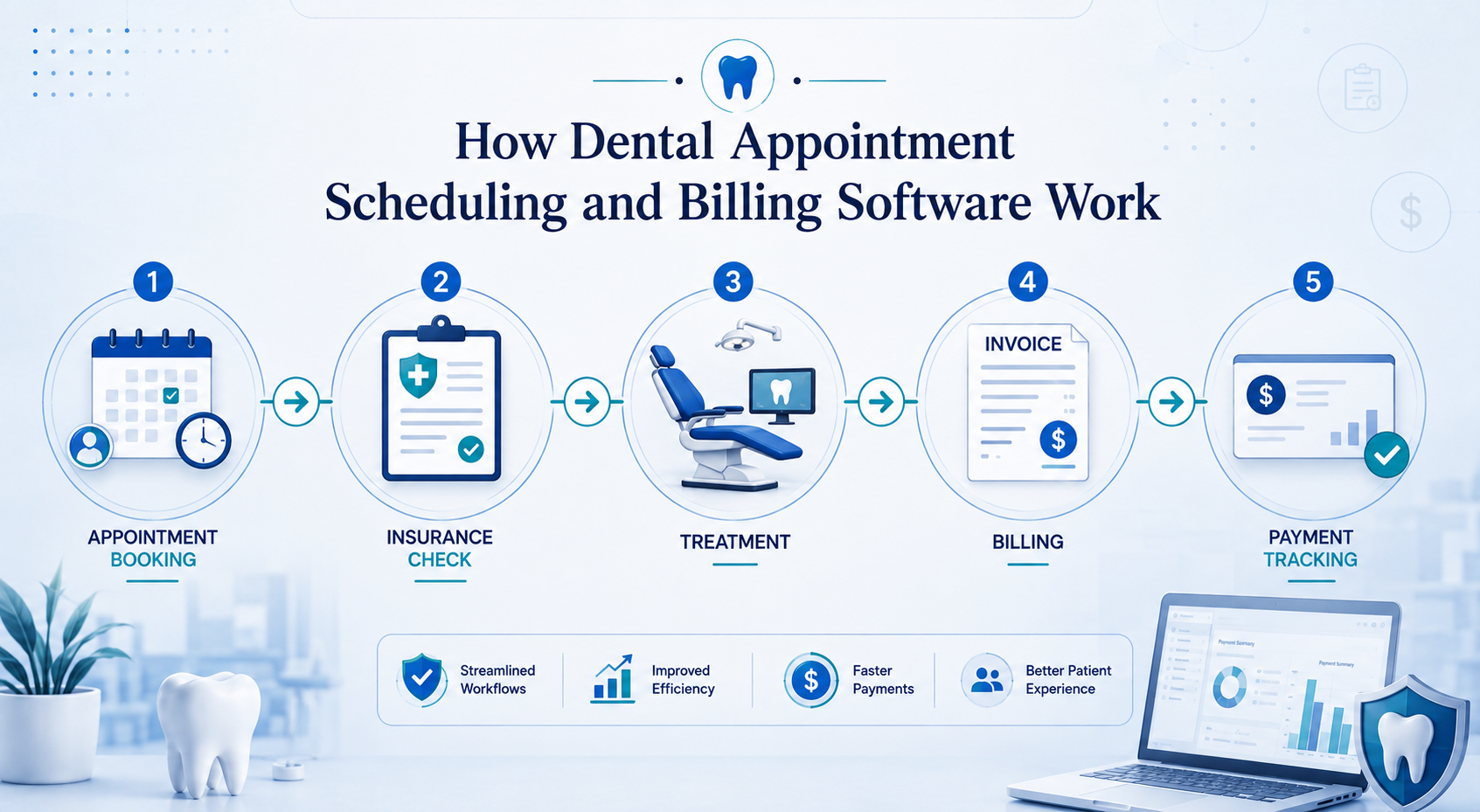
First, a patient books online and dental practice management software checks insurance eligibility automatically before the visit is even confirmed.
Second, an automated reminder goes out by text so the chair does not sit empty from a missed appointment.
Third, the medical billing software layer generates a claim immediately after treatment, reducing delays and manual processing.
Fourth, the claim gets tracked until payment lands, so a denial gets caught and corrected within days, not months. This sequence is what separates real dental appointment scheduling software from a basic calendar app with reminders bolted on.
Must Have Features Checklist for Dental Practice Management Software
A serious dental practice management software platform needs to cover clinical, financial, and administrative needs from one place.
The checklist below covers what to confirm before signing with any Dental Practice Software vendor, and it applies just as much to a solo office as it does to a growing group.
- Patient management and digital records in one file.
- Dental EHR integration that removes duplicate data entry.
- Appointment scheduling automation that fills empty chair time.
- Billing and revenue cycle management that speeds up payment.
- Insurance claims management that cuts denial rates.
- Dental imaging integration inside the same patient chart.
- Patient portals for booking, paying, and messaging.
- Analytics dashboards showing real production numbers.
- Multi-location management from a single login.
- Security and compliance controls built in.
Skipping any one of these on a dental clinic software shortlist usually shows up later as a workflow gap nobody planned for. A shortlist built around this exact list rarely leaves a practice searching for a second dental clinic software vendor within the first year.
How Dental Practice Management Software Improves Efficiency and Revenue
Dental practice management software delivers measurable business impact by enabling healthcare workflow automation that replaces manual, disconnected processes across the practice, and this is exactly where Dental Practice Software earns back its cost fastest.
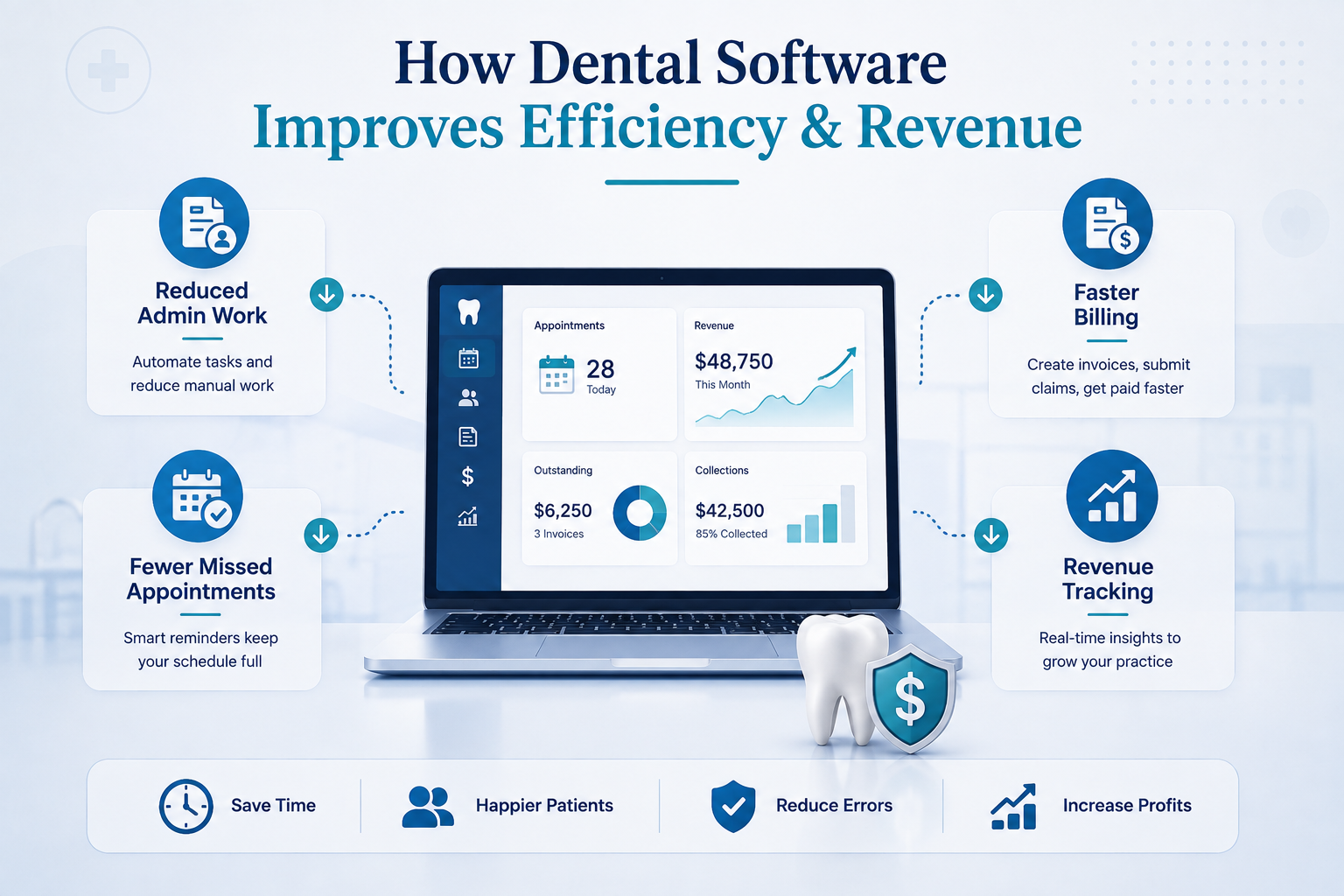
Reduced administrative workload comes first, since staff stop entering the same patient details three times.
Faster billing cycles follow, with claims going out within a day of treatment.
Fewer appointment gaps show up as automated recall fills cancellations before they sit empty.
Better resource utilization and improved patient retention round out the list, backed by revenue visibility through analytics that finally lets an owner see the numbers in real time.
Improving Patient Experience and Multi-Location Visibility
Patients expect the same convenience from a dental office that they get from any other business, and dental practice management software delivers that through online booking that skips the phone call entirely.
Real Dental Practice Software makes this the default experience, not an upgrade a patient has to ask for.
Automated communication confirms visits and sends recall notices without staff lifting a finger, while a secure patient portal lets patients reschedule appointments and pay balances without waiting on hold.
For a group with multiple locations, consistent workflows matter as much as any single feature, since a patient should get the same experience walking into any office in the network.
Dental clinic software built for groups keeps intake, billing, and communication identical across sites.
Centralized reporting for DSOs then gives leadership one login to see production and collections across the entire group, replacing a stack of spreadsheets pulled from each location manager every week.
Dental Imaging Integration: Why It Matters for Modern Clinics
- Dental imaging integration places X-rays, intraoral images, and scans directly inside patient charts with treatment plans, eliminating the need to switch between systems.
- In dental practice management software, integrated images help dentists explain findings quickly using real scans, improving patient trust and communication.
- Dental clinic software enables seamless collaboration between dentists and specialists by keeping images within the same record, reducing file sharing and referral delays.
- This integration supports faster diagnosis, clearer discussions, and smoother dental workflows.
Off the Shelf vs Custom Dental Practice Management Software
Choosing between ready-made and custom platforms follows the same principles discussed in custom vs off-the-shelf software, where ownership, flexibility, and long-term cost determine the better investment. The comparison below breaks down where each dental clinic software option actually wins.
|
Factor |
Off the Shelf |
Custom Build |
|
Flexibility |
Limited to vendor settings |
Shaped around exact workflow |
|
Scalability |
Depends on vendor tiers and pricing |
Built for planned growth from day one |
|
Integration Requirements |
Works only with supported partners |
Connects to any lab, imaging, or billing system |
|
Ownership |
Vendor owns the platform and data format |
Practice owns source code and data |
|
Long Term Costs |
Lower upfront, rises with every seat added |
Higher upfront, flattens once scaled |
A solo practice rarely needs custom dental software development, since the return takes years to show up. A DSO running many locations often earns that cost back through lower per location fees and a workflow built exactly around how the group already operates, making the case for Dental Practice Software built from scratch far stronger past a certain size.
Comparison and Decision Stage
SaaS vs Custom Dental Software: Detailed Comparison
Choosing between SaaS dental practice management software and a custom build comes down to setup speed, ownership, and how fast a practice plans to grow past its current size. Both paths still count as dental clinic software; the real question is who owns the platform underneath it.
|
Factor |
SaaS Dental Software |
Custom Dental Software |
|
Setup Time |
Days to a few weeks |
Several months |
|
Customization |
Limited to vendor settings |
Built around exact workflow |
|
Scalability |
Depends on vendor tiers |
Built for planned growth |
|
Integration Capability |
Limited to supported partners |
Open to any system |
|
Ownership |
Vendor owns the platform |
Practice owns the platform |
|
Long Term Cost |
Lower upfront, rises with seats |
Higher upfront, flattens over time |
A single location practice usually gets more value from SaaS dental clinic software, since setup speed and lower upfront cost matter more than deep customization at that scale.
A DSO managing many locations tends to outgrow SaaS limits within a few years and moves toward a custom dental practice management software build to control both cost and data ownership long term.
What Does Dental Practice Management Software Cost?
The cost of dental practice management software depends on several factors rather than a single fixed price. When comparing plans, dental practices should evaluate each cost component separately instead of relying on a bundled quote.
- Subscription plans define the base cost, usually through a monthly fee per provider that increases as more dentists or users are added.
- Number of providers and users directly impacts pricing, as a multi-provider dental practice will typically pay more than a solo dentist using the same software tier.
- Required features can increase costs, with advanced analytics, reporting dashboards, multi-location management, and other premium capabilities often available as add-ons.
- Cloud infrastructure and support levels influence pricing, especially in enterprise plans that include higher uptime guarantees, enhanced security, and faster support response times.
- Third-party integrations with lab systems, imaging platforms, payment solutions, or other tools may require additional setup fees along with the ongoing subscription cost.
- Custom dental software development follows a different pricing model, where costs depend on the specific workflows, features, integrations, and level of customization required to build tailored custom dental clinic software.
Build vs Buy: ROI Considerations for Dental Practices and DSOs
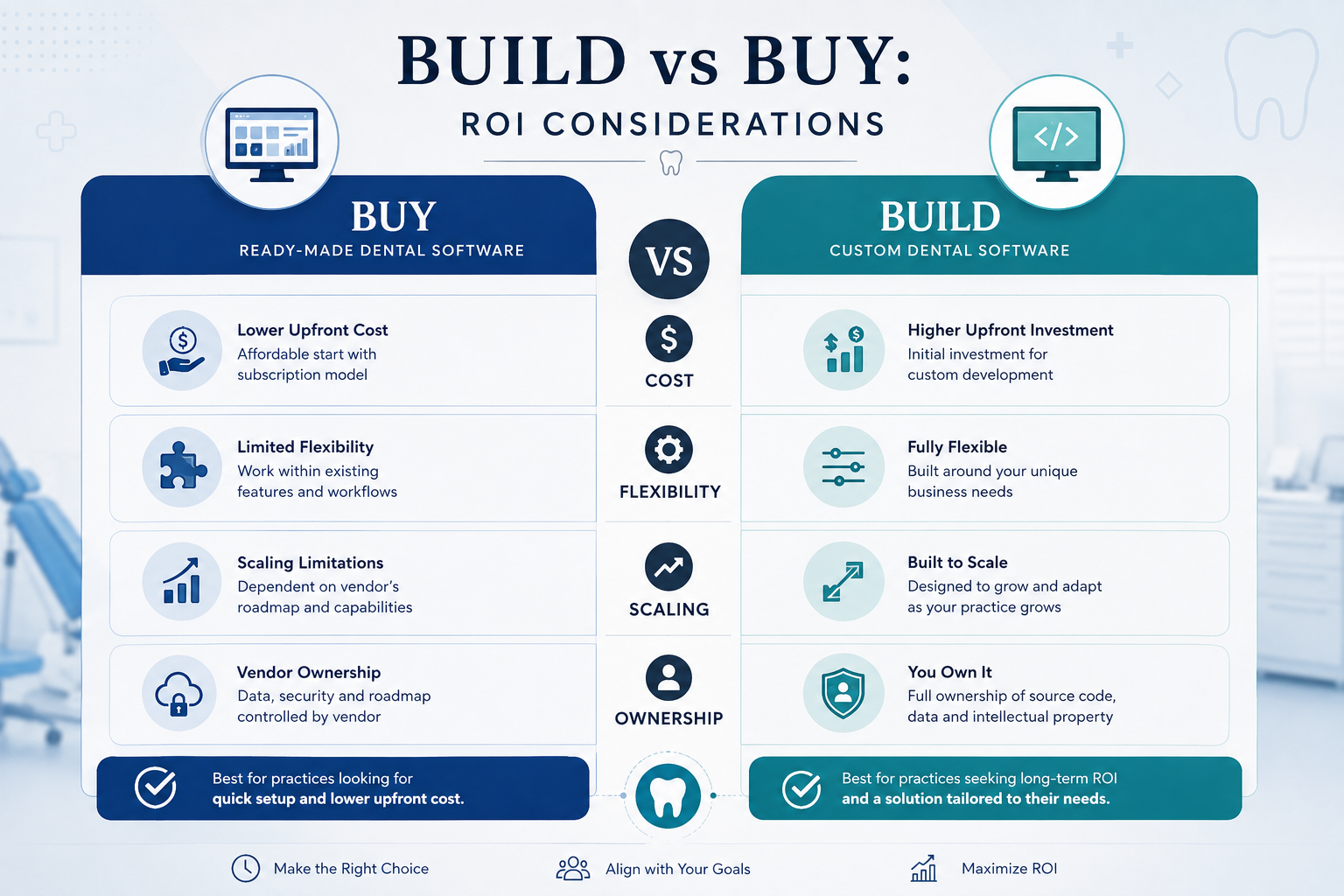
The build vs buy decision for dental practice management software depends on workflow complexity, growth plans, and long-term operational goals.
- A single dental practice with simple scheduling, limited users, and one location often gets better ROI from a ready-made platform, as it already covers essential workflows without the time and cost of custom development.
- A DSO managing multiple locations with complex workflows may achieve stronger ROI through custom software development tailored to its operational requirements.
- Custom software can create long-term savings by reducing recurring licensing costs, improving efficiency, and supporting scalable operations across multiple locations.
- For example, a ten-location DSO that reduces per-user software expenses can recover a significant portion of the initial development investment over time as savings multiply across every practice and year.
Compliance, Security and Vendor Lock-In Risks
Dental practice management software must comply with HIPAA regulations, encrypt patient data at rest and in transit, and enforce role-based access controls.
Strong healthcare software security requires clear data ownership terms alongside encryption, ensuring practices can export patient records whenever they switch platforms. Since a practice needs to confirm it can export its own records in full if it ever switches dental clinic software providers.
Migration challenges show up fast when a vendor locks data into a proprietary format that a new Dental Practice Software platform cannot read cleanly.
Decision Checklist Before Choosing Dental Software
Before signing with any dental practice management software vendor, run through this short checklist so nothing gets missed in the excitement of a good demo. This applies whether the platform is SaaS Dental Practice Software or a custom build.
- Does it support the exact workflow the front desk already follows?
- Can it scale as the practice adds providers or locations?
- Does it support seamless API integration with existing imaging platforms, laboratory systems, and third-party healthcare applications?
- Is security built into the platform from day one?
- Does the vendor support customization as the practice grows?
- Does it integrate with existing imaging, laboratory systems, and applications that support the HL7 FHIR standard for healthcare interoperability?
A practice that runs through this list before signing rarely ends up locked into Dental Practice Software that stops fitting the workflow a year later.
Conclusion
Dental practice management software is the foundation a scalable, efficient, patient-focused dental business gets built on, well beyond a line item on a monthly budget. Look at current workflow gaps, growth plans, and how much flexibility the practice will need in three years before picking a software platform.
Whether that lands on ready-made Dental Practice Software or a custom build, match the choice to where the group is headed, well beyond where it stands today. The right platform should support smoother operations today while creating room for future expansion.
FAQs:
Dental practice management software is a platform that runs scheduling, billing, insurance claims, and reporting for a dental office from one system, connecting the front desk with clinical records so staff avoid duplicate data entry every visit.
Cost for dental practice management software depends on provider count, feature modules, and whether custom integrations are needed. Most vendors charge per provider each month, with imaging and multi-location reporting priced as add ons on top.
A dental EHR holds clinical records like chart notes and X-rays. Dental practice management software handles the business layer, including scheduling, billing, and reporting, and modern platforms merge both into a single record.
A single office usually benefits from SaaS Dental Practice Software for speed and lower upfront cost. A DSO with many locations and heavy customization needs often earns back the cost of a custom dental practice management software build through lower long-term fees.
Prioritize scheduling automation, billing and claims management, dental imaging integration, and analytics dashboards inside your dental clinic software, since these four features drive the most day-to-day time savings for staff.
Not automatically. Dental practice management software must be configured with encryption, access controls, and audit logging to meet HIPAA requirements, so a practice should confirm these settings during setup and never assume they are already on.